The ad-testing gap nobody wants to talk about
Most social media teams I know are not short on creative ideas. They’re short on evidence. You finish a shoot, cut three vertical variants for Reels and TikTok, write two hooks for LinkedIn, and then someone senior picks the one that “feels right.” Two weeks and a few thousand dollars of ad spend later, you find out whether the gut call was correct. The interesting thing about AI Creative Insights from Decode by Entropik is that it tries to collapse that feedback loop from weeks to minutes by predicting attention and emotion before a single impression is served. That’s a big claim, and I want to walk through what it actually offers, where it fits in a creator’s stack, and where I think the promise outruns the proof.
What problem this actually solves
The pitch is straightforward: traditional pre-testing is slow and expensive, so most creatives ship on gut feel. The team’s framing is that a research study takes weeks and a big budget, which means the overwhelming majority of ads never get tested at all — only the tentpole campaigns do. AI Creative Insights is positioned as the tool for “the other ninety-plus percent,” per Sumit Singh Chauhan, the company’s VP of Machine Learning & Data Science.
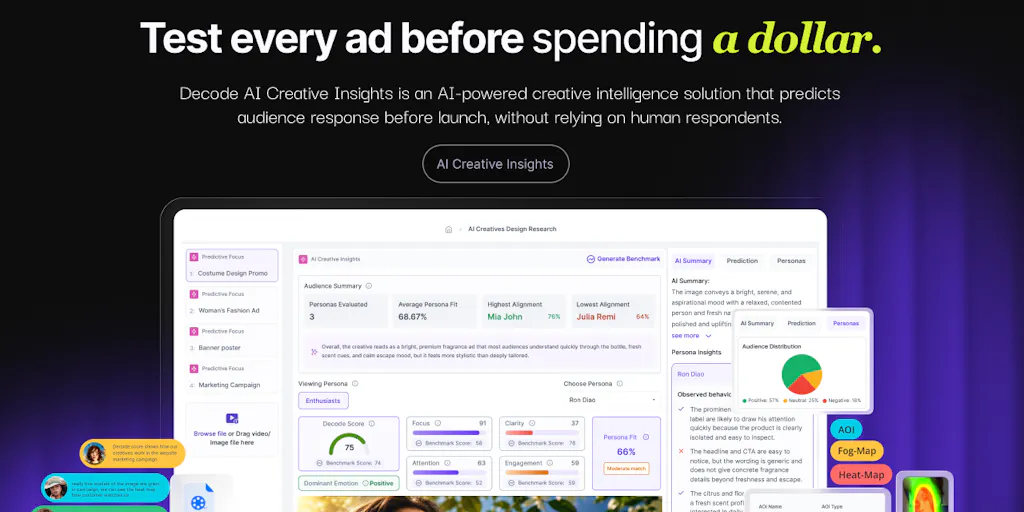
The workflow, as described on the launch page: upload a creative — video, banner, social, or OOH — and within minutes you get four outputs. First, a heatmap showing where eyes land and what gets missed. Second, an emotion curve tracked second by second, with drop-off points flagged. Third, a short list of suggested changes with expected impact. Fourth, a benchmark against your category. That’s the whole loop. No panel recruitment, no scheduling, no waiting on a report.
For a social media operator, the appeal isn’t the science. It’s the cadence. If I’m shipping ten pieces of creative a week across Instagram, TikTok, and YouTube Shorts, I can’t run a formal study on any of them. I can barely run a Meta Ads A/B test on all of them, because you need volume and budget for statistical significance. A tool that gives directional signal on every asset, even imperfect signal, changes how I sequence my week.
Why this is closer to a weather forecast than a verdict
The most honest thing anyone said on the launch thread came from Sumit, who explicitly invited skeptics and described the model as “a weather forecast for attention.” He was clear it’s trained on real attention and emotion data from real people watching real ads, that it’s a prediction and not a guarantee, and that it won’t replace testing with real people for your biggest campaign of the year. I want to underline that because it’s the right mental model. A forecast tells you to bring an umbrella; it doesn’t tell you it will rain. If you treat AI Creative Insights as a pre-flight check rather than a replacement for measurement, you’ll use it well. If you treat it as an oracle, you’ll get burned.
How it differs from the tools you’re probably already using
Let me place this against the incumbents a social team actually pays for. Canva and CapCut help you make the creative. Buffer, Hootsuite, Later, and Metricool help you schedule and report on it after it’s live. Meta Ads Manager and TikTok Ads Manager let you test variants in market, but only after you’ve spent money and only at the volume the algorithm needs to learn. Almost nothing in the mainstream creator stack sits before publish and tells you something useful about the asset itself.
That’s the gap Decode is aiming at. The closest analogues in my experience are the attention-prediction tools that have floated around enterprise media buying for years, plus the newer crop of AI ad-scoring startups. What Decode brings to the table is a specific lineage: the same company sells Mira, an AI moderator that runs user interviews on its own, and a broader research platform it says is trusted by 150+ global brands. So the pitch is essentially “we already do emotion and attention research for big brands; here’s the fast, self-serve version.” That lineage is the strongest part of the story. It’s also the part I can’t independently verify from the launch page.
Where the math breaks
Here’s my honest concern. Attention and emotion models are only as good as their training distribution. If the model was trained primarily on the ad categories and formats Decode’s enterprise clients run — think CPG, auto, finance, big-brand video — then its predictions on a scrappy UGC-style TikTok hook from a solo founder may be systematically off. Not wrong in a way that’s obvious, but wrong in a way that quietly nudges you toward the wrong variant. A heatmap that says “eyes land here first” is only useful if the model has seen enough content like yours to know where your audience’s eyes actually go. On the launch thread, Lambert de beru asked exactly the right question — whether the tool uses something like Google or Meta’s ad libraries as a baseline — and I didn’t see a direct public answer in the thread. That’s not a red flag; it’s just an open question I’d want answered before I trusted it on my own niche.
What creators and social teams can borrow from this
Even if you never touch AI Creative Insights, the product’s framing is worth stealing. Three things stand out.
One: treat the first two seconds as a measurable asset, not a vibe. The emotion curve concept — plotting feeling second by second and flagging where attention drops — is a discipline you can apply manually. When I review a short-form video, I now scrub through it and ask, at each beat, “what is the viewer feeling here, and is there a reason to stay?” If I can’t answer, the beat is filler. You don’t need a model to run that check. You need the habit.
Two: benchmark against category, not against your own history. Most creators compare a new post to their last post. That’s a weak baseline. The more useful comparison is against what’s working in the category right now. If you’re a fitness creator, what are the top-performing Reels in your niche doing in the first three seconds? You can answer that manually with a saved collection and twenty minutes a week.
Three: separate “which creative” from “which hook.” The launch page’s opening scenario — three ad versions, a launch on Friday, a room of smart people debating — is a decision-making problem, not a creative one. The bottleneck is usually that nobody defined the decision criteria in advance. Before you debate variants, write down what “winning” means: watch-through rate, CTR, saves, comment sentiment. Then the debate gets shorter regardless of what tool you use.
Why TikTok creators should care more than LinkedIn ones
If you post primarily on LinkedIn, the cost of a bad creative is low. Organic reach is forgiving, the audience is small and forgiving, and the format is text-first. You can afford to iterate in public. On TikTok and Reels, the cost of a bad hook is brutal — the algorithm decides in the first second or two whether to distribute, and a weak opening kills the whole post. That asymmetry is why pre-publish attention tooling matters more for short-form video than for almost any other format. If you’re spending real money on paid social, the asymmetry is even sharper: a bad hook on a $5,000 campaign is a $5,000 lesson. The economics of pre-testing get better the more you spend per asset and the faster your platform’s algorithm judges you.
Where my judgment says it falls short
I want to be balanced here, because the launch page is enthusiastic and I’m not being paid to be.
Pricing isn’t disclosed. The launch offers a code — PHCREATIVE — for five free creatives, which is a generous trial, but the page doesn’t say what it costs after that. For a solo creator or small team, that’s the single most important number, and it’s missing. I’d want to see it before recommending this to anyone.
The “expected impact” claim needs scrutiny. The tool promises “what to change, why, and the expected impact.” That’s the highest-value output and the hardest to get right. An expected-impact number is only as good as the historical data behind it, and the launch page doesn’t specify how that’s calculated or how accurate it’s been. I’d treat any expected-impact figure as directional until I’d validated it against my own campaign results. The team themselves frame it as a forecast, so I’d hold them to that framing.
It’s a pre-test, not a post-test. Nothing here replaces real measurement. You still need UTMs on every link, you still need to read your platform’s native analytics, and you still need to close the loop between predicted performance and actual performance. If you don’t have that measurement discipline, a prediction tool just adds another dashboard.
Who it’s not for: creators who post purely organically with no ad spend and no interest in paid, and teams whose creative volume is low enough that they can just test everything in market. If you ship one post a week, you don’t need a prediction engine. You need a spreadsheet and patience.
The trust question nobody answered
Mridhu Varshini, who runs growth marketing at Entropik, asked the community two questions in the launch thread: how do you decide between ad versions today, and what would make you trust a prediction enough to act on it? Those are the right questions, and I’d flip them back on the product. For me, trust in a prediction tool comes from calibration — showing me, over time, how often the prediction matched the outcome. If AI Creative Insights can surface that calibration data for my own account, that’s the feature that would move me from “interesting” to “in my stack.” Without it, I’m taking the model’s word for it.
What I’d watch / test next
If you’re curious, here’s what I’d actually do this week. First, grab the free trial — the PHCREATIVE code gives you five creatives, which is enough to run a real experiment. Pick five assets you’ve already published and whose performance you know cold. Run them through the tool and compare the predictions against your actual results. That’s the only test that matters. Second, if the predictions line up even loosely, run it on a set of unpublished variants before your next campaign and see whether the suggested changes are ones you’d have made anyway. Third, watch for pricing to be published, and watch whether Decode ships the “Synthetic Audience” feature they mention for early access — comparing reactions persona by persona is the piece that would make this genuinely useful for audience-segmented campaigns rather than just asset-level scoring. Fourth, keep an eye on whether they publish calibration data. Until then, treat it as a weather forecast: useful, directional, and worth checking before you leave the house — not a reason to skip the umbrella.