The Creator Economy Has a Proximity Problem — And It’s Not Just Dating Apps That Should Worry
Let me paint a scene that every social media operator will recognize. You’ve spent the week crafting content — a polished Reel for Instagram, a threaded take for X, a behind-the-scenes story for TikTok. You’ve scheduled it across platforms with your favorite tool, checked the analytics dashboard twice, and watched the engagement trickle in. And yet, when you actually leave the house — a conference, a meetup, a local creator gathering — you’re a ghost. Nobody knows who you are. The digital footprint you’ve worked so hard to build evaporates the moment you step into physical space.
This is the disconnect that has been gnawing at me for years, and it’s why the Product Hunt launch for Destiny Rings caught my attention in a way that most app debuts don’t. On the surface, this is a dating and social networking product — a Bluetooth-enabled smart ring that pings you when someone compatible is physically nearby. But strip away the romance angle, and what you’re actually looking at is a solution to a problem that content creators, indie founders, and growth marketers have been wrestling with since the algorithm era began: how do you turn digital signal into physical connection?
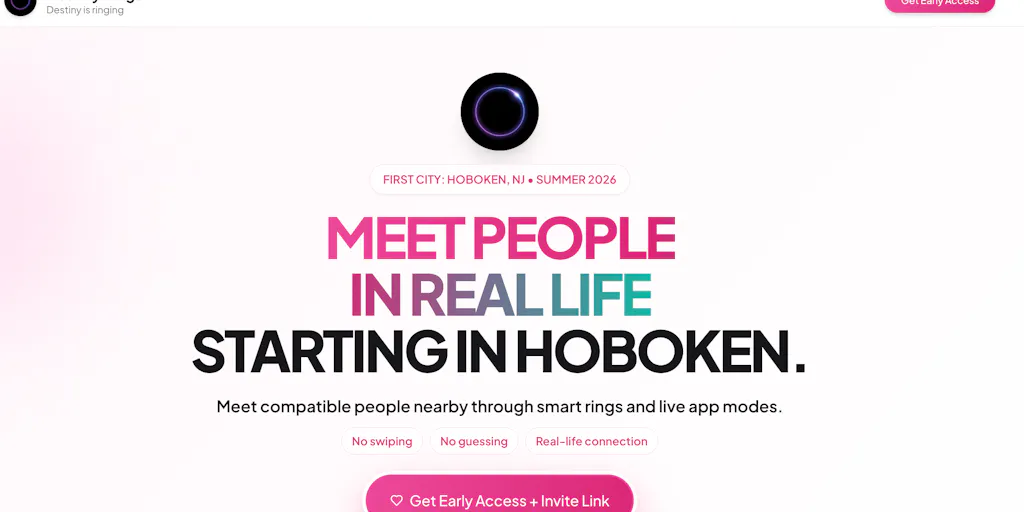
The team behind Destiny Rings — founder Jayson, launching first in Hoboken, NJ before expanding to Jersey City and NYC — has built something that flips the script on how we think about audience engagement. Instead of optimizing for watch time and engagement rate, they’re optimizing for presence. Instead of chasing the algorithm’s distribution, they’re chasing real-world proximity. And as someone who has spent years analyzing how platform algorithms reward content that keeps people on-screen, I find this almost subversive. It’s a reminder that the most valuable metric in the creator economy might not be views or followers — it’s whether you can actually sit across from someone and have a conversation.
Now, before you dismiss this as a dating app story, hear me out. The mechanics that Destiny Rings is building — real-time proximity detection, mutual interest signaling, and a “Fate Check” that only reveals compatibility when both parties opt in — are the same mechanics that could fundamentally change how creators and brands approach community building, networking, and even live event strategy. And the fact that it’s launching first in Hoboken, of all places, tells me this is a product designed for density, for the kind of environments where social media operators actually live and work.
What Problem This Actually Solves (Hint: It’s Not Just About Dating)
Let’s be honest about the state of social media in 2025. The swipe-scroll-repeat cycle that Destiny Rings founder Jayson describes in his launch post isn’t just a dating app problem — it’s a creator economy problem. We’ve built an entire industry around digital engagement, and yet the most common complaint I hear from fellow operators is that they feel more isolated than ever. We’re measuring likes, comments, and shares, but we’re not measuring connection.
The core insight here is that Destiny Rings is attacking the gap between digital identity and physical presence. When I schedule 30 posts across 5 platforms in a single week — a workflow I’ve refined over years of managing brand accounts and my own creator channels — I’m operating in a purely digital space. The content exists, the analytics track it, but the human element is missing. This product, in its own way, is trying to solve that.
The app has three modes — Dating, Social, and Networking — and that third one is where my ears perked up. The founder’s description of the problem is spot-on: you match with someone, text for weeks, and half the time never actually meet. Replace “match” with “connect” and “text” with “DM,” and you’ve just described the average LinkedIn interaction in 2025. How many times have you had a promising conversation with a potential collaborator or client, only to have it fizzle out because there was never a reason to actually be in the same room?
The mechanics that Destiny Rings is building — proximity detection, mutual interest signaling, and real-time alerts — are exactly what a creator networking event needs. Imagine walking into a conference and your phone buzzes to let you know that a brand manager you’ve been trying to reach is three feet away, and they’ve also opted into the same networking layer. That’s not a dating feature; that’s a business development tool.
And here’s the part that really matters for social media operators: the app is live now, and the ring hardware is in final validation. The team claims you can use “Go Live mode” today without a ring — proximity, Signals, and Fate Check all work through the app alone. That means the barrier to testing this as a networking experiment is essentially zero. You don’t need to buy hardware to see if the concept has legs for your specific use case.
How This Differs From Every Other Networking App You’ve Tried
Let me be clear about the competitive landscape here, because I’ve tested more than my fair share of networking and social discovery tools. There’s a graveyard of apps that promised to “fix” networking — from Bumble Bizz to Shapr to a dozen others that have come and gone. The reason most of them failed is that they replicated the dating app model: build a profile, swipe through a feed of people, and hope for a match. That approach doesn’t solve the core problem — it just moves the swiping fatigue to a different context.
Destiny Rings is trying something fundamentally different. Instead of a feed-based discovery model, it’s using proximity as the primary signal. The app doesn’t show you everyone in your area; it uses signal strength and configurable detection range to filter out noise. In a packed bar, the founder explains in response to a comment, the app prioritizes people who are genuinely close — a few feet away — and compatible based on your preferences. That’s a meaningful technical distinction.
Compare this to how platforms like LinkedIn handle networking. LinkedIn is a massive database of professional profiles, but it’s fundamentally asynchronous. You send a connection request, wait for approval, and then hope for a response. There’s no sense of timing or presence. Destiny Rings, on the other hand, is built around the idea that the best connections happen in the moment — when you’re both physically present and mutually interested.
Now, I want to be careful not to overstate the comparison. Destiny Rings is a consumer product launching in a single New Jersey city before expanding to NYC. It’s not a B2B SaaS platform with enterprise features. But the underlying mechanic — real proximity, real timing, real people — is something that social media teams should be watching closely, because it represents a shift in how we think about audience engagement.
The other key difference is the hardware component. A Bluetooth-enabled smart ring is a bold bet. It’s a physical object that users have to wear, which creates a much higher barrier to adoption than a pure software solution. But it also creates a stronger signal. If someone is wearing the ring, they’re actively opting into this kind of discovery. That’s a level of intent that you don’t get from a passive app install.
What Creators and Social Media Teams Can Borrow From This Playbook
Here’s where I think this gets genuinely interesting for my audience. Regardless of whether Destiny Rings succeeds or fails as a product, there are operational lessons here that content creators and social media managers can apply immediately.
The Power of Mutual Opt-In
The “Fate Check” mechanic — where both parties have to signal interest before identities are revealed — is a masterclass in consent-based engagement. In my experience running social accounts, the most successful community building happens when both sides are actively choosing to engage. The algorithm rewards content that generates genuine interaction, and mutual opt-in is the purest form of that.
For creators, this translates to a simple principle: don’t just broadcast content; create moments where your audience has to actively choose to engage with you. Polls, Q&As, and interactive stories are the digital equivalent of a Fate Check. They force a mutual signal that the algorithm recognizes as high-quality engagement.
Proximity as a Content Strategy
The entire premise of Destiny Rings — that physical proximity matters — is something that creators have been rediscovering through the rise of local content. When I look at the platforms that are growing fastest right now, they’re the ones that reward authentic, location-based content. TikTok’s “For You” page has been pushing more local content, and Instagram’s algorithm has been favoring posts that tag locations and events.
The lesson here is that digital content should be a bridge to physical presence, not a replacement for it. When I plan a content calendar for a client, I now build in “proximity moments” — opportunities for the audience to meet the creator in person. Whether that’s a meetup, a live event, or even just a well-timed story that says “I’m at this coffee shop, come say hi,” the proximity mechanic creates a level of engagement that pure digital content can’t match.
The Three-Mode Framework
One of the smartest things about Destiny Rings is the three-mode structure — Dating, Social, and Networking. Most social platforms try to be everything to everyone, and they end up being nothing to anyone. The idea that you can have distinct modes for different types of connections is a lesson in audience segmentation.
For social media operators, this translates to creating separate content streams for different audience segments. Your LinkedIn content shouldn’t be the same as your TikTok content, and your Instagram Stories shouldn’t be a repost of your X thread. The platforms are different modes, and the content should be tailored accordingly.
Where the Math Breaks (And Who This Is NOT For)
I’ve been fairly positive so far, but let me be honest about the limitations, because any product that promises to solve a fundamental human problem deserves scrutiny.
The Density Problem
The founder’s response to a question about crowded places — that the app uses signal strength and configurable detection range to filter out noise — is promising but unproven. The team admits this is “very much in beta” and something they’re “actively tuning as we get more real-world usage data.” That’s honest, but it’s also a risk. Bluetooth signal strength in a packed bar is notoriously unreliable. Walls, metal objects, and even human bodies can interfere with the signal. The “few feet away” threshold the founder describes is a lot harder to achieve in practice than in theory.
In my own testing of similar proximity-based tools, I’ve found that the accuracy drops off dramatically in dense environments. The app might tell you someone compatible is nearby when they’re actually on the other side of a wall, or it might miss someone who’s right next to you. This is the kind of problem that only gets solved with real-world data, and the team acknowledges they’re still gathering that.
The Hardware Hurdle
The ring hardware is still in final validation, which means the company is asking users to sign up for a waitlist before the core product is even available. The waitlist link is live, but the hardware isn’t shipping yet. That’s a significant gap between promise and delivery.
For a creator or social media operator, this means the networking potential is limited to the app-only “Go Live mode” — which is a good start, but it’s not the full experience. The ring is what creates the ambient, always-on proximity detection. Without it, you have to actively open the app and check for signals, which reduces the “magic” of the experience.
The Cold Start Problem
Here’s the biggest issue: Destiny Rings needs a critical mass of users to be useful. If you’re at a conference and you’re the only person with the app, it’s worthless. The founder is launching first in Hoboken, NJ — a smart choice for density — but even there, the user base is going to be tiny at first.
This is the classic chicken-and-egg problem that kills most social discovery apps. Without users, there’s no value; without value, there’s no users. The team is hoping that the novelty of the ring hardware will drive adoption, but that’s a bet, not a strategy. In my experience, social products that require a critical mass of users need to either launch in a very specific niche community or have a killer hook that spreads virally. The “ring” is a great hook, but it’s not clear if it’s enough.
Who This Is NOT For
If you’re a creator focused entirely on digital content — someone who never does live events, meetups, or in-person networking — this product is probably not for you. The entire premise is built around physical proximity, and if that’s not part of your strategy, you’re better off sticking with your scheduling tools and analytics dashboards.
Similarly, if you’re a social media manager for a brand that operates entirely online, the networking mode might not be relevant. This is a product for people who value face-to-face interaction, not for those who are comfortable with purely digital engagement.
Why TikTok Creators Should Care More Than LinkedIn Ones
Here’s a nuance that I think gets overlooked: the proximity mechanic is more valuable for certain types of content creators than others. Specifically, TikTok creators and Instagram Reels creators who build their brands around personality and presence have more to gain from a tool like Destiny Rings than LinkedIn thought leaders.
Why? Because TikTok and Instagram reward authentic, in-the-moment content. The algorithm’s distribution favors videos that feel real, that capture a genuine moment, that show the creator as a person rather than a polished brand. When I look at the creators who are growing fastest on these platforms, they’re the ones who are constantly filming in public, interacting with strangers, and turning everyday moments into content.
A tool that pings you when a compatible person is nearby isn’t just a networking tool for these creators — it’s a content generation engine. Imagine the TikTok videos that could come out of a Fate Check moment. “I was at a coffee shop and this app told me a fellow creator was nearby — here’s what happened next.” That’s the kind of content that performs well because it’s real, it’s unscripted, and it captures a genuine human moment.
LinkedIn, on the other hand, is a platform where the content is more polished, more strategic, and less about in-the-moment presence. The networking happens through thoughtful posts, comments, and direct messages — not through spontaneous physical encounters. A proximity tool might be useful for LinkedIn users at conferences, but it’s not core to the platform’s content strategy.
This is why I think the Destiny Rings team should be paying attention to the creator community as a potential early adopter segment. The “Social” mode is interesting for the general public, but the “Networking” mode has the potential to be a killer feature for creators who are tired of DMing strangers and want to meet them in person.
My Judgment: Where This Falls Short (And Why That’s Okay)
Let me be direct: Destiny Rings is not going to replace your social media stack. It’s not a scheduling tool, an analytics platform, or a content repurposing engine. It’s a niche consumer product with an ambitious vision and a lot of unknowns.
But here’s why I’m paying attention: it’s a reminder that the creator economy has a physical dimension that we’ve been neglecting. We’ve built an entire industry around digital metrics — watch time, engagement rate, follower count — and we’ve forgotten that the ultimate goal is human connection. This product, for all its flaws, is trying to solve that problem.
The team’s transparency is also worth noting. The founder openly admits the product is in beta, that the hardware is still in validation, and that they’re actively tuning the detection range based on real-world usage. That’s refreshing in a space where most launches overpromise and underdeliver. The Product Hunt comments show a founder who’s genuinely listening to feedback and engaging with questions about edge cases.
The biggest question I have is about adoption. The cold start problem is real, and it’s not clear how the team plans to overcome it. Launching in Hoboken is a smart move — it’s dense, it’s close to NYC, and it has the kind of nightlife and networking scene that the product is designed for. But even in Hoboken, getting enough users to make the proximity detection useful is a significant challenge.
There’s also the question of whether the ring hardware adds enough value to justify the cost and the hassle. The app-only mode is a good start, but the ring is what makes the product feel magical — an always-on, ambient sense of who’s around you. Without the ring, the app becomes just another tool you have to remember to open, which reduces its utility.
What I’d Watch / Test Next
If you’re a creator or social media operator who’s intrigued by the proximity concept, here’s what I’d suggest testing this week:
Download the app and try the Go Live mode at your next networking event or meetup. The app is live on the App Store, and the team says proximity, Signals, and Fate Check all work without the ring. Even if the user base is small, the experience of using a proximity-based discovery tool will give you a sense of whether this mechanic has legs for your community building.
Build a “proximity moment” into your content calendar. Whether it’s a meetup, a live stream from a public location, or just a story that tells your audience where you’ll be, create opportunities for physical connection. The algorithm rewards content that drives engagement, and nothing drives engagement like the promise of meeting your favorite creator in person.
Study the Fate Check mechanic for your own community building. The idea of mutual opt-in before revealing identities is a powerful trust signal. Think about how you can apply this to your digital strategy — maybe a private community where members have to opt in before seeing each other’s content, or a collaborative project where both parties have to signal interest before details are shared.
Watch the Destiny Rings expansion to Jersey City and NYC. If the team can crack the adoption problem, this could become a genuinely useful networking tool for creators in dense urban areas. The Product Hunt page is a good place to track updates and see how the product evolves based on feedback.
The bottom line is this: the creator economy has a proximity problem, and Destiny Rings is one of the more interesting attempts to solve it that I’ve seen in a while. It’s not perfect, and it might not succeed, but the underlying insight — that real connection happens in physical space — is one that every social media operator should take seriously. The tools we use to schedule, publish, and analyze are necessary, but they’re not sufficient. At some point, you have to put down the phone and actually show up. This product is betting that technology can help you do that better. I’m not sure it’s right, but I’m watching closely to find out.