The Creator Economy’s Real AI Gap Isn’t Generation — It’s Continuity
Every social media operator I know has the same quiet problem, and it has nothing to do with posting cadence. It’s that AI content tools are extraordinary at producing one-off artifacts — a caption, a thumbnail, a 15-second clip — and almost useless at maintaining a character across weeks of output. If you run a brand mascot account, a faceless storytelling channel, or a kids’ IP, you already know the pain: the algorithm rewards consistency of persona, but every new AI generation quietly resets it. That’s why Storytailor® caught my attention — not as a children’s app, but as a signal about where persistent-identity content tooling is heading.
What Storytailor Actually Is (And Why It’s Not Just a Kids’ App)
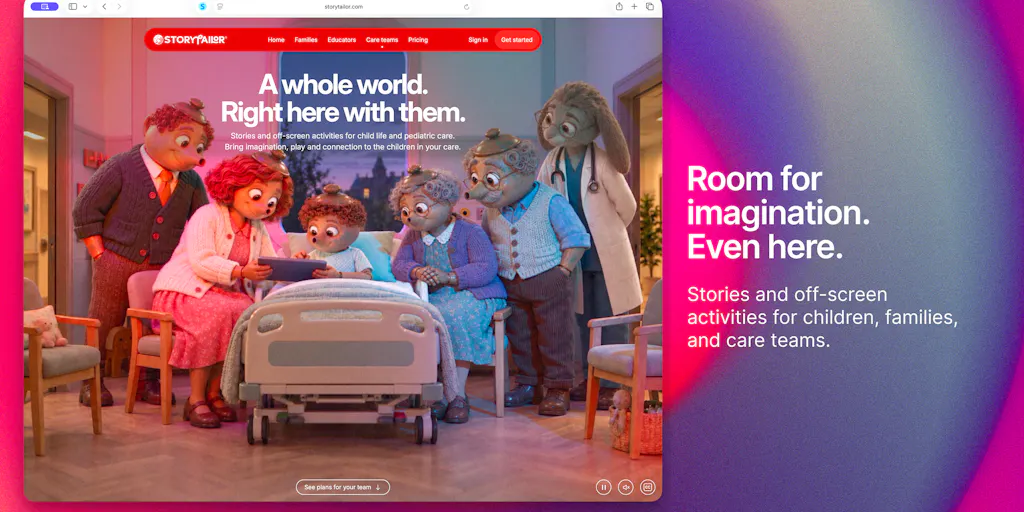
Let me get the facts straight first, because the Product Hunt listing is easy to misread. Storytailor is a personalized children’s storytelling product from Storytailor® — the maker, JQ Sirls, rebuilt it with a collaborator named Herston, and describes the core loop this way: “a family can upload a drawing, create a character and bring it back for new illustrated stories.” You start with a prompt — “a ridiculous adventure, a first day at school or a change at home” — then read or listen together, explore something called Wonder Words™, and continue with off-screen activities. Educators get lesson plans. The first two stories are free; pricing beyond that is not disclosed in the listing.
Here’s the part that matters for anyone who reads Product Hunt for a living: this is a character persistence product dressed up as a bedtime-story app. And character persistence is the exact unsolved problem in creator tooling right now.
The mechanic that matters: identity as a reusable asset
When you upload a child’s drawing and it becomes a character that returns across multiple illustrated stories, you’ve built something structurally different from a text-to-image prompt. You’ve built a lightweight identity layer. The child gets a “Storytailor ID” — a profile managed by the adult that keeps “their characters, stories, and preferences together,” per the maker’s reply in the thread. The adult signs in; the child never needs credentials.
I’ve spent the last year watching creators try to do the same thing manually. A YouTube channel with an animated mascot, a TikTok account built around a recurring illustrated narrator, a newsletter with a consistent visual protagonist — every one of them is duct-taping continuity together with folders of reference images, pinned prompts, and a growing dread that the model will drift. Storytailor’s framing — upload once, reuse forever — is the workflow those creators actually want. The children’s-book skin is incidental to the underlying pattern.
Why this is a signal, not a product recommendation
I want to be careful here. Storytailor is not a social media tool. It doesn’t schedule, it doesn’t publish to Instagram or TikTok, and it has no analytics. Treating it as a competitor to Buffer or Metricool would be a category error. What it is is a working example of a pattern I expect to see replicated across creator tooling within 18 months: persistent AI characters that outlive a single generation. If you’re building a content brand around a recurring persona — human, illustrated, or animated — the architecture Storytailor demonstrates is worth studying even if you never touch the app.
How It Stacks Up Against the Tools You Already Use
Let me place this honestly in the landscape, because “AI storytelling app” is a crowded shelf and most of it is disposable.
Canva has Magic Studio, which can generate images and even spin up branded templates, but it has no concept of a character that survives across projects unless you maintain a Brand Kit and manually re-reference assets. CapCut can generate clips and apply consistent styles, but again — no persistent persona layer. Midjourney has character reference features that get closer, but they’re still prompt-and-reference workflows, not a managed identity object with metadata, preferences, and history attached.
Storytailor’s differentiation, as I read the maker’s comments, is that the character is the object. It has a name, a profile, a history, and a set of associated stories. That’s closer to a database record than a prompt. For a creator running a serialized narrative — think a kids’ YouTube channel, a branded comic, a recurring Instagram character series — that’s a meaningfully different mental model.
Where the comparison breaks down
But I’d be lying if I said this was a fair fight. Storytailor is scoped to a family-and-educator use case. There’s no evidence in the listing that it supports batch export, aspect-ratio variants for different platforms, voice cloning for consistent narration, or any of the publishing integrations a social operator needs. If you tried to run a TikTok account off Storytailor tomorrow, you’d be screenshotting the output and manually uploading it — which is exactly the kind of friction that kills a workflow at scale.
The honest read: Storytailor is a proof of concept for persistent characters, not a production tool for social teams. Watch it for the pattern, not for the feature list.
What Social Media Operators Should Actually Steal From This
Here’s where I switch from observer to practitioner. I’ve run enough accounts to know that the most valuable thing about a launch like this isn’t the product — it’s the workflow logic you can transplant into your own stack today, with the tools you already pay for.
Build a character spec, not a prompt library
Most creators I’ve audited keep a Notion page full of prompts. That’s the wrong artifact. What you want is a character spec: a single document with the canonical description of your persona — visual traits, voice, vocabulary, backstory, things they’d never say, things they always say. When you generate with ChatGPT or Claude, you paste the spec, not a fresh prompt. When you generate images with Midjourney or Ideogram, you reference the same spec and a pinned seed or reference image.
Storytailor’s “upload a drawing → create a character → reuse it” flow is just this idea with a UI. You can replicate it in a Google Doc and a shared folder in an afternoon. The discipline of writing the spec once and reusing it is what creates the continuity the algorithm rewards.
Treat continuity as an algorithmic asset
This is the part most operators miss. Platform distribution systems — TikTok’s For You feed, Instagram’s Reels ranking, YouTube’s suggested-video graph — don’t just reward watch time and engagement rate in isolation. They reward recognizability. A viewer who sees your character in one video and recognizes them in the next is more likely to follow, more likely to return, and more likely to complete the second video. That’s a compounding effect on retention, which is the metric that actually drives reach.
If your AI-generated content resets its visual identity every post, you’re paying a recognition tax on every upload. Storytailor’s core insight — that identity should be a persistent object, not a per-generation artifact — is a direct answer to that tax. I’d bet the creators who internalize this in 2025 will outperform the ones still prompt-spamming, even with identical tools.
The off-screen activities thing is quietly smart
One more detail worth flagging: the maker mentions “off-screen activities” and lesson plans for educators. For family-focused creators — the massive parenting, homeschooling, and kids’ activity niches on Pinterest and YouTube — this points at a content extension strategy. The story isn’t the product; the story is the lead magnet for a printable, a lesson plan, a craft. That’s a repurposing loop social operators should be running anyway: long-form asset → short-form clip → downloadable companion → email capture. Storytailor hints at it; you should be doing it explicitly.
Where My Judgment Says This Falls Short
I promised a limitations section and I’m going to deliver one, because the Product Hunt thread itself surfaces the most important open questions.
Safety and the “no child login” tradeoff
The most-praised feature in the comments is that children don’t need their own accounts. Dennis Porter called it “much more practical for families with younger kids,” and Ebrima “Abraham” Sisay shared a genuinely moving use case — using Storytailor to explain a parental separation to a five-year-old, building “an entire series” together. That’s real product-market fit, and I don’t want to be cynical about it.
But the same design choice raises the questions any operator working with minors’ data should be asking. The maker points to a trust page for details, and the adult-managed “Storytailor ID” model is a reasonable answer — but the listing doesn’t disclose data retention policies, model training practices, or what happens to a child’s uploaded drawing after processing. For a family app that’s a gap. For anyone thinking about applying this pattern to a youth-facing brand account, it’s a hard blocker until those answers exist.
Onboarding friction and the “what do I do next” problem
Nika flagged an onboarding confusion — an unclear error message around a date-of-birth field — and the maker’s response was that the label said “MM/DD/YYYY” and the user had entered only “96” instead of “1996.” Fair enough on the specifics, but the exchange reveals a broader issue: the app is doing age-gating, which means it’s making compliance decisions at the front door, and the UX around those decisions is still rough. The maker says they’ve since made it “a bit clearer.” I’d want to test that flow myself before recommending it to anyone.
The category ceiling
My biggest reservation is strategic, not functional. Storytailor is priced per-family (first two stories free, rest not disclosed), which is a consumer subscription model. That’s a fine business. But it means the product has no incentive to build the export, batch, and multi-platform features that would make it useful to a social media operator. The pattern is portable; the product isn’t. Don’t expect Storytailor to become your content engine. Expect it to inspire one.
What I’d Watch / Test Next
If you’re a creator or social operator reading this, here’s what I’d actually do this week — no new subscriptions required.
First, write your character spec. One page. Name, visual traits, voice rules, three things they’d never say. If you’ve been generating content with AI and it feels inconsistent, this document is the fix, and it costs you nothing but an hour.
Second, audit your last ten posts for recognition. Open your grid or your channel page and ask: would a stranger know these came from the same creator? If not, you’ve found your continuity tax. Fix it before you scale output.
Third, watch Storytailor as a pattern, not a product. Follow the maker’s Product Hunt page and see whether the character-persistence model gets picked up by tooling aimed at creators. I’d bet it does — and I’d bet the first serious entrant will be a scheduling or asset-management platform bolting on persistent AI characters, not a storytelling app growing into social features.
Fourth, if you work with youth-facing brands, put Storytailor on a watchlist with a safety asterisk. The adult-managed account model is smart. The undisclosed data practices are not. Wait for clarity before you build anything on it.
The launch itself is small — 121 upvotes on the original Storytailor.ai listing, 82 on the rebuilt one, a single five-star review. But the underlying idea — that AI content needs persistent identity to compound — is the most important shift in creator tooling right now. Storytailor is a children’s app that accidentally shows social media operators where their own stack is heading. That’s worth more attention than its upvote count suggests.