The warm-intro problem is a distribution problem — and creators are the ones who feel it first
Every creator I know has a version of the same spreadsheet: a tab of dream collaborators, dream sponsors, dream podcast hosts, dream hiring managers, each one annotated with a half-finished theory about how to reach them. The theory is almost never “DM them cold.” It’s “who do I already know who knows them.” That gap between knowing who you want to reach and knowing how you’re connected to them is the real bottleneck in creator growth, and it’s the problem Nepotism Network — built by Ankush Singh and a small team, launching on Product Hunt during the GPT-6 Astra Challenge — is trying to close. If you run social accounts for a living, this is worth understanding, because the mechanics behind it are the same mechanics behind why some of your posts travel and others die in the feed.
What NepoNet actually does (and what it doesn’t)
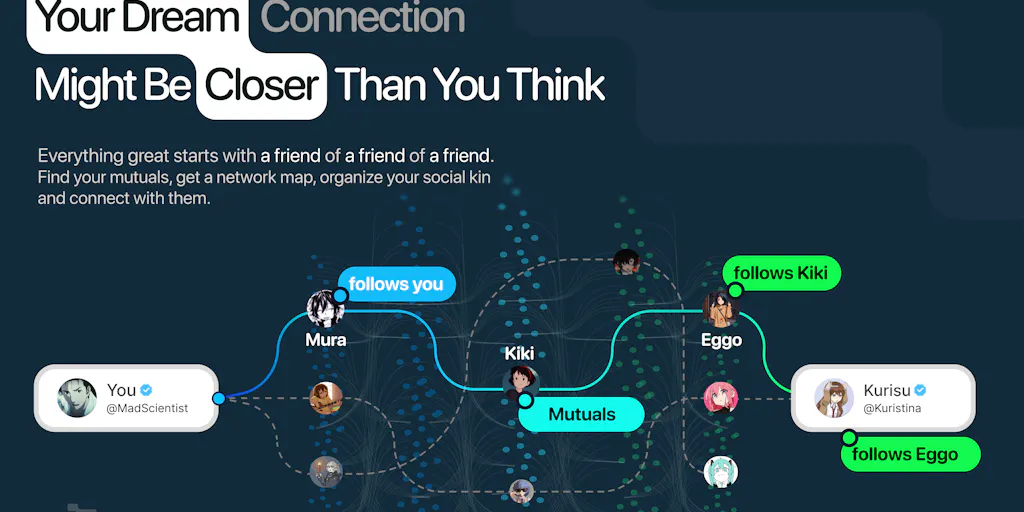
Short version from the megathread: you type any X handle, and the tool maps who that person follows, who follows you, and the people in between, then ranks the warmest routes to them. Every step is explained, and a first-ask draft is generated for you. The maker’s pitch is blunt — “you need to know a guy who knows a guy to achieve great things.”
The five-step product flow, per Singh’s launch post:
- Type a handle, get a mapped graph of mutuals and ranked routes with per-step explanations.
- It tells you who to befriend first and why.
- One click reads up on everyone on the route and drafts a plan — who to message, when, why they’d help, plus draft messages.
- Outreach tracking so you don’t lose the thread of who you asked and what happened.
- MCP support, so you can drive it from ChatGPT, Claude, Codex, or Cursor and give your agent the same tools.
The team is explicit that it never sends anything on your behalf — the final message is always yours. Designer Vibhansh Alok framed this as a design principle, not a limitation: “A good connection only works when the ask feels personal, not like some automated spam cannon.”
Pricing isn’t disclosed on the page. Product Hunt supporters are offered a month of free premium. There’s also a Discord and the product itself lives at nepotism.network.
How the ranking actually works
In a reply to Sandeep Vemu, Singh said the score weighs followers/following volume, recent engagement, and frequency of engagement, then outputs a 0–100 score — “quite similar to how ELO ranking gets calculated in chess.” That’s the kind of mechanism detail I want from any tool that claims to rank relationships, and it’s a useful disclosure. It also tells you what the score can’t see: whether the two people actually like each other, whether one of them is quietly burned out on intros, or whether the “engagement” is just a reply-guy habit. ELO works in chess because the game has rules. Social graphs don’t.
Why this matters more to creators than to VCs
The obvious comparison is to LinkedIn’s “mutual connections” feature or to warm-intro tools like Clay and Attio on the sales side. But the user who benefits most from NepoNet isn’t a B2B SDR — it’s a creator trying to get a collab, a podcast booking, a brand deal, or a co-marketing swap across platform lines.
Here’s why. A salesperson has a CRM, a defined ICP, and a quota. A creator has a half-broken Notion database of “people I should know” and no systematic way to work it. When I ran growth for a mid-size creator account last year, the single highest-leverage action wasn’t posting more — it was getting one well-placed repost from someone with a bigger audience in the same niche. We spent weeks figuring out the connection chain manually, scrolling follower lists and guessing. A tool that maps that chain in seconds would have saved us the entire month.
Where the math breaks
I want to flag two things before anyone gets too excited.
First, X’s API is the constraint nobody talks about on launch day. Mapping “who follows whom” at scale means either heavy scraping or paying for X’s API tiers, and the tiers that allow this kind of graph traversal are not cheap. If NepoNet is scraping, it’s one rate-limit change or one legal letter away from breaking. If it’s paying for API access, the unit economics of a free tier get tight fast. Singh hasn’t said which, and I’d want that answered before I built a workflow on top of it.
Second, “warmest route” is a proxy, not a truth. A 0–100 score based on followers, following, and engagement frequency is a reasonable heuristic — but the actual warmth of a relationship lives in DMs, group chats, and shared history that no public graph can see. In my experience, the person with the highest engagement overlap is often not the right person to ask for the intro. It’s usually the person who’s quietly been a fan for two years and has never once replied publicly.
What social media operators should steal from this
Even if you never touch NepoNet, the underlying logic is worth borrowing for your own content operation. Three things stand out.
1. Rank your outreach the way you rank your content ideas
Most creators treat outreach as a flat list — a spreadsheet of names with no priority order. NepoNet’s ELO-style scoring is a reminder that you should be scoring your outreach targets too, on dimensions you can actually observe: mutual followers, engagement overlap, recent activity, whether they’ve publicly said they’re open to collabs. A simple 0–100 score in your own Notion base beats a flat list every time.
2. Draft the ask, but never auto-send
The design principle Alok articulated — the tool drafts, the human sends — is the correct one for anything touching relationships, and it’s the same principle you should apply to AI-assisted DMs, comment replies, and brand outreach. Canva and CapCut made it easy to produce content at volume; the creators who win are the ones who still personalize the last mile. Automation should remove the blank-page problem, not the human problem.
3. MCP is the quiet story
The MCP integration — driving NepoNet from ChatGPT, Claude, Codex, or Cursor — is the part I’d bet gets copied fastest. We’re moving toward a world where your outreach tool, your scheduling tool, and your analytics tool are all callable from one agent surface. If you’re a social media manager running Buffer, Metricool, or Later today, watch for MCP endpoints on those tools over the next 12 months. When they land, the workflow changes: you’ll ask your agent to “find the warmest route to this creator, draft three variations of the ask, and schedule a follow-up reminder for Thursday,” and it’ll just do it.
Where I think this falls short
Balanced take, since the Product Hunt page is (understandably) a hype surface.
- X-only. The entire value prop is X graph traversal. For creators whose audience lives on Instagram, TikTok, or YouTube, the tool is currently useless. The team hasn’t said whether other platforms are on the roadmap. That’s a real limitation, not a nitpick — most creators I know are multi-platform by default.
- The ethical grey zone. A tool that maps “who follows whom” and ranks routes to strangers is, functionally, a surveillance tool aimed at public social graphs. The maker addressed the “we never auto-send” concern, but not the “is this scraping, and is that okay with X’s ToS” concern. The EaseOps commenter asked about cyber threats and got a joke reply from Manu Arora instead of an answer. That’s a gap I’d want closed.
- Not for introverts who hate networking. If the idea of systematically working a graph of acquaintances makes your skin crawl, this won’t change that. It just makes the crawl more efficient.
- Not for people with a small graph. If you have under a few hundred real connections on X, the routing options will be thin. The tool’s value scales with your existing network — which is a slightly ironic pitch for a tool named after nepotism.
- The “month of free premium” is a launch hook, not a pricing model. No public pricing means you can’t yet evaluate whether this is a $9/month utility or a $99/month sales tool. That matters for whether a solo creator or a small agency can justify it.
What I’d watch / test next
If you’re a creator or social media operator reading this, here’s what I’d actually do this week — not “sign up and hope.”
- Run one search on yourself first. Type your own handle and see what the tool thinks your graph looks like. That tells you more about the ranking logic than any launch post.
- Pick one real target — a podcast host, a brand’s social lead, a creator you’ve wanted to collab with for months — and run the route. Compare the top-ranked path against your own intuition about who you’d actually ask. If they match, the tool is calibrated to your instincts. If they don’t, that’s the interesting data.
- Don’t send the draft as-is. Treat the generated ask as a first pass, then rewrite it in your own voice. The whole point of the design is that the human closes the loop.
- Watch the MCP angle. If you already use Claude or Cursor daily, wire NepoNet in and see whether the agent workflow actually beats clicking through the UI. That’s the feature most likely to survive the launch-week hype cycle.
- Ask the team the two questions they haven’t answered: how they access X’s graph data, and whether other platforms are coming. The answers determine whether this is a durable tool or a clever demo.
My take: the underlying insight — that distribution in the creator economy is increasingly a function of who can introduce you to whom, not just what you publish — is correct and underexplored. Whether NepoNet is the tool that captures it depends on questions the launch page doesn’t answer. Worth a free month to find out. Not worth rebuilding your outreach stack around until it does.


