The video bottleneck is the last unautomated mile of the creator workflow — and Pexo is a bet that chat beats timelines
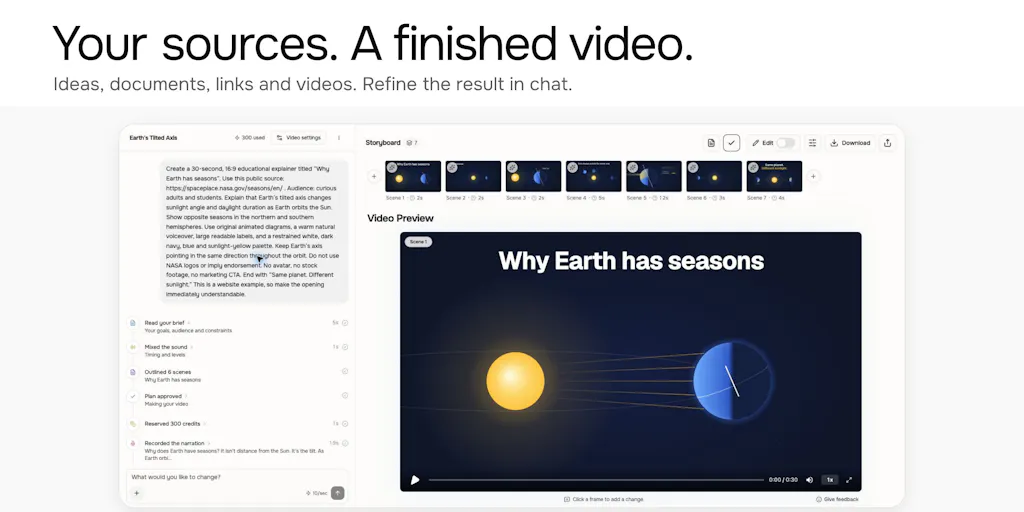
If you run social for a living, you already know the dirty secret of the AI era: writing got fast, design got fast, even coding got fast — but a 60-second product video still eats a week. I’ve watched founders ship a working MVP in a weekend and then spend five days fighting a timeline for the launch clip. That asymmetry is the whole reason Pexo, an autonomous AI video agent from founder Evan Liao, is worth your attention even if you never touch it. The pitch is simple: you talk to a chatbox, it shapes the story, picks the right AI model per step, and hands back a finished, on-brand cut. No keyframes, no timeline, no agency invoice. Whether it delivers is a separate question — but the problem it’s aimed at is real, and it’s the one most social teams quietly lose days to every single month.
What Pexo actually solves, and why it’s not just another AI video toy
Let me be precise about the mechanics, because “AI video tool” is now a meaningless category. There are three broad buckets in 2024–2025:
- Generative clip tools — Runway, Pika, Sora — where you prompt and get a short, often surreal clip. Great for B-roll, terrible for product explainers with a narrative.
- Template editors — Canva, CapCut, InVideo — where you drag assets into a structured layout. Reliable, but you’re still the editor.
- Agentic assemblers — the newest bucket, where an LLM orchestrates script, voiceover, music, captions, motion graphics, and assembly. Pexo sits here.
The distinction matters because the first two buckets still require you to know what you want frame by frame. The third bucket is a bet that most social video doesn’t need that level of authorship — it needs a coherent story, decent pacing, and brand consistency, fast. Liao’s framing in the launch thread is telling: he says the team built products for creators for a decade, watched AI collapse software build times, and then hit the same wall everyone else does when a launch video is needed. The maker’s claim is that Pexo “puts a full production studio right in your chatbox” — that’s marketing language, so treat it as a claim, not a benchmark.
What’s actually interesting operationally is the workflow the team describes in the comments. You can start from a product page, a website, or loose assets; Pexo writes the script, chooses the model per step (this is the part I’d want to audit — model routing is where quality lives or dies), and assembles a final cut. Then the editing loop is comment-based: you click a frame, type what you want changed, and it re-renders. That’s the single most important design decision in the product, and it’s the one I’d test hardest.
Why comment-based editing is the real feature, not the AI generation
Anyone who has edited a 60-second explainer in Premiere Pro or DaVinci Resolve knows the pain isn’t the first cut — it’s revision seven, when a stakeholder says “can we make the logo bigger at 0:14” and you have to find the clip, adjust the keyframe, re-export, re-upload. If Pexo genuinely turns that into a comment on a timestamp, it removes the single biggest tax on social video production. I’d bet that’s where the retention is. The generation is table stakes now; the revision loop is the moat.
How this fits the actual social-media operator’s stack
Here’s where I want to be honest about the category. If you’re a solo creator posting to Instagram, TikTok, YouTube Shorts, and LinkedIn, you already have a repurposing pipeline. You shoot once, cut a 9:16, a 1:1, and a 16:9, you caption it, you schedule it in Buffer, Later, or Metricool, and you check Instagram Insights or TikTok Analytics a week later to see what actually moved. Video is the highest-leverage format on every one of those platforms — watch time and completion rate are the dominant ranking signals on TikTok and Reels, and YouTube’s own guidance has been consistent for years that the first 30 seconds decide distribution. So a tool that gets you from brief to finished cut in an afternoon instead of a week isn’t a novelty — it’s a throughput multiplier on your best-performing format.
The launch thread’s request log is genuinely useful signal here. The team shipped multi-format video export presets for 9:16 vertical and 1:1 square — which is exactly the thing a social operator would have demanded in week one. They also shipped video comments tied to specific moments, quick preview before applying edits, start-from-reference, and download options. Read that list as a roadmap of what real users asked for, and it tells you the team is listening to operators, not just founders.
Why TikTok and Reels creators should care more than LinkedIn ones
A LinkedIn product video tolerates a slow open, a talking head, and a 90-second runtime. TikTok and Reels do not. Completion rate is the metric that decides whether the algorithm gives you a second distribution wave, and a 60-second clip with a weak first three seconds dies regardless of how polished the back half is. So if Pexo’s model routing and script generation can reliably produce a punchy hook, it’s disproportionately valuable for short-form vertical. If it produces a generic “Hi, we’re excited to announce” opener, it’s worthless for TikTok and fine for a LinkedIn feature drop. My take: test it on vertical first, because that’s where the failure mode is most visible and most fixable.
Where the math breaks
Let’s talk credits. The launch offer is a code — BZ8B29 — for 10% off monthly plans and 500 bonus credits, which tells you the pricing model is credit-based. Credit-based AI video pricing is a trap for social teams if you don’t do the math before you commit. A single 60-second explainer with voiceover, music, captions, and motion graphics can burn a lot of generation cycles, and revision loops burn more. If your team produces 20 videos a month, model your expected credits-per-finished-video including revisions, not just the happy path. The source doesn’t disclose the underlying credit costs per generation, so I can’t give you a number — but I’d demand it before signing a team plan.
What creators and social teams can borrow from Pexo’s playbook
Even if you never use the tool, three ideas here are worth stealing for your own workflow.
1. Treat video like a conversation, not a project. The mental model Pexo pushes — describe what you want, review, comment, iterate — is the same loop that works when you’re briefing a freelancer or an agency. If you’re a social manager, write your video briefs as if you were talking to a chat agent: goal, audience, hook, key beats, CTA. That discipline alone will improve your output, tool or no tool.
2. Build a brand memory, not a brand guideline PDF. In the comments, the team says Pexo remembers brand assets, preferred style, and feedback, and that you can point it at a previous video and ask it to carry that style forward. That’s the right architecture for any content operation — a living style reference beats a static PDF every time. Do this manually if you have to: keep a “best performing” folder per platform and brief new work against it.
3. Let the tool propose, but you approve the storyboard. The team explicitly says you can ask to review the script and storyboard before production starts. That’s the correct control point. Automation without a checkpoint is how you get 20 off-brand videos in a folder. My rule for any AI video tool: never let it go from brief to final cut without a script review.
The launch thread also surfaces a feature I’d watch closely: talking avatars from a photo plus ~30 seconds of your voice. The team confirms you can upload a selfie as a reference and provide a short voice sample to narrate an explainer. For creators who don’t want to be on camera but want a personal feel, that’s a meaningful unlock — and it’s the kind of feature that raises real questions about disclosure and platform policy, which I’ll get to below.
Where my judgment says Pexo falls short (or at least, where I have questions)
I haven’t run a full production on Pexo, so treat everything in this section as informed skepticism, not a verdict.
Model routing is opaque. The claim that Pexo “chooses the right AI model for each step” is a black box. Which models? Chosen on what criteria? If the routing is good, it’s a genuine differentiator — most creators don’t know whether a given shot needs Runway, Sora, or ElevenLabs for voice. If the routing is mediocre, you get the average of several models, which is worse than picking one good one. Not disclosed in the source.
The comparison to Claude-based workflows is unresolved. One commenter says they’ve been solving this with Claude plus a knowledge base since a recent model release, and the maker invites a head-to-head. That’s the honest competitive frame: for a technical operator, a well-prompted Claude or ChatGPT workflow plus CapCut for assembly is free-ish and flexible. Pexo wins on convenience and consistency; it loses on control and cost transparency. The maker also notes you can connect Pexo to Claude Code through their skill — which is a smart hedge, but it also admits the agent isn’t always the right interface.
Avatar and voice cloning raise policy questions the source doesn’t address. Platforms have been tightening disclosure rules around synthetic media and AI-generated voices. If you’re publishing a talking-avatar explainer to TikTok or Meta, you need to know their current labeling requirements — and you need to check them yourself, because the launch page says nothing about it. I’d also want clarity on consent and data handling for uploaded voice samples. Not disclosed.
Who it’s NOT for: teams with a strong in-house editor who already ships fast; creators whose entire brand is on-camera authenticity; anyone who needs frame-level control for a hero brand film. Pexo is for the 80% of video that needs to exist, not the 5% that needs to be perfect.
What I’d watch / test next
Concrete steps for this week, in order:
- Run one controlled test. Take a video you’ve already shipped and re-brief Pexo with the same inputs. Compare hook strength, pacing, and caption accuracy side by side. Don’t judge the tool on a fresh idea — judge it on a known quantity.
- Audit the revision loop. Make five comment-based edits on one cut and count how many credits and how much time each one costs. That number is your real cost-per-video.
- Check the export presets against your actual platform specs. The team shipped 9:16 and 1:1 — verify safe zones, caption burn-in, and loudness normalization before you trust it for a scheduled post.
- Ask about model routing and voice data handling in writing. If the answers are vague, that’s your answer.
- If you’re on Claude or ChatGPT already, take the maker up on the head-to-head. Same brief, same assets, two outputs. That’s the only comparison that matters.
The bigger trend here is that video — the highest-leverage, highest-friction format in social — is finally getting the agentic treatment that writing and design got two years ago. Pexo is one bet on how that plays out. The operators who win the next 18 months won’t be the ones with the fanciest tool; they’ll be the ones who build a revision loop fast enough to ship ten versions while everyone else is still keyframing the first.