The Last Six Digits Are the Whole Game: Why Your Content Workflow Will Soon Need a Phone Number of Its Own
Here’s the thing that keeps me up at night as someone who has spent the last decade managing social accounts, building content pipelines, and watching the creator economy mature: we have gotten incredibly good at automating the visible part of our work. I can schedule 30 posts across five platforms in an hour. I can repurpose a YouTube video into a dozen TikTok clips, an X thread, and a LinkedIn carousel before my coffee gets cold. But the moment my workflow requires a human on the other end—a brand manager who needs a call to approve a campaign, a platform support line that texts a verification code, a collaborator who only books via phone—the entire machine grinds to a halt. The AI does everything perfectly until it has to touch the real world, and then it hands the task back to me, a human, to do the one thing that can’t be automated.
This is the exact problem that caught my eye on a recent Product Hunt launch. It’s not a content scheduling tool or another AI video editor. It’s called Dial, and it’s built by a team that hit this same wall while building their own AI agents. The founder, Gal Dayan, describes watching an agent fill out an entire signup form flawlessly, only to stall at the final step: a six-digit code sent via text message. The agent had no phone number, no way to receive the SMS, and no workaround. It was a fully autonomous system defeated by a piece of telecommunications infrastructure designed for humans.
For social media managers and creators, this might sound like a developer problem. But it’s not. It’s a distribution problem. It’s a monetization problem. It’s a trust problem. As we push deeper into AI-assisted content creation, the bottleneck is no longer the creative work—it’s the administrative and human-verification layer that surrounds it. Dial is a phone number that belongs to your AI, and understanding why that matters is understanding where the creator economy is heading next.
The Real Problem: Your AI Can Create, But It Can’t Verify
Let me be specific about why this matters to you, the person running a newsletter, a YouTube channel, or a brand’s Instagram presence. The creator economy runs on accounts, and accounts run on verification. You need a phone number to set up a new business profile. You need two-factor authentication to access your analytics dashboard. You need a way to receive SMS codes when you’re managing a client’s ad account from a new device. Every single one of these steps is a place where automation dies.
In my own experience testing various AI scheduling and analytics tools, I’ve hit this wall repeatedly. I once tried to build an automated workflow that would flag underperforming posts and suggest revisions. The AI could analyze the engagement rate, compare it against benchmarks, and even draft a new caption. But when I wanted it to actually log into the platform’s support portal to dispute a false copyright claim on a video, it couldn’t get past the login screen. The platform sent a verification code to my phone, and the entire process stopped. I had to do it myself, manually, breaking the flow of my afternoon.
Dial solves this specific problem. It’s not an AI that answers your phone; it’s a phone number that belongs to your AI. The pitch is straightforward: one API call gives your agent a real phone number in about 10 seconds. No paperwork, no weeks of registration, no per-seat pricing that assumes a human is on the other end. The agent can then place and receive voice calls with real-time transcription, send and receive SMS in over 200 countries, and even message over iMessage with automatic RCS/SMS fallback. The killer feature for my use case is the ability to read inbound codes, which means phone-gated signups stop being a dead end.
Why TikTok Creators Should Care More Than LinkedIn Ones
Let’s talk about where this matters most. If you’re a LinkedIn influencer posting thought-leadership text, you probably don’t need this. Your workflow is writing, maybe a bit of scheduling, and engaging in comments. The verification layer is minimal. But if you’re a TikTok creator or an Instagram Reels producer, your world is different. You’re constantly dealing with platform support for things like music licensing disputes, shadowban appeals, or account recovery after a hack. These processes are notoriously opaque, and they almost always require phone verification.
I’ve seen creators lose access to accounts with hundreds of thousands of followers because they couldn’t receive a verification code while traveling internationally. The platform’s automated system flags the login as suspicious, sends a code to a number that can’t receive it, and the creator is locked out for days. A tool like Dial would let a creator’s AI assistant hold a number, receive that code, and complete the login—or at least flag the issue immediately with the full SMS content for the creator to act on. The team claims this works because the agent sees the whole SMS, not just the extracted code, allowing it to make contextual decisions about what to do next. That’s a huge operational advantage for anyone managing multiple accounts across different platforms.
How Dial Differs from the Existing Tooling
To understand why this is a meaningful step forward, you have to look at what we’re currently using. For social media management, the incumbents are Buffer, Hootsuite, and Later. These tools are excellent at scheduling and analytics, but they’re walled gardens. They don’t give your AI agent a presence in the physical world. They can post on your behalf, but they can’t receive a text message from a platform to complete a two-factor authentication flow.
On the AI agent side, you have frameworks like Claude Code or Cursor, which are getting very good at giving agents tools. But as Dayan points out in his launch post, every agent framework has gotten very good at giving agents tools, but the moment an agent needs to exist in the physical world—verify an identity, call a human, receive a text—it hits a wall that was built for people. The problems are systemic: no way to provision a number programmatically, registration paperwork that takes weeks, per-seat pricing that makes no sense when you have 100 agents, and no way for an agent to read an inbound code.
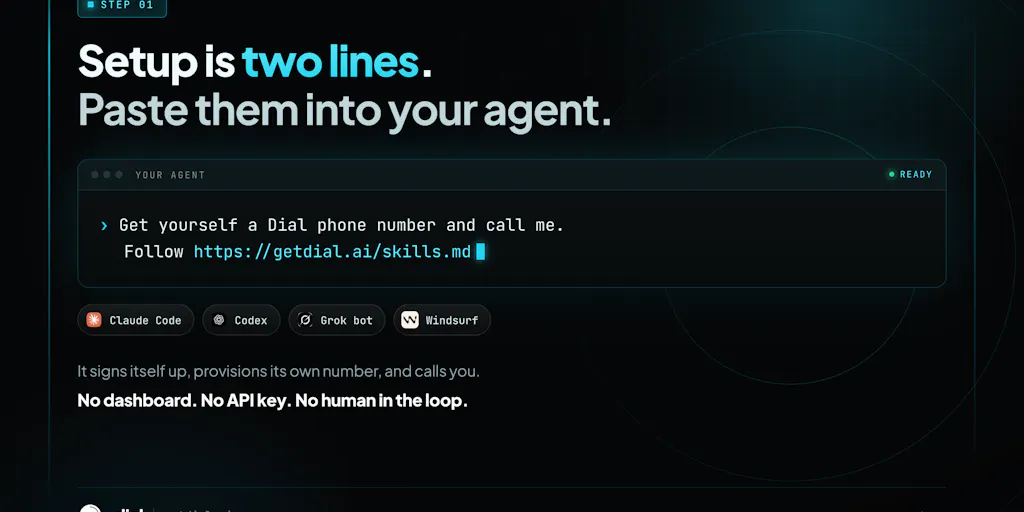
Dial’s approach is to abstract away all of that telecommunications complexity. The founder’s example is telling: he suggests you paste a command into Claude Code, Cursor, Grok Bot, Codex or any agent that instructs it to get a Dial number and call him. The agent signs itself up, provisions its own number, and his phone rings. No dashboard, no human in the loop. For someone like me who has spent hours wrestling with API rate limits and webhook configurations, the promise of a single webhook, one format, every channel is genuinely appealing.
Where the Math Breaks
Let’s talk about the economics, because that’s where I see the most friction. The founder mentions that pricing is $3 per number on the website, but when asked if that’s consistent across countries, the answer is not the same pricing. That’s a red flag for me. If you’re a creator or a small team with a global audience, you might need numbers in multiple countries to receive verification codes from region-locked platforms or to make local calls for bookings. If the pricing varies wildly by country, your cost structure becomes unpredictable.
There’s also the question of 10DLC compliance. For those unfamiliar, 10DLC is a US telecommunications standard for business text messaging. It requires registration and approval, and the founder acknowledges that regulations are sucks (his words, not mine). Dial claims to offer fully managed 10DLC with a self-healing feature that gets approved in 1-3 days instead of the usual 10-15. But this is a claim, not a guarantee. In my experience with similar services, approval times can vary based on the content of your messages and the industry you’re in. If you’re a creator promoting a newsletter, you might face different scrutiny than a utility company sending service alerts.
What Creators and Social Media Teams Can Borrow
Even if you’re not ready to hand a phone number to an AI agent, the philosophy behind Dial is something every social media operator should steal. The core lesson is about removing the human bottleneck from your workflow. When I schedule content, I don’t want to be the person who has to manually approve every post. I want to set up a system where the content is reviewed against my brand guidelines, approved if it meets the criteria, and scheduled automatically. The only time I should step in is when something falls outside the parameters.
This is where the concept of an agent that can handle inbound communication becomes powerful. Imagine a customer support workflow for a creator brand. A fan texts a question about a product launch. Instead of you stopping your creative flow to answer, an AI agent receives the text, understands the query, and responds with the relevant information from your FAQ. If it can’t handle the query, it flags it for you with the full context. The team’s example of using the agent to press keypad digits mid-call to interact with phone menus is a perfect illustration of this. It’s not about replacing human interaction; it’s about handling the routine, low-value interactions so you can focus on the creative work that actually grows your audience.
For social media teams, the operational benefit is even clearer. If you’re managing multiple client accounts, you know the pain of client approval workflows. A client wants to approve a campaign, but they want to do it over the phone. With a tool like Dial, your AI agent could call the client, walk them through the proposed content calendar, and record their feedback with real-time transcription. The agent could then update the schedule based on the client’s verbal approval. This isn’t science fiction; it’s a logical extension of the tools being built right now.
Where My Judgment Says It Falls Short
I’m going to be honest here, because I think this is where the trustworthiness of my analysis matters. Dial is solving a real problem, but it’s solving it for a very specific audience: developers and technically sophisticated operators. The launch page is full of commands like dial number set --inbound-instruction "." and references to MCP servers. This is not a tool for a creator who just wants to post better content. It’s a tool for someone who is already building AI agents and needs to extend their capabilities.
The barrier to entry is the first problem. If you’re not comfortable with command-line interfaces or configuring webhooks, this tool is not for you—at least not yet. The founder’s own example of getting started involves pasting a command into Claude Code or Cursor, which presupposes you’re already using those tools. For the majority of social media managers I know, that’s a significant hurdle.
The second problem is the complexity of the telecommunications landscape. Even with Dial’s managed 10DLC, you’re still dealing with a system that has regulatory requirements, carrier-specific quirks, and the ever-present risk of messages being flagged as spam. The founder’s candid admission that you shouldn’t have to be a telecommunication engineer/legal expert is both a value proposition and a warning. It means Dial is handling a lot of complexity on your behalf, but it also means you’re dependent on their ability to navigate that complexity effectively.
Who This Is NOT For
Let me be clear about who should skip this for now. If you are a solo creator just starting out, using a scheduling tool and posting manually, you do not need Dial. The friction of setting it up outweighs the benefits. If you are a social media manager at a traditional company, working within established workflows and IT approval processes, you will likely struggle to get this approved. It’s too new, too developer-focused, and too far outside the typical marketing technology stack.
Dial is for the operator who is already building automated workflows, who is comfortable with AI agents, and who has hit the specific wall of phone verification or outbound calling. It’s for the indie founder who wants their AI to handle customer support calls without hiring a team. It’s for the growth marketer who is experimenting with AI-driven outreach and needs a reliable way to send and receive SMS at scale. If that’s not you, keep this in your back pocket for later, but don’t force it into your workflow now.
The other concern I have is around privacy and security. If your AI agent has a phone number and can receive SMS, it’s a potential vector for attacks. What happens if the agent receives a phishing message that looks like a verification code from a platform? The founder says the agent sees the whole SMS, which is good for context, but it also means the agent needs to be sophisticated enough to discern legitimate messages from malicious ones. In my experience, that’s a high bar for current AI models.
What I’d Watch / Test Next
Dial is an intriguing piece of infrastructure, but it’s not a finished product in the consumer sense. It’s a toolkit. Here’s what I’d do this week if you’re intrigued by the possibilities:
First, if you’re already using an AI agent framework, spend 30 minutes testing the core premise. Follow the skills.md link the founder provided and see if you can get an agent to provision a number and make a call. This is the fastest way to understand whether the tool works as advertised. Don’t just read about it; test it.
Second, think about a specific, low-risk workflow where this could save you time. For me, it’s handling the verification codes for my analytics dashboards. If I can set up an agent to receive those codes and complete the login flow, I save myself from a recurring interruption. For you, it might be automating appointment confirmations for client calls or managing a community support line.
Third, monitor the pricing. The $3 per number figure is attractive, but the country-specific pricing is not disclosed. If you have a global audience, contact the team at founders@getdial.ai to get clarity on what your specific use case would cost. The founder has been responsive in the comments, which is a good sign for a young company.
Finally, watch how this integrates with the broader AI ecosystem. The launch page mentions Groq and other models, and the founder discusses using in-house SLMs to decide the best speech-to-speech model every turn. This suggests Dial is positioning itself as a layer that works across different AI providers, not just one. If they execute on that vision, this could become a standard piece of infrastructure for AI agents that need to exist in the physical world.
The last six digits of a verification code are a small thing, but they represent the boundary between the digital and the physical. Tools like Dial are starting to erase that boundary. For creators and social media operators, that means the future isn’t just about better content—it’s about building systems that can act autonomously on our behalf, right up to the very last step. And maybe, with the right tools, even past it.