The AI assistant is becoming an operator, not a chatbot
Every social media operator I know is living the same quiet emergency: the work lives in ten tools, and the AI assistant we were promised can only write, not act. It can draft a hook, but it can’t move a card from “approved” to “scheduled” in the content calendar. That’s why the Dover MCP launch stopped my scroll. Dover is a recruiting company, not a social tool, but the thing it just shipped is the missing layer for every pipeline we run: a Model Context Protocol connector that lets Claude, ChatGPT, and other AI assistants do real work inside a system — not just summarize it. If that pattern works for hiring candidates, it is about to change how content assets get hired, scheduled, and shipped too.
What Dover MCP actually solves — and why it matters beyond HR
Dover has been building toward this for a while. This is the company’s 12th Product Hunt launch, and the arc is visible in its previous launches: a free sourcing extension, a fractional recruiter marketplace, a job description grader called RateMyJD, and an AI applicant sorting tool. The core product is an all-in-one recruiting solution for startups: a free ATS, a sourcing toolkit, and a marketplace of fractional recruiters. The MCP connector is the new piece, and it turns the ATS from something you log into into something an AI assistant can operate.
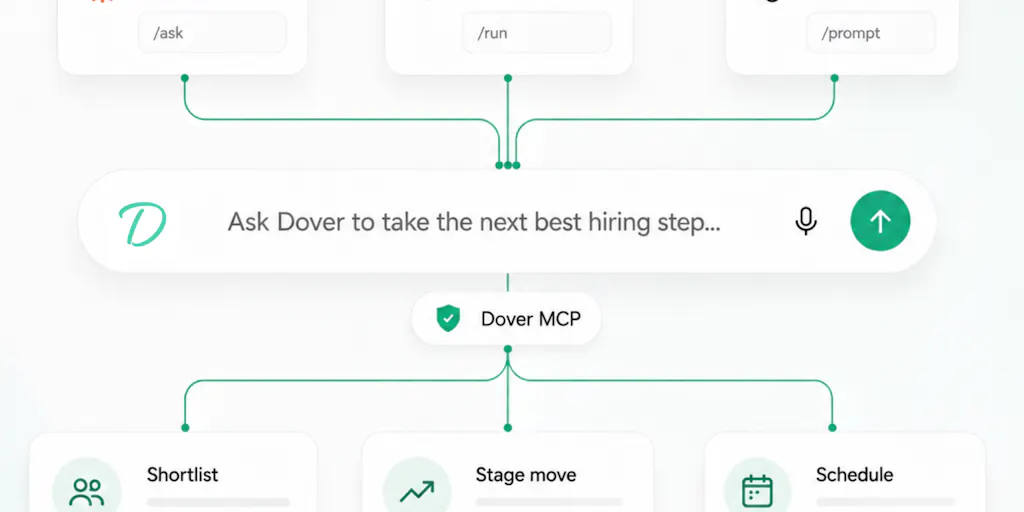
The action list is deceptively simple. According to the maker, you can ask Claude to find a candidate, schedule an interview, prepare a hiring manager, add debrief notes after the call, move the candidate to the next stage, and draft the follow-up email. That’s not a demo of resume summarization. That’s an AI assistant running a workflow. The difference between Dover MCP and most AI recruiting features is the difference between reading a menu and cooking the meal. A commenter on the launch thread put it well: most AI hiring features just summarize resumes or generate interview questions, but actually moving candidates and scheduling interviews from Claude or ChatGPT feels different. It is different, because it’s the difference between a read-only tool and a read-write tool.
Why should a social media operator care? Because the same distinction is about to hit every content tool we use. When I use Buffer or Hootsuite, the AI features are mostly suggestion engines. They generate captions, propose hashtags, or tell me the “best time to post” based on retrospective data. They don’t take action. They don’t reschedule a campaign because engagement dropped. They don’t move an underperforming post out of the queue and flag it for a re-edit. They don’t log UTM parameters back into a master spreadsheet. Dover’s MCP treats the ATS as a database and lets the assistant mutate state. That is the difference between a chat tool and an operations tool.
In my own experience running hiring for content teams, the time sink was never sourcing. It was the state changes. Moving a candidate from “phone screen” to “interview,” emailing the hiring manager, logging feedback, updating the pipeline, sending the polite rejection. There are no creative breakthroughs in that work. It is pure execution, and AI is good at execution when it has a structured data model and clear permissions. Dover’s MCP gives it both. The same structure applies to a content calendar: every piece of content is an object with a stage, an owner, a due date, and a next action. The verbs are the same — move, add, schedule, follow up. The nouns are just different.
How Dover MCP differs from every ATS I’ve used
Traditional ATS incumbents like Greenhouse, Lever, and Ashby have good APIs and are slowly adding AI features. But those features are locked inside their own UI. You go to the AI tab, you use their screening model, you stay in their world. Dover’s approach is inverted. The ATS is the backend, and the front end is any MCP-compatible assistant. It’s not “AI inside your ATS.” It’s “your ATS inside your AI.”
That matters for a simple reason: the AI assistant is becoming the layer where people actually work. More and more operators are starting their day in Claude or ChatGPT, not in ten different SaaS dashboards. If the assistant can’t reach into your scheduling tool, your analytics tool, or your ATS, it is just a writing partner. Dover’s MCP turns the assistant into a bridge. The team positions it as a way to manage hiring “without paying for expensive recruiting software” — a direct shot at a category that charges per seat. My take: the free ATS is the bait, and the MCP is the moat. Once your candidate data, hiring notes, and pipeline history live in a tool your AI assistant can act on, switching costs go up. You’re not paying for the ATS. You’re paying for the connection.
It’s also worth comparing Dover to the point solutions that have proliferated in the hiring space. There are dozens of AI resume screeners, interview schedulers, and job description writers. They do one job, and they do it in isolation. Dover’s previous launches show a deliberate stacking strategy: a sourcing extension to find emails, a marketplace to hire recruiters, a job description grader, an AI applicant sorter, and now an MCP connector. The company is building a platform, not a feature. The earlier AI Applicant Sorting launch claimed you could review resumes 10x faster. My take: treat that as marketing copy, not a benchmark. But the direction is clear. The MCP is the integration layer that pulls all those pieces into one conversational interface.
Why TikTok creators should care more than LinkedIn ones
The MCP pattern is not equally valuable for every creator. On TikTok, distribution is a cold-start testing machine. The algorithm doesn’t reward authority; it rewards engagement velocity. Creators who ship more variants, test more hooks, and iterate faster win. A pipeline that lets an AI move a video from concept to script to rough cut to review to scheduled is worth real money when you’re shipping multiple times a week. The bottleneck is not creativity. It’s state management — getting each piece through the stages before the trend dies.
LinkedIn, by contrast, is a relationship graph. Volume matters less, thought leadership loops matter more, and automation can feel hollow if it isn’t carefully edited. The MCP pattern still matters for LinkedIn creators, but mostly for the business side: hiring a ghostwriter, a community manager, or a fractional strategist. In my experience, LinkedIn content fails when it feels like a batch job. TikTok content fails when it ships too late. The same automation that hurts you on one platform can save you on the other.
What your content operation can borrow without buying an ATS
The biggest lesson from Dover MCP is to treat content as candidates. Every asset should have a status, an owner, a source, and a next action. When I look at my own workflow, ideas land in DMs, comments, voice memos, and random notes. They die there because there is no pipeline. Dover’s MCP makes the workflow visible: an object enters, moves through stages, and exits with a follow-up. You can copy that shape tomorrow with a board or a spreadsheet. The job is not to buy the tool; it’s to define the stages.
Before connecting an AI assistant to anything, define what it can see and do. Dover says access respects your team’s existing permissions. A commenter on the launch pushed back with exactly the right question: is the permission check happening per request against the asking user, or once at connection time? That distinction is the difference between a tool a head of people can approve and one their counsel quietly kills. The same question applies to your content stack. If an AI assistant can read your analytics, can it read private revenue data? If it can schedule posts, can it delete them? If it can see your content calendar, can it see notes about a client you haven’t signed yet? Build the permission map before you build the workflow.
There’s also a hiring lesson for the creator economy. Most creator businesses are fractional by nature. Your next hire might not be a full-time employee; it might be a top 2% fractional editor, a contract strategist, or a part-time community manager. Dover’s model — a marketplace of vetted operators plus a free ATS to manage the flow — is exactly how a serious creator business should run. You don’t need a recruiting team. You need a system and a network. The ATS gives you the system; the marketplace gives you the network. Even if you never hire a recruiter, the discipline of tracking candidates, stages, and follow-ups will save you from the chaos of managing contractors through DMs.
The assistant-as-operator workflow
Here is the workflow I want to test. Ask an assistant: “Pull the three best-performing Reels from last month. Turn them into a TikTok series. Draft five hooks for each, append UTM parameters, and add them to the content calendar with a ‘needs footage’ tag.” That is not a chatbot prompt. That is an operations workflow. It needs a tool that can read analytics, write to a calendar, generate structured captions, and track UTM links. The architecture is the same as Dover’s example: find candidate, schedule interview, add notes, move stage, draft email. The nouns changed. The verbs didn’t.
The best content workflows are repurposing pipelines. A YouTube video becomes a podcast clip, a blog post, a Twitter thread, and three Shorts. Each artifact is an object moving through stages. An MCP connector for your content stack would let an assistant do the mundane transfers — pulling transcripts, generating clip lists, logging performance — instead of you doing it at midnight. In my experience, that is where most content operations fall apart. It’s not the content. It’s the logistics. The platforms keep changing their algorithms, watch time keeps shifting, and engagement rate is never stable enough to plan in advance. You need to iterate, and iteration requires a pipeline.
Where my judgment says it falls short
First, Dover MCP is not a content tool. If you’re a creator looking for an AI that schedules Instagram posts, this is not it. It is an ATS with an MCP server. It solves hiring admin. You can borrow its pattern, but don’t install it and expect TikTok growth.
Second, MCP permissions are still the sore spot. The most important comment on the launch was the user asking whether permission checks happen per request or at connection time. The maker responded that Dover has a strong permissions model, but I’d want the documentation, not the reassurance. Hiring data is legally sensitive, and the same privacy leak with a content analytics assistant is a business risk. The source does not disclose the security audit details or the granularity of the permission model. Until I can see how permissions are enforced per user and per request, I’d treat this as promising but not production-ready for sensitive pipelines.
Third, the math breaks on batch operations. AI assistants still have context windows, token limits, and API rate limits. Asking an assistant to “review all 200 applicants and rank them” in one prompt is not a safe operation. You need to chunk by stage, define scoring criteria, and keep a human in the loop for anything with legal or financial weight. The same is true for content: “find every underperforming post this year” is a batch job, not a chat message. The MCP makes the pipeline accessible, but it doesn’t make batch operations reliable. You still need scheduled jobs, retry logic, and audit trails.
Fourth, who is this not for? If you’re a solo creator with no hiring needs and no team, the ATS/MCP stack is overkill. If your content pipeline is “post when inspiration hits,” no tool will save you. And if you need an enterprise ATS with robust compliance, the free startup tool may not have the depth you need. The review summary describes a simple, effective ATS for early- and mid-stage startups, but it also mentions occasional sync issues. An AI that writes to a system that syncs badly is worse than no AI. Treat this as early-stage software, and test it against your actual workflow before you trust it with anything sensitive.
What I’d watch / test next
Here is what I would do this week, whether or not you are hiring anyone soon.
First, map one workflow as a pipeline. Write down every stage a piece of content or a candidate goes through, and the verb that moves it from one stage to the next. If you can’t describe the pipeline, no AI will be able to operate it. The workflow is the product.
Second, test a read-only MCP connection. Connect Claude or ChatGPT to a sandbox account or a tool that has an MCP server, and ask it to summarize and move an object. Watch what it can and can’t see. That will teach you more about permissions than any whitepaper.
Third, if you hire contractors, try Dover’s free ATS with one real role. Ask Claude to surface the strongest applicants and schedule one interview. See whether the permission model holds, and pay close attention to whether the AI can see information it shouldn’t.
Fourth, watch the scheduling category. The first major social media scheduling tool to ship an MCP server will change how creators operate. When one does, test the same pattern on a real content calendar. The tools that let AI move objects, not just generate text, are the ones that will survive the next platform shift.