The real lesson from a party-game launch: distribution is the product, and most social tools still get it backwards
Every week a new app hits Product Hunt promising to “10x your reach” or “automate your entire content calendar,” and every week I open it hoping it solves the one problem that actually keeps social media managers awake at night: getting a piece of content in front of the right people without burning the team out. Most don’t. They add another dashboard, another AI writer, another scheduling queue, and the operator is left doing the same manual work with a prettier interface. So when I saw Drunken Penguins launch — a phone-based party game from a solo maker in Sri Lanka — I almost scrolled past it. It’s not a social media tool. It’s not a scheduler. It’s a card game you play with friends in the same room. And yet the launch mechanic is more instructive for creators and social operators than half the “creator economy SaaS” I test in a given month. Here’s why, and what I’d actually steal from it.
What Drunken Penguins actually is, and why the mechanic matters more than the game
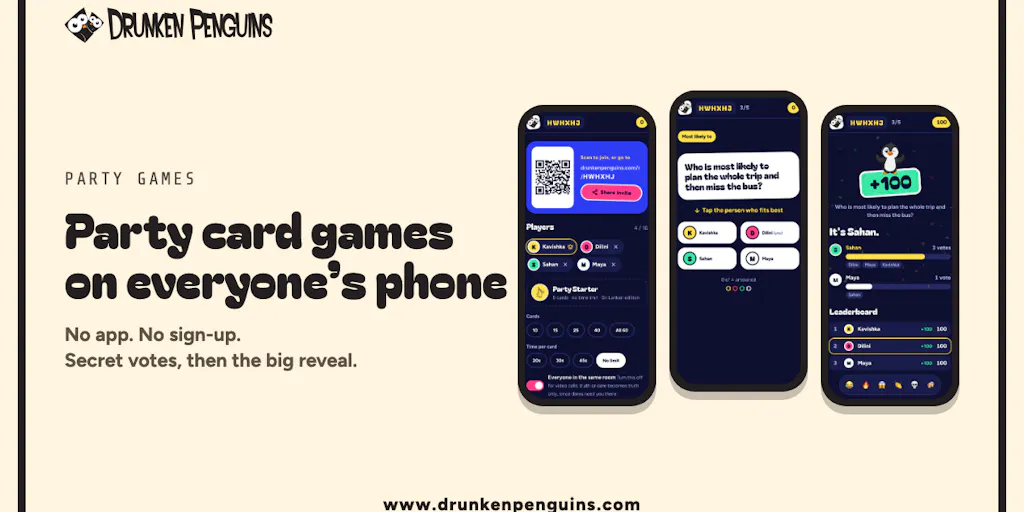
Let me get the facts straight first, because the launch page is short and I don’t want to invent anything. Drunken Penguins is a party game built by Kavishka Perera, a maker based in Sri Lanka. The origin story, per the launch post, is a game night where friends kept passing one phone around, reading cards out loud, and arguing over who voted for who. The fix: one person creates a room, everyone else joins on their own phone with a six-letter code, votes stay secret, and the reveal is the payoff moment.
The content itself is familiar territory: “Most likely to,” “Never have I ever,” “Would you rather,” and “Truth or dare.” There’s a free starter deck of 60 cards, no sign-up required to play, and extra packs are a one-time unlock — with the explicit promise that friends always join free. There’s also a local card game called Omi, which the maker describes as “the card game everyone here grew up with,” bundled in with bots to fill empty seats. The launch offer is a 50% discount on any pack for 14 days using the code PRODUCTHUNT.
That’s the whole product surface. No AI, no analytics, no growth loop dashboard. And that’s exactly why I think it’s worth writing about.
The six-letter code is the growth engine
Here’s the mechanic I want every social media manager to sit with: one person creates a room, and everyone else joins with a six-letter code. That’s it. No account creation, no app store friction, no “sign in with Google.” The host does the work of getting the room started, and the guests get in with almost zero effort.
If you’ve ever tried to run a UGC campaign, a referral program, or a community challenge, you know that every additional step between “interested” and “participating” costs you a percentage of your audience. Sign-up walls kill participation. App downloads kill participation. OAuth screens kill participation. A six-letter code is about as close to frictionless as a multi-player experience gets, and the maker clearly understood that the host is the one who needs to be motivated — not the guests. The guests just need to show up.
I’ve run enough Instagram Stories polls and TikTok comment-bait prompts to know the pattern: the lower the effort, the higher the reply rate. The same math applies to any social campaign where you’re asking an audience to do something. If your call to action requires more than one tap, you’re already losing people.
“Friends always join free” is a monetization philosophy, not a pricing detail
The other line that jumped out at me: extra packs are a one-time unlock, and friends always join free. That’s a deliberate choice, and I think it’s the right one for a social product. It means the paying user is the host — the person who wants the experience to be good — and the non-paying users are the audience that makes the experience worth paying for. You’re not charging per seat. You’re charging the person who cares.
Compare that to how most creator tools price. Buffer, Hootsuite, and Later all charge per seat or per social profile, which means the moment a small team wants to collaborate, the bill scales with headcount. That’s fine for agencies, but it’s a terrible fit for the indie creator who just wants a VA to help schedule posts. The Drunken Penguins model — host pays, guests are free — is a reminder that pricing should map to who gets the value, not to how many people touch the product.
How this compares to the social tooling I actually use
I want to be clear that Drunken Penguins is not competing with Buffer, Metricool, or Sprout Social. It’s a party game. But the launch got me thinking about how the same design principles show up — or don’t — in the tools social teams rely on every day.
Scheduling tools are still solving the wrong problem
When I scheduled 30 posts across five platforms last month — Instagram, TikTok, YouTube Shorts, X, and LinkedIn — the actual scheduling took maybe 40 minutes. The rest of the time went to repurposing: cropping a horizontal YouTube clip into a vertical TikTok, rewriting the LinkedIn caption into something that wouldn’t get flagged as cross-posted, pulling the right thumbnail from Canva, re-exporting from CapCut because the first export had the wrong aspect ratio. That’s the workflow that needs fixing, and most scheduling tools barely touch it. They’ll let you queue the post, but they won’t help you transform the asset.
The tools that do try — Repurpose.io, Opus Clip, and a dozen AI repurposing startups — are getting better, but they still produce output that needs a human pass. My take: the winning product in this category won’t be the one with the most platforms supported. It’ll be the one that gets the transformation right, because that’s where the hours actually go.
The “no sign-up to play” principle applies to landing pages too
The free starter deck with no sign-up is the same principle as a landing page that lets you try the product before you create an account. It’s rare, and it works. If you’re a creator selling a course, a template pack, or a community membership, ask yourself: what’s the equivalent of the free starter deck? What can you give away that lets someone experience the value before they pay or sign up? A single free template. One sample lesson. A public Notion page with the first module. The friction you remove at the top of the funnel compounds.
Where the math breaks
Here’s where I’d push back on the Drunken Penguins model, and it’s the same pushback I’d give to any social product with a viral loop: the six-letter code only works if the host can get people in the room. That’s a distribution problem disguised as a product feature. The game is only as good as the host’s ability to convene. For a solo maker launching on Product Hunt, that’s fine — the launch itself is the convening moment. But for long-term growth, the product needs a reason for hosts to keep hosting. A leaderboard, a streak, a “best moments” recap you can share to Instagram or TikTok — something that turns the in-room experience into a social artifact. The launch page mentions the maker’s Instagram, but there’s no evidence of a built-in share mechanic. That’s the gap I’d watch.
What creators and social teams can steal from this launch
I’ve been doing this long enough to know that the most useful ideas often come from outside your own category. Here’s what I’d actually borrow from Drunken Penguins for social media work.
Make the host the hero, not the platform
Every community has hosts — the people who start the group chat, organize the watch party, run the Discord. If you’re building a creator business, identify your hosts and give them tools that make hosting easier. That could be a shareable template, a “start a room” link, a co-host feature. The hosts bring the guests. The platform just needs to not get in the way.
Price for the value-creator, not the headcount
If you’re selling anything to creators — a course, a tool, a membership — look at who actually gets the value. If it’s one person doing the work and ten people consuming, charge the one person. If it’s a team collaboration tool, charge per seat. The mistake is charging per seat for something one person uses on behalf of many.
The reveal is the content
The maker says the reveal is the best part of the game. That’s a content insight. In social media, the reveal is the payoff moment — the before/after, the results screenshot, the “here’s what happened when I tried this.” If you’re not engineering a reveal into your content, you’re leaving the most shareable moment on the table. Think about the last five posts you published. How many had a genuine reveal? My guess is fewer than you’d like.
No sign-up is a growth strategy, not a courtesy
The free starter deck with no sign-up is the kind of thing that feels generous but is actually a growth decision. It removes the biggest drop-off point in any funnel. If you’re running a newsletter, a free trial, a lead magnet — test the no-sign-up version. Give the value first, ask for the email second. I’d bet the conversion rate on the back end is higher than the sign-up-gated version, because the people who convert are the ones who already experienced the value.
Where my judgment says it falls short
I want to be balanced here, because the launch page is short and I’m working from limited information.
First, the game itself is in a crowded category. “Most likely to,” “Never have I ever,” and “Truth or dare” are the same prompts you’ll find in a hundred free apps and a thousand TikTok comment sections. The differentiation has to come from the experience — the secret voting, the reveal, the room mechanic — not the content. Whether that’s enough to sustain a paid product over time is an open question. Not disclosed: retention numbers, active rooms, or repeat-play data.
Second, the Omi inclusion is interesting but geographically specific. The maker describes it as “the card game everyone here grew up with” — which suggests a Sri Lankan or South Asian audience. That’s a smart localization play, but it also raises the question of whether the product is designed for a global audience or a specific one. My take: the localized content is a strength, not a weakness, but it needs to be paired with a clear expansion path.
Third, the 50% launch discount for 14 days is a classic launch tactic, but it creates a deadline that may not match the product’s natural adoption curve. Party games spread through actual parties, and parties happen on weekends, not on launch-day timelines. I’d watch whether the discount converts to paid users or just to launch-week curiosity.
Fourth, and this is the biggest one: there’s no visible mechanism for the game to spread beyond the room. The six-letter code gets people in, but nothing in the launch materials suggests the game creates shareable artifacts — no recap, no highlight reel, no “share your results” prompt. For a product whose entire value is social, that’s a missed loop. The maker asks “what game should we add next?” which is a good engagement question, but the more important question is “how does this game get played by people who weren’t in the room?”
Who this is not for
If you’re a social media manager looking for a scheduling tool, an analytics dashboard, or an AI content generator, this isn’t it. If you’re a creator looking for a monetization platform, this isn’t it. If you’re a growth marketer looking for a referral engine, this isn’t it. It’s a party game. The value for social operators is in the design lessons, not the product itself. I’d rather be honest about that than pretend it’s something it’s not.
What I’d watch / test next
Here’s what I’d actually do this week if I were paying attention to this launch as a social operator.
First, I’d study the six-letter code mechanic and ask what the equivalent is in my own funnel. Where can I remove a step between “interested” and “participating”? A link that opens directly to a template. A poll that doesn’t require a login. A comment prompt that’s one word. Pick one and test it.
Second, I’d look at my pricing or my offer and ask who the host is. Who’s the person doing the work on behalf of others? Are they the one paying? If not, why not?
Third, I’d audit my last ten posts for a reveal moment. If fewer than three have one, I’d add one this week — a before/after, a results screenshot, a “here’s what happened” story. The reveal is the content.
Fourth, I’d watch whether Drunken Penguins adds a share mechanic in the next 30 days. If it does, that’s the signal that the maker understands the growth loop. If it doesn’t, the product stays a launch-week story. I’d also keep an eye on the maker’s Instagram to see how the game gets documented in the wild — that’s where the real product-market fit signal will show up, not on the launch page.
Finally, I’d steal the “no sign-up” principle for whatever free thing I’m giving away. The free starter deck is 60 cards. What’s your 60 cards? What’s the thing you can give away that lets someone experience the value without committing? Find it, ship it, and watch what happens.