The creator’s next moat isn’t reach — it’s real-time language
Most social media operators I know are quietly hitting a ceiling that has nothing to do with the algorithm. Their content is fine. Their hooks are tested. Their posting cadence is dialed. But the audience they can actually serve is capped by the languages they can speak fluently — and the platforms keep pushing distribution into markets where English-first content underperforms. When I schedule a month of posts across five platforms, the analytics almost always show the same thing: the fastest-growing slice of impressions comes from non-English-speaking regions, and the engagement rate on those impressions is worse than my domestic baseline. Not because the content is bad, but because it’s in the wrong language for the viewer.
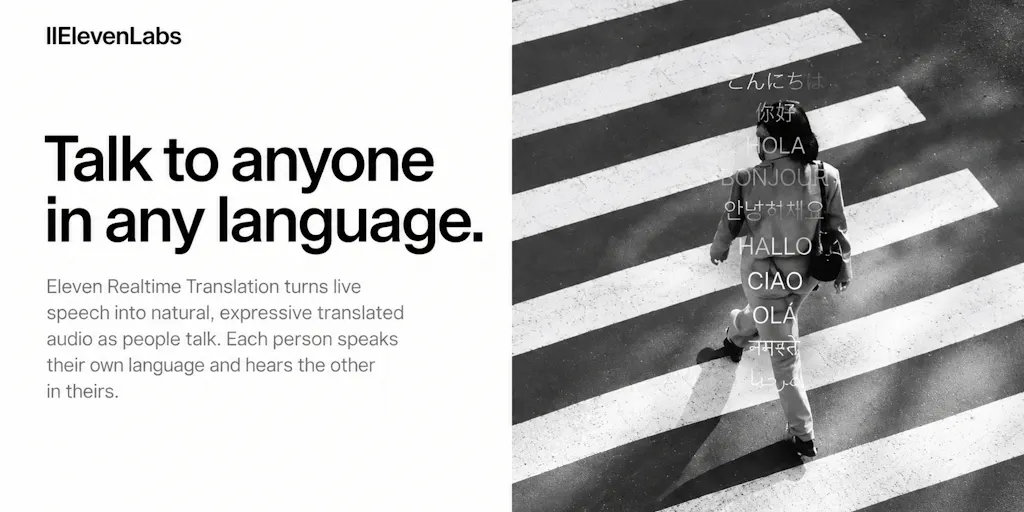
That’s the lens I want to use for ElevenLabs Realtime Translation, which the team at ElevenLabs recently hunted on Product Hunt. The surface-level read is “another AI voice tool.” The more interesting read, for anyone who runs social accounts for a living, is that live two-way translation with a consistent voice is a distribution unlock — for interviews, live events, podcasts, and eventually the kind of native-language content that platforms reward. The team claims it supports 90+ languages with a voice that stays the same across the whole conversation, plus streaming captions and transcripts. I’ll take that claim at face value while flagging that I haven’t yet run it through my own stress tests. What I can tell you is why it matters, how it stacks up against the tools I already use, and where I think it falls short.
The problem it actually solves — and why social teams should care
Let me be concrete about the operational pain. When I run a creator interview or a live event, the bottleneck is rarely the recording. It’s the post-production translation layer: I record in English, send the file to a transcription service, pay a translator or run it through a machine translation pass, then re-record voiceover in the target language (or accept subtitles). That’s three tools, a day of turnaround, and a voice that doesn’t match the original. For a podcast or a YouTube long-form, that’s tolerable. For a live stream or a TikTok Live, it’s a non-starter.
Realtime Translation, as described on the launch page, collapses that pipeline. Each person speaks their own language and hears the other in theirs, live. The hunter — Kate Ramakaieva — frames it around founders on international calls, but the social-media translation is obvious: the same mechanic applies to creator collabs across markets, live shopping events, and multilingual AMAs. The voice stays consistent for the whole conversation, which matters more than it sounds. A robotic readout breaks the parasocial contract that creators spend years building. A voice that sounds like the person actually talking preserves it.
Why TikTok creators should care more than LinkedIn ones
Here’s my take, and it’s grounded in how the platforms distribute. TikTok’s recommendation engine is famously language- and region-sensitive — it will happily push your content into adjacent-language markets if the watch time holds, but a viewer who doesn’t understand the audio bails in the first three seconds, and that early drop-off poisons the watch-time signal. LinkedIn is the opposite: it’s text-first, the feed tolerates subtitles, and the professional audience is more likely to read a translated caption than watch a dubbed video. So a real-time translation tool is a bigger lever for short-form video creators than for B2B LinkedIn posters. If you’re a TikTok or YouTube Shorts operator with ambitions in LATAM, Southeast Asia, or the Gulf, this is the category to watch. If your whole game is LinkedIn thought leadership, the ROI is thinner.
The other piece is captions and transcripts streaming alongside the audio. That’s not a nice-to-have — it’s the thing that makes the output repurposable. A live translated stream that also emits a transcript gives you the raw material for a translated carousel, a sub-titled clip, and a blog post without a second pass through CapCut or a transcription service. In my experience, the repurposing workflow is where most social teams bleed hours, and anything that emits clean text alongside audio is worth a look.
How it differs from the tools already in my stack
I want to be fair to the incumbents, because “AI translation” is a crowded shelf and most of it is not built for live, two-way, voice-preserving conversation.
The closest comparison in my own workflow is the translation layer inside Descript and the dubbing features that have crept into CapCut and Canva. Those are excellent for asynchronous post-production: you record, then dub or subtitle. They are not built for live two-way calls, and the voice match is approximate at best. On the live side, the comparison is to the real-time captioning in Zoom and Google Meet — which are genuinely useful but produce text, not expressive voice, and are one-directional in practice. And then there’s the general-purpose machine translation layer — DeepL and Google Translate — which is text-in, text-out and has no concept of a live conversation.
What the ElevenLabs product claims to do differently is the combination: two-way, voice-preserving, 90+ languages, with a tunable speed-versus-accuracy dial. That last detail is the one I’d test first. In a live event, latency is the enemy — a two-second lag makes conversation feel like a bad satellite call. In a recorded interview, accuracy wins. The fact that the team exposes that trade-off as a setting tells me they’ve actually used the thing in the field, rather than shipping a demo. That’s a trust signal, not a feature list.
Where the math breaks
Here’s the honest limitation, and it’s structural. Realtime translation is a live-conversation tool. Most social media output is asynchronous. If your job is scheduling 30 posts a month across five platforms — which is exactly what I did last month — this product does not touch your scheduling workflow. It doesn’t plug into Buffer, Hootsuite, Later, or Metricool. It doesn’t generate captions for your feed. It doesn’t do UTM tracking or analytics. So the operator who reads “AI translation” and expects a content-generation shortcut is going to be disappointed. This is infrastructure for live conversation, and the social-media value is downstream: the recording, the clip, the transcript, the repurposed post. You still have to do that work.
What creators and social teams can borrow from it
The most useful thing about a launch like this isn’t the product itself — it’s the workflow it implies. Here’s what I’d steal for my own operation, regardless of whether I adopt the tool.
First, treat language as a distribution lever, not a localization afterthought. When I plan a content calendar, I now ask a question I didn’t ask two years ago: which of these pieces could earn watch time in a second language if the audio were translated? The answer is usually the evergreen, visual-first content — the tutorials, the behind-the-scenes, the reaction clips. Those are the candidates for a translated cut. The product makes the live version of that possible; the async version is already within reach of Descript and CapCut.
Second, build a “voice consistency” rule into your brand kit. If you’re going to translate a creator’s audio, the translated voice has to sound like the creator, or the audience notices. That’s the same reason I insist on a consistent thumbnail style and a consistent hook format. The ElevenLabs claim that the voice stays the same across the whole conversation, even across 90+ languages, is the detail that makes this usable for creator brands rather than just for call centers. I’d bet that voice consistency becomes a checkbox in every creator’s brand guidelines within a couple of years — the same way “caption style” did.
Third, use live translation as a collab unlock. The hunter’s framing — founders on international calls — undersells the creator use case. Creator-to-creator collabs across language markets are one of the highest-leverage growth plays on Instagram and TikTok, and the friction is almost always the language barrier in the planning call. If two creators can talk naturally in their own languages and hear each other in theirs, the collab becomes feasible. That’s a distribution unlock disguised as a productivity tool.
The repurposing multiplier
I keep coming back to the transcript. A live translated conversation that streams captions and transcripts is, functionally, a content-generation engine. One 30-minute live event becomes: a translated clip for YouTube Shorts, a quote card for X, a carousel for Instagram, a text post for LinkedIn, and a pinned thread for Threads. The translation is the input; the repurposing is the output. That’s the workflow I’d build around it, and it’s the same workflow I already run with Metricool for scheduling and analytics once the assets exist. The tool doesn’t replace the stack — it feeds it.
Where my judgment says it falls short
I promised a balanced read, so here it is. The launch page is thin on the details that matter to an operator. Pricing is not disclosed. Whether there’s an API for teams that want to pipe translated audio into their own streaming setup is not disclosed. Latency numbers — the thing that determines whether a live event feels natural or laggy — are not disclosed. The team claims it’s “built for teams (contact centers, telecom, live events),” which tells me the initial go-to-market is enterprise, not indie creators. That’s a real limitation: if you’re a solo creator or a two-person social team, you may be waiting for a self-serve tier, and the launch page doesn’t say when or whether that’s coming.
There’s also a trust question that any operator should ask about live translation generally. Machine translation fails in specific, predictable ways: idioms, humor, fast crosstalk, and domain jargon. In a recorded setting you can fix those in post. In a live setting you can’t. The speed-versus-accuracy dial helps, but it doesn’t eliminate the failure mode — it just lets you choose which failure you’d rather have. For a brand livestream, a mistranslated joke is a minor embarrassment. For a live shopping event, a mistranslated price or product claim is a compliance problem. I’d want to see how the tool handles numbers, brand names, and legal disclaimers before I’d put it in front of a paying audience.
And finally, the platform-integration gap. There’s no mention of native integrations with the platforms where creators actually publish — Instagram, TikTok, YouTube, X, LinkedIn, Facebook, Threads, or Pinterest. That’s not a criticism of the product — it’s a live-conversation tool, not a publishing tool — but it means the operator has to bridge the gap manually. In my experience, manual bridges are where workflows die. The teams that get value from this will be the ones that build the repurposing pipeline themselves, not the ones waiting for a one-click “translate and publish” button.
What I’d watch / test next
If you run social for a creator brand or a growth team, here’s what I’d do this week, in order.
First, read the launch page and the product page yourself and note what’s not there — pricing, latency, API access. Those gaps tell you whether it’s ready for your use case or still enterprise-only. Second, audit your last 90 days of analytics for non-English impressions and watch time. If the gap between impressions and engagement is wide, you have a translation opportunity, and you now have a category to evaluate. Third, run a low-stakes test: a recorded interview or a live stream with a friendly audience, translated into one target language, and measure whether the translated cut holds watch time against your baseline. Don’t trust the demo — trust your own retention curve. Fourth, build the repurposing pipeline before you build the translation pipeline, because the transcript is the asset and the translation is just the input.
My take: this is a category-defining capability dressed as a productivity tool, and the creators who treat language as a distribution lever will be the ones who benefit. The tool itself is enterprise-first and integration-light today, and I’d bet the self-serve creator tier is where the real social-media value lands. Watch the pricing page and the API docs — that’s where the signal will be.