The real lesson from Evvery isn’t the AI — it’s the “one API, many models” routing layer your content stack will need next
If you run social for a living, you already know the dirty secret of the AI tool boom: the bottleneck was never model quality. It was orchestration. Picking a model, wiring it into your workflow, keeping your data out of training sets, and swapping providers when pricing or policy shifts — that’s the actual labor. So when a solo maker ships a consumer AI app and credits a routing gateway for making it possible, I pay attention, because the same architectural pattern is quietly reshaping how we build caption generators, repurposing pipelines, and analytics assistants. Evvery launched on Product Hunt as a “private, memory-first personal AI,” and while it’s aimed at everyday people rather than social teams, the build decisions behind it are a preview of where creator tooling is heading. Here’s what’s actually worth stealing — and where I think the pitch outruns the product.
What Evvery actually is, and what problem it’s solving
Strip away the launch-page poetry and Evvery is a personal AI assistant with two defining promises: your data is never used for training, and you never have to choose a model. The maker, Bobby Renteria, frames the origin story around a gap he saw while working at companies like Meta, Discord, and Rocket: enterprise-grade AI got all the attention while “average folks” were left stitching together tools “built for techies.”
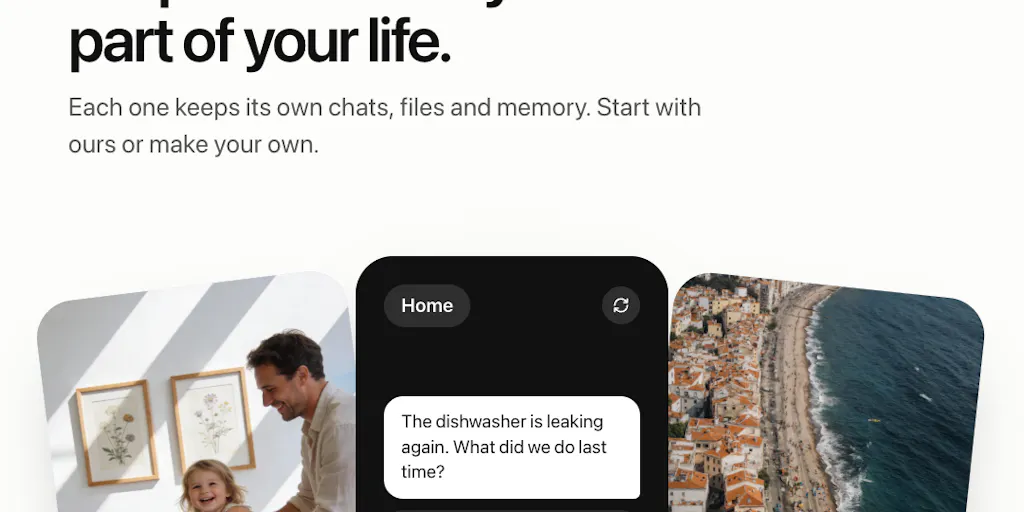
That’s a positioning claim, not a feature list, and it’s worth reading carefully. The team’s stated mission is to “bring AI to the people” with privacy, personal context, and user control as the pillars — explicitly promising to never sell user data or use it for advertising. The product is described as “memory-first,” meaning it’s designed to retain and organize context about who you are and what you care about, rather than treating each session as a blank slate.
For a social media operator, the interesting part isn’t the consumer framing. It’s the claim that model names “never appear in the app.” Renteria says one of Evvery’s promises is that “you never have to pick a model,” and that the app routes automatically. That’s a deliberate UX stance, and it’s the opposite of how most AI writing tools for creators currently present themselves — where the model name is often the headline feature.
Why the “no model picker” decision matters more than it sounds
Most creator-facing AI tools I’ve tested over the last two years lean hard on model branding. They’ll advertise which frontier model powers their captions, their thumbnail copy, their repurposing engine. It’s a trust proxy: “we use the good one.” But it’s also a maintenance liability. Model deprecations, pricing changes, and policy shifts happen constantly, and every time one lands, the tool either eats the cost or passes it to you as a feature regression.
Evvery’s approach — abstract the model away entirely — is the same bet that infrastructure layers like Vercel’s AI Gateway are making at the developer level. Renteria explicitly credits the Gateway with making the one-person-team build realistic: “Every AI call goes through one API, so I route open models by task (small and fast for background work, larger for conversation) and swap them without touching the product.” He also notes it lets him “enforce no training on user data across every provider in one place.”
My take: this is the single most transferable idea in the entire launch. If you’re building any internal AI workflow for your social team — a caption drafter, a comment triage bot, a repurposing pipeline — the value isn’t in which model you pick. It’s in whether you can swap models without rewriting your workflow. That’s an architecture decision, and it’s one most creator teams get wrong because they optimize for the wrong thing.
How it stacks up against the tools creators actually use
Let’s be honest about the comparison set. Evvery is not competing with Buffer, Hootsuite, or Later on scheduling. It’s not a Metricool analytics replacement. It’s not Canva or CapCut on asset creation. It’s a personal AI assistant, which puts it closer to ChatGPT, Claude, and Gemini in daily use — with the differentiator being memory and privacy rather than raw capability.
That distinction matters for how you evaluate it. If you’re a creator looking for a tool that writes your captions, schedules your posts, and pulls your analytics, Evvery isn’t that. If you’re a creator who wants a persistent AI that remembers your brand voice, your content pillars, and your audience notes across sessions — without feeding that context into a training pipeline — that’s the niche it’s claiming.
The privacy angle is the sharper wedge. The maker’s promise is that no training happens on user data, enforced “across every provider in one place” via the Gateway. For creators who’ve built a personal brand on a specific voice, that’s not paranoia — it’s asset protection. Your voice is your moat. Handing it to a system that might train on it is a real strategic risk, even if the practical downside is hard to quantify.
Where the math breaks
Here’s where I get skeptical. “Never train on your data” is a policy promise, and policy promises are only as strong as the enforcement mechanism behind them. Renteria says the Gateway lets him enforce it “in one place,” which is a meaningful technical claim — centralized routing means centralized policy. But the source doesn’t disclose which specific providers Evvery routes to, what the audit or verification process looks like, or how a user could independently confirm the promise holds. Not disclosed. That’s not a knock on the product; it’s a gap in the launch material, and it’s the first thing I’d want answered before trusting it with brand-voice context.
The second gap: “memory-first” is a strong claim with no disclosed mechanics. How is memory stored? Locally, server-side, encrypted at rest? How do you edit or delete it? For a social team, memory that you can’t inspect or correct is worse than no memory at all, because it silently drifts your output. I’d bet the product handles this — but the launch page doesn’t say, and I’m not going to assume.
What creators and social teams should actually borrow from this
Three operational lessons, in order of how soon I’d apply them.
First: separate your model choice from your workflow. If your AI-assisted content process is hardcoded to one tool or one model, you’re one pricing change away from a rebuild. The Gateway pattern — one API, swappable models, task-based routing — is the durable version. You don’t need to be a developer to benefit from the principle: when you evaluate AI writing tools, ask whether the vendor can swap models without you noticing. If the answer is no, you’re renting, not building.
Second: treat voice and context as protected assets, not inputs. The reason Evvery’s privacy promise resonates is that it treats personal context as something the user owns. For social teams, the equivalent is your brand voice guide, your audience personas, your content pillar definitions. Whatever AI tool you feed those into, you should know exactly where they go and whether they can be used to train anything. Most creator tools don’t make this clear. Ask anyway.
Third: watch the routing layer as a competitive category. The Gateway approach isn’t unique to Evvery — it’s an infrastructure trend. As more creator tools adopt it, the differentiator stops being “which model powers this” and becomes “how well does this tool route and remember.” That’s a better competitive dynamic for users, because it rewards tools that optimize for outcomes rather than branding.
Why TikTok creators should care more than LinkedIn ones
I’d argue the memory-first pitch lands harder for short-form video creators than for text-first platforms. Here’s why: TikTok and Instagram Reels creators operate in a fast-iteration loop where hook testing, caption variants, and comment-response cadence matter enormously. A persistent AI that remembers which hooks performed, which comment threads turned into content, and which audience segments engaged — that’s genuinely useful context that currently lives in scattered spreadsheets and screenshots.
LinkedIn creators, by contrast, tend to work in longer cycles with more deliberate positioning. Memory helps, but the iteration speed is lower, so the compounding value is smaller. If you’re a TikTok operator, the “remembers who you are and what you care about” promise maps directly to a workflow you already run manually. If you’re a LinkedIn operator, it’s a nice-to-have.
Where my judgment says Evvery falls short — and who it’s not for
The launch material is thin on the things that matter most for adoption. Pricing: not disclosed. Platform availability: not disclosed. What “memory” actually stores and how it’s editable: not disclosed. Whether there’s a team or just a solo maker: the maker describes building it solo, but ongoing support capacity isn’t addressed.
The “10x” style claims are absent here, which I appreciate — the maker’s language is more mission-driven than hyperbolic. But “best experience for anybody to use AI” is still a claim, not a demonstration, and the launch page doesn’t show the product in action beyond the description.
Who it’s not for: social teams that need scheduling, analytics, and multi-platform publishing in one place. That’s a different product category entirely, and Evvery isn’t pretending to be it. Also not for teams that need SSO, role-based access, or audit logs — none of which are mentioned. If you’re running social for a brand with compliance requirements, this isn’t your tool yet.
Who it might be for: solo creators and small teams who want a persistent, privacy-respecting AI assistant that remembers their context and don’t want to think about model selection. That’s a real need, and it’s underserved by the current crop of tools that either over-index on model branding or treat every session as disposable.
What I’d watch / test next
This week, if you’re an operator, do three things. First, audit your current AI content workflow and identify every place a model name is hardcoded into your process — that’s your fragility map. Second, if you’re evaluating Evvery or anything like it, ask the vendor directly: where does my context live, can I export or delete it, and how do you verify the no-training promise? Third, watch the routing-gateway category — if Evvery’s build approach works for a solo maker, it’ll work for the internal tools your team builds next.
For Evvery specifically, I’d want to see: a public pricing page, a clear memory-management UI, and some indication of which providers are in the routing pool. Until then, the architecture lesson is more valuable than the product itself. That’s not a knock — it’s the highest compliment you can pay a launch. The build decisions are worth copying even if you never sign up.