The Creator Economy’s Next Asset Class Isn’t Content — It’s Judgment
Every creator I know is wrestling with the same unspoken dread: the content treadmill is speeding up, AI is flattening the value of generic advice, and the thing that made you successful — your hard-won expertise — is increasingly being scraped, summarized, and redistributed by models that don’t cite you, pay you, or even remember your name. We’ve spent years building audiences, but we’ve been giving away the crown jewels to do it. Every framework post, every “here’s my 5-step system” thread, every polished LinkedIn carousel is training the very tools that will make your paid expertise obsolete. The question that keeps me up at night isn’t “how do I grow faster?” — it’s “how do I own what I know?” That’s why I’ve been watching the launch of Expertise AI with more than passing interest. It’s not another scheduling tool or another AI content generator. It’s an attempt to build infrastructure for the one asset class creators have never been able to productize: the judgment, process, and decision-making frameworks that live in your head and show up in your best work. The pitch is deceptively simple — publish your playbook as an AI skill, let businesses run it without ever seeing inside it, and get paid while it works. But the implications for how creators, consultants, and social media operators think about their intellectual property are genuinely disruptive.
The Problem: You’ve Been Giving Away Your Playbook for Free
Let me be direct about the operational pain this addresses, because I’ve lived it and so have you. When I was running social for a portfolio of B2B SaaS clients, the most valuable thing I produced wasn’t the Instagram Reels or the LinkedIn posts — it was the system behind them. The content pillar framework I’d refined over years. The hook-writing checklist that consistently outperformed. The repurposing workflow that turned one YouTube video into 14 pieces of content across six platforms without burning out my team. And how did I monetize that? I gave it away. I wrote it up in Notion docs, shared it in newsletters, and included it in proposals. The moment that document left my hands, it stopped being mine. A client could take it, fire me, and run the system themselves. A competitor could read my newsletter and replicate my process. And now, with AI tools like Claude and ChatGPT being fed on publicly available content, my frameworks are likely being absorbed into models that can reproduce my thinking for anyone who asks the right prompt.
This is the exact problem the Expertise AI team describes in their launch discussion: “A playbook written as text is just a string, and a string gets copied the moment it’s worth copying.” They’re right. I’ve seen it happen a hundred times. A creator builds a following on their unique methodology, then tries to monetize it with a course or a PDF, only to find their content repackaged on Medium, summarized in YouTube videos, or — increasingly — just generated on demand by an AI that was trained on their best work. The economics are brutal. The more successful you are at sharing your expertise to build an audience, the more you devalue the exclusive access to that expertise.
The team’s framing of the modern twist is particularly sharp: “ten years ago you open-sourced for other humans, who fork you, cite you, hire you. Now the biggest consumer of an open playbook is the AI itself.” That’s not hyperbole; that’s the reality of how LLMs are trained on publicly available content. Every time you publish a brilliant breakdown of your content strategy, you’re not just sharing with your audience — you’re feeding the model that will eventually let a brand generate a similar strategy without ever hiring you. The value of your judgment is being extracted without compensation.
What Expertise AI Actually Does (and How It’s Different)
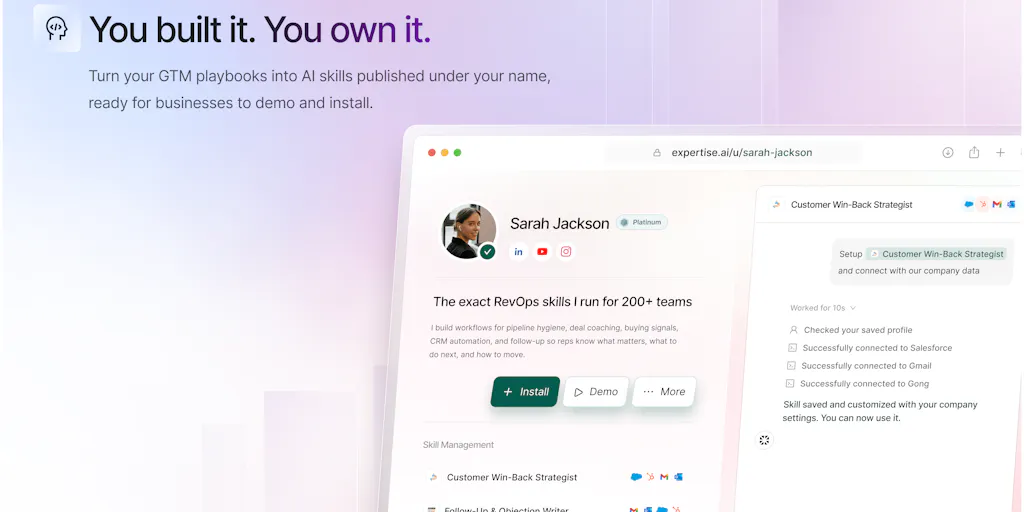
So what’s the proposed solution? Expertise AI is a platform where GTM experts — and potentially creators, consultants, and operators of all stripes — publish their playbooks as “skills” that run on AI agents. The founder, Hao, describes it as building “the missing infrastructure” for human expertise. The core mechanic is that your playbook — the step-by-step process, the decision trees, the judgment calls, the “if-then” logic you’ve internalized — gets encoded into a skill that a business can install and run. The skill personalizes itself to the buyer’s business, their ICP, their stack, without requiring you to be on a setup call. Crucially, you choose whether the playbook stays “locked” (so nobody can see inside it) or goes open-source. Either way, your name stays on it, and you get paid every time it runs.
This is fundamentally different from the existing options in the creator monetization space. Let me run through the incumbents and why they fall short:
The course economy — platforms like Teachable and Gumroad let you package your expertise as static content. But a course is a one-time transfer of knowledge. Once someone buys it, they own it. They can screenshot it, share it, or use it to train their own AI assistant. The value of your judgment is frozen in time, and you have no ongoing relationship with the buyer beyond the initial transaction.
The consulting model — selling your hours through Calendly or Clarity means you’re trading time for money, which scales terribly. You can only do so many calls in a week, and every call is a fresh opportunity for the client to extract your knowledge and then try to do it themselves next time. The Expertise AI team’s own marketing lead put it well: “productizing never failed at the creation stage. The frameworks were already written. It failed at the selling stage, where every option either sold their hours or handed over the file.”
The prompt marketplace — this is the closest analog, and the one that’s most instructive. Platforms like PromptBase and various “prompt marketplaces” have tried to let creators sell their AI prompts. But a prompt is just text. It’s copyable, shareable, and easily absorbed into a model. The Expertise AI team notes that these marketplaces “kept dying” because a string gets copied the moment it’s worth copying. A prompt has no ongoing execution value — it’s a static artifact that loses value the moment it’s shared.
The AI agent builders — tools like Zapier’s AI agents or Make let you build automations, but they’re focused on workflow automation, not on capturing and distributing expert judgment. As one commenter on the launch page noted, “There are plenty of agent builders now, but fewer products focused on distributing the judgment and process behind a good agent.” That’s the gap Expertise AI is targeting.
The key differentiator is the “locked” skill. Your playbook is encoded in a way that the buyer can run it but can’t see it. The IP can’t be copied or owned, only executed. The team explains this as a deliberate reversal of the free-content dynamic: “The moment something’s free, its perceived value drops to zero. So we went the other way. The IP can’t be copied or owned, only run. Expert gets paid. Buyer actually uses it.”
In my experience testing similar tools and thinking through the economics of expertise, this is the right instinct. The value of a great social media strategist isn’t the list of tactics they use — it’s the judgment about when to use which tactic, how to adapt a framework to a specific brand’s voice, and how to read the signals in the data and pivot. That judgment is what’s been impossible to productize because it’s contextual and iterative. If Expertise AI can actually encode that into a runnable skill, it’s solving a genuinely hard problem.
What Creators and Social Media Teams Can Borrow From This
Even if you’re not ready to publish your playbook as an AI skill tomorrow, the thinking behind Expertise AI has immediate practical applications for how you run your social media operation.
First, audit your content for “judgment leakage.” Go through your last 30 posts, your last 5 newsletters, your last 10 client proposals. Identify the places where you’ve given away your most valuable process thinking — the exact frameworks, the decision trees, the “here’s exactly how I do X” breakdowns. I’m not saying you should stop sharing entirely; that would be bad for building an audience. But you should be strategic about what you share publicly versus what you reserve for paid engagements. The Expertise AI team’s insight about the “3-D picture” — the contextual judgment that no document captures — is exactly right. Your public content should demonstrate that you have the expertise, not give away the entirety of the expertise.
Second, think about “run, don’t read” as a monetization model. The fundamental insight here is that people don’t want your PDF — they want your outcome. When I’ve sold social media audits in the past, the clients didn’t want a 40-page report they’d never read. They wanted the result of the audit — the prioritized action plan, the content calendar, the revised strategy. The Expertise AI model takes this to its logical conclusion: the buyer doesn’t want to read your playbook, they want to run it. If you’re a creator or consultant, start thinking about how you can package your expertise as something that produces outcomes rather than something that requires the buyer to do the work of understanding your framework.
Third, reconsider your “free content” strategy. The team’s discussion about open versus locked playbooks is directly relevant to how you think about your content funnel. The old model was: give away 80% of your value free, and charge for the last 20%. But in an AI-mediated world, that 80% isn’t just building your audience — it’s training your replacement. I’d bet we’ll see a shift toward “tease the framework, charge for the execution” as the dominant creator monetization model. Show enough to prove you know what you’re talking about, but make the actual doing — the personalized application of your judgment — the thing people pay for.
Why TikTok Creators Should Care More Than LinkedIn Ones
This is where I need to be platform-specific. If you’re a LinkedIn creator, your content is already being scraped by AI tools at an alarming rate. LinkedIn’s own AI features are training on user content, and the platform has been pushing AI writing tools that draw on the collective expertise of its users. If you’re publishing your methodology as LinkedIn posts, you’re literally feeding the system that will let your competitors generate similar content with one click. The calculus is different for TikTok creators, though. Short-form video is harder to scrape for process knowledge — the value is in the performance, the personality, the specific delivery. But that’s changing. CapCut and other AI video tools are getting better at extracting structure from video content, and the trend toward AI-generated avatars means your visual presence is becoming replicable too. The lesson from Expertise AI applies across platforms: the more your expertise is encoded in a format that can be copied, the more you need to think about how to make the execution the product, not just the information.
Where the Math Breaks: My Honest Concerns
I want to be balanced here, because there are real open questions about whether Expertise AI can deliver on its promise. Let me flag the concerns I’d have if I were a creator considering this platform.
The “locked skill” problem is technically hard. The team claims the IP “can’t be copied or owned, only run.” That’s a strong claim. In practice, any AI system that can run a skill can also be probed to reveal its logic. Prompt injection attacks, careful questioning, or simply running the skill multiple times with different inputs could allow a determined buyer to reverse-engineer the underlying playbook. The team says they’ve “built first” the protection mechanisms, and they’re inviting hard questions about this exact issue. But I’m skeptical that any lock is unbreakable. The more valuable the skill, the more incentive there is to crack it.
The marketplace problem is real. Expertise AI is launching with “founding experts” and open spots, but a marketplace only works with liquidity on both sides. The launch page shows only 199 upvotes and a handful of reviews, which suggests this is early days. The team’s previous launch from April got only 11 upvotes. For a creator, the question is whether there’s enough buyer demand to justify the effort of encoding your playbook. If the marketplace doesn’t grow, you’ve invested time in a platform that doesn’t deliver revenue.
The “what counts as expertise” problem. The launch is heavily focused on GTM (go-to-market) experts — sales playbooks, pipeline reviews, deal coaching, deliverability audits. That’s a specific B2B use case. The question for creators and social media operators is whether the platform can generalize to our domain. Can I encode “how to write a viral hook” or “how to build a content repurposing workflow” as a skill that’s valuable enough for someone to pay for, and locked enough that my IP is protected? The team says “if it’s a repeatable process that relies on your judgment, it can probably become a skill,” but I’d want to see examples from the creative space, not just sales.
The pricing model is undisclosed. The source doesn’t specify how revenue sharing works, what the pricing tiers are, or how much an expert can expect to earn. The founder mentions “founding spots are open” and that they’ll “build your first skills with you and migrate your existing files free,” but the long-term economics are unclear. For a creator who’s already juggling multiple revenue streams, adding an unproven platform with unclear payout potential is a risk.
Where the Math Breaks
Let me be more specific about the economic tension. The team’s pitch is that experts get paid “while it runs.” That implies a usage-based or subscription-based model where the buyer pays for ongoing access to the skill. But here’s the problem: if the skill is truly locked and the buyer can’t see inside it, how do they know it’s working? How do they audit the quality of the output? And if the skill is running on the buyer’s own AI infrastructure, what’s stopping them from using it to generate outputs, then using those outputs to train their own model? The trust requirements here are enormous. The buyer has to trust that the locked skill is actually doing what it claims, and the expert has to trust that the platform is accurately tracking usage and preventing extraction. That’s a lot of trust to place in a platform that’s launching with only 199 upvotes.
Who This Is NOT For
Let me be clear about who shouldn’t jump on this bandwagon yet.
If you’re a beginner or mid-tier creator still building your audience, this is not for you. You don’t have the proprietary playbook yet. Your expertise is still largely borrowed from others, and trying to lock it down would be premature. You need to be sharing aggressively, building your name, and learning what works. The Expertise AI model rewards people who have refined a process over years — the “3-D picture” that comes from reps and failures. If you haven’t put in those reps, you don’t have a playbook worth locking.
If you’re a creator whose value is primarily in personality and performance, this is not for you. If your content is successful because of you — your voice, your face, your specific way of delivering — then a locked skill that runs without you is missing the point. The judgment might be encoded, but the charisma can’t be. For creators like this, the better monetization path is still sponsorships, merchandise, and live appearances.
If you’re not already systematized, this is not for you yet. The platform requires you to have a repeatable process that can be encoded. If you’re still flying by the seat of your pants, creating content based on vibes and intuition, you can’t productize what you don’t understand. The first step isn’t signing up for Expertise AI — it’s documenting your own process, identifying the patterns in your best work, and building the system before you try to sell it.
What I’d Watch / Test Next
Here’s my practical takeaway for anyone in the creator economy or social media operations who’s intrigued by this model:
This week, start documenting your judgment. Not your content — your process. When you sit down to write a hook, what are the three questions you ask yourself? When you audit a client’s social presence, what are the five signals you check first? When you decide whether to post a Reel or a carousel, what’s the decision tree you run through? Write it down. This is the raw material for any future “skill” you might publish, and even if you never use Expertise AI, the act of documenting your judgment will make you better at what you do.
In the next month, run a “locked vs. open” experiment with one piece of your expertise. Pick one framework you’re known for. Create a version that you share publicly — the “open” version, designed to build audience. Then create a version that’s your actual full process, with the judgment calls and edge cases — the “locked” version. See which one generates more interest, more inbound requests, more willingness to pay. You might be surprised at how much more valuable the locked version feels when you treat it as protected IP rather than shareable content.
Track the Expertise AI launch and watch for three signals. First, do they publish case studies showing actual expert earnings? The source is silent on revenue numbers, so I’d want to see real data before committing. Second, do they expand beyond GTM into creative domains? If they start onboarding social media strategists and content creators, that’s a signal the model generalizes. Third, how do they handle the security question? If they can demonstrate that locked skills genuinely can’t be extracted, that’s a meaningful technical achievement. Until those signals appear, treat this as an interesting experiment, not a core part of your monetization strategy.
The bigger picture here is what matters. The creator economy has spent the last decade optimizing for distribution — more platforms, more tools, more content. The next decade is going to be about ownership — owning your audience, your data, and increasingly, your expertise. Expertise AI is an early attempt to build infrastructure for that ownership. Whether it succeeds or not, the question it’s asking is the right one: in a world where AI can replicate your output, what’s the thing that can’t be replicated? The answer is your judgment — and the creator who figures out how to own and monetize that judgment will be the one who survives the AI transition.