Why the Creator’s Next App Isn’t a Post
If you’re a creator or social media operator who still thinks your job ends the moment your post goes live, you’re leaving money—and trust—on the table. The creator economy has matured past the era of “just” content. The most successful indie founders, newsletter writers, and course sellers now operate micro-businesses that need custom software to handle bookings, client onboarding, community Q&A, and automated marketing. The platforms we depend on—Instagram, TikTok, YouTube—are not built for that. So we improvise: link-in-bio tools, third‑party schedulers, manual DMs. It’s a patchwork that breaks the second you get traction.
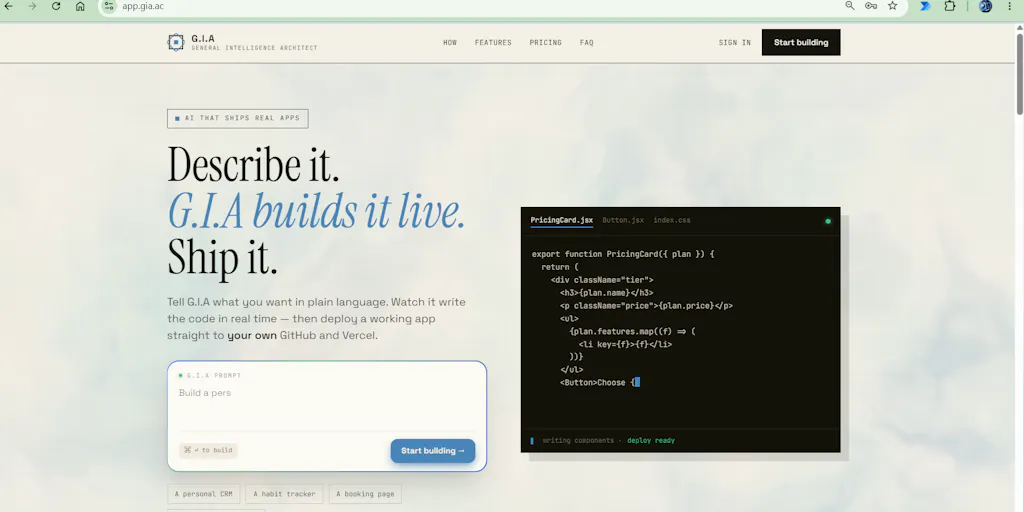
Two product launches from the last week on Product Hunt catch this shift. Zernio WhatsApp API promises to build WhatsApp features and agents in minutes. G.I.A.ac goes further—it’s an AI‑powered app builder that takes a plain‑language description and generates a real, deployable web app with its own built‑in AI assistant. One is a channel‑specific tool; the other is a platform‑agnostic generator. Both point to the same reality: creators who can ship lightweight, functional apps will own the relationship with their audience in ways that a static social feed never can.
The Real Problem Isn’t Content Volume—It’s Operational Debt
Every social‑media operator I know has a Notion doc full of “I should build a…” ideas. A booking page for coaching calls. A simple waitlist for a product drop. A private WhatsApp group that auto‑responds to FAQs. But most of us aren’t developers. We reach for Bubble, Glide, or—if we’re desperate—a custom coded solution on Upwork. The result is operational debt: the tool works until you hit a scaling wall, the freelancer disappears, or the platform changes its API.
That’s where G.I.A.ac enters. The maker, Elhoucine Idousaid, describes it as a tool that takes a sentence like “a booking site for a nail salon in Paris” and builds a live, working app—real code, no black box, deployed to your own GitHub and Vercel accounts. He contrasts it with “most tools in this space” that keep your app inside their walls. In his comment on the launch, he says: “Not hosted on my platform, no per‑app hosting fees, export anytime. … You own it, you can leave whenever.” For a creator who has been burned by a platform‑locked scheduling tool or a no‑code builder that raised prices overnight, that value proposition is magnetic.
I’ve built a few no‑code projects myself—a referral bot for a newsletter, a mini dashboard for tracking watch‑time across YouTube channels. Every time, I hit the same wall: the builder’s template was fine for a demo, but I couldn’t customize the logic or export the underlying code. G.I.A.ac’s approach—running an actual coding agent that writes files in real time, fixing mistakes you can see—feels like the next step. It’s not a promise; it’s a live debug session. One early tester, Z, commented: “Tried describing a simple habit tracker and got a working layout back in like under a minute.” That’s the speed a creator needs when a new algorithm shift demands an immediate response.
Why WhatsApp Deserves a Second Look
Zernio’s launch is quieter but equally significant for anyone running a direct‑to‑audience channel. WhatsApp is the dark horse of the creator economy. While we obsess over TikTok’s watch‑time or LinkedIn’s engagement rate, the messaging app quietly handles billions of messages daily, and the business version now supports rich media, catalogs, and payment. For creators with a loyal following—especially in non‑English markets or B2B niches—WhatsApp is where the actual conversion happens. A 2024 survey by Meta for Business showed that 70% of WhatsApp Business users said the platform helps them connect with customers more effectively than email.
Yet building a WhatsApp bot usually requires a paid Twilio account, a webhook endpoint, and a decent understanding of the WhatsApp Business API. Zernio’s pitch—build features and agents in minutes—directly addresses that friction. While the product page doesn’t disclose pricing or specific use‑case templates, the positioning suggests a visual builder or low‑code interface. For a creator running a small‑group coaching program, an automated welcome flow and booking agent could save hours of manual DMs per week.
How These Two Tools Differ From the Incumbents
The no‑code and low‑code space is crowded. Replit and Lovable already let you describe an app and get code in return. ManyChat and Chatfuel dominate the chatbot‑for‑messaging niche. So why should a creator care about these two newcomers?
G.I.A.ac’s key differentiators are transparency and ownership. Most app‑from‑text tools treat the generated code as a black box—you see a loading bar, then a preview. If the app has a bug, you’re stuck waiting for the next iteration. G.I.A.ac shows you the actual files being written, tested, and repaired in real time. That’s not just a marketing gimmick; it builds trust. The maker explicitly compares his approach to “a loop over a pile of templates.” In my experience testing Lovable, the generated app often worked for the demo but failed when I tried to deploy it to my own domain. G.I.A.ac’s “deploy to your own GitHub and Vercel” model sidesteps that lock‑in entirely. And the built‑in AI assistant that knows the business’s data—services, prices, availability—is a genuinely unique feature. For a creator who sells time‑based services (consulting calls, makeup tutorials, song production), that assistant could handle the “do you have any openings?” questions automatically.
Zernio faces a more established field. ManyChat already offers WhatsApp integration, but it’s template‑based and often requires a paid plan. Twilio Studio is powerful but developer‑oriented. Zernio’s value is speed and simplicity—the promise of “in minutes” without needing to read API docs. However, the launch page doesn’t show a concrete walkthrough, so I’d flag that as a trust gap. A creator needs to see the flow before committing.
What Creators and Teams Can Borrow From These Launches
1. Treat your own app as a content hub
Every time you post an offer or announcement on Instagram, you send people to a link‑in‑bio that is usually just a list of URLs. That’s a dead end. G.I.A.ac’s model suggests you could build a lightweight, branded app—a booking site, a tiered membership portal, a question‑submission tool—and embed it as the primary destination. Your social content becomes the traffic driver; your app becomes the conversion machine.
2. Use AI assistants to cut support time
The G.I.A.ac assistant isn’t a generic chatbot—it knows the specific business’s data. If you’re a fitness coach, the assistant can answer “what’s the difference between your 8‑week and 12‑week program?” without you writing a single FAQ page. This mirrors what smart creators are already doing with custom GPTs or Voiceflow, but with less setup. The automatic generation from the same prompt that built the app means the assistant is contextually aware from day one.
3. Own your code (and your future)
G.I.A.ac’s export‑anytime policy is a masterclass in trust. As a creator, you’ve likely experienced the pain of a SaaS tool that changes its API, raises prices, or simply shuts down. Buffer has been stable, but smaller scheduling tools come and go. If you can generate code that lives in your own repository, you’re not just renting the functionality—you’re buying a permanent asset. I’d extend that principle to WhatsApp bots: if Zernio lets you export the bot logic or connect to your own database, it’s worth serious consideration.
Where the Math Breaks (and Who Should Skip)
I’m bullish on the trend, but both tools carry significant open questions for a creator’s workflow.
G.I.A.ac is a solo built project (“built solo in Morocco,” the maker notes). That means support, uptime, and roadmap are entirely dependent on one person. The launch page shows only a handful of comments, and the pricing—€9.99/mo to download code or deploy—feels aggressively low. That could be a temporary launch price or a sustainable model if the hosting costs are zero (since the user supplies their own GitHub and Vercel). But I’d want to see a month of active development before I rely on it for a revenue‑critical app.
Zernio hasn’t disclosed its pricing or integration depth. If it’s a subscription model that also charges per WhatsApp message (like many bot platforms), it could become expensive as your audience grows. I also worry about compliance: WhatsApp Business API has strict policies around opt‑in and message templates. A “build in minutes” tool might gloss over those legal requirements. A creator sending newsletters via a WhatsApp bot without proper consent could face account suspension.
Both products target a specific profile: creators who are comfortable managing a GitHub repo and a Vercel deployment. If you’ve never pushed a commit or dealt with DNS, G.I.A.ac’s “your own account” requirement is a barrier. The tool is not as beginner‑friendly as Squarespace or Carrd. That’s fine—it’s for the indie tech‑savvy founder, not the TikTok dancer selling merch.
One More Blind Spot: The Algorithm Doesn’t Care
No matter how good your custom app is, social‑media algorithms still reward fresh content. Building an app won’t save you from a shadowban or a declining reach. I see creators fall into the trap of spending weeks on a fancy booking portal while their Instagram Stories dry up. Use tools like G.I.A.ac and Zernio to automate the operational work so you have more time for actual content. If the tool doesn’t save you at least two hours per week, it’s a distraction.
What I’d Watch / Test Next
This week, I’ll do three concrete things, and I suggest you try them too:
Pitch a 10‑word prompt into G.I.A.ac (free, no card) and watch the agent build a simple app. Example: “A waitlist for a limited‑edition podcast merch drop.” See if the generated assistant understands the product and can answer basic questions (size, price, shipping). If it works, deploy it to a test Vercel domain and send the link to one friend.
Join Zernio’s early access or request a demo. Ask specifically: (a) What message volume is included? (b) Can I export the bot logic? © Does it support dynamic reply based on calendar availability? Without those answers, don’t wire it to your real WhatsApp number.
Audit your current operational debt. List every manual task you do after a post goes live—DM responses, booking coordination, FAQ replies. If that list has more than three items, a custom app (even a simple one) probably saves you 5+ hours a month. That’s the signal that tools like G.I.A.ac and Zernio are worth the trial period.
The creator economy’s next phase won’t be won on a single platform. It will be won by those who can build—quickly, cheaply, and without a vendor lock-in—the digital infrastructure their audience actually needs. These two product launches are early signals of that shift. Treat them as a wake‑up call, not a finished solution. And never forget: the algorithm might change tomorrow, but the code you own is yours forever.