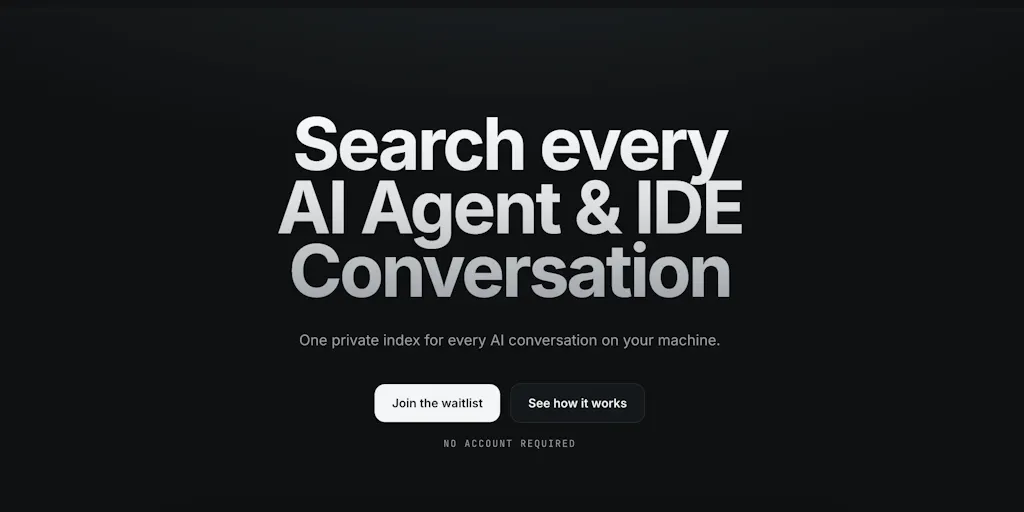
Every creator I know is running a memory-loss epidemic. We generate dozens of AI conversations a week — hook variations, caption drafts, script rewrites, audience research — and then leave them scattered inside the apps that made them. That is why Inventory, a local search index for AI coding conversations, matters way more than its launch-page niche suggests. The product is built for developers, not social media operators. But it names the problem we’ve been quietly ignoring: AI-generated content has become the raw material of our publishing workflow, and we still don’t have a reliable memory layer for it. Until we do, we’re not building a content library. We’re renting one from software companies that can change their algorithms, pricing, or data retention whenever they want.
The AI conversation graveyard is now a creator problem
Last month I found myself on the wrong end of a familiar conversation. A client reminded me about “the thing we loved” from a brainstorming call six weeks earlier — the hook that was supposed to anchor the campaign. I knew we had generated it in an AI chat. I remembered the prompt. I could even picture the app’s sidebar color. I could not find the actual output anywhere.
I opened ChatGPT, then Claude, then a half-dozen notes. Twenty minutes later I regenerated the idea. It was close, but it was not the same. That lost conversation represents something bigger than one annoying afternoon. It is the structural flaw in how creators work now.
Every social media operator I know runs a repurposing pipeline: one video idea becomes a LinkedIn post, an X thread, a Pinterest pin, and a newsletter section. Each variant is a separate AI conversation, with separate context. Platform algorithms reward consistency and frequency, so we generate more variants than ever. And because the AI tools we use don’t share memory, we lose the thinking behind all of it.
The developer world has the same disease. Neil Shah, maker of Inventory, describes it as: “I kept losing conversations. Not because I deleted them. Just because they pile up across Cursor, Claude Code, Zed, Codex, Kiro. and there’s no way to search any of it.” The tools he names — Cursor, Claude Code, Zed, Codex, and Kiro — are dev tools, but swap them for ChatGPT and Claude and you have my operating week.
Shah says browser history doesn’t help and that the apps themselves have weak or zero search. So he built something that runs locally, indexes everything on the machine, and gives one search bar across all of it. The product is early, and it’s aimed at a technical audience. But the underlying instinct is exactly the one creators need: AI conversations are assets, and assets need to be searchable.
When I scheduled 30 posts across five platforms last month, I had to open three AI apps to find the set of hooks the client had approved. It took longer than writing the captions would have. That is not a workflow problem. It is an institutional memory problem.
Shah calls Inventory “the memory layer” for AI agents. The maker claims nobody built it before. My take is simpler: the memory layer is coming for content teams too. The only question is whether we build it ourselves or wait for a vendor to own it.
What Inventory actually does — and where it sits
The Product Hunt page describes Inventory as “the private, local index for every Cursor, Claude Code, Zed, Codex and Kiro conversation. No signups, no cloud, one-time fee.” It is not a scheduling tool, not an AI assistant, not a dashboard. It is an index. It sits on your machine, reads conversation history from other tools, and gives you a single search bar across all of them.
The maker’s comments add important detail. It indexes historical conversations, not just new ones. When a commenter asked whether it scanned existing history or only from install onward, Shah answered: “Yes it indexed Historical, all of it.” For a first public release, that is ambitious. It means the tool is not just a going-forward logger; it is trying to make sense of the piles already there.
The exact price is not disclosed on the page, though the launch includes a 30% discount and the model is a one-time fee. The product website makes the same pitch: no account, no sync, no subscription. “One time and it’s yours,” Shah says. That is rare in a category where just about everyone charges per seat, per month, or per AI token.
How does it differ from existing options? The big AI chat apps have search, but only inside their own walls. Cloud memory tools want you to upload data; Inventory’s pitch is the opposite — everything stays local. Product Hunt surfaces Pieces for Developers and Fabric as similar products, but those are broader AI workspaces. Inventory is narrower. It doesn’t try to be an agent or a copilot. It just remembers.
The product is also scoped to individuals. In the comments, a user named Artem Fedorovich asked whether Inventory works across a team with permissions, or whether it’s limited to one person’s history. Shah replied: “for now it is focused towards individuals.” He said the team use case was noted for a future release. That is honest scope. It also matters if you’re evaluating this for an agency where three people need to search the same conversation history.
The page showed 91 followers and 105 points on launch day. Not a mega-launch. For a niche developer utility, that’s fine. It means the product is early, the audience is technical, and the judgment calls are still being made.
In my own tests of similar local-search tools, the first thing that fails is almost always the parser. Inventory is not immune. Shah told one commenter that if a tool changes its local storage format, “that tool’s index will stop working for now.” That is not a gotcha; it is the reality of indexing someone else’s files. But it is also the thing to watch before you commit a serious workflow to it.
What creators and social media teams can borrow from it
Inventory itself is not built for creators. Most social media managers don’t live inside Cursor or Claude Code. We live inside ChatGPT, Claude, and the platforms where we publish. But the pattern is exactly what our workflow needs: a searchable memory layer for every AI conversation that touches our content.
Here is the system I’m starting to build for my own accounts.
First, keep a prompt library. Every time an AI output makes it into a published post, copy the full prompt, the model version, the date, the platform, and the engagement metric into a markdown file. Name it with a consistent convention, like 2026-08-03-instagram-hook.md. This gives you a searchable index with the operating system’s own search. It is not as elegant as Inventory, but it is the same principle: one place to query everything.
Second, store the input, not just the output. A typical swipe file saves the winning caption or hook. But the real value is the prompt that produced it. Inventory stores entire conversations, which lets you see not just what worked but why. In content ops, the difference between a one-hit idea and an repeatable framework is the context around the output.
Third, tie prompts to performance. Attach UTM parameters to the links in each AI-generated variant and log the prompt family against actual traffic. When you query by engagement rate or watch time, you can see which prompt styles drive distribution and which ones just look clever in a chat window. This is the missing bridge between AI generation and platform analytics.
Fourth, respect local-first privacy. If you manage client accounts, you have probably been told not to paste proprietary brand information into public AI tools. A local index keeps that context on your machine. That is not just a compliance nicety; it is a trust advantage you can sell to clients.
The core habit is searchability. If a content team cannot search its own history, it is not a team — it is a fire drill. The tool that solves this for AI conversations will be as important to the creator economy as the scheduling dashboard was a decade ago.
Why creators should care more than LinkedIn thought-leaders
A LinkedIn thought-leader can publish one post a day and survive on memory. A creator runs an iterative content engine: hook, script, shoot, edit, publish, repurpose, analyze, repeat. Every cycle generates multiple AI conversations. The winning hook from cycle three will be needed again in cycle eight. Without a memory layer, you either regenerate it or lose it.
That is the difference between building an audience and renting reach. Platform algorithms don’t reward memory, but they reward the consistency that memory makes possible. When one platform shifts to shares and another to watch time, you need to search your past to know what to double down on. A local index is one way to do that. A prompt library is another. The tool matters less than the discipline.
Where my judgment says it falls short
Inventory is a promising niche tool, but it has real limits.
First, it is the wrong tool for most creators. It indexes developer tools only — Cursor, Claude Code, Zed, Codex, and Kiro. The source does not mention ChatGPT, Claude, Jasper, Copy.ai, or any of the content-generation tools where creators actually work. So don’t buy it this week if you post on Instagram. Borrow the idea, not the product.
Second, the local-only model has an unresolved security question. In the Product Hunt thread, commenter Gal Dayan made a sharp point: when your secrets are scattered across five tools, no single file on disk is that valuable. But a searchable index of literally every conversation is a much juicier target for anything else running on the machine. Shah did not answer whether the index is encrypted at rest. That is an open question, and it matters for anyone handling client data.
Third, format fragility is real. Shah openly told a commenter that if a tool changes its local storage, that tool’s index stops working until a fix ships. For a first release, that is honest. For a creator, it is a warning: do not build your entire content memory on a parser that can break when an app updates.
Fourth, there are no team features yet. The product is intentionally individual. No permissions, no shared search, no collaboration. Agencies and social teams are out of luck until a future release.
Fifth, one-time fee economics concern me. This is my take, not a sourced fact. Maintaining parsers for multiple apps is a treadmill. A one-time fee can work for an indie tool, but the moment the maker needs ongoing revenue, the model tends to shift. I’d bet on a team tier or a subscription appearing eventually.
Who is this not for? If you are a social media manager who lives in ChatGPT and Instagram, this is not your tool — yet. If you run an agency that needs shared conversation history, wait for team features. If you need cross-device sync, a local-only tool will frustrate you. If you need encryption-at-rest guarantees, the project has not stated them.
Where the math breaks
Indexing someone else’s local storage is a losing game on a long enough timeline. Every AI coding tool stores conversations in its own format. When the app updates, the format changes. Shah said the index for that tool stops working until a fix ships. The math only works if the tool maintains perfect parsers forever. That is expensive. For a one-time fee, I would want a clear maintenance commitment or an open format.
For creators, this is the same lesson as “don’t build your business on someone else’s platform.” Own the raw files. Export conversations. Keep a prompt library in a format you can grep. The index is a convenience; the source is the asset.
What I’d watch / test next
This week, do two things.
First, if you are a technical founder or indie hacker who uses Cursor and Claude Code daily, try Inventory against your own history. Stress-test it with an old conversation from a year ago. Check whether the one-time fee feels fair after a week of use. And join the maker’s waitlist if you want the format-fix update, since that is the most important maintenance promise.
Second, if you are a creator or social media operator, start your own memory layer now. Create a folder named prompt-library and save every prompt that produces a published post, with the model, date, platform, and UTM parameters. Search it before you start a new brief. It’s not as elegant as a local AI index, but it is the same principle: your next good idea is already in your past — if you can find it.
I’ll be watching whether Inventory expands beyond developer tools into the AI chat and content generation space. If it does, it becomes the cross-app search layer creators have been missing. If it doesn’t, someone else will build that layer. Either way, the memory-first creator stack is coming. Get in front of it now.