The Backend Is the New Brand: Why Creators Who Ignore Infrastructure Will Lose the Next Platform War
Let me paint a scene that will feel painfully familiar if you’ve been running social accounts for more than a year. You’ve got a killer content engine. You’re repurposing a 15-minute YouTube video into five TikToks, three Reels, two LinkedIn carousels, and a Threads thread. You’ve got your scheduling calendar locked in Buffer, your analytics in Metricool, and your thumbnails in Canva. You’re hitting every trend, your engagement rate is up, and then—the client or the brand deal or the platform itself asks a question you can’t answer.
“Where does the data live?”
Not your analytics data. Your operational data. The client roster. The campaign assets. The approval workflows. The compliance logs. The thing that separates a creator who looks like a business from a creator who is a business. For most of us, that answer is a mess of Google Sheets, a Notion database we abandoned in March, and a bunch of DMs that we screenshot for tax purposes.
I’ve been watching the Product Hunt feed for a decade now, and I’ve seen the lifecycle of a thousand “game-changing” tools. But the launch that caught my eye this week isn’t a new editing suite or another AI scheduling app. It’s Knack’s MCP Server, a product that on the surface is aimed at developers and healthcare startups. On the surface, it has nothing to do with a TikTok creator or a LinkedIn ghostwriter. But underneath, it’s the clearest signal yet that the creator economy is entering its infrastructure phase. The era of “vibe coding” your entire operation is over. The backend is the new brand.
We’ve spent the last two years obsessed with the frontend—the hooks, the thumbnails, the editing. But the next competitive edge isn’t going to be a filter or a transition. It’s going to be the invisible plumbing that lets you scale trust. And if you’re a solo creator or a three-person social team, you need to understand what this means before the platforms force you to.
The Problem Isn’t Creating—It’s Proving You’re Safe
The launch post from Knack hits on a problem that I’ve been hearing echoed in every creator economy mastermind I’ve joined this year. The makers, Elliott Sprecher and John Karas, frame it around builders using Lovable, Claude Code, and Base44. The story is always the same: someone builds something genuinely useful with AI, gets the frontend looking slick, and then hits a wall when they try to take it to a serious buyer.
“The frontend was done. The backend was the problem,” Sprecher writes.
Swap “healthcare organization” for “sponsorship manager at a Fortune 500” and “enterprise client” for “a brand that requires SOC 2 compliance before they’ll wire a penny,” and you have the exact conversation I had last month with a friend who runs a 200k-subscriber YouTube channel. He was trying to close a six-figure deal with a financial services brand. The brand loved his content. The brand’s legal team, however, wanted to know how he stored their campaign assets, who had access to his content calendar, and whether his client data was protected. He had a Google Drive folder and a prayer.
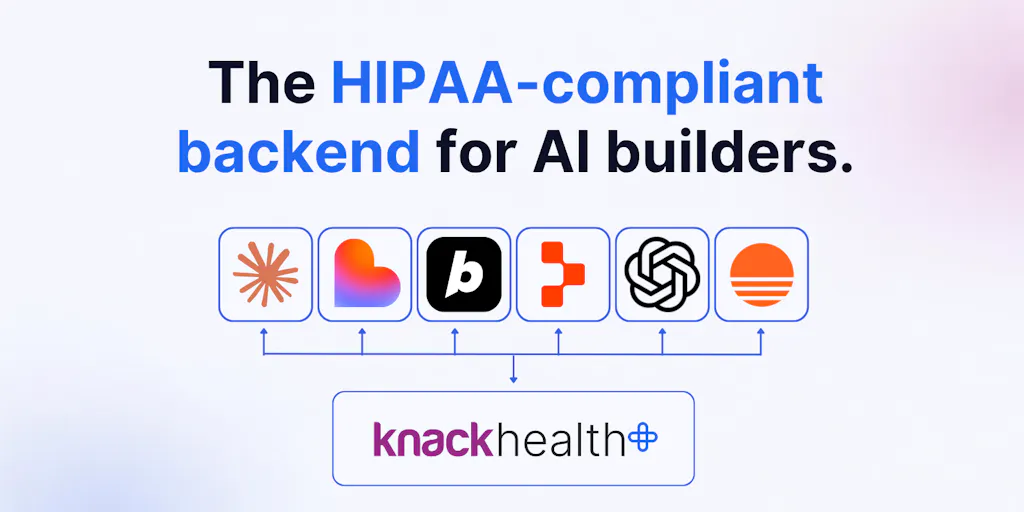
This is the gap that Knack is targeting. They’re not selling a database. They’re selling a trust layer. The MCP Server connects any MCP-compatible AI coding tool to Knack’s hosted relational database, role-based access controls, record change logs, and 700+ integrations. For healthcare specifically, they offer Knack Health with HIPAA-compliant infrastructure and a signed BAA.
Now, I’m not a healthcare startup. I’m a guy who writes essays about algorithm shifts. But I recognize the architecture of the problem. The tools we use to run our creator businesses—our CRMs, our asset libraries, our sponsor pipelines—are often just as flimsy as a vibecoded AI app. We’re building our businesses on the equivalent of a Google Sheet with a shared link. And as the money gets bigger, the scrutiny gets sharper.
My take: The creator economy is bifurcating. There are the creators who treat their operation like a media company, and there are the creators who treat it like a hobby that occasionally pays. The former are going to adopt tools that give them audit trails and access controls, not because they’re paranoid, but because the brands they want to work with demand it.
How This Differs from the Incumbent Stack
If you’re a social media manager, you’re probably thinking, “Okay, but I already have a stack. I have Airtable for my content calendar, Notion for my SOPs, and Asana for my tasks. Why do I need a relational database with a server?”
That’s a fair question. Let me explain the difference between a database and a content calendar.
Airtable and Notion are fantastic for organizing your output. They are terrible at being the system of record for your business logic. When I scheduled 30 posts across 5 platforms last month, I didn’t need Airtable to tell me that a post was published. I needed it to tell me who approved the final asset, when they approved it, and what the contractual obligation was for that specific piece of content.
Knack’s pitch is that it sits behind your AI tools. Instead of using Lovable to generate a frontend that talks to a flimsy backend, you use the MCP server to wire the AI directly to Knack’s relational database. The AI agent modifies the Knack backend directly via runtime API, bypassing the other backend entirely. This is a massive architectural difference.
In my experience, most creators and social teams use a patchwork of SaaS tools that don’t talk to each other. Your scheduling tool knows when a post goes live. Your CRM knows who the client is. Your finance tool knows how much they paid. But none of them share a single source of truth. Knack’s approach—and this is the part I find compelling—is to make the database the center of the universe, with everything else (frontends, AI agents, integrations) as a peripheral.
Compare this to the incumbents. Hootsuite and Buffer are great for distribution, but they’re not databases. Later is great for visual planning, but it’s not a system of record. Even Metricool—which I use daily for analytics—is focused on measurement, not on the relational logic of your business.
The difference is the schema. A content calendar has columns for “Date,” “Platform,” and “Copy.” A relational database has tables for “Clients,” “Campaigns,” “Assets,” “Approvals,” and “Deliverables,” all linked by keys. When a client asks, “Can you show me the final version of the asset we approved for the Q3 campaign?” a relational database gives you a clean, queryable answer. A folder structure gives you a panic attack.
Sidebar: Why TikTok Creators Should Care More Than LinkedIn Ones
You might think this is a B2B problem, relevant only to LinkedIn ghostwriters and agency owners. But I’d argue the opposite. TikTok creators are the ones who need this most, precisely because their businesses are the most chaotic.
The TikTok algorithm rewards volume and speed. You’re posting three times a day, testing hooks, and chasing trends. The faster you move, the more you rely on ad-hoc processes. You have a “vibe” folder for sounds, a “sponsor” folder for contracts, and a “raw footage” folder that is a digital landfill.
When a brand comes to you for a campaign, they don’t care about your vibe. They care about deliverables. They care about usage rights. They care about whether you can prove you posted the video on the agreed-upon date and time. If you’re a TikTok creator scaling to brand deals, you need a backend that can prove your work. Knack’s record change logs and role-based access controls are exactly the features that turn a chaotic creative into a reliable vendor.
LinkedIn creators, on the other hand, usually have a more structured operation because they’re already selling to businesses. They have a CRM. They have a proposal process. TikTok creators are still operating on vibes, and that’s where the risk—and the opportunity—lies.
What Creators and Social Teams Can Borrow from This
Even if you never open Knack, the launch is a blueprint for how to professionalize your operation. Here are three concrete lessons I’m taking from the MCP Server launch and applying to my own workflow.
1. Separate the frontend from the backend.
We all love shiny frontends. We love new scheduling UIs and analytics dashboards. But the tools you use to display your content are not the tools you use to manage your business. The moment you start treating your content calendar as your system of record, you’re in trouble.
Last year, I migrated my entire content operation to a new scheduling tool because it had a better drag-and-drop interface. It took me a month to realize I had lost the audit trail of which versions of a video were approved. The frontend was prettier, but the backend was weaker. I’ve since moved my approvals and asset tracking back to a simple relational database, and I keep the scheduling tool as a dumb pipe.
2. Use AI for the frontend, but keep the data authoritative.
The Knack team’s answer to a question about schema migrations is the key insight here. When a user asked how the AI handles new tables, Sprecher replied that once the AI tool’s backend is migrated to Knack, the AI agent wires all schema updates to the Knack backend, bypassing the original backend entirely.
This is a profound workflow shift. Instead of letting an AI tool generate a bespoke database that you can’t control, you force the AI to conform to your existing structure. For creators, this means you can use AI to draft your content, but the *metadata*—the client names, the campaign IDs, the approval statuses—should live in a system you control.
In my own tests of similar tools, I’ve found that the biggest time-sink is not creating content, it’s reconciling the content with the business context. If I can use an AI agent to draft a proposal and have it automatically populate my CRM with the right client ID and project code, I save hours. But that only works if the database is authoritative, not the AI’s hallucinated schema.
3. Compliance is a feature, not a constraint.
The word “HIPAA” makes most creators’ eyes glaze over. But the concept behind it—that you need to know who accessed what data and when—is critical.
Think about your client onboarding. When you sign a new sponsor, you’re handling their logos, their campaign messaging, sometimes their unreleased product details. Do you have a log of who on your team (or your freelance editors) accessed that asset? If not, you’re one leaked video away from a lawsuit.
Knack’s record change logs are the kind of feature that seems boring until you need it. I’d bet that within two years, major brands will start requiring creators to have some form of access auditing before they sign off on big campaigns. It’s the same way that brands started requiring creators to disclose sponsored content—it becomes table stakes.
Where the Math Breaks: Limitations and Open Questions
I’m enthusiastic about the category of tools, but I have to be honest about the specific execution. Knack is not a magic bullet, and the launch post leaves several critical questions unanswered.
First, the pricing model is not disclosed for the MCP server specifically. The source mentions that Knack’s pricing is “not user-based,” which is a point in their favor for agencies. But the cost of the HIPAA-compliant Knack Health tier is not disclosed. For a solo creator, this could be a non-starter. If you’re making $5k a month from your newsletter, paying enterprise rates for a database is a hard sell.
Second, the setup complexity. The launch is aimed at people using Lovable, Claude Code, and Base44. If you’re a creator who doesn’t code, the MCP server is irrelevant to you. You’re not going to be wiring up runtime APIs. The value proposition is for the builder who is creating tools for creators, not for the creators themselves.
My take: This is a tool for the “tool makers” in the creator economy—the agencies, the SaaS founders, the consultants who build systems for others. If you’re a solo creator, you should look at the principles of this launch, not the product itself. You don’t need an MCP server; you need a clean Airtable base with proper relationships.
Third, the “vibecoded” problem. The entire premise of the launch is that AI-generated apps are insecure. But adding a compliant backend doesn’t fix a bad AI prompt. If your AI agent generates a broken frontend, Knack won’t save you. The database is the foundation, but the house still needs to be built properly.
Sidebar: Where the Math Breaks
The “700+ integrations” claim is a classic enterprise software brag. In my experience, integration counts are a vanity metric. What matters is whether the integration is deep. A Zapier integration that just creates a record is useless. A native integration that syncs two-way with conflict resolution is gold.
I’ve seen too many tools tout their integration marketplace, only to find that the most important one—say, a two-way sync with Google Sheets—is broken. The Knack launch doesn’t specify the quality of these integrations, so I’m taking that number with a grain of salt. I’d rather have 20 rock-solid integrations than 700 shallow ones.
Who This Is NOT For
Let me be clear about the target audience, because I see too many creators buying tools they don’t need.
This is not for the solo creator who posts their own content and manages their own brand deals. You don’t need role-based access controls if you’re the only user. You don’t need a hosted relational database if you can manage your client list in a spreadsheet. You’re better off investing in a better camera or a course on storytelling.
This is not for the social media manager who just wants to schedule posts. You already have Buffer or Later for that. Don’t overcomplicate your life with a database that requires schema design.
This is for the agency owner who manages multiple clients and needs to prove compliance. This is for the SaaS founder building a tool for creators that needs a secure backend. This is for the content operation that has grown to the point where the “who approved what” question is keeping you up at night.
The launch review from John Karas mentions “pricing model that is not user-based. Great for portals!” That’s the key. If you’re building a portal—whether that’s a client portal, a member portal, or a content library—Knack’s model makes sense. If you’re just posting to Instagram, it’s overkill.
What I’d Watch / Test Next
Here’s my concrete advice for the next week, based on this launch.
1. Audit your own backend (this week). Take a hard look at where your client data lives. If it’s in a folder structure or a single spreadsheet, spend 30 minutes mapping out the relationships. What if you needed to prove who approved a specific asset? Could you? If not, you have a gap. You don’t need to buy Knack; you need to fix your process.
2. If you’re a builder, test the MCP server with a dummy project. If you’re already using Lovable or Claude Code, follow the setup guides mentioned in the launch. See how painful the migration actually is. The team claims it’s easy, but I’d bet there’s friction. Test it with a non-critical project first. See if the AI agent can actually modify the schema without breaking things.
3. Watch the healthcare angle. The creator economy is moving into health and wellness, and that brings a whole new level of compliance. If you’re a fitness creator or a mental health app founder, the Knack Health launch is more relevant than the MCP server. Watch how they handle the BAA and HIPAA compliance. That’s the future of high-ticket sponsorships in the wellness space.
4. Don’t buy the hype, buy the principle. The most valuable takeaway from this launch isn’t the product. It’s the reminder that the frontend is saturated. We have a million tools for making content. We have almost none for making the business of content trustworthy. Focus your energy on building a system of record, not a system of publication.
The platforms will keep changing their algorithms. The trends will keep shifting. But the demand for trust and accountability is only going one way: up. The creators who treat their backend like a brand asset will be the ones who survive the next platform war. The ones who rely on vibes and Google Drive will be left behind.
I’m not saying you need to buy Knack today. I’m saying you need to start thinking like an infrastructure company, even if you’re just a person with a phone and a tripod. Because the backend is the new brand, and the brands are watching.