The Analytics Bottleneck Has Moved — and Your Content Workflow Is Next
If you’ve managed social accounts for more than a quarter, you know the real pain isn’t creating content. It’s not even scheduling it, despite what the calendar apps want you to believe. The pain is the loop that happens after you publish: you check the dashboard, you squint at the bar charts, you try to remember what you changed three weeks ago that might have caused the dip, and then you make a decision based on a gut feeling that’s really just fatigue.
That loop is broken. And it’s breaking in a way that most social media tooling isn’t addressing.
I’ve run accounts where I scheduled 30 posts across 5 platforms in a single month, and the most time-consuming part was never the copywriting or the Canva resizing — it was the Monday morning ritual of exporting data, reconciling date ranges that never matched my actual shipping schedule, and trying to answer one question: did what I did last week actually work? The tools we have — Buffer, Hootsuite, Later, Metricool — are fantastic at pushing content out and mediocre at pulling insight back in. They give you dashboards. They give you charts. What they don’t give you is a direct line from “I shipped something” to “here’s what the data says about it, and here’s what you should do next.”
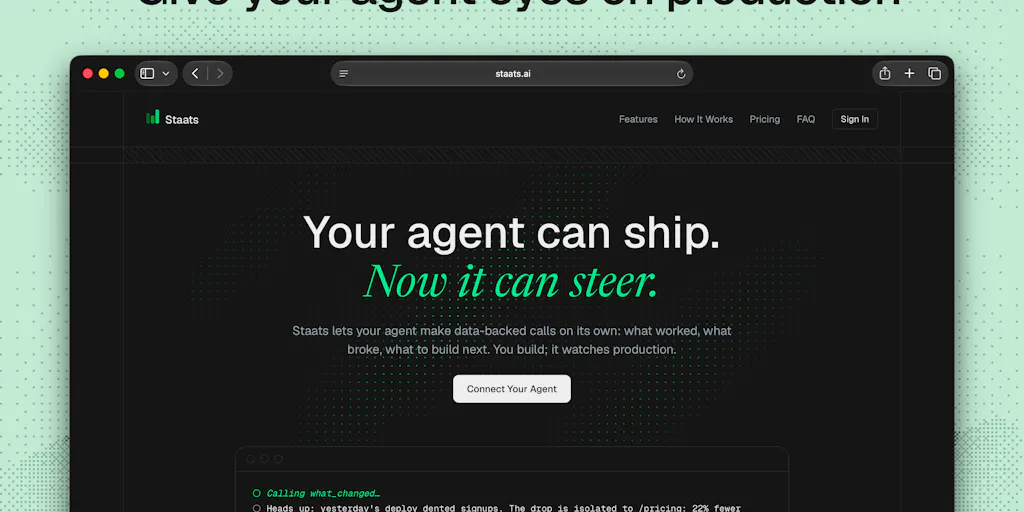
That’s the gap I’ve been watching, and it’s the gap that a new Product Hunt launch called Staats is trying to close — not with another dashboard, but by putting analytics directly inside the coding agent workflow. Which sounds like a developer tool, until you realize that every serious content operation is now a mini software team, and the people running it are increasingly comfortable asking an AI to do things they used to do by hand.
What Staats Actually Does — and Why It’s Not Just Another Analytics Widget
Here’s the product in plain terms: Staats is a cookieless web script plus an MCP server. The script tracks traffic and interaction events on your site, and the MCP server lets your coding agent — Claude Code, Cursor, Codex, and similar — read that data live inside your chat interface. The pitch from the maker, Myster Violets, is that the loop collapses from “ship → check data → make sense → decide → ship” down to “ship → agent checks data → ship.” The agent proactively warns you before you change something that was working and pushes you to take another pass at something that wasn’t.
Now, if you’re a social media manager, your first reaction might be: I don’t use coding agents. But stay with me, because the pattern here matters more than the specific tooling.
The core insight — and it’s a genuinely good one — is that date ranges are the enemy of learning. The maker makes this point explicitly in the comments when someone asks about Search Console data: the preset ranges never line up with when you actually shipped something. I’ve hit this exact wall more times than I can count. I’ll publish a YouTube video on a Tuesday, run a LinkedIn carousel on Thursday, and then try to evaluate both on a standard 7-day window that starts on Monday. The calendar doesn’t care about your shipping schedule. It never has.
Staats tries to solve this by letting agents mark when you ship, so comparisons are anchored to those marks instead of calendar dates. That’s not a feature — that’s a philosophy shift. It’s saying: the unit of analysis should be your action, not the arbitrary span of a week.
For content operators, this is the part worth stealing even if you never touch an MCP server. The question “did this change work?” only makes sense if you know precisely when the change happened and what the baseline was before it. Most analytics tools are built for the calendar. The best ones will be built for your shipping rhythm.
Why This Matters More for TikTok and YouTube Than LinkedIn
Here’s where I’d bet on a divide. If you’re running LinkedIn or X, your content has a longer half-life, and the correlation between a specific post and a specific outcome is looser. You’re playing a compounding game. But if you’re on TikTok or YouTube, the algorithm punishes and rewards based on velocity and early engagement signals within hours. The feedback loop is tight, and the cost of not checking data quickly is high.
In my experience running short-form channels, the difference between a video that gets 10,000 views and one that gets 100,000 is often decided in the first 60 minutes. If you’re waiting until Monday to review, you’ve already lost the window to double down or pivot. An agent that checks traffic and interaction events live and warns you before you change something that’s working — that’s not a nice-to-have for short-form creators. That’s the difference between riding a wave and getting crushed by it.
The LinkedIn crowd can afford to be more leisurely. The TikTok crowd cannot. And I’d bet the early adopters of something like Staats are going to be people who’ve felt that time pressure acutely.
How This Differs From the Incumbents — and What It Gets Right
Let’s be clear about what Staats is not. It’s not a replacement for Google Analytics, Plausible, or Fathom. Those tools are about human consumption — you log in, you look at charts, you export PDFs. Staats is agent-only, as the maker confirms in the comments: “There’s a web app but that’s just for the script tag, sites, teams. etc. I find that dashboards are built for everyone and fit no one.”
That line — dashboards are built for everyone and fit no one — is the sharpest thing in the entire launch. It’s true, and it’s been true for years. Every social media manager I know has a version of the same complaint: the default dashboard never shows the number I actually care about, so I export to a sheet every Monday and rebuild it by hand. One commenter on the launch, Lisa, says exactly this: “The number I want is never on the default dashboard, so I export to a sheet every Monday instead.”
That manual ritual — exporting, cleaning, reshaping, reconciling — is the hidden tax on every content operation. It’s unpaid, unglamorous, and it eats hours every week. Tools like Buffer and Hootsuite have tried to solve this with better reporting, but they’re still fundamentally building dashboards for a human to look at. The next evolution isn’t a better dashboard. It’s no dashboard at all — it’s asking the question directly and getting an answer.
That’s the shift Staats represents. And while the product is early — the maker admits “my heaviest user is me so far” — the direction is right.
Where the Math Breaks
Let me flag a few things that give me pause, because trust requires balance.
First, the free tier is 10,000 events per month. For a small site or a low-traffic blog, that’s fine. For anyone running serious campaigns or driving real traffic, that’s going to vanish in a day. The pricing beyond that is not disclosed, which is fine for a launch, but it means the long-term cost is unknown. If you’re building a workflow around this, you’re betting on pricing that hasn’t been announced yet.
Second, the cookieless tracking approach is smart from a privacy standpoint, but it also means you’re getting a different kind of data than what you’re used to. Cookieless tracking tends to undercount repeat visits and cross-device sessions. If you’re comparing Staats data to your Google Analytics numbers, they won’t match. That’s not a bug — it’s a different methodology — but it will confuse you if you’re not ready for it.
Third, and this is the big one for social media operators: Staats tracks your site, not your social platforms. It can’t tell you how your TikTok video performed or what your Instagram reach was. The maker is clear about this — when asked about Search Console data, the response is “Staats can’t pull that data but your agent can” via API. So this isn’t a replacement for your platform analytics. It’s a complement that lives on your owned properties.
That’s a real limitation, and it means the use case is narrower than the “AI answers all my questions” framing suggests. For a creator whose revenue depends on platform distribution, this tool doesn’t touch the most important numbers.
What Creators and Social Media Teams Can Borrow — Even Without the Tool
Here’s the part I actually want you to take away, regardless of whether you ever install Staats.
The operational insight buried in this launch is that your content workflow should be anchored to your shipping events, not to the calendar. When I started treating every piece of content as a discrete experiment with a known start time, my review process got dramatically better. I stopped asking “how did this week go?” and started asking “what happened in the 48 hours after I published X?” That single shift — from calendar thinking to event thinking — improved my decision-making more than any analytics tool ever did.
The second thing to borrow is the idea of letting the agent check the data before you change something. In my own workflow, I’ve started using a simple version of this: before I repurpose a piece of content or kill a series, I ask the system to pull the last 7 days of performance for that specific content type and compare it to the previous period. It’s not MCP-sophisticated, but it’s the same principle — don’t touch what’s working, and take another pass at what isn’t.
And the third thing is the comment thread itself. The exchange between the maker and Lisa about Search Console data — where she says “the preset ranges never line up with when I shipped” and the maker responds that Staats anchors comparisons to ship marks — is a masterclass in listening to user pain. That’s the kind of insight that should drive every content tool’s roadmap. The people who are actually running accounts know what they need. The tools that win will be the ones that let them ask for it directly.
Why This Is a Signal, Not Just a Product
Stepping back, I think Staats is worth watching less for what it is today and more for what it represents. We’re at the point where the creator economy and the software development workflow are converging. The people making content are increasingly using AI agents to help them produce, schedule, and now analyze. The tools that win the next phase of the creator economy won’t be prettier dashboards — they’ll be interfaces that let you ask a question in plain language and get an answer grounded in your actual data.
That’s a big deal. And it’s why I’m paying attention to a Product Hunt launch that, on its face, looks like a developer tool.
Where My Judgment Says It Falls Short
I want to be honest about the gaps, because hype is the enemy of trust.
Staats is agent-only by design. The maker says dashboards are built for everyone and fit no one, and I get that. But the reality is that most social media teams are not ready to live entirely inside a chat interface. The person who needs to see the numbers is often not the person who’s comfortable asking an agent for them. There’s a collaboration problem here that the product doesn’t address. If you’re a solo founder who’s technical, this is great. If you’re managing a team of five, this creates a new bottleneck: everyone has to learn to talk to the agent.
The event-based anchoring is smart, but it only works if you’re disciplined about marking events. If you ship content sporadically — which is most creators, let’s be real — the “ship marks” become sparse and the comparisons get noisy. The product assumes a cadence that many content operations don’t have.
And the platform gap is real. For social media managers, the numbers that matter live inside TikTok, Instagram, YouTube, and LinkedIn. Staats doesn’t touch those. The maker’s suggestion is to use APIs to pull that data — and that’s technically possible, but it’s a significant setup lift, and it’s not what the product is built to do. If you’re looking for a tool that answers “how did my Instagram reel perform relative to my last one?” — this is not it.
The pricing is also an open question. Free for 10,000 events per month is generous for a test, but the paid tiers aren’t disclosed. I’ve seen too many tools launch with a generous free tier and then price themselves out of the creator market once they hit scale. I’d want to see the roadmap before building a long-term workflow around this.
What I’d Watch and Test Next
If you’re intrigued by the pattern, here’s what I’d actually do this week — no coding required.
First, audit your own review process. When you check your analytics, are you anchored to calendar dates or to your actual shipping events? If it’s the former, start keeping a simple log: every time you publish, note the date and time. Then, when you review, compare the 48 hours after each publish against your baseline. You’ll learn more from two weeks of this than from a year of weekly dashboard checks.
Second, try asking an AI agent a question about your data before you make your next content decision. Even if it’s as simple as asking Claude or ChatGPT to look at a CSV export and identify which of your last 10 posts overperformed relative to your average, the exercise will show you the difference between “looking at a dashboard” and “asking a question.” That’s the shift Staats is betting on.
Third, watch the MCP ecosystem. If you’re not familiar, MCP (Model Context Protocol) is how agents get access to external data. It’s early, but it’s moving fast. The tools that make it easy for non-technical operators to connect their data sources to their agents are going to be the ones that win the creator economy’s next wave. Staats is one of the first to try this for web analytics, and it won’t be the last.
And fourth, if you run a website — even a simple landing page for your content business — consider dropping the Staats script on it and asking the agent one question: “What should I improve on my site?” The free tier covers 10,000 events per month, which is enough for a real test. The worst case is you learn something about your traffic. The best case is you get a glimpse of what the next generation of analytics looks like.
The bottleneck has moved. It’s not building anymore — it’s knowing what to build next. And for anyone who creates content for a living, that means the tools that help you decide are about to matter more than the tools that help you publish.