The Creator Economy’s Real Shortage Isn’t Content — It’s Play
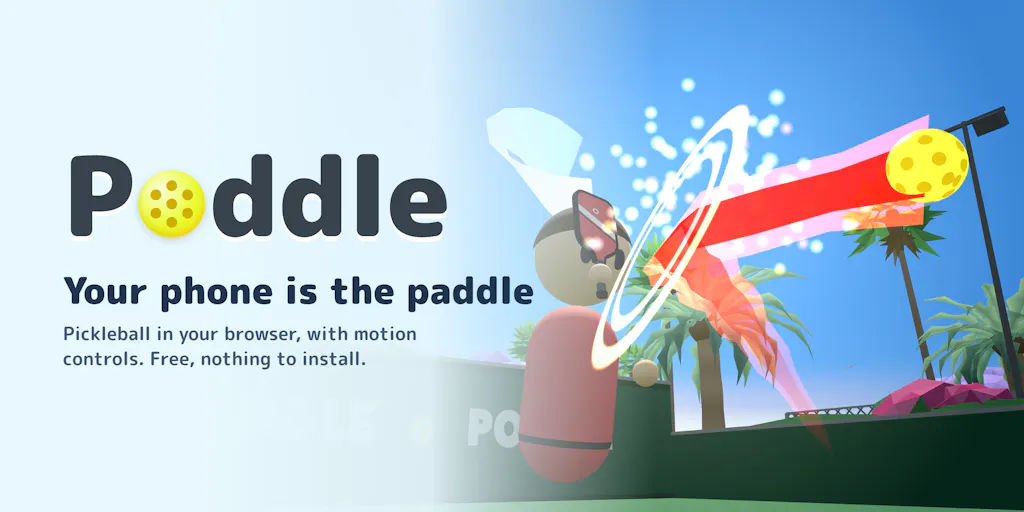
Every social media operator I know is quietly fighting the same battle: the feed has become a treadmill, and the only content that still travels is the content that feels like it wasn’t made for the feed at all. That’s why I pay attention when a solo maker ships something small, weird, and genuinely fun — because the mechanics behind it are the same mechanics we’re all trying to reverse-engineer for engagement. Poddle, a free browser-based pickleball game built by Daniel that turns AirPods and a webcam into a motion controller, is exactly that kind of artifact. It’s not a social tool. It has no scheduler, no analytics dashboard, no API. And yet it’s one of the more instructive product launches I’ve read this month, because it demonstrates — in miniature — how constraint, physicality, and low-friction onboarding drive the behaviors that platforms reward. If you run accounts across Instagram, TikTok, YouTube, X, LinkedIn, Facebook, Threads, or Pinterest, there’s a lesson here about why your best-performing posts often feel like games rather than broadcasts.
What Poddle Actually Is, and the Problem It Quietly Solves
Let me get the facts straight first, because the launch page is refreshingly honest about them. Poddle started as a last-minute hackathon idea: AirPods contain motion sensors, so the maker wondered whether one could function as a pickleball paddle in a Wii Sports-style game. According to his own Product Hunt launch post, it “worked better than we expected,” didn’t win anything, and he kept building it anyway out of affection for the idea. That origin story matters more than it sounds — it’s the same trajectory as a lot of the tools creators actually adopt: built for personal use, refined in real social settings (university clubs, in his case), then shipped.
The core mechanic is genuinely clever and worth understanding because it’s a masterclass in working with a sensor’s limitations rather than pretending they don’t exist. A motion sensor knows how your hand turns, not where it is. So instead of trying to fake positional tracking, the game reads the swing itself: speed and reach set the power, direction aims the shot, a scoop produces a lob, and a wrist cut adds spin. Court movement is handled separately by your webcam, which tracks where you stand — and the maker is explicit that the video never leaves your computer. If you don’t have a camera, the game runs you to the ball automatically, like Wii Sports tennis, so you just swing. Phone support was added early for testing convenience and stuck around because everyone already has one and it’s faster to start than AirPods.
Beyond the core loop, there’s a bot named Matt at various difficulties, online play with friends, trophies, knockout tournaments, and live match spectating. Poddle is free, and you don’t need an account unless you want progression and stat tracking. You can play it in the browser or read the how-to-play guide first.
Why this belongs in a social media newsletter
Here’s my take, and I’ll flag it as opinion: the most durable content formats of the last three years — Duolingo’s unhinged TikTok voice, Wordle share grids, Strava segment screenshots, BeReal’s daily prompt — all share one trait. They generate behavior first and content second. Poddle does the same thing. A game where your body is the controller produces reactions, fails, near-misses, and trash talk. Those are the raw materials of short-form video. Nobody has to be told to film a swing that sends the ball into the net; the impulse is automatic. That’s the difference between a tool that asks creators to generate content and a product that generates content as a byproduct of use.
How It Differs From the Tools You’re Actually Comparing It To
Poddle isn’t competing with Buffer, Hootsuite, Later, or Metricool — those are workflow and analytics layers, and Poddle has no publishing, scheduling, or reporting surface at all. The honest comparison set is consumer motion gaming and the broader “physical input” wave: Nintendo’s Wii Sports lineage, which the maker cites repeatedly, and modern browser-based experiences that skip the console entirely.
What makes Poddle structurally different from most of what lands on Product Hunt is that it doesn’t require hardware you don’t own. That’s a bigger deal than it sounds. The last decade of motion gaming kept asking people to buy things — consoles, cameras, dedicated controllers, VR headsets. Poddle’s bet is that the sensors and cameras are already in your pocket and on your desk, and the only missing piece was software willing to work around their limitations. The wrist-cut-for-spin design is the tell: rather than adding hardware to capture rotation, the game leans into the one thing a motion sensor is genuinely good at.
Why TikTok creators should care more than LinkedIn ones
I’d bet the platform fit here is lopsided, and it’s worth being explicit about why. TikTok and Instagram Reels reward the first 1–2 seconds of visual novelty and the completion of a physical action — a swing, a miss, a reaction. A game whose entire input is a hand gesture is native to that format. YouTube is a natural home for longer “can I beat Matt on Pro difficulty” challenge content, which the maker himself teases in the launch post. LinkedIn, by contrast, is a text-and-authority platform where the winning content is usually a lesson or a framework; a pickleball game with AirPods is a harder sell there, though I’ve seen stranger things work when framed as a founder story about shipping a hackathon idea out of pure love. Threads sits somewhere in between — conversational, low-production, good for a quick “this is absurd, try it” post.
The onboarding math is the real product decision
The detail I keep coming back to is the phone support decision. The maker added it for testing ease, then kept it because “everyone already has one, and the time to play was so much faster than AirPods.” That’s a conversion-rate insight disguised as a throwaway line. Every creator tool I’ve evaluated lives or dies on time-to-first-value. If your scheduling tool takes 20 minutes to connect five accounts before you can queue a single post, you’ve already lost the casual user. If your link-in-bio builder requires a signup before preview, you’ve lost them too. Poddle’s account is optional unless you want progression — which means the funnel is: land, play, enjoy, then consider registering. That’s the inverse of how most SaaS onboarding works, and it’s worth stealing.
What Creators and Social Teams Can Borrow From This
I’ve spent enough time inside content calendars to know that most repurposing advice is recycled from the same three blog posts. What Poddle demonstrates is more specific and more useful.
Constraint is a content strategy, not a limitation
The single-sensor design forced the maker to invent a control scheme around speed, direction, scoop, and wrist cut. That’s the same discipline that separates good short-form from bad: you don’t have 30 minutes, you have 15 seconds, so what’s the one physical or emotional beat you’re delivering? When I’ve audited accounts that plateaued, the problem is almost never production quality — it’s that the creator refused to accept the format’s constraints and tried to cram a YouTube essay into a Reel. Pick your constraint. Design around it. The audience feels the difference even if they can’t articulate it.
Build for the byproduct, not the broadcast
If you’re a brand or solo creator, ask yourself what your product makes people do — not what it makes them watch. A challenge, a score, a shareable result, a screenshot-worthy moment. Poddle’s trophies, tournaments, and live matches exist partly as progression systems, but they’re also content generators. Every tournament is a bracket graphic. Every trophy is a milestone post. Every live match is a watchable stream. If your current content operation has no such byproduct engine, you’re doing manual labor that a mechanic could be doing for you.
Privacy as a positioning asset
The line that the webcam video “never leaves your computer” is doing quiet marketing work, and it’s the right call. In a year where AI content tooling is under real scrutiny and platform trust is at a low ebb, on-device processing is a genuine differentiator. I’d argue creators should be applying the same principle to their own stacks: if you’re piping raw customer footage, DMs, or audience data into third-party AI tools without knowing where it goes, you’re accumulating risk you can’t see. Local-first isn’t just a dev philosophy — it’s a brand value you can actually communicate.
The hackathon-to-product pipeline is still alive
This is a first launch for the maker, and it came out of a weekend idea that didn’t win anything. I mention this because the creator economy has quietly convinced a lot of people that you need a content team, a growth budget, and a six-month roadmap before you ship. You don’t. You need one idea that’s slightly absurd and a willingness to keep building after the applause stops. The maker’s replies in the comments about wanting to extend the concept to boxing, beat-saber-style rhythm games, and Wii Sports-style swordplay suggest he’s already thinking in that direction — two hands, two AirPods, one new game.
Where My Judgment Says It Falls Short
I want to be balanced here, because the launch page is charming and it’s easy to let charm substitute for scrutiny.
The competitive moat is thin. Motion-controlled browser games are not defensible on technology alone. If Poddle finds an audience, expect fast-followers. The maker’s advantage is taste and iteration speed, not IP — and that’s a fragile position unless the community compounds.
Cross-platform play and matchmaking are unproven at scale. The launch post mentions playing friends online, but not how matchmaking works, what the latency story is, or whether there’s any anti-cheat. For a game where the input is a hand gesture, cheating and false positives are real problems. Not disclosed in the source.
The AirPods dependency is a double-edged sword. Apple’s motion sensors are excellent, but the experience is tied to one vendor’s hardware and one ecosystem’s quirks. Phone support mitigates this, but I’d want to know how consistent the swing feel is across devices — the maker himself asks for feedback specifically on how the swing feels, which suggests it’s still being tuned.
No monetization is visible. Poddle is free, and there’s no stated plan for revenue, subscriptions, or cosmetics. That’s fine for a passion project, but it means there’s no obvious incentive to invest in the infrastructure that competitive online play requires. If you’re a creator thinking about building on top of it — streaming tournaments, running leagues — you’re building on a foundation whose long-term funding is not disclosed.
Who this is not for
If you’re looking for a scheduling tool, an analytics platform, or an AI repurposing engine, Poddle is irrelevant to your stack and you should close this tab. If you’re a social media manager trying to justify time spent on it to a client, the honest pitch is culture research, not productivity. And if you’re a creator who needs reliable, repeatable content formats with predictable performance, a game whose core input depends on hardware you may not own is a risky bet for a content pillar. Play it for fun, study it for mechanics, but don’t build your Q3 calendar around it.
What I’d Watch / Test Next
Here’s what I’d actually do this week if I were running accounts and paying attention to this launch. First, play a few rounds yourself — Poddle is free and runs in the browser, and the fastest way to understand a mechanic is to feel it. Second, record one session, even a bad one, and watch it back with a creator’s eye: where did you react, where did you laugh, where did you want to share the clip? Those timestamps are your content template. Third, if you run a brand account, ask whether your product has an equivalent “byproduct engine” — a score, a result, a moment people naturally want to post. If it doesn’t, that’s a strategy gap, not a content gap. Fourth, test the constraint principle on your next repurposing batch: take one long asset and force it into a single 15-second physical or emotional beat, no explanation, no context. Fifth, follow the maker’s Product Hunt thread to see how the boxing and rhythm-game experiments develop — if two-AirPod input works, it opens a whole category of motion content that creators could ride early. And sixth, treat this as a reminder that the most shareable thing you can build isn’t a post. It’s a reason for people to move.