The real product on Product Hunt this week isn’t a tool — it’s a distribution channel
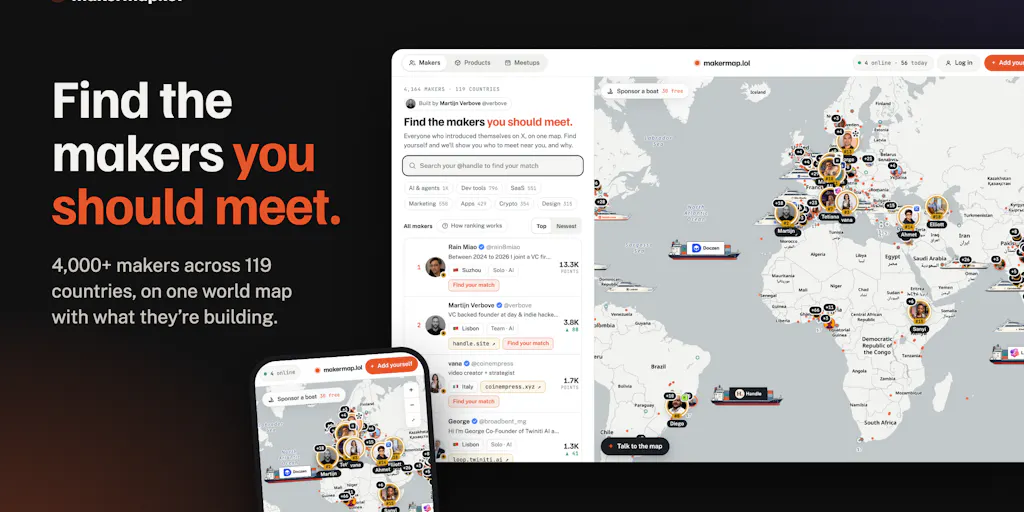
If you run social for a living, you already know the dirty secret of the creator economy: discovery is broken. The algorithm rewards the loudest, the most consistent, and the most shamelessly self-promotional — which is fine if you’re a media company with a team, and brutal if you’re a solo founder, an indie maker, or a social manager trying to get a client’s product in front of actual humans. So when a launch crosses my radar that isn’t another AI caption generator or a scheduling dashboard with a fresh coat of paint, I pay attention. MakerMap — built by Martijn Verbove — is a directory of 4,000+ makers and products you can search geographically, and it’s the most interesting thing I’ve seen on Product Hunt in weeks. Not because the tech is novel, but because it accidentally solves a problem every social operator has: how to find the people worth collaborating with before the algorithm does.
Let me be clear about what this is and isn’t. MakerMap is not a scheduling tool. It is not an analytics platform. It is not going to replace your Buffer queue or your Metricool dashboard. What it is, based on the launch page and the maker’s own comments, is a living map of the builder economy — searchable by things like “AI founders in Lisbon,” “Twitter tools,” or “designers building iOS apps.” Every maker gets a profile showing what they’re building, where they are, their posts, activity, and growth. And the part that actually matters for social operators: the maker says people are already using it to arrange IRL meetups. That’s not a feature. That’s a distribution channel forming in real time.
Why this matters more to a TikTok creator than a LinkedIn ghostwriter
Here’s my take, and I’ll flag it as opinion because the source doesn’t say this: the value of a geographic maker directory is wildly uneven across platforms. If you’re a TikTok creator, your entire growth model depends on riding sounds, trends, and formats that have a half-life measured in days. Finding a collaborator in your city who can shoot a duet with you this weekend is worth more than a thousand LinkedIn connection requests. If you’re a LinkedIn ghostwriter, your distribution is already solved by the feed’s obsession with text posts and the platform’s willingness to show your content to strangers. You don’t need a map. You need a better hook.
But if you’re an indie founder building in public on X — which is clearly MakerMap’s native habitat — the map is a cheat code. The maker confirmed in the comments that you need an X account to log in, though you don’t need to be active there. That’s a deliberate constraint. It means the directory is seeded with people who already understand the rhythm of build-in-public culture: ship, post, engage, repeat. For a social media manager trying to place a client’s product in front of early adopters, that’s a pre-qualified audience. You’re not cold-emailing strangers. You’re browsing a map of people who have already opted into being found.
What problem does this actually solve — and how is it different from the incumbents?
The obvious comparison is to the graveyard of maker directories that have come and gone: Product Hunt itself, BetaList, Indie Hackers, and the various “startup maps” that pop up every few years. Each of those solves a different slice of the problem. Product Hunt is a launch-day popularity contest — great for a spike, terrible for sustained discovery. Indie Hackers is a forum, which means discovery is driven by who posts the most, not who’s building the most interesting thing. BetaList is a static directory that, as one commenter on the MakerMap launch page pointed out, tends to go stale because people fill out a profile once and never touch it again.
That staleness critique is the sharpest question in the entire comment thread, and the maker’s answer — or lack of a detailed answer — is worth noting. The launch page doesn’t disclose a specific mechanism for keeping profiles current. The maker says every profile shows “posts, activity, growth and more,” which implies some kind of automated pull from X, but the source doesn’t specify how that works, how often it refreshes, or what happens when someone stops posting. In my experience testing similar directory products, this is where most of them die. A directory is only as valuable as its least stale profile. If I search “AI founders in Lisbon” and half the results haven’t posted in six months, I’m not coming back. The maker’s responsiveness in the comments — one user praised his “near real time” implementation of feedback — suggests he’s aware of the problem. But awareness isn’t a retention strategy.
Where the math breaks
Let’s do the operator’s math. MakerMap claims 4,000+ makers and products. That sounds impressive until you filter by geography and niche. If you’re in Lisbon and you search for “AI founders,” you’re probably looking at a few dozen profiles at best. That’s not a network. That’s a dinner party. The value of a directory scales with density, and density is a function of two things: total users and geographic concentration. The maker’s own examples — “gym bros in Lisbon,” “designers building iOS apps” — suggest he understands that the search needs to be granular to be useful. But granular search on a 4,000-person dataset is going to return a lot of empty rooms.
This is the classic cold-start problem, and it’s why most directories pivot to becoming newsletters, job boards, or communities. The maker says the platform is free, with optional paid support and “Ships/Yachts” for more exposure — which sounds like a classic freemium visibility play. That’s not disclosed pricing, by the way; the maker just says you can “optionally choose to pay and support the platform or buy one of the Ships/Yachts to get more exposure for your company.” No numbers. No tiers. That’s fine for a launch, but it tells me monetization is still a hypothesis, not a business.
What creators and social teams can actually borrow from this
Here’s where I stop reviewing the product and start stealing from it. Because the real lesson of MakerMap isn’t “go sign up.” It’s that geographic + interest-based discovery is an underrated content strategy, and you can replicate the mechanic without waiting for a directory to reach critical mass.
Build your own map, even if it’s a spreadsheet
When I scheduled 30 posts across 5 platforms last month for a client launch, the hardest part wasn’t the scheduling. It was finding the right people to tag, mention, and collaborate with. The algorithm doesn’t reward you for tagging strangers. It rewards you for tagging people who actually engage back. So I built a spreadsheet: name, platform, city, niche, last post date, engagement rate, whether they’d responded to a previous mention. It took four hours. It was worth more than any AI caption tool I tested that month.
MakerMap is essentially a public version of that spreadsheet, with a UI that makes it browsable. If you’re a social operator, you should be building a private version of this for every client. Not because the platform will reward you, but because collaboration is the last organic reach hack that still works. A duet, a stitch, a quote-tweet, a joint live — these are the formats that break through because they borrow someone else’s audience. And you can’t borrow an audience you can’t find.
The X login is a feature, not a bug
One commenter asked if MakerMap would open up to makers not on X. The maker’s answer was polite but firm: you’ll need X to login, but you don’t need to be active there. My take: that’s the right call, and it’s also a warning. X is where the build-in-public crowd lives. It’s where the “shipping in public” ethos was codified. If you’re a creator on TikTok or Instagram, you might look at that and think it’s exclusionary. I’d argue it’s curation. The directory is only useful if the people in it share a common language of shipping, posting, and engaging. X provides that lingua franca. If MakerMap opened up to every platform, it would become a generic LinkedIn clone within a month.
But here’s the tension: the maker also said people are using the map to arrange IRL meetups. That’s a behavior that doesn’t need X at all. It needs trust, proximity, and a shared interest. If the IRL component becomes the primary value — if people start using MakerMap to find co-founders, collaborators, and friends — then the X login becomes a bottleneck, not a filter. I’d bet the maker eventually adds other login options, or at least a way to claim a profile without an X account. But I’d also bet he’s smart to wait until the X-native community reaches critical mass first.
Why TikTok creators should care more than LinkedIn ones
I said this earlier, but it deserves its own sidebar. TikTok’s algorithm is the most efficient discovery engine ever built for short-form video. You don’t need a directory to find an audience on TikTok. The For You Page does that for you. What TikTok doesn’t do is help you find collaborators. There’s no “find a creator in your city who makes similar content” button. There’s no way to search for “designers building iOS apps” and see who’s active. That’s the gap MakerMap fills, even if it wasn’t designed for TikTok creators.
LinkedIn, by contrast, is already a directory. It’s a searchable database of professionals with filters for location, industry, and title. If you’re a LinkedIn creator, you don’t need MakerMap. You need to stop writing posts that sound like press releases. The platform’s algorithm rewards dwell time and comments, not external links. A directory isn’t going to fix your hook.
Where my judgment says it falls short
I want to be balanced here, because the launch page is genuinely charming and the maker’s engagement in the comments is impressive. But charm isn’t a moat. Here’s what I’d want to see before I’d recommend MakerMap to a client.
Retention mechanics are unclear. The sharpest comment in the thread — from Justin Rockmore — was about staleness. The maker didn’t give a detailed answer. If profiles don’t stay current, the directory becomes a museum. I’d want to know: does the profile auto-update from X? Does it prompt users to refresh? Is there a “last active” indicator? The source doesn’t say.
Density is a chicken-and-egg problem. 4,000 makers sounds like a lot until you filter by city and niche. The maker’s own search examples — “AI founders in Lisbon,” “gym bros in Lisbon” — suggest he knows the value is in the long tail. But the long tail is exactly where a 4,000-person dataset is thinnest. I’d want to see a heat map of where the makers actually are before I’d trust a search result.
Monetization is a black box. The maker says it’s free, with optional paid support and “Ships/Yachts” for exposure. No pricing. No tiers. No indication of what “more exposure” actually means. That’s fine for a launch, but it’s not a business model yet. If the paid tiers end up gating the most useful features — search filters, contact info, analytics — then the free version becomes a lead magnet, not a tool.
The IRL meetup thing is the most interesting part, and it’s the least developed. The maker says people are already arranging meetups. That’s the kind of behavior that turns a directory into a community. But the source doesn’t describe any features that support it — no event listings, no RSVP tools, no group chat. If the IRL component is happening organically, that’s great. But organic behavior is fragile. It needs scaffolding to scale.
Who this is NOT for
If you’re a social media manager running accounts for enterprise clients, MakerMap is probably not worth your time. The audience is too small, too early-stage, and too X-centric. If you’re a creator with a million followers, you don’t need a directory to find collaborators — you have an inbox full of them. If you’re a growth marketer looking for a scalable acquisition channel, this isn’t it. Not yet.
MakerMap is for the indie founder who’s tired of shouting into the void. It’s for the social operator who wants to find the 20 people in their city who actually care about the thing their client is building. It’s for the creator who understands that the algorithm is a lottery, and the only way to hedge is to build real relationships with real people in real places.
What I’d watch / test next
If you’re an operator, here’s what I’d do this week. First, go to makermap.lol/introduce and add yourself or your client. Not because it’ll drive a spike in traffic, but because it’ll force you to write a clear, concise description of what you’re building and where you are. That’s a useful exercise regardless of whether the directory takes off. Second, search for your city and your niche. See who’s already there. If the results are thin, that’s your answer about the current value. If the results are surprisingly dense, send three messages. Not pitches. Just “hey, I’m building something similar, want to compare notes?” Third, watch the maker’s X account and the Product Hunt page for the next two weeks. If he ships the retention mechanics, the density tools, and the IRL scaffolding, this becomes a real platform. If he doesn’t, it becomes a case study in launch-day enthusiasm versus long-term utility.
My bet: the IRL meetup behavior is the signal. Everything else is noise. If makers are already using this to find each other in person, the directory has product-market fit for a niche that every social platform has ignored. The question is whether the maker can build the scaffolding before the novelty wears off. I’d watch that. I’d test that. And I’d steal the spreadsheet idea either way.