Every few weeks I open Product Hunt and scroll past the polished AI landing pages, only to get stuck on something small and strange. This week it’s Ododok, an app that uses the motion sensors in AirPods to estimate how many times you chew during a meal. On the surface it has nothing to do with social media management. It has no content calendar, no UTM builder, no AI caption generator, no scheduled posting queue. But if you run accounts for a living, you should read the launch thread and steal three things from it: a method for finding invisible behaviors, a feedback loop that turns users into research collaborators, and a positioning trick that makes a gimmick feel like a product. This essay is about why a chew counter matters to people who post for a living.
The Problem Ododok Actually Solves
Let’s start with the product, because it’s weirder than it sounds.
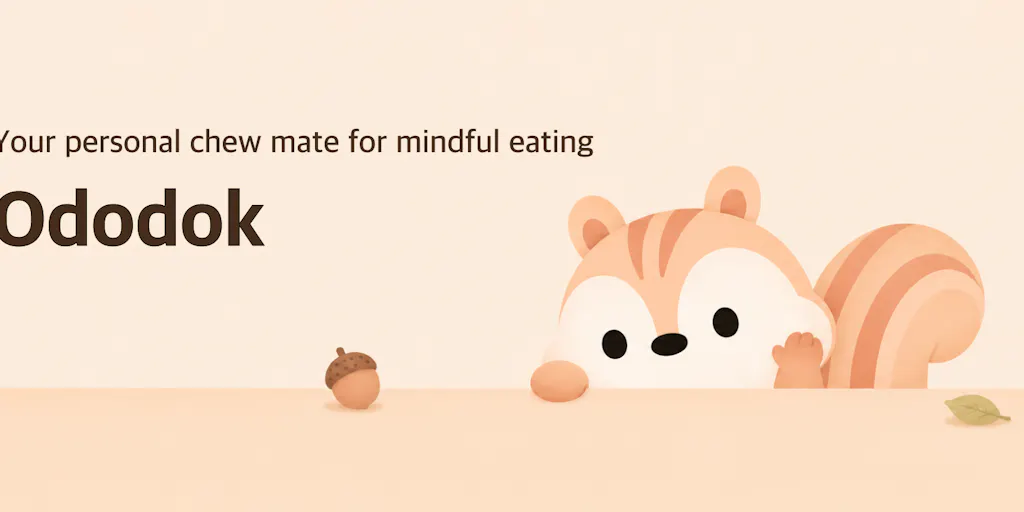
Ododok is made by a team that posts under the @ododok account on Product Hunt. In the launch note, the maker Hyun describes the observation that started it: chewing isn’t just a jaw movement — it creates a subtle, repetitive motion around your ear, and since AirPods sit right there, their built-in motion sensors can detect it. That’s the entire thesis. The app uses motion data from supported AirPods to estimate your chews in real time. During a meal, it shows your current chew count, chewing pace, time spent chewing, and meal duration. Afterward, it creates a meal summary so you can look back at your eating rhythm and habits. There’s also a short personal calibration before tracking, because everyone chews differently.
The stated goal is not to turn you into a biohacker. It’s to “make those habits visible without asking people to buy or wear another dedicated device.” In other words, the team isn’t selling a new sensor. They’re repurposing a sensor you already own.
That sentence is the whole reason this launch matters to creators and social media operators. “Make those habits visible” is the job description. It’s what we do when we turn a raw idea into a content calendar, or when we take a scattered customer conversation and turn it into a thread that gets engagement. The problem is that most of us stop at the content layer. We publish, we measure likes and comments, and we call that visibility. Ododok goes one level deeper: it makes a normally invisible behavior visible in the moment, while you’re still performing it.
My take: that is the difference between a metric and a feedback loop. A metric tells you what happened. A feedback loop changes what you do next. Ododok is aiming for the second, and that’s exactly the gap where most creator strategies underperform.
The invisible-behavior audit
Every account I’ve ever audited has a version of this problem. Brand managers say they want more engagement, but they can’t see what causes engagement until after the post flops. Creators say they want more watch time, but they only see the average retention graph, not the moment where viewers left. We’re all acting on advice like “post more consistently” or “make better content,” without a real-time signal to tell us whether we’re chewing too fast, so to speak.
Ododok’s structure is a useful template. Pick a behavior that people get advice about but can’t measure. Find a sensor in a device they already own. Build a small calibration step. Then show the number while they’re doing the thing. That’s not just a health app — that’s a content system. The moment someone sees their own chew count, they have a story to tell. That story is the content.
Ododok Is Not a Social Media Tool — That’s the Point
If you’re a social media manager, your first reaction is probably: “Cool, but I can’t schedule posts with it.” Correct. Ododok won’t help you with a multi-platform content calendar, and it won’t replace Buffer or Metricool for the operational part of your job. Last month, when I scheduled thirty posts across five platforms, I spent more time resizing media and checking API rate limits than I spent thinking about what the posts actually meant. That is the grind of social media operations. Ododok does not solve that grind, and honestly, it shouldn’t try.
What Ododok does is ask a different question: what measurable signal is hiding in a routine action you’ve already automated or ignored? The tools we use in social media are obsessed with distribution. Ododok is obsessed with sensing. It turns a mundane act — eating — into a live data stream. And that shift from distribution to sensing is exactly what makes products feel magical.
For creators, the transferable lesson is about repurposing. We already know that Canva and CapCut became essential because they let creators turn one raw asset into many formats. Ododok applies the same logic to hardware: instead of asking users to buy a new device or change their behavior, it finds a signal in something they already do and already wear. That’s a smart constraint. New behavior is friction. New hardware is more friction. Existing hardware plus a clever algorithm is a much easier sell.
Why TikTok creators should care more than LinkedIn ones
If you’re deciding who should actually pay attention to this launch, I’d put TikTok and Instagram Reels creators at the top of the list, and LinkedIn thought-leaders somewhere near the bottom.
On TikTok, the algorithm rewards content that keeps people watching and brings them back for a repeated pattern. A personal, measurable behavior is an endless series format. “I let AirPods judge my chewing” has a built-in reveal: did my count match what I expected? And because the count changes every meal, viewers have a reason to come back. It’s the same reason “what I eat in a day” videos work — but it’s sharper, because Ododok gives you a number to react to in real time. The algorithm doesn’t know or care that the product is niche. It cares about whether people watch to the end and comment on the result.
On LinkedIn, the same concept is harder to position. The professional audience will ask, “What do I do with this?” A chew-counting demo could work as a case study in product design or wearable sensing, but it won’t sustain a personal brand the way it can on a short-form video feed. TikTok rewards the weird, specific, repeatable thing. LinkedIn rewards frameworks and career lessons. Ododok as a product is a TikTok story. As a LinkedIn post, it’s a one-off.
How Ododok Differs From Every Health Tracker I’ve Tested
I say this as someone who has worn an Apple Watch, tried a Whoop, and seriously considered Oura: none of them made chewing feel like a metric I should care about. Wrist-based and finger-based trackers are good at detecting broad physical signals — steps, heart rate, sleep stages, stress recovery. They are not good at detecting something specific like jaw motion. Your ear, on the other hand, is arguably the best cheap vantage point for eating behavior. The AirPods are already there, they already have motion sensors, and they’re already paired to a phone. Ododok is the first launch I’ve seen that treats that placement as a feature, not an accident.
The existing alternative for people who want to eat more slowly is usually a manual food journal or a timers app. Apps like MyFitnessPal require me to log calories and meals, and in my experience, that habit dies by the third day. Ododok’s pitch is that you don’t have to log anything — just eat normally while wearing AirPods. The data appears. That’s a fundamentally better onboarding loop. Whether it’s accurate enough is another question, but from a product design perspective, the friction reduction is real.
This is also where I’d compare Ododok to the current wave of AI content tooling. Most AI tools for creators are focused on generation: write a caption, make an image, summarize a video. Ododok has nothing to do with generation. It’s about perception — making a hidden input visible. In my opinion, that’s the next gap in creator software. We have enough tools that help us produce more. We don’t have enough tools that help us observe better.
Where the math breaks
I want to be clear that I am not crowning Ododok as the future of health tracking. The launch post itself is honest about its limits. The maker says the app “estimates” your chews in real time, and that wording matters. This is not a clinical measurement; it’s an inference from accelerometer data. There are a million variables: head shape, ear canal size, jaw structure, how much you talk while eating, whether you’re eating soup versus a steak, whether you’re chewing with your mouth open or closed. The team says they’ve tested it themselves, but self-testing is not peer-reviewed validation. In my view, the first version will be rough around the edges, and the calibration step is doing a lot of heavy lifting.
Also, the launch post doesn’t disclose which AirPods models are supported. It just says “supported AirPods.” It doesn’t disclose pricing, subscription plans, or whether the data stays on-device. It doesn’t say whether the app is available outside certain regions. A French user named Bathilde R commented that they wanted to download it from France and asked if it could be made available. As of the thread I read, there’s no public answer. Another commenter, Maksym Kuzmovych, asked whether Ododok educates users as they go — whether it actually explains what each chew count means. Also no public answer yet.
Those open questions don’t make the product a failure. They make it a beta. But if you’re thinking about building your personal brand around this tool, you should treat it as an early experiment, not a stable platform.
The Launch Thread Is the Real Product
Here’s where the social media operator in me starts taking notes. Hyun’s launch note isn’t a feature list. It’s a four-question feedback survey disguised as a comment:
- How closely did the count match your chewing?
- Did seeing the count or pace change how you ate?
- What would make the meal summary more useful?
- Would you actually wear AirPods during a meal for this?
That last question is the best one. It admits the social awkwardness of the product. It invites pushback. It gives commenters permission to say, “No, I wouldn’t wear AirPods to dinner,” which is still useful feedback for the team, and it also generates conversation. If you’re a creator or a brand, this is a textbook comment prompt. “What do you think?” is lazy. A binary, slightly uncomfortable question like “Would you wear AirPods during a meal?” sets up a debate.
This matters because engagement algorithms across every major platform reward comment depth and dwell time. A post that asks a specific, answerable question will outperform a post that just announces something. Ododok’s launch thread is structured around questions, not claims. That’s a trust signal too. The maker explicitly says they’ll be there reading and responding to every piece of feedback. That might not scale forever, but at launch, it sets the right expectation: we don’t know if this is good yet, help us find out.
For social media teams and indie founders, I’d copy this pattern immediately. Next time you launch a product, a newsletter, or even a single long-form post, end with four specific questions. Not one. Four. Make one of those questions a little uncomfortable. Then sit in the comments and answer people. That is how you turn a launch into research, rather than a broadcast.
Where I’d Pump the Brakes
If I’m being balanced, Ododok is not for everyone. It’s not a tool for a social media team that needs to schedule, measure, and optimize distribution. For that, you’re better off sticking with Buffer, Metricool, Canva, and the rest of the operational stack. Ododok is also not for people who don’t already own supported AirPods and an iPhone, because the product is dependent on that specific hardware combination. The whole “no new device” promise only works if you already live inside the Apple ecosystem.
Privacy is my biggest open question. The launch post doesn’t say where chewing data is processed, whether it stays on-device, or whether it gets sent to a cloud server for model training. Not disclosed. If you’re a public figure who cares about your biometric data, that’s a real concern. I’m not saying Ododok is doing anything shady — I’m saying they haven’t told us enough to judge.
Accuracy is the second big concern. The product uses the word “estimate,” which is honest but also admitting that the count will be wrong sometimes. Will it be wrong by 5% or 30%? We don’t know. The calibration step helps, but it’s a short personal calibration, not a clinical protocol. I’d bet the accuracy varies a lot across different foods and eating styles. For a health behavior product, that variation is not a footnote. It’s the product.
Who is Ododok not for? People who don’t wear earphones during meals. People who find passive biometric tracking creepy. People who don’t want another data source to worry about. And, most importantly, social media professionals who are looking for a tool to solve their content workflow. Ododok is not that tool. It’s a product that can inspire content and teach you a better feedback loop. That’s valuable, but it’s not a replacement for your marketing stack.
My take: right now, Ododok is a better content engine than a health tool. The phrase “your AirPods can count your chews” is not just a product description — it’s a hook. In a creator economy full of recycled advice and generic launches, a genuinely weird observation is worth more than another AI template. The hard part is turning that hook into something sustainable. Ododok hasn’t proven that yet. But the fact that I’m still thinking about it after reading the launch page means the team already did one thing right.
What I’d Watch / Test Next
If you have supported AirPods and an iPhone, the first thing I’d do this week is try Ododok during one meal. Don’t trust the count. Pay attention to whether seeing the number changes how you eat — that’s the actual product test. Then answer the maker’s four questions in the thread, because they’re clearly collecting feedback and it might shape the roadmap.
If you don’t have the hardware, I’d still steal the playbook. This week, run a content experiment based on one invisible behavior in your niche. Pick a number your audience can’t see, make it visible, and post it every day. If you’re a marketer, measure your own reaction to a post in real time. If you’re a founder, ask four specific questions under your next launch post — including one awkward question you almost don’t want to ask. That’s where the signal lives.
I’ll be watching whether Ododok publishes an accuracy update, expands availability, and answers the people who asked for it in France. If they treat the comments like a research panel, this could become a case study in product-led community building. If they disappear after the launch spike, it’ll be another reminder that a great hook is only the first bite.