The Real Bottleneck Isn’t Your AI — It’s Your Workflow’s Handoff Problem
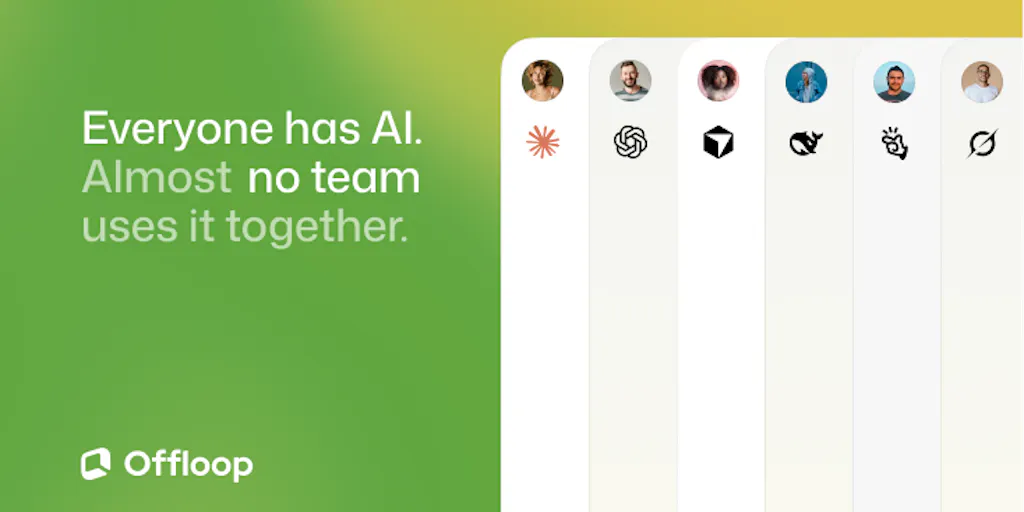
Every week, I watch another social media team celebrate their AI adoption. They’ve got ChatGPT drafting caption variations, Midjourney spinning up visual concepts, and maybe a scheduling tool firing posts across five platforms. And every week, the same thing happens: the work stalls the moment it needs to move from one person’s screen to another’s. The AI does its part beautifully. Then someone copy-pastes the output into Slack, someone else reformats it into a doc, and a third person manually uploads it to the scheduler. The intelligence survives, but the momentum dies.
This is the gap that Offloop is aiming at, and it’s why I spent a good chunk of my week digging through their Product Hunt launch instead of treating it as another “AI workspace” also-ran. The thesis here isn’t about making individual prompts better. It’s about making the organizational layer around AI output actually function — turning one-off AI wins into repeatable team process. For anyone running a content operation, that’s not a nice-to-have. That’s the difference between a team that uses AI to make more content and a team that uses AI to change how content gets made.
The Problem That Offloop Actually Solves: Context Switching Is Eating Your AI ROI
Let me ground this in something I lived last month. I was coordinating a cross-platform campaign — YouTube long-form, TikTok and Instagram Reels cutdowns, a LinkedIn thought-leadership thread, and Pinterest pins for the blog assets. Five platforms, four team members, one shared brief. The AI tools were the easy part. I had Claude generating the core script variations. I had CapCut handling the repurposing. I had a scheduling tool queuing everything. The nightmare was the in between — the moments where one person’s AI output had to become another person’s input.
That’s the workflow Offloop is trying to fix, and the maker’s framing in the launch post is sharp: “AI made individuals faster, but team progress still breaks at the organizational layer.” The team’s example workflow — a growth lead opening a shared Channel, adding a brief and files, then @ mentioning a Research Agent to analyze customer feedback — is exactly the kind of handoff that currently lives in a graveyard of Slack threads and “can you just take a look at this?” DMs.
What Offloop is proposing is that agents and humans occupy the same workspace as first-class participants. They share Channels. They get @ mentioned. They own work. They review results. They hand off to the next owner. That’s not a feature list — that’s a fundamental rethinking of how work flows through a small team. In my experience, the tools that win in the creator economy aren’t the ones with the most impressive AI. They’re the ones that reduce the friction between thinking and shipping. Offloop is betting that the friction isn’t in the generation — it’s in the handoff.
How Offloop Differs From the Incumbent Stack
If you’re a social media operator, you’ve probably already got a version of this workflow stitched together. Let me name the pieces I’ve used and seen others use, because the comparison matters.
The Slack + ChatGPT + Google Docs stack. This is the default for most small teams. ChatGPT gives you the output. Slack gives you the handoff. Google Docs gives you the artifact. The problem is that the context lives in three different places. The brief is in the doc. The AI conversation is in ChatGPT. The approval decision is buried in Slack. Offloop’s bet is that collapsing those into a single workspace — where the context, files, decisions, tool activity, and artifacts stay attached to the work — eliminates the context-switching tax. The maker’s claim is that “owners, approvals, and next steps remain durable and traceable,” which is exactly what’s missing when your approval chain is a series of emoji reactions.
The Notion AI + Zapier + Airtable stack. This is the more sophisticated version, and it’s where I’ve seen teams get closest to what Offloop is describing. You build a Notion database for content ideas, use Zapier to pipe AI outputs in, and Airtable to track status. It works, but it’s brittle. Every time a platform changes its API or a team member leaves, the whole Rube Goldberg machine needs maintenance. Offloop’s pitch is that by making agents native to the workspace — rather than bolted on via integrations — the system becomes more resilient. The “reusable execution” piece is key here: turn successful Agents and Flows into repeatable operating capacity across retries, waits, schedules, and handoffs. That’s not just a workflow. That’s a system.
The Buffer / Hootsuite / Later layer. These tools handle the publishing side beautifully — I’ve used all three, and they’re essential for anyone managing multiple accounts. But they’re not thinking tools. They’re distribution tools. Offloop isn’t trying to replace your scheduler. It’s trying to replace the chaos that happens before you get to the scheduler. The question from the comments — “Does Offloop replace the tools a team already uses, or work alongside them?” — is the right one. My read is that it sits alongside, as the thinking-and-approval layer that feeds your publishing stack.
What Creators and Social Media Teams Can Borrow From Offloop’s Approach
Even if you’re not ready to adopt a new workspace tool, there are three operational principles in Offloop’s launch that you can steal right now.
Principle one: Make your AI context persistent and shared. The biggest mistake I see teams make with AI is treating it as a private conversation. Someone runs a prompt, gets a result, and the context of that prompt — the brief, the brand voice notes, the platform-specific requirements — dies with that conversation. Offloop’s model of attaching context, files, and decisions to the work itself is the fix. You don’t need their tool to adopt this. You need a shared prompt library, a documented brand voice reference, and a rule that says no AI output gets used without the context that generated it being attached.
Principle two: Design for handoff, not just generation. When I schedule 30 posts across 5 platforms in a month, the bottleneck is never the generation. It’s the approval chain. Who reviews the TikTok caption? Who signs off on the LinkedIn angle? Who owns the final cut? Offloop’s “handoff to the next owner” model is a forcing function for making those roles explicit. Even in a solo operation, you need this — the handoff between your creating self and your editing self is real, and it needs structure.
Principle three: Build reusable workflows, not one-off prompts. The maker’s point about “reusable execution” is the most underrated idea in the launch. Most teams treat AI as a prompt generator — you ask, you get, you move on. The teams that win treat AI as a process — they build templates for recurring work. A content repurposing flow. A trend-analysis flow. A competitor-tracking flow. Offloop’s architecture makes this explicit, but you can start doing it today with a simple folder structure and a documented checklist.
Why TikTok Creators Should Care More Than LinkedIn Ones
Here’s a hot take: the teams that will feel Offloop’s value most acutely are the ones operating at TikTok and Instagram speed, not LinkedIn pace. The reason is distribution mechanics. TikTok’s algorithm rewards consistency and volume in a way that LinkedIn’s doesn’t. If you’re posting once a week on LinkedIn, you can survive a manual workflow. If you’re posting three times a day on TikTok, you need a system where AI-generated concepts move through approval and adaptation without a human touching every pixel.
My take: the creator economy is bifurcating into two speeds — the “brand builder” speed (LinkedIn, YouTube long-form, podcasts) where human touch matters more, and the “volume player” speed (TikTok, Reels, Shorts) where the winner is whoever can ship the most iterations with the least friction. Offloop is built for the second group, even if the marketing doesn’t say so explicitly.
Where the Math Breaks: Offloop’s Limitations and Open Questions
Let me be clear about what I think Offloop is not yet, based on the launch page and the comments. The team has been responsive on Product Hunt — answering questions about workflow examples and day-one fit — but the source material is thin on hard numbers and edge cases.
The “bring your own subscription” model is a double-edged sword. The maker claims “no Offloop model-usage markup on BYOP runs,” which is genuinely good for cost control. But it also means you’re managing multiple provider accounts, each with their own rate limits and quirks. When I’ve tested similar setups, the operational overhead of juggling API keys and usage limits can eat the time you thought you were saving. The commenter asking “Do I keep paying the provider directly, and what does Offloop charge separately?” is asking the right question — and the answer in the source is vague. They mention “free AI credits for the first 30 days” for new workspaces, but ongoing pricing is not disclosed.
The agent-to-agent handoff question is unresolved. One commenter asked directly: “Can one Agent pass work to another, or does a person need to step in?” The maker’s response — a product launch workflow example where a growth lead @ mentions a Research Agent — suggests human-initiated handoffs are the current model. That’s fine for now, but it means Offloop isn’t yet the autonomous agent network that the “org-level harness” language implies. If you’re expecting agents to wake each other up and collaborate without human oversight, you’ll be disappointed.
The access control question is answered, but the implementation is untested. The maker’s response to “Can an Agent see everything in the workspace?” emphasizes “workspace-scoped identity, exact access grants, isolated runs, approval gates, and revocable connections.” That’s the right architecture — but I’ve seen too many tools promise granular access and deliver either over-permissioned defaults or a permission model so complex that nobody configures it correctly. The trust question here isn’t about intent. It’s about whether the implementation survives real-world use by a busy team that doesn’t read the docs.
Who this is NOT for. If you’re a solo creator with no team — this is overkill. You don’t need an org-level harness. You need a better prompt library. If you’re a large enterprise with established workflows — this is too small. The “small AI-native teams” framing is explicit, and it’s the right call. The sweet spot is a team of 3–15 people who already use AI individually and are drowning in the handoff chaos.
What I’d Watch / Test Next
If Offloop’s positioning is right, and I think it partially is, here’s what I’d do this week to pressure-test their thesis without committing to a full migration.
Run a one-week pilot on a single workflow. Pick your most painful recurring content task — the one that currently requires three tools and two status meetings. Recreate it in Offloop. The maker’s example of a product launch workflow — brief, files, @ mention a Research Agent, get findings back in the Channel — is a good template. If the tool can’t handle that one flow end-to-end, it’s not ready.
Test the BYOP model with your existing subscriptions. Connect the model account you already pay for and verify the “no markup” claim in practice. Run a month of usage through it and compare your bill to what you’d pay using the provider directly. If the math doesn’t work, the cost savings argument collapses.
Probe the approval gates. Set up a workflow where an Agent produces a draft and a human must approve before it moves to the next step. Test whether the approval is genuinely gated — can the next step start without it? — and whether the audit trail actually captures who approved what, when. In my experience, this is where most workflow tools fail. The promise of “durable and traceable” decisions is easy to make and hard to deliver.
Watch the comment threads on the Product Hunt page. The team is actively responding, which is a good sign. But the real signal will come in the next 30 days — whether they publish case studies, whether early adopters report actual workflow wins, and whether the “free AI credits for the first 30 days” converts into paying customers. If they can’t show retention after the credits run out, the tool is a toy.
My honest read: Offloop is asking the right question — “If AI already helps individuals on your team, what still breaks when their work needs to become team progress?” — and the answer is, everything. The handoff layer is where AI adoption dies. Whether Offloop is the tool that fixes it, or just the first credible attempt at naming the problem, remains to be seen. But for anyone running a small content team in 2025, the problem is real, and the solution space is just opening up.