The creator-economy lesson hiding in a research IDE: own your stack, or someone else owns your reach
If you publish across Instagram, TikTok, YouTube, X, LinkedIn, Facebook, Threads, and Pinterest for a living, the launch of OpenScience probably didn’t cross your feed. It’s an open-source, model-agnostic workspace for computational research — not a scheduler, not a repurposing engine, not a hook-writing assistant. But the problem its maker describes is the exact problem every serious social operator is about to inherit: your most important production capability increasingly lives inside someone else’s closed product, governed by terms you didn’t negotiate and can’t audit. That’s the thread worth pulling.
What OpenScience actually is, minus the launch-day gloss
Let me recap the facts before I editorialize, because the specifics matter for the analogy.
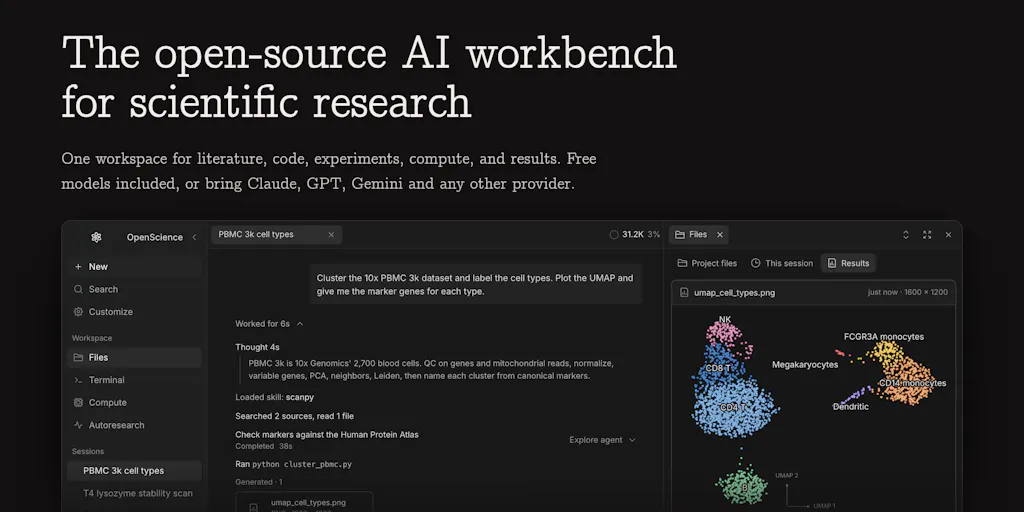
Ishaan Gangwani, one of the builders, frames the origin plainly: doing research with AI meant “copying things back and forth between a chat window, a terminal, a notebook, and whatever cluster you had access to.” OpenScience collapses that into one workspace where an agent operates across papers, code, notebooks, LaTeX, a terminal, and 3D protein and genomics viewers.
The launch bundles four things:
- A redesigned IDE with the agent sitting next to the artifacts
- “Autoresearch” — experiment loops that run on Modal GPUs, your own servers, or Slurm and PBS clusters
- “OpenScience Ace” — 30+ models (GPT-6 Astra, Claude Opus 5.5, Kimi K3, GLM-5.3 and more) through one pay-as-you-go wallet, or bring your own keys, your ChatGPT/Codex login, or a local model
- Updated tooling: 300+ research skills, 50+ scientific tools and databases, and NVIDIA BioNeMo support
The team claims OpenScience is currently #1 on agentic scientific research benchmarks, including Terminal Bench Science, TerminalBench 4.0 (Science subset), BiomniBench, and their internal OpenScience Bench. Researchers at 30+ universities and labs used the beta; it’s now open to everyone, and a .edu email gets you $5 in free Ace credit. Pricing beyond that credit is not disclosed. The most interesting line for non-scientists: give Autoresearch a metric — validation loss, p99 latency, build time — and it forms hypotheses, runs experiments, and logs every attempt.
Now here’s why I’m writing about it in a social-media column.
The part that should make social operators nervous
Two design decisions carry the real signal. First: open source. Second: model-agnostic — pick any model, swap it mid-project, or run it locally on your own hardware.
The maker’s stated reason is worth quoting in spirit, not as gospel: the strongest models and products increasingly come with restrictions set by the labs that train them — which fields they’ll help with, who gets access, and on what terms. Whether or not you agree with that framing for research, it is already true for social media tooling. Your scheduling layer, your analytics layer, your AI caption layer, and your asset pipeline each sit behind a vendor’s roadmap, a vendor’s API access, and a vendor’s pricing page.
The problem social teams actually have (and keep mistaking for a tooling problem)
Ask a social manager what’s broken and you’ll get a list: too many platforms, too many formats, too many approval chains, too many dashboards. All true. But underneath is a structural issue that OpenScience names directly — the work is scattered across disconnected surfaces, and the connective tissue is a human doing copy-paste.
In my own experience running multi-platform calendars, the copy-paste tax is the single biggest hidden cost. A single campaign asset typically moves through: a doc for the brief, a Canva or CapCut project for the visual, a caption draft in a notes app, a scheduling tool like Buffer, Later, or Metricool, a spreadsheet for UTM tracking, and a reporting view stitched together from native analytics. Every hop is a place where versioning breaks, where a platform-specific crop gets missed, where the wrong CTA ships.
OpenScience’s answer is to put the agent inside the workspace where the artifacts live, rather than in a chat window beside it. That’s the transferable idea. Most “AI for social” tools today are a chat box bolted onto a calendar. The genuinely useful version is an agent that can read the asset, see the platform constraints, check the performance history, and act — without you as the message bus.
Why model-agnosticism is a creator-economy issue, not a nerd issue
Here’s where I’d push back on the instinct to dismiss this as irrelevant. Think about what happened to social teams over the last few years of platform API changes. Rate limits tightened, endpoints deprecated, third-party access renegotiated on the platform’s terms. If your entire publishing workflow depends on one vendor’s continued API access, you don’t have a workflow — you have a hostage situation with a nice UI.
OpenScience’s stance — bring your own keys, your own login, or run a local model — is the research-world version of a principle social teams should adopt: keep the orchestration layer portable. I’d bet the operators who survive the next round of platform and vendor shifts are the ones who can swap the model, swap the scheduler, and swap the analytics source without rebuilding their process from scratch.
What creators and social teams can borrow from this launch
Strip the biology and chemistry out and there are four operational patterns here worth stealing this quarter.
1. Metric-driven iteration loops, applied to content
Autoresearch takes a metric — validation loss, p99 latency, build time — and runs experiment loops against it, logging every attempt. Social teams already have metrics. Most just don’t run loops against them.
The translation: pick one number per platform per month. Not “engagement rate” as a vague north star — a specific, measurable target like 3-second view retention on TikTok or click-through on a LinkedIn carousel. Then run structured variations and log every attempt the way Autoresearch does. The logging is the part everyone skips, and it’s the part that compounds. Without a record of what you tried, you’re not iterating — you’re guessing with extra steps.
2. One wallet, many models — the case against single-vendor AI stacks
OpenScience Ace routes 30+ models through one pay-as-you-go wallet, with the option to bring your own keys or a local model. For a social team, the equivalent is refusing to let one AI writing tool become the only way you produce captions.
Different models genuinely perform differently on different tasks. In my testing of similar setups, a model that writes a sharp X thread often produces bloated LinkedIn copy, and vice versa. Being able to route per task — and to swap when a model degrades or a vendor changes terms — is resilience, not indecision.
3. Skills and tools as a library, not a monolith
The launch lists 300+ research skills and 50+ scientific tools and databases. The lesson for content ops: build your own skill library. A “skill” in social terms is a reusable, documented procedure — “how we turn a long-form YouTube video into five Shorts,” “how we localize a caption for three markets,” “how we QA a UTM string before it ships.” Write them down, version them, and hand them to whatever agent or teammate runs the task. Teams that treat process as a library scale; teams that treat it as tribal knowledge don’t.
Why TikTok creators should care more than LinkedIn ones
Short-form is where iteration speed wins hardest. TikTok’s distribution rewards volume and fast feedback — you can test a hook format, read retention curves within hours, and pivot the same day. That’s an Autoresearch-shaped loop whether you call it that or not. LinkedIn’s distribution is slower and more relationship-weighted, so the same experiment cadence yields less signal per cycle. If you only have bandwidth for one rigorous iteration loop, put it where the feedback is fastest.
Where my judgment says this falls short — and where the analogy breaks
I want to be honest about the limits, both of the product and of my own comparison.
The analogy is imperfect. OpenScience is built for computational research across ML, biology, chemistry, physics, and data science. It is not a social media tool. Its benchmarks — Terminal Bench Science, BiomniBench, the internal OpenScience Bench — measure research-agent performance, not content performance. Anyone reading this as “use OpenScience for your content calendar” has misread me. The value here is the architectural philosophy, not the feature list.
Benchmark claims deserve scrutiny. The team claims #1 on several benchmarks, including an internal one. Self-reported internal benchmarks are, by definition, not independently verified. That’s not an accusation — it’s the standard caveat I apply to any vendor’s “we’re #1” claim, including the “10x your reach” language that litters social tool marketing.
Open source cuts both ways. Open source means no vendor lock-in, but it also means no vendor SLA. If something breaks, you’re depending on a community, not a support contract. For a solo creator, that’s often fine. For an agency running 40 client accounts, that’s a real operational risk to weigh.
Pricing opacity. Beyond the $5 .edu credit, pricing is not disclosed. For a pay-as-you-go wallet model, the actual cost depends on model choice and usage volume — which means budgeting requires experimentation. Same is true of most AI tooling, but it’s worth flagging.
Who this is NOT for: If you’re a social manager who just needs to schedule posts and see basic analytics, none of this is your problem yet. Hootsuite, Buffer, and Later do that job fine, and adding an agentic orchestration layer would be over-engineering. The portability argument starts mattering when you’re producing at volume, running multiple platforms, or building AI into your pipeline in a way that would be expensive to unwind.
Where the math breaks
The metric-driven loop has a failure mode: optimizing for a measurable number that doesn’t map to business outcomes. Watch time is measurable; brand affinity isn’t. If you let the loop chase the measurable proxy too hard, you get content that performs on the dashboard and does nothing for the bottom line. Pick your metric deliberately, and revisit it quarterly — a good loop pointed at the wrong target is just faster failure.
What I’d watch / test next
Three concrete things an operator can do this week, no new tooling required.
Audit your dependencies. List every tool in your publishing pipeline and mark which ones you could swap in a day versus which would require a rebuild. The second category is your risk. For each item there, write down one fallback — even if you never use it.
Start one metric-driven loop. Pick a single platform and a single number. Run four variations over two weeks. Log every attempt in one doc: what you tried, what you expected, what happened. This is the Autoresearch pattern at content scale, and it costs you nothing but discipline.
Build your first three “skills.” Document the three most-repeated procedures on your team as step-by-step playbooks. Version them. This is the unglamorous work that makes any future agent — or new hire — actually useful on day one.
As for OpenScience itself: I’d watch whether the open-source, model-agnostic stance holds as the project scales, and whether the benchmark claims get independently verified. If they do, the architecture becomes a template worth citing in every “should we build or buy our AI stack” conversation your team has this year. If they don’t, the philosophy still stands on its own — because the underlying insight, that your production capability shouldn’t live entirely inside someone else’s product, is true regardless of who’s winning which leaderboard.