The inbox is the last platform you don’t rent — and that’s exactly why creators should be paying attention
Every creator I know has quietly become an email operator. The newsletter is the only channel where the audience list is actually yours, where an algorithm can’t decide tomorrow that your reach is 4% of what it was yesterday, and where a single send doesn’t get throttled by a recommendation system you’ll never see. And yet most of us are still renting the pipes: paying per-contact or per-send to a platform that holds our sending domain’s reputation in its hands, decides what features sit behind which tier, and can change the rules whenever it wants. That’s the tension opensend.cc is poking at, and it’s worth a few thousand words because the underlying question — who owns your distribution? — is the defining strategic question of the creator economy right now.
What opensend.cc actually is, minus the launch-day gloss
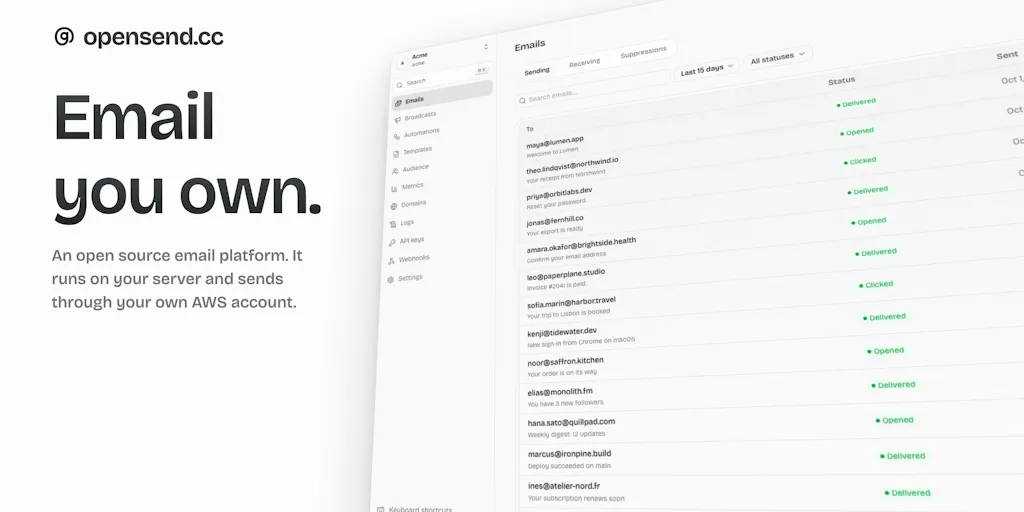
The maker, Kamal Panara, frames it bluntly in the launch thread: “Every product sends email, but almost none of them own it. Your mail goes through someone else’s platform. You pay for every email, some features cost extra, and your domain’s reputation is in someone else’s hands.” That’s the pitch. opensend.cc is a self-hosted email platform — you run it on your own server, and it sends through your own AWS account via Amazon SES. The claimed v0.1.0 feature set includes a REST API and SDK plus SMTP, guided DKIM/SPF/DMARC setup, per-email tracking from sent through clicked, broadcasts, templates, automations, audiences, webhooks, logs, and an MCP server so AI agents can send email too. It’s Apache-2.0 licensed and free; you pay AWS for sending at the rate the maker cites of $0.10 per 1,000 emails on SES, plus your own server costs. There’s a one-line Docker install, and — this is the part that made me sit up — the API is compatible with Resend, so a migration is described as changing the import and the key.
I want to be careful here, because launch-day posts are marketing documents. Everything above is the maker’s claim, not a verified benchmark. But the architecture is the interesting part, not the feature list, and the architecture is legible enough to reason about.
The problem isn’t “email is expensive” — it’s that you don’t control the reputation layer
Here’s the thing most creators learn the hard way, usually around the time their first big launch email lands in spam. Deliverability is not a function of your copy or your subject line. It’s a function of domain reputation, authentication (SPF, DKIM, DMARC), list hygiene, and — critically — who else is sending from the same IP pool you’re sending from.
That last one is the shared-sender-pool problem, and it’s the most underrated risk in creator email. A commenter on the launch thread, Gal Dayan, puts it better than I could: “the shared-sender-pool anxiety is real, one other customer on the same platform burns a bad list and your deliverability takes the hit too even though you did nothing wrong.” If you’ve ever run cold outreach at volume, or even a big newsletter list, you’ve felt this. Your open rates dip for two weeks and you have no idea why, because the cause was somebody else’s list.
Where the math breaks
Let me do the arithmetic that the per-send pricing model quietly hides. Most creator email platforms price on contacts or sends. If you’re a mid-size newsletter operator — say a few tens of thousands of subscribers, sending a few times a week — you’re paying a monthly platform fee that scales with your list, not with your actual cost to send. SES pricing is dramatically lower per email than what most SaaS platforms charge, and the gap widens as your list grows. That’s the arbitrage opensend.cc is built on: swap a per-contact subscription for infrastructure you own plus AWS’s meter.
But — and this is where I’d push back on anyone treating this as free money — you’re not eliminating cost, you’re moving it. You now own:
- Server ops. Something has to run the Docker container, stay patched, and not fall over during your launch-day send spike.
- Deliverability ops. SES starts new accounts in a sandbox. You request production access and sending limits from AWS, and those limits grow as your account builds a clean record. That’s on you now.
- Compliance. Suppression lists, unsubscribe handling, bounce processing. The maker says opensend.cc suppresses bounced and complaining addresses for you, which helps — but the accountability is yours.
In other words: you’re trading a subscription line item for an operations line item. For some operators that’s a clear win. For others it’s a trap.
Why this matters more to newsletter operators than to social-first creators
If your entire audience lives on Instagram and TikTok, this product is not for you yet — and I’ll get to that. But if you’ve been building the “owned audience” layer the way every growth marketer tells you to, the email list is your moat, and the platform you send from is a strategic dependency, not a utility. Owning the sending infrastructure is the email equivalent of owning your own website instead of publishing only on rented land. That’s the frame that makes this launch interesting beyond the dev-tools crowd it’s aimed at.
How it stacks up against the incumbents you’re probably already paying
I’ve run accounts and lists across most of the usual suspects, so let me place this honestly rather than pretend it’s in a category of one.
Against Resend: This is the most direct comparison, and the maker leans into it — API compatibility means the migration story is “change the import and the key.” Resend is a developer-first transactional email API with a generous free tier and a hosted model. opensend.cc’s bet is that the same developer wants the same interface but wants to run it themselves and pay AWS instead of a markup. That’s a real segment. It’s also a segment that has to be comfortable with self-hosting, which is a much smaller slice of creators than of backend engineers.
Against Mailchimp, ConvertKit, Beehiiv, Substack: These are the platforms most creators actually use, and they sell something opensend.cc doesn’t: the editor, the landing pages, the recommendations network, the monetization rails, the “I don’t want to think about DKIM” peace of mind. Beehiiv and Substack in particular are not email infrastructure — they’re media businesses with email attached. Comparing opensend.cc to them is a category error, and I’d bet the maker knows it. The honest framing is that opensend.cc replaces the sending layer under a tool like this, not the tool itself.
Against SendGrid and Postmark: Both are mature transactional email providers with strong deliverability reputations and enterprise trust. opensend.cc’s differentiator — per-team SES tenant isolation so “one team’s bad list can’t pause anyone else’s sending” — is a genuine architectural answer to a real problem those providers solve with their own reputation management. Whether a self-hosted newcomer can match years of deliverability tuning is an open question, and I’d want to see independent inbox-placement data before believing it.
Against Listmonk and the self-hosted newsletter crowd: There’s a whole ecosystem of open-source newsletter tools. opensend.cc’s edge over the classic ones is the modern surface: API/SDK, webhooks, tracking, automations, and the MCP server for AI agents. That last item is the tell — this was built in 2025, for a world where agents send mail.
What creators and social teams can actually borrow from this
Even if you never install it, there are three operational lessons here that apply to every channel you run.
1. Audit which layer of your stack you’re renting vs. owning
Map your distribution: social platforms (rented, always), your website (owned), your email list (owned), your sending infrastructure (usually rented). Most creators own two of four layers and think they own three. The opensend.cc pitch is a prompt to ask, for each layer: if this vendor tripled its price or changed its terms tomorrow, what happens to my business? That question is worth asking about your scheduler, your link-in-bio, your analytics, your hosting — not just email.
2. Treat domain reputation as a first-class asset
The maker’s answer to Gal Dayan’s migration question is the single most useful technical nugget in the whole thread, and it applies to anyone moving email providers: “Gmail and Outlook judge your domain mostly by the domain itself (the one your DKIM signs with), not by which provider sent the mail. So if you move the same domain… the reputation you’ve built moves with it.” The practical takeaway: keep your sending domain stable across provider migrations. New SES DKIM keys sign for the same domain, so your reputation follows. What doesn’t follow is provider-side history — a new AWS account starts in the sandbox and has to earn its limits back. And the migration playbook the maker lays out is genuinely good operational advice: add the new DKIM records alongside the old ones (both can work simultaneously), shift a small share of volume first, grow it over one to two weeks, and watch bounces and complaints. He cites SES’s review thresholds of 5% bounces or 0.1% complaints — numbers worth knowing regardless of which provider you use.
3. The MCP server is the signal, not the feature
An MCP server that lets AI agents send email is, right now, a novelty. In twelve months I think it’s table stakes for any tool in the creator stack. If you’re building agent workflows — an agent that drafts your newsletter, segments your list, sends a re-engagement sequence — the bottleneck isn’t the model, it’s whether the tool has an interface an agent can call. opensend.cc shipping MCP in v0.1.0 tells you where the maker thinks the puck is going. I’d bet he’s right about the direction and early about the timing.
Where my judgment says this falls short
I promised balance, so here’s the unvarnished version.
It’s v0.1.0, and it says so. Broadcasts, templates, automations, audiences — these are listed as present, but a first release from a solo maker is not the same maturity as a platform that’s been battle-tested through a million sends. If your livelihood depends on email landing, being an early adopter of sending infrastructure is a high-variance bet.
Self-hosting is a real skills tax. The Docker install is one line. Keeping it running, patched, monitored, and backed up is not. If you don’t already run servers, the “free” software costs you either money (managed hosting) or time (yours) that a SaaS subscription would have absorbed.
No pricing page because there’s no product to price — but also no SLA. The maker is refreshingly direct that opensend is free to self-host and you just pay AWS, with “no hidden pricing from us.” That’s a trust signal. It’s also a support-model question: who do you call at 2am when your launch send is stuck in the SES sandbox? Not disclosed. For a hobby project, fine. For a business, that’s the gap.
The audience mismatch. This is built for developers and technical founders, not for the average creator. A creator who can’t read a DKIM record or spin up a VPS should not touch this. The right user is a technical operator, an indie hacker, or a creator with a developer on the team — someone who wants to own the infrastructure and has the skills to do it.
The deliverability claim is unproven at scale. The per-team tenant isolation is a smart design. But “smart design” and “proven inbox placement across Gmail, Outlook, and the long tail of corporate filters” are different claims, and only one of them is testable on day one. I’d want to see third-party deliverability benchmarks before moving a revenue-critical list.
Who this is NOT for
- Creators who want an editor, landing pages, and monetization in one place — stay on Beehiiv, Substack, or ConvertKit.
- Anyone without server ops comfort.
- Teams that need a support contract and an SLA today.
- Anyone whose email volume is small enough that the SaaS fee is trivial — the savings won’t justify the ops burden.
What I’d watch / test next
If you’re a technical operator with an email list you care about, here’s a concrete week-one plan that doesn’t require committing your whole list.
First, audit your current sending domain’s authentication — run your domain through a DKIM/SPF/DMARC checker and see how you actually score. Most creators are surprised. Second, spin up opensend.cc on a throwaway VPS and send to a small seed list of your own addresses across Gmail, Outlook, and one corporate domain. Watch inbox placement, not just open rates. Third, request SES production access early — the sandbox is the first wall you’ll hit, and the approval takes time. Fourth, test the Resend compatibility claim by pointing a non-critical transactional flow (password resets, receipts) at it for two weeks. Fifth, and most importantly, decide which layer you want to own. Infrastructure ownership is a strategy, not a savings tactic — and it only pays off if you’re prepared to operate what you own.
My take: opensend.cc is not the tool most creators should adopt this month. It is the clearest articulation I’ve seen of a question every creator should be asking — who holds the keys to your distribution, and what would it cost to take them back? Answer that honestly for your own stack, and you’ll know whether this launch is a curiosity or a roadmap.