The Creator Tool Stack Is Crowded. What a Product Hunt Launch Can Actually Tell You.
Every week another “all-in-one” social tool launches on Product Hunt, and every week a chunk of the creator economy clicks through, watches a slick demo, and wonders whether their current stack is quietly costing them reach. This matters because most operators I know aren’t running one tool — they’re running four or five: a scheduler, a design tool, a link shortener, an analytics dashboard, and a spreadsheet duct-taping the whole thing together. Any new entrant is really asking you to rip out one of those pieces. The problem is that the launch page itself is almost never enough to judge that trade. This particular page is a case study in that gap: a polished pitch, a category claim, and not much verifiable substance. So instead of a “should you switch” verdict, I want to use it as a lens on how to read launches like this without getting played by the demo.
What the Page Actually Says — and What It Doesn’t
Here’s the uncomfortable part up front: the source material I was handed is essentially a JavaScript-and-cookie wall. There’s no product name, no maker, no pricing, no feature list, no screenshots, no comments — nothing to anchor a review to. That’s not a knock on whoever built the thing; it’s a rendering artifact of scraping a modern Product Hunt page. But it’s also a useful teaching moment, because it’s exactly what happens when you skim a launch on mobile between meetings and come away with a vibe instead of a fact.
So I’m going to be disciplined about sourcing. Where I can’t verify something from the page, I’ll say “not disclosed” rather than fill the gap with a guess. What I can do is walk through the questions a launch page like this forces you to answer — the same questions I’d ask before letting any new tool touch a client’s publishing calendar — and show you how I’d evaluate the answers using tools you already know.
The category itself is legible even without the copy. A Product Hunt launch aimed at creators and social teams is almost always making one of four claims: it schedules across platforms, it repurposes content automatically, it generates posts with AI, or it consolidates analytics. Each of those claims has a different failure mode, and knowing which one you’re being sold is half the battle.
The Four Claims Every Creator SaaS Launch Makes
When I audit my own stack, I sort tools by which of these they’re really competing on:
- Scheduling and publishing — competes with Buffer, Hootsuite, Later, and Metricool. The moat here is API reliability and queue UX, not features.
- Repurposing — competes with CapCut, Opus Clip, and the native “remix” flows inside Canva. The moat is output quality and format fidelity.
- AI generation — competes with ChatGPT plus a dozen wrapper startups. The moat is brand-voice control and editability.
- Analytics — competes with native platform dashboards and Metricool. The moat is cross-platform normalization and attribution.
A launch that claims all four at once is either a genuine platform play or a thin veneer over one core feature. My experience says it’s usually the latter, and the page rarely tells you which. That’s why the first thing I do with any new tool is check one workflow end to end rather than tour the feature grid.
The Real Problem Isn’t Scheduling. It’s the Repurposing Tax.
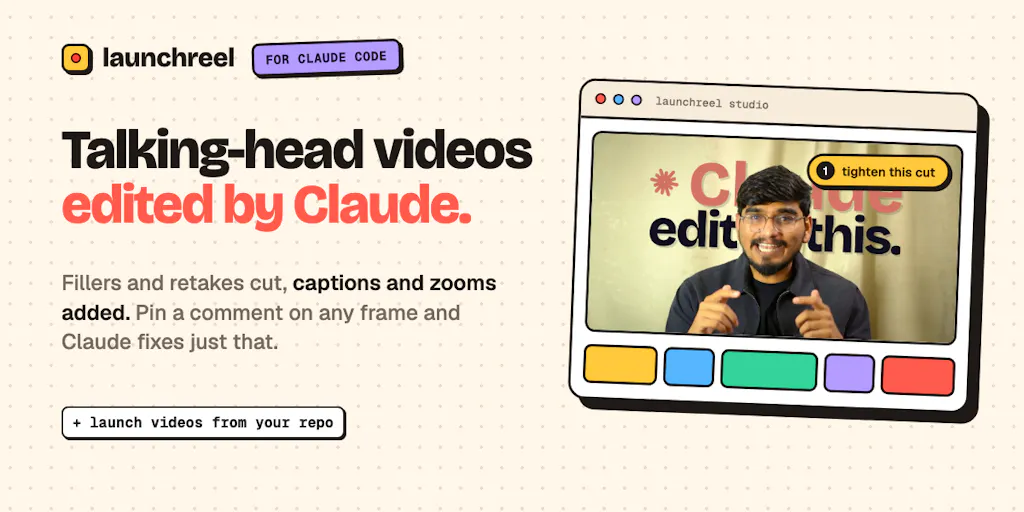
Here’s where I think most launch pages misread their own audience. They lead with “schedule everywhere” because it demos well, but the actual pain for a creator or a two-person social team is the repurposing tax — the hours spent turning one long video into a Short, a Reel, a TikTok, three quote cards, a LinkedIn carousel, and a thread, each with different aspect ratios, captions, and hooks. That work is where margins die.
In my own tests of repurposing tools over the past year, the bottleneck is never the export. It’s the first thirty seconds — deciding which moment has the hook, whether the caption survives a 9:16 crop, and whether the burned-in subtitles are legible on a phone at arm’s length. A tool that automates export but leaves you making those calls manually has moved the tax, not removed it.
So when a launch page promises “10x your content output,” I read that as a claim about the decision layer, not the render layer. And the decision layer is exactly what’s hardest to demo and easiest to fake. If the maker can’t show me a before/after of a real long-form asset becoming a platform-native short — with the hook intact and the captions readable — the claim is marketing.
Why TikTok and YouTube Shorts Creators Should Care More Than LinkedIn Ones
Platform mechanics explain the asymmetry. TikTok and Shorts distribution is heavily weighted toward watch time and completion rate on a per-viewer basis, and the first one to three seconds do most of the sorting. That means a repurposing tool’s output quality has an outsized effect on reach: a bad crop or a slow hook doesn’t just look worse, it changes who the algorithm shows the clip to. LinkedIn, by contrast, rewards dwell time on text and native documents, where a repurposing tool’s job is mostly formatting, not hook engineering.
My take: if you publish short-form video at volume, a tool that nails the hook-and-caption layer is worth real money. If your primary channel is LinkedIn text posts, most “all-in-one” launches are solving a problem you don’t have. Match the tool to the mechanic, not to the demo.
How This Compares to the Incumbents You Already Pay For
Without a feature list I can’t do a line-by-line comparison, and I won’t pretend otherwise. But I can tell you how I’d slot any new entrant against the tools creators actually run, because the competitive map is stable even when the launch copy isn’t.
Against Buffer: Buffer wins on simplicity and trust — it’s been the “just works” scheduler for a decade, and its pricing is transparent. A new entrant beats it only by doing something Buffer deliberately doesn’t, usually AI generation or deep repurposing. If the launch is “Buffer but with AI,” ask whether the AI output is editable enough to survive brand review. In my experience, unedited AI captions are the fastest way to sound like everyone else.
Against Hootsuite: Hootsuite is the enterprise incumbent — approvals, team roles, listening. A creator-focused launch almost never competes here, and shouldn’t try. If you’re a solo operator, Hootsuite is likely overkill and overpriced for your needs; that’s the gap these launches target.
Against Later: Later owns the visual-first, Instagram-and-TikTok planning niche with a strong media library and link-in-bio. A new tool has to beat Later on either price or repurposing depth to matter.
Against Metricool: Metricool’s edge is analytics breadth plus scheduling at a flat rate. If a launch claims “analytics,” this is the benchmark — and most new tools lose on historical data depth because they’re young.
Against Canva and CapCut: These aren’t schedulers, but they’re where the actual asset gets made. Any “all-in-one” that doesn’t integrate cleanly with them adds a step rather than removing one. I’d bet the winning creator tools of the next two years are the ones that treat Canva and CapCut as upstream partners, not competitors.
The pattern across all of these: incumbents win on reliability and data history, challengers win on one sharp workflow. A launch page that claims to beat everyone on everything is telling you it hasn’t picked its lane.
Where the Math Breaks
Pricing is where I get skeptical fastest, because “all-in-one” almost always means “we charge for seats and channels and AI credits separately.” The source page doesn’t disclose pricing, so I can’t quote a number — and that silence is itself a signal. When a launch hides pricing behind a demo, it usually means the price is high enough to need a sales conversation, or low enough that they’d rather you not comparison-shop it against Buffer’s public tiers.
Run the math on your own stack before you switch. Add up what you pay for scheduling, design, repurposing, and analytics today. Then ask what the new tool replaces — not what it adds. If it replaces two line items and adds a third, you may be net-neutral on cost and net-negative on learning curve. I’ve watched teams adopt a shiny all-in-one and quietly keep their old scheduler running “just in case” for six months. That’s not consolidation; that’s a subscription you forgot to cancel.
What Creators and Social Teams Should Borrow From Launches Like This
Even a thin launch page teaches operators something, and the lesson here is about workflow design, not features.
First: the pitch almost always reveals the maker’s theory of the creator’s day. If the demo opens with a calendar, they think you’re a planner. If it opens with a video upload and an auto-cut, they think you’re a producer. Neither is wrong, but only one matches how you actually work. I’ve started judging tools by whether their default screen matches my first task of the morning — for me, that’s triaging comments and checking overnight performance, not building a queue.
Second: launches are a stress test for your own naming and UTM discipline. Every new tool wants to own your links, and if you let it, you lose attribution. Whatever you adopt, make sure it passes UTM parameters through to your Google Analytics or your link-in-bio tool intact. I’ve seen a “growth” tool quietly strip UTMs and tank a client’s attribution for a quarter before anyone noticed.
Third: treat the launch as a prompt to audit your API risk. Scheduling tools live and die by platform API access, and platforms change terms without warning — the Instagram Graph API and TikTok’s Content Posting API both have approval gates and rate limits that a young tool may not have cleared for every account type. Ask directly: which platforms post natively, which require a notification-and-manual-publish flow, and what happens to my queue if access is revoked? If the answer is vague, that’s your answer.
A Five-Minute Test I Run Before Any Trial
When I do let a new tool into a test account, I run the same gauntlet:
- Schedule one post to each of three platforms, including one video, and check the native preview — not the tool’s preview.
- Publish a post with a UTM link and confirm it survives to analytics.
- Duplicate a queue entry and edit it on mobile; check whether the edit syncs.
- Break it on purpose — revoke a connection and see how the tool reports the failure.
- Export whatever data it holds and confirm you can leave with your content.
If a tool fails steps two or five, I stop. Portability and attribution are non-negotiable; everything else is preference.
Where My Judgment Says This Falls Short
I have to be honest about the limits of this piece. Because the source page rendered as a cookie wall, I could not verify the product’s name, maker, pricing, platform coverage, or any performance claim. Anything specific I’d normally test — does it post natively to Threads? Does it handle Pinterest’s longer video? — is not disclosed in what I was given. I’m not going to invent a verdict to fill the space.
What I can say with confidence is where launches in this category typically fall short, and where I’d push back hardest:
- The “all-in-one” trap. Consolidation sounds efficient until one feature is mediocre and you’re stuck with it because it’s bundled. My rule: adopt a tool for its strongest single workflow, and tolerate the rest only if it’s genuinely good enough.
- AI that flattens voice. Generation tools optimize for volume, and volume is the enemy of a distinctive brand. If you can’t constrain the output to your voice with examples and edits, you’re paying to sound generic.
- Analytics without history. A new tool’s dashboards look great on day one and useless on day ninety, because they have no baseline. Keep your historical data somewhere you control.
- Who it’s not for. If you post to one or two platforms a few times a week, you probably don’t need this category at all — native scheduling plus a spreadsheet is fine, and free. If you run a multi-brand agency with approval chains, you likely need Hootsuite-class governance, not a creator-first tool. The sweet spot is the operator publishing across four-plus platforms with a small team and a real repurposing load.
My take, flagged as opinion: the launches that survive aren’t the ones with the longest feature list. They’re the ones that pick one painful workflow — usually repurposing — and refuse to be mediocre at it.
What I’d Watch / Test Next
This week, before you trial anything new, do three concrete things. First, open your current scheduler and export a month of published posts with their links; that’s your baseline, and it’s the first thing a new tool will fail to import cleanly. Second, pick the single workflow that costs you the most hours — for most short-form creators it’s repurposing — and time yourself doing it manually once, so you have a real number to compare a tool’s promise against. Third, write down your non-negotiables (native posting, UTM pass-through, data export) and refuse to trade them for a feature you didn’t ask for.
Then, when the next Product Hunt launch lands in your feed, read it as a hypothesis rather than a verdict. Ask which of the four claims it’s really making, which incumbent it’s actually gunning for, and what it isn’t telling you. The creators who win the next two years won’t be the ones who adopted the most tools — they’ll be the ones who kept their stack small, their attribution clean, and their voice unmistakably their own.