The Quiet Crisis Under Your Subscription Revenue: Why Payment Orchestration Is Suddenly a Creator-Economy Problem
If you run a subscription business — a Patreon-like membership, a paid newsletter, a community platform, a SaaS tool for creators — you probably think about payments the way you think about server uptime: it’s someone else’s problem until it isn’t. You set up Stripe or Gumroad or whatever merchant of record felt easiest at launch, you connected it to your dashboard, and you moved on to the content calendar. That’s exactly how I operated for years, until the day a processor’s risk team froze a client’s account over a sudden spike in chargebacks that turned out to be a fraud ring targeting their niche. The business didn’t die from bad content or poor engagement — it died because the payment layer, the thing nobody wanted to think about, became a single point of failure.
Here’s why this matters to you as a creator or social media operator, even if you never touch a line of code: your subscription revenue is the foundation that funds your content operation. Every hour you spend planning Instagram Reels or TikTok hooks is subsidized by recurring payments that you assume will keep flowing. But that assumption is fragile. Processors can change their risk thresholds overnight, Visa adjusts its monitoring programs with little fanfare, and your customers’ cards expire or get reissued constantly — each one a tiny leak in your revenue bucket. PaymentKit, a product that just launched on Product Hunt, is attempting to solve this exact problem with a layer of payment orchestration that sits between you and your processors. And while it’s aimed at SaaS companies, the underlying lesson — that your payment infrastructure is a creative asset, not just a utility — is something every subscription-based creator should understand.
What PaymentKit Actually Does (and Why It’s Not Just Another Stripe Wrapper)
The product pitch from Diego Vidal, the maker, is refreshingly direct: PaymentKit didn’t start as a startup idea. The team built it for their own portfolio of subscription brands after getting burned by the same three problems — billing in one tool, payments in another, revenue data in a third — and then realized they couldn’t find anything on the market that solved all three together. That origin story matters because it explains the product’s architecture in a way a feature list never could.
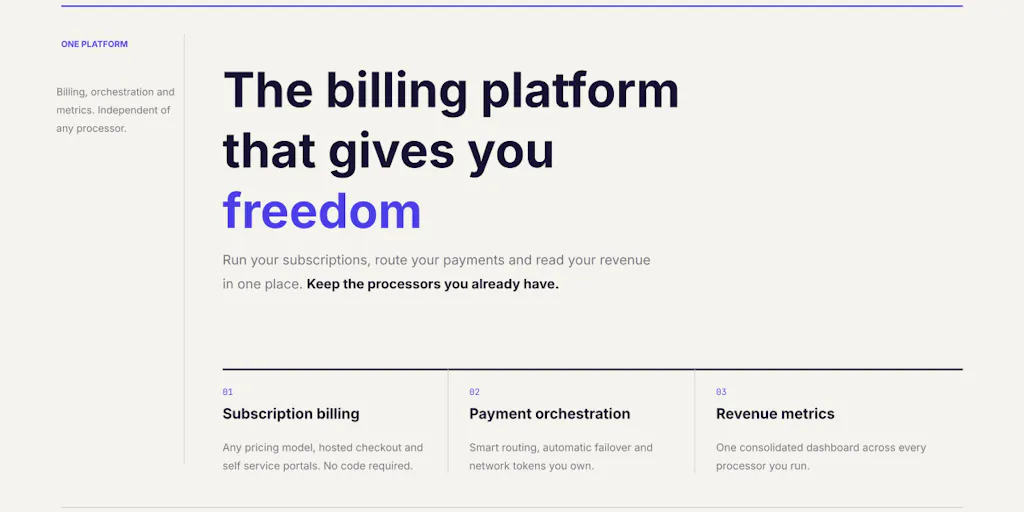
At its core, PaymentKit does four things, but the first two are the real story. Payment orchestration means you connect multiple processors — Stripe, Adyen, Authorize.net, Airwallex, NMI, and others — and every transaction routes to the one most likely to approve it. If a card gets a soft decline on one processor, it cascades to the next one automatically instead of becoming lost revenue. This is not a new concept in the broader fintech world — companies like Spreedly and Finix have been doing orchestration for years — but PaymentKit’s angle is different. The independent vaulting piece is what sets it apart: your customers’ cards, Apple Pay, and Google Pay credentials are stored as network tokens under your control, not your processor’s. You can add or drop a processor without asking a single customer to re-enter anything. If a merchant ID gets shut down, your subscribers never feel it.
The team claims this produces “more than 10% lift in authorization rates on average after merchants switch,” with one merchant going from 63% to 76%. I’d flag that number as a maker claim, not an independent benchmark — 10% is plausible given the three mechanisms they describe (routing, cascading, and network tokens that keep cards on file alive longer), but it’s also exactly the kind of figure a launch page would lead with. The more interesting detail is buried in the comments: one merchant’s jump from 63% to 76% is a 13-point improvement, which is the difference between a subscription business that’s bleeding revenue and one that’s healthy. In my own experience running membership sites, a 5% lift in authorization rates is the difference between hitting your growth targets and falling short.
The third piece is subscription billing — flat, tiered, usage-based, or hybrid pricing, with hosted checkout and self-service portals that go live without writing code. This is the table-stakes feature that every billing tool claims, but the integration with the orchestration layer is what makes it interesting. The fourth is revenue metrics — one dashboard across every processor so you can compare success rates and fees side by side instead of stitching together exports from multiple tools. That last one is more valuable than it sounds; I’ve spent too many hours reconciling Stripe exports against PayPal reports and manually calculating effective take rates.
Why the “Merchant of Record” Trap Is the Silent Serial Killer
The most important thing PaymentKit is doing — and the thing that should make every creator who sells subscriptions sit up — is attacking the merchant of record (MOR) problem. When you sell through a platform like Gumroad, Lemon Squeezy, or even Patreon’s built-in payments, you’re using their merchant account. That’s convenient, but it means they own your customer data and your tokens. If you ever want to leave, or if the platform’s risk profile changes, you’re stuck. The maker’s comment on this is worth quoting directly: “That works right up until it doesn’t.”
This is where the product’s positioning gets clever. PaymentKit isn’t trying to replace Stripe — it’s trying to make Stripe replaceable. The independent vaulting means your tokens are portable, so you can switch processors without a painful migration. In the comments, the team makes a strong technical claim: PaymentKit holds its own Token Requestor ID (TRID) through VGS’s direct integration with the card networks, meaning tokens are provisioned against PaymentKit itself, not against any individual processor. When a customer’s bank reissues a card, PaymentKit gets notified directly and updates its own record — the processor never sees or stores the update. They even request merchant tokens (MPANs) instead of device tokens (DPANs) for Apple Pay and Google Pay, which is a subtle but important distinction: the token is tied to the merchant account, not the customer’s phone, making it more portable across processors.
The critical question, of course, is what happens if PaymentKit itself gets acquired or shuts down. One commenter, Asad M., pushed on exactly this: “owning the TRID moves the lock-in to you instead of to Stripe, which is fine right up until it isn’t.” The maker’s response — “we are more than happy to assist with migrating your tokens in the event that you need them migrated” — is the right answer from a customer-success standpoint, but it’s not a contractual guarantee. This is the classic chicken-and-egg problem of infrastructure trust: you’re swapping one dependency for another, and the new one is smaller and less proven. I’d want to see an exit clause in writing before I built my entire subscription business on it.
How This Compares to the Incumbents (and Where the Math Gets Interesting)
The payment orchestration space already has established players, and it’s worth positioning PaymentKit against them honestly. Spreedly has been doing vaulting and processor abstraction for over a decade, and it’s the default choice for companies that need broad processor coverage. Finix does full-stack payments infrastructure with a focus on embedded payments. Stripe itself has grown into a behemoth that offers billing, checkout, and revenue reporting natively — and for most small creators, Stripe’s all-in-one approach is genuinely simpler than assembling a multi-processor stack.
Where PaymentKit differs is in its focus on subscription businesses specifically, and its willingness to be opinionated about the vaulting layer. Spreedly is a pure infrastructure play — you still need to build your own billing logic. Stripe Billing is excellent but locks you into Stripe’s ecosystem. PaymentKit is trying to be the neutral layer that gives you Stripe’s convenience without the lock-in, plus the authorization-rate benefits of multi-processor routing. That’s a compelling middle ground, but it comes with a cost: complexity. Every processor you add is another integration to monitor, another set of fees to reconcile, another potential point of failure.
The math on multi-processor routing is where I’d push back on the hype. The maker claims that cascading retries across processors “increases authorization rates by 5–10%,” and the launch page says “more than 10% lift on average.” These numbers are plausible in theory — different processors have different risk appetites and different relationships with card networks, so a decline on one might approve on another. But the actual lift depends heavily on your customer base. If most of your subscribers are in the US with strong credit, you’re probably already getting 90%+ authorization rates, and the ceiling for improvement is low. If you’re selling internationally, especially in emerging markets where cards are more likely to be declined for non-fraud reasons, the lift could be much higher. The team’s own example — a merchant going from 63% to 76% — suggests they’re seeing the biggest gains in markets where authorization rates are already poor.
Where the Math Breaks: The VAMP Threshold and Why Single-Processor Risk Is Worse Than You Think
The most genuinely educational part of the launch post is the warning about Visa’s VAMP (Visa Acquirer Monitoring Program) threshold. The maker notes that Visa dropped the excessive VAMP threshold from 2.20% to 1.50% effective April 1st this year across the US, Canada, Europe, and Asia Pacific. The key detail: the ratio is measured per MID (merchant ID), not per company. If all your volume sits in one processor account, one bad month of chargebacks can push you over the threshold and trigger a cascade of fees or even account termination.
This is the kind of operational risk that doesn’t show up in a feature comparison chart, but it’s exactly the kind of thing that kills subscription businesses. I’ve seen it happen: a creator launches a successful campaign, gets a surge of new subscribers, and then a small percentage of those subscribers turn out to be fraudulent transactions. The chargeback ratio spikes, the processor freezes the account, and suddenly the entire revenue stream is cut off while the creator fights to get reinstated. Multi-processor routing spreads that risk across multiple MIDs, so no single account gets close to the threshold. That’s not a feature — it’s insurance.
The team also mentions smart dunning with “proprietary AI” that takes into account time of day, card type, processor, and other variables to determine the best time to retry a failed payment. I’m inherently skeptical of “proprietary AI” claims, but the underlying logic is sound: retrying a declined card at 2 AM when the customer is asleep is different from retrying at 7 PM when they’re likely to be checking their phone. The manual scheduling option is a nice fallback for control freaks like me who don’t want an algorithm deciding when to charge our customers.
What Creators and Social Media Teams Can Actually Borrow From This (Without Becoming Payment Nerds)
You don’t need to be running a SaaS company to learn something useful from PaymentKit’s approach. In fact, the product’s philosophy maps directly onto how you should be thinking about your content operation across platforms.
Diversify your infrastructure. The maker’s story is about payment processors, but the lesson is universal: don’t put all your revenue eggs in one basket. If you’re a creator who relies on Instagram for 80% of your income, you’re one algorithm change away from a crisis. The same logic that says “route payments across multiple processors” says “distribute your content across multiple platforms, build an email list, and own your audience data.” When Instagram’s algorithm shifted to favor Reels over static posts a couple years ago, creators who had diversified to YouTube and newsletters survived; those who hadn’t, didn’t.
Portability is power. The most compelling feature of PaymentKit is that your tokens are yours, not the processor’s. The equivalent in the creator economy is owning your email list, your customer data, and your content archive — not renting them from a platform. If you’re building a membership community on a platform that doesn’t let you export your member emails, you’re setting yourself up for a painful migration later. The same way PaymentKit makes processor changes “reversible,” you should be asking: can I leave this platform without losing my audience?
Monitor your metrics like a hawk. PaymentKit’s revenue dashboard consolidates data across processors so you can spot problems early. The creator-economy equivalent is tracking your engagement rate, watch time, and conversion metrics across platforms in one place — not just vanity metrics like follower count. The makers mention that most people learn about processor risk “the hard way”; the same is true for algorithm changes. By the time you notice your reach has dropped, it’s usually been declining for weeks.
Why TikTok Creators Should Care More Than LinkedIn Ones
If you’re a LinkedIn influencer selling a course or a newsletter, your payment infrastructure is probably simple — you’re likely using Stripe or a merchant of record, and your audience is mostly in North America and Europe with strong credit cards. The authorization-rate lift from multi-processor routing is probably marginal for you.
But if you’re a TikTok creator with a global audience, especially one that spans emerging markets, the math changes. International cards are more likely to be declined for non-fraud reasons — insufficient funds, bank restrictions on cross-border transactions, or simply card issuers being conservative about new merchants. A 10% lift in authorization rates on international transactions is the difference between a viable subscription business and one that’s constantly fighting churn. The team’s comment about routing by geography — “EU payments go to one processor and US to another, since local acquiring usually approves more” — is directly relevant to creators with global audiences.
There’s also a subtler lesson here about the creator economy’s evolution. As platforms like TikTok and Instagram push more creators toward subscription features (TikTok’s LIVE subscriptions, Instagram’s Subscriptions), you’re increasingly becoming a merchant yourself rather than just a content producer. That means you’re exposed to all the payment complexity that used to be someone else’s problem. Understanding how payment orchestration works — even if you never use a tool like PaymentKit — is part of being a professional operator in this space.
Where My Judgment Says This Falls Short (and Who Should Skip It)
I want to be clear about the limitations, because the launch page is understandably promotional and the comment section is mostly enthusiastic. This is not a product for solo creators just starting out. If you’re making your first $1,000/month from subscriptions, the complexity of managing multiple processors is not worth the authorization-rate lift. You should be on Stripe or Gumroad or whatever’s simplest, and you should be focused on content, not payment infrastructure.
Even for established businesses, there are open questions. The team hasn’t disclosed pricing on the launch page — it says “free trial” but doesn’t list tiers. The comment about migration assistance (“we are more than happy to assist”) is reassuring but not a legal commitment. The “proprietary AI” for dunning is unproven. And perhaps most importantly, the product’s value proposition depends on you actually having multiple processors to route between — if you’re only on one, the orchestration layer is just an extra hop with no benefit.
There’s also a fundamental trust question that the commenters raised and the makers didn’t fully answer. When you use PaymentKit, you’re placing your customers’ payment data in the hands of a small startup that’s been running its own volume but hasn’t been battle-tested at scale. The maker’s response about helping with token migration is the right sentiment, but the reality is that if PaymentKit goes under, you’re dealing with a startup that no longer exists. That’s a risk you need to price in, even if it’s small.
The disputes piece is also worth noting honestly. The maker acknowledged that disputes are “the honest exception” — they’re resolved by the acquirer that processed the transaction, and no orchestration layer changes that. What PaymentKit does is upstream fraud rules to block transactions likely to become disputes. That’s useful, but it’s not a substitute for having a real dispute-management workflow. If you’re dealing with chargebacks at scale, you still need to handle them processor by processor.
What I’d Watch / Test Next
If you’re a subscription business reading this, here’s what I’d actually do this week, based on the lessons from PaymentKit’s launch rather than the product itself:
Audit your payment concentration risk. Log into your Stripe dashboard (or wherever your subscriptions live) and check your chargeback ratio. If you’re anywhere near the 1.5% VAMP threshold, that’s a fire alarm, not a suggestion. Even if you’re not, map out what would happen if your processor froze your account tomorrow. Do you have a backup processor set up? Can you export your customer list and tokens? If the answer to either is no, that’s your first project.
Evaluate your portability. If you’re on a merchant of record like Gumroad or Lemon Squeezy, check their terms on data export and token portability. The answer might surprise you — and not in a good way. The same way PaymentKit’s makers recommend having backup processors “already set up,” you should know exactly what your exit path looks like before you need it.
Test the free trial if you’re at scale. If you’re doing significant subscription volume — say, $10K/month or more — and you’re seeing authorization rates below 85%, the free trial is worth a weekend. The “5-second processor switch” claim is the kind of thing you need to feel to believe. Set up a test processor, route a small percentage of traffic through it, and see if the approval rates actually differ.
Steal the diversification philosophy, not just the tool. Whether or not PaymentKit is right for you, the underlying principle is sound: your revenue infrastructure should be resilient, portable, and observable. Apply that same thinking to your content distribution, your email list, and your community platform. The creators who survive platform shifts are the ones who treat their infrastructure as a strategic asset, not a default choice.
The payment layer isn’t sexy, and it’s not going to generate content ideas or boost your engagement rate. But it’s the foundation that makes everything else possible. PaymentKit’s launch is a reminder that the quiet infrastructure underneath your business deserves as much strategic thinking as your content calendar. The creators and operators who internalize that lesson will be the ones still standing when the next processor freeze or algorithm shift hits.