The creator economy’s real bottleneck isn’t content — it’s the listening gap
Every social media operator I know has the same quiet problem, and it has nothing to do with posting cadence. It’s that we’ve gotten very good at producing content and very bad at absorbing the raw material our audiences actually live inside. If you run accounts in a language or subculture you didn’t grow up in — Japanese TikTok, Brazilian football Twitter, Korean beauty YouTube — you can schedule flawlessly and still miss the joke. That’s the gap Tori, a new Japanese listening tool from maker Lehi Thomas, is chasing. It’s a language-learning product, not a social tool. But the problem it names — hours of input you can’t decode — is the same one that makes so much “localized” brand content feel like a tourist reading a menu.
What Tori actually is, and the problem it’s really solving
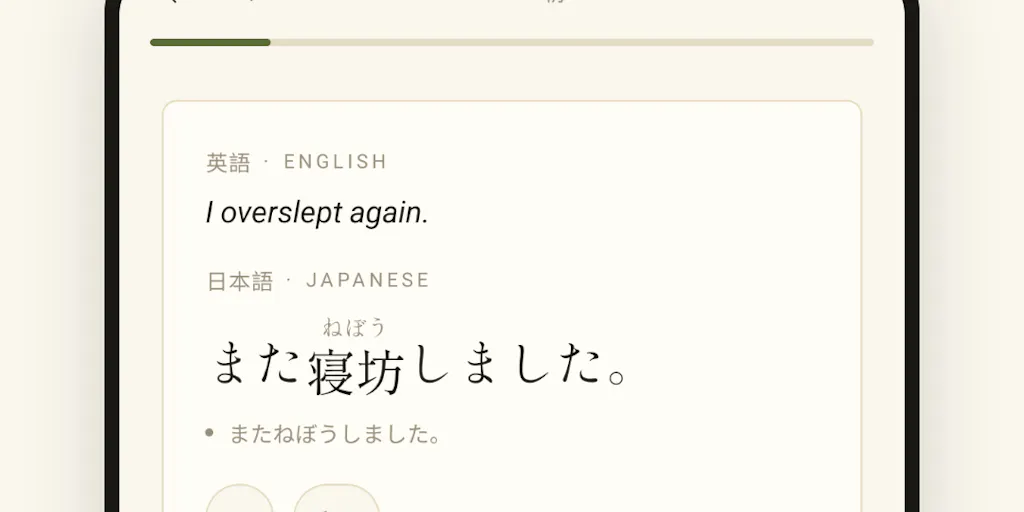
Let me be precise about what the source says, because the launch page is thin and I don’t want to inflate it. Tori is a Japanese listening and SRS (spaced repetition system) product. The maker’s origin story, in his own words, is that he’d “been learning Japanese with the owl for years” — a clear reference to Duolingo’s mascot — and after visiting Japan “quickly realized that I still don’t know Japanese at all.” He wanted more listening and immersion but “felt lost since I never knew what anyone was saying.” So he built Tori to “give you hours of listening while still allowing you to understand what is being said and build vocabulary that you use.”
That last clause is the whole thesis. Not vocabulary you study. Vocabulary you use.
In a follow-up comment, Gal Dayan, who is building Dial, pushes on the most interesting design question on the page: whether Tori builds listening material from your own journal entries rather than “generic stock sentences.” Dayan’s point is sharp — “the vocabulary gap is always ‘the specific words I need’ not ‘the textbook’s words.’” He then asks whether Tori cleans up rough or simplified Japanese into how a native speaker would phrase it, or keeps the literal phrasing so you don’t train your ear on wording nobody would actually use.
That question is not answered in the source. Not disclosed. And I want to flag that clearly, because it’s the single most important unresolved thing about the product.
Why this matters more to a TikTok operator than a LinkedIn one
Here’s my take, and it’s the reason I’m writing about a language app on a social media blog. The platforms have diverged hard on how much spoken, idiomatic, in-group language you need to survive.
LinkedIn rewards a kind of flattened corporate English that travels. You can write it as a second-language speaker, run it through a grammar pass, and it lands. TikTok and Instagram Reels are the opposite. The algorithm optimizes for watch time and completion rate, which means the first 1.5 seconds have to sound like a native speaker talking to a friend — not a brand talking to a market. If your ear is trained on textbook Japanese, your captions, your on-screen text, your voiceover cadence, and your comment replies will all read as slightly off. Slightly off kills retention. Retention kills distribution. This is not a soft skill. It’s a distribution mechanic.
So when I see a tool whose entire pitch is “hours of listening you can actually decode,” I don’t file it under education. I file it under content-market fit for anyone operating outside their first language.
How it differs from the incumbents you already know
The listening-and-immersion category is crowded, and Tori is entering it without a lot of differentiation on the surface. Let me map the field honestly.
The owl. Duolingo is the default, and the maker names it as his own starting point. Duolingo’s strength is habit and gamification; its well-documented weakness is that it produces people who can complete exercises but freeze in conversation. That’s exactly the failure the maker describes. I’ve watched this pattern in my own circles — streaks measured in years, confidence measured in nothing.
Comprehensible input purists. The Refold community and the broader immersion school argue you should just watch native content with subtitles and let acquisition happen. The problem, as the maker says, is feeling “lost.” Pure immersion without scaffolding is demoralizing for most people, which is why so many immersion attempts die in week three.
Sentence-mining tools. Migaku and similar browser extensions let you turn native video into flashcards. Powerful, but they assume you already have the ear to segment what you’re hearing. Tori’s bet seems to be the reverse: give you the audio and the comprehension together.
Journaling-based apps. Dayan’s Dial is in this neighborhood — build the material from your own life. That’s a genuinely different philosophy, and Dayan’s comment suggests he thinks it’s the stickier one. I’d bet he’s right about retention and wrong about scale, but that’s a guess, not a fact.
Where Tori seems to sit, based on the source alone: between pure immersion and pure drilling, with a personalization hook (your own vocabulary) as the differentiator. The team claims it gives you “hours of listening” with comprehension built in. I can’t verify that claim — no user numbers, no pricing, no completion data is disclosed on the page. Treat it as a maker’s promise, not a measured outcome.
The repurposing lesson hiding in here
Here’s the part I’d actually steal for social work, and it has nothing to do with Japanese.
Tori’s core loop is: take input you care about → make it comprehensible → drill the gaps. That is exactly the right loop for content repurposing, and almost nobody runs it that way.
Most creators repurpose by reformatting. Take the YouTube video, cut the vertical clip, post it to CapCut-styled Reels, cross-post to TikTok, done. That’s format-shifting, not repurposing. It ignores the fact that each platform has its own comprehension context. A 60-second clip that works on YouTube Shorts assumes the viewer knows your channel’s premise. The same clip dropped cold into TikTok assumes nothing and dies.
The Tori-style move is to ask: what does this audience not understand yet, and how do I make the next 30 seconds comprehensible to them? That’s a different edit. It usually means front-loading context you’d normally cut, and cutting the inside jokes you’d normally keep. If you’ve ever wondered why your Metricool dashboard shows strong YouTube retention and weak TikTok retention on the same asset, this is usually why. Same content, different comprehension baseline.
What creators and social teams can borrow from it
I’ve run enough cross-platform accounts to know that tooling rarely transfers cleanly, but mental models do. Three things here are portable.
1. Personal vocabulary beats generic templates. Dayan’s comment is the sharpest thing on the page. The words you actually need are the words you actually use. If you’re building a content calendar, the equivalent is: stop pulling hooks from a swipe file of viral formats and start pulling them from your own comment section. The phrasing your audience already uses in replies is the phrasing that will land in your next post. I’ve seen this move engagement rate more reliably than any hook template, and I say that as someone who has tested a lot of hook templates.
2. Comprehension is a retention lever, not a nice-to-have. Watch time is the metric every platform’s distribution rewards, and comprehension is upstream of watch time. If a viewer doesn’t understand the first sentence, they don’t watch the second. This sounds obvious. Almost no one operationalizes it. The practical version: audit your last ten posts and ask how many of them assume context a brand-new viewer wouldn’t have. In my experience, most accounts fail this audit badly.
3. Spaced repetition is underrated as a content strategy. SRS works because it resurfaces material at the moment you’re about to forget it. Social works the same way. The posts that compound aren’t the ones that go viral once — they’re the ones you intentionally re-run with new framing every few months to a growing audience that never saw the original. Most creators treat reposting as lazy. Done with new context, it’s just SRS for an audience.
Where the math breaks
I want to be honest about the limits of this analogy, because I’ve watched people over-apply it.
Language acquisition has a finite target — there’s a real, if distant, finish line where you understand most of what you hear. Audience comprehension does not. Your audience turns over constantly. Every month, a chunk of your followers are new and know nothing about you. So the “make it comprehensible” loop never ends; it just resets. That’s not a reason to skip it. It’s a reason to build it into your calendar permanently rather than treat it as a one-time onboarding fix.
Where I think Tori falls short, and who it’s not for
Now the balanced part, because a launch page with one maker comment and one question is not enough to declare anything a winner.
The personalization question is unanswered. Dayan asked the most important thing on the page and got no reply in the source. Does Tori clean up your rough Japanese into natural phrasing before generating audio, or does it preserve your literal phrasing? If it’s the latter, you risk training your ear on Japanese nobody speaks — which is worse than textbook Japanese, because it’s your textbook. Until that’s answered, I’d hold off on treating the journaling feature as a selling point. Not disclosed.
No pricing, no user numbers, no retention data. I can’t tell you what it costs, how many people use it, or whether anyone sticks past week two. The maker’s testimonial is compelling precisely because it’s personal — he lived the failure he’s fixing. But personal experience is a reason to build something, not evidence that it works at scale. Adrian Knoll’s reply on the page makes exactly this point: “nothing like personal experience to build better solutions!” True, and also the most common reason products fail — the founder’s problem isn’t always the market’s problem.
It’s a single-language, single-skill tool. Japanese listening only, as far as the source shows. If you’re a social operator working across Spanish, Portuguese, and Korean markets, this doesn’t help you yet. If you’re monolingual and operating in English, it’s irrelevant to you entirely. I’d rather say that plainly than pretend every launch is for everyone.
Who it’s not for: absolute beginners who need grammar scaffolding first; people who want speaking practice (listening comprehension and production are different skills, and Tori appears to address one); and anyone who needs a social scheduling or analytics tool, which this is not. If you came here looking for a Buffer or Hootsuite alternative, close the tab.
Who it might be for: intermediate learners who can read but can’t hear, and — more interestingly to me — creators who operate in Japanese-language markets and need their ear to catch idiom, tone, and register before they write a single caption.
What I’d watch / test next
Concrete steps, this week, whether or not you ever open Tori.
First, run the comprehension audit I mentioned. Pull your last ten posts across your two most different platforms — say Instagram and LinkedIn — and mark each one for how much prior context it assumes. My bet is your weaker platform is your higher-context platform. That’s a fixable edit, not a strategy problem.
Second, if you work in a non-native language market, go find out whether Tori answers Dayan’s question. That single answer determines whether the personalization feature is a moat or a trap. If the maker responds publicly, that’s your signal.
Third, steal the SRS habit. Pick three posts that performed well six months ago and re-run them this month with fresh framing and updated context. Track the delta in UTM-tagged traffic if you’re driving to a site, or saves and shares if you’re not. Saves and shares are the closest thing social has to “I understood this and want it later.”
Fourth, watch the listening-and-immersion category generally. If Tori’s journaling-to-audio pipeline works, the same architecture applies to any domain where comprehension is the bottleneck — including, I’d argue, helping new followers understand what your account is even about. Somebody is going to build that for creators. It might as well be you.