The Real Bottleneck for Creators Isn’t Production — It’s Knowing What to Build
Every social-media operator I know has the same pain. We can schedule 30 posts across five platforms in a single morning. We can repurpose a YouTube video into a TikTok, a Twitter thread, and a LinkedIn carousel by lunch. We have AI tools that write captions, generate thumbnails, and even record demo videos while we sip coffee. The *production* side of the creator economy has never been this automated.
But the question that keeps people awake at 2 a.m. is not “How do I make more content?” It’s “What the hell should I make?” The algorithm rewards consistency, but it rewards direction more. One wrong niche, one trend that fizzles after three days, one content series that feels like shouting into a void — those mistakes cost weeks or months of momentum. Most creators solve this by chasing whatever is loudest: a viral sound, a TikTok hashtag, a LinkedIn bro-guru’s latest framework. That approach works until it doesn’t, and when the algorithm shifts (hello, Instagram Reels deprioritizing reposted watermarked content), the audience evaporates.
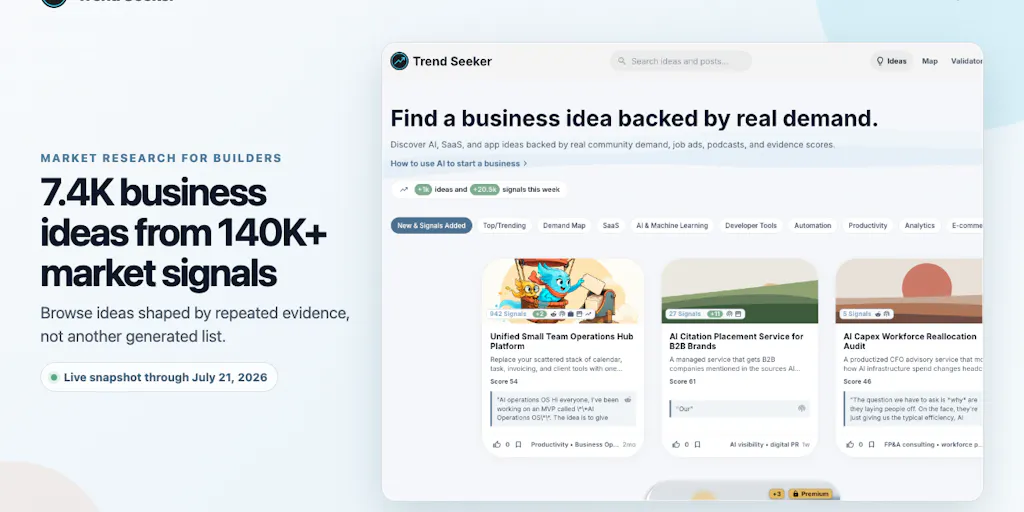
I’ve been watching the Product Hunt launch of Trend Seeker by Tõnis Tiganik with more than casual interest. It’s positioned as a founder tool — aggregate signals from Reddit, podcasts, Google searches, job ads, and launch directories, then cluster them into business ideas. But the methodology underneath it is exactly what creators and growth teams need: multi-source signal triangulation. The same problem a founder faces when deciding whether to build a SaaS product is the problem a creator faces when deciding whether to invest in a content vertical. This essay isn’t a tool review. It’s a look at what the Trend Seeker approach teaches us about content strategy, and where it falls short for the social-media operator’s actual workflow.
The Signal Problem That Algorithms Don’t Solve
Platform-native analytics are useless for this job. TikTok’s Creative Center shows you trending sounds and hashtags, but it shows you what is already popular, not what is about to be. Google Trends gives you search volume, but search volume without context is a trap. A spike in “AI SEO audit” queries could be genuine buying intent, or it could be a single viral tweet sending curious skimmers to Google. Instagram’s Insights tells you what your existing followers engaged with, but it won’t tell you whether a completely new content category has legs.
The core insight in Tõnis’s launch post — “signal quality matters more than raw volume” — is the most valuable sentence in the entire Product Hunt thread. He built Trend Seeker after noticing that “each source showed part of the picture, but none was reliable on its own.” A Reddit thread with 2,000 upvotes might be a one-off. A podcast episode where a KOL says “I would pay for that” carries more weight than a thousand anonymous comments. A job ad asking for “AI content strategist” signals that companies are spending real money, not just talking.
For a creator or social-media team, the equivalent is stark: a YouTube search with high volume but low competition might be a goldmine — or it might be a dead zone where nobody actually watches the content beyond the title. The only way to de-risk is to look at multiple windows into demand. I’ve personally made the mistake of building a content series around a trend I saw only on Twitter: “memecoin education.” Two weeks of scripting, filming, and publishing. The engagement came, but the audience was all bots and tourists. When the trend cooled, the channel dropped back to baseline. That’s the cost of single-source signal.
Trend Seeker’s approach — grouping 140K+ signals into 7.4K business ideas, each linked to its sources — is designed to prevent that. For a creator, it suggests a workflow: before committing to a content pillar, cross-reference at least three independent signals. Reddit complaints (are people frustrated?), Google Trends growth (is the search interest rising?), podcast mentions (are thought leaders discussing it?), and job ads (are companies hiring for it?). If three or four agree, the odds improve dramatically.
How Trend Seeker Differs From Your Current Toolkit
Let’s be honest about what most creators use today. If you’re not running blind, you’re probably leaning on one of these:
- Google Trends — Great for direction, lousy for context. You see a line going up, but you don’t know why or whether the interest comes from casual browsers or active buyers.
- Exploding Topics — Better at surfacing early-stage trends, but focused on broad consumer categories. It won’t show you the specific problems people are griping about on Reddit.
- SparkToro — Excellent for audience intelligence (what your followers read, watch, follow), but passive. It tells you what your audience already does, not what they wish existed.
- Platform-native analytics — TikTok, YouTube, Instagram all give you engagement metrics, but those are outcome metrics. They don’t tell you what to make next.
Trend Seeker sits in a different layer. It’s not a trend-spotting tool; it’s a hypothesis-gathering tool. The product clusters related evidence — a Reddit thread about “I hate writing social media captions” plus a rising Google Trends query for “AI caption generator” plus a job ad for “social media automation manager” plus six similar products on Product Hunt — into a coherent idea. That idea might be wrong, but it gives you a starting point for customer interviews or landing-page tests.
For a creator, the parallel is a content concept validator. Let’s say you’re a LinkedIn creator considering a series on “AI for B2B marketers.” Instead of guessing, you could plug that theme into a tool like Trend Seeker’s free Idea Validator (the maker mentions it returns related requests and nearby ideas). If it returns strong signals from multiple sources — podcast clips, Reddit discussions with high upvotes, rising job ads for “AI marketing specialist” — you have confidence. If it returns scattered noise, you reconsider.
That’s fundamentally different from what Later, Buffer, or Hootsuite offer. Those tools optimize when and where you publish. They don’t touch what you publish. Trend Seeker is a pre-production research layer that sits before your content calendar even opens.
Why Creators Building Products Should Care More Than Pure Content Creators
There’s a specific category of creator who will get disproportionate value from this approach: the indie founder who also publishes content to promote their SaaS. You know the archetype — building a tool while running a Twitter account, a newsletter, and a YouTube channel. That person needs to validate product-market fit and content-market fit simultaneously. The lines blur. A content series that gets traction can become a product feature; a product feature that gets requests can become a content series.
For those hybrid operators, Trend Seeker’s inclusion of job ads and launch-directory signals is a superpower. Tõnis notes that the tool pulls data from around 170k job ads, extracting signals about what companies are hiring for. If you see a rising trend in job postings for “TikTok shop manager” and your content niche is e-commerce, you have a clear signal that money is flowing into that area. That’s more reliable than a hundred retweets.
Pure content creators — the ones who monetize through sponsorships or affiliate links rather than their own product — might find the tool less directly useful. Their unit of output is a video or post, not a SaaS. The job ad signal doesn’t translate as cleanly. But the methodology still applies: triangulating Reddit, Google Trends, and podcast mentions to decide whether to invest in a long-form YouTube series vs. a TikTok micro-content chain.
What Creators and Social-Media Teams Can Borrow Right Now
You don’t need a Trend Seeker subscription to apply the logic. In my own workflow, I’ve started manually replicating the multi-source approach when planning quarterly content strategies. Here’s a concrete process you can test this week:
- Identify a potential content niche — something you’ve been considering but haven’t committed to. For example: “short-form video editing workflows for busy marketers.”
- Check Reddit for genuine frustration or interest. Search r/socialmedia, r/marketing, r/editors. Look for threads with 50+ upvotes and active discussion. Are people complaining about how long it takes to edit? Are they asking for tools?
- Run a Google Trends query for related terms (“video editing for social media,” “AI video editor,” “batch editing Reels”). Note whether the trend is rising and whether it’s seasonal or sustained.
- Listen to one or two podcasts in the space — the maker mentions that a KOL saying “I would pay for that” is a strong signal. You can do this manually by searching episode transcripts for your keyword.
- Check job boards — if you see “Social Media Video Editor” postings with specific skill requirements, that indicates market need.
- Scan launch directories like Product Hunt or BetaList for similar products. Six competitors means the market is validated; sixty means you need a narrower angle.
That’s a two-hour exercise that can save you from two months of misdirected effort. The Trend Seeker team claims their tool automates this — “grouping related evidence into business ideas” — and I believe the automation is valuable, but the discipline of checking multiple sources is what really matters. The tool is a accelerator, not a replacement for judgment.
One detail from the Product Hunt thread that stood out: Tõnis added a mind map feature to his own product after finding a competitor on Trend Seeker. “After adding this feature and updating front page, I started getting more subscribers,” he wrote. That’s a textbook example of using signal to drive a product decision that improved conversion. For creators, the equivalent would be: you discover through cross-referencing that your audience is more interested in “time-saving hacks” than “advanced techniques,” so you pivot your content series. The tool didn’t make the decision for you, but it gave you the evidence to make it with confidence.
Where the Math Breaks
I have to be honest about the limitations, because every creator who picks up a “validate your ideas” tool ends up over-indexing on its predictions. Here’s where I’m skeptical.
First, the tool is designed for SaaS and product founders, not for content creators. Its output is “business ideas” — complete with competitive analysis and market sizing. A creator doesn’t need a business idea; they need a content format and a hook. The unit of analysis is different. Trend Seeker might tell you that “AI for personal finance” is a hot space, but it won’t tell you whether that space works better as a 60-second TikTok or a 20-minute YouTube deep dive. That’s a gap no trend-spotting tool can fill.
Second, the signal quality feature is a work in progress. Tõnis acknowledges that signal count alone is not useful and that they are iterating on weighting sources (podcast reputation, Reddit karma, etc.). Early adopters are effectively beta-testing that weighting. For a busy social-media team, relying on a half-baked signal score could lead to false confidence. I’d want to see more transparency about how each source is weighted before betting a content quarter on a Trend Seeker idea.
Third, the conversion gap is real. A commenter named Clemente Lopez raised the crucial point: “The loudest problem was not the one people paid to solve.” In healthcare, everyone complained about clinical notes, but the money was in reimbursement. For creators, the loudest topic on Reddit might not produce the most engagement on TikTok. The algorithm rewards format fit, emotional triggers, and pacing as much as topic. A tool that measures demand via text-based signals (Google searches, Reddit threads) will miss that a niche with low search volume can still generate millions of views if the content is formatted right (e.g., “day in the life” vlogs).
Fourth, pricing is not disclosed. The Product Hunt page doesn’t mention a plan. If Trend Seeker ends up costing $50–100/month, that pricing works for an agency or a productized creator, but it’s prohibitive for a solo operator who is still trying to get their first 1,000 subscribers. Many creators would be better off spending that money on a decent microphone or a stock footage subscription.
Who Should Skip This Tool
If you’re a creator who already has a well-defined niche and a loyal audience — you know exactly what your people want — you don’t need a signal aggregator. Your signal is your comments section and your DMs. Trend Seeker would be noise.
If you’re a social-media manager at a large brand, your content strategy is likely driven by broader brand positioning and campaign calendars, not by organic trend discovery. You’re better off with social listening platforms like Brandwatch or Sprout Social that give you share of voice and sentiment analysis.
If you’re looking for micro-trends — “what sound should I use on TikTok tomorrow?” — this tool is useless. Its data is aggregated and lagging. It surfaces patterns that develop over weeks, not hours.
What I’d Watch and Test Next
I’m not ready to call Trend Seeker a must-have for creators. But I am ready to call its methodology a must-steal. Here’s my practical plan for the next two weeks:
- Take three content concepts I’ve been sitting on — one around AI tools for creators, one about the death of organic reach, one about repurposing workflows — and run them through the free Idea Validator. I expect the AI tools concept to light up with signals. The organic reach concept might surprise me with high Reddit discussion but low Google Trends — which would tell me the audience is passionate but not searching for solutions. That’s useful nuance.
- Manually cross-reference job ads for “social media automation” and “content repurposing” to see if hiring data aligns with the content I plan to make. If job postings are rising, it indicates companies are desperate for efficiency — a good signal for efficiency-focused content.
- Track whether the tool helps me kill an idea. The hardest discipline for creators is saying no. If Trend Seeker’s free tier shows me an idea has weak signals across all sources, I’ll take that as permission to move on. That alone could save a week of planning.
I’ll also keep an eye on how Tõnis evolves the signal quality feature. If he can weight sources by actual conversion data — not just engagement — that would be a breakthrough for both founders and creators. Until then, treat Trend Seeker as an input, not an oracle. The real value isn’t the tool. It’s the reminder that no single source tells the full story, and the best content comes from the intersection of three or four independent signals that all point in the same direction.


