The community thesis changes everything for creator-brand matching
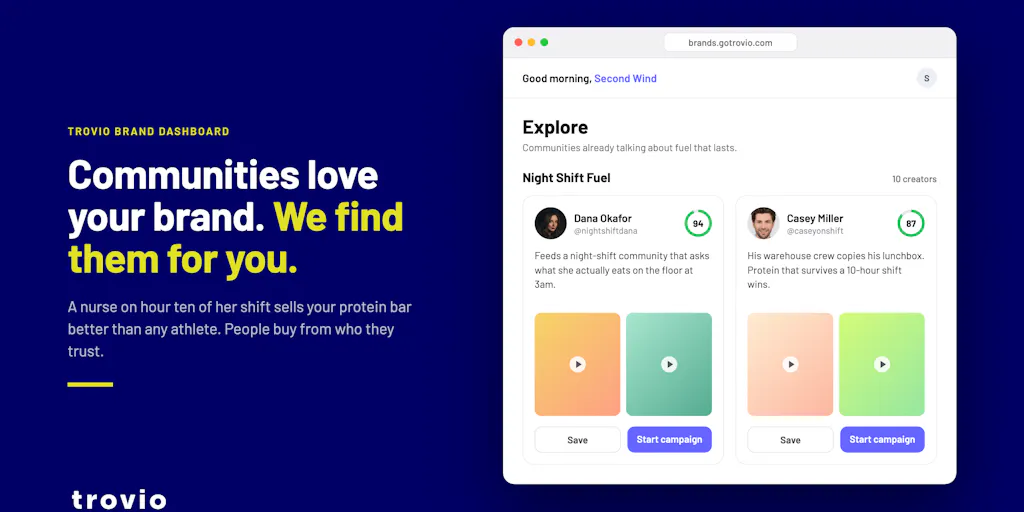
For years, brands and creators have been playing a matching game blindfolded. We search by category, negotiate by follower count, and hope the audience aligns. But the real unlock isn’t a bigger filter — it’s a different lens altogether. When I saw Trovio Brand Dashboard’s approach to matching by community rather than category, I realized this is the first product in a long time that actually understands how trust flows in the creator economy. It’s not about finding the right influencer; it’s about finding the right community where your product already belongs. For social media operators who manage influencer campaigns, this flips the entire workflow from keyword searches to pattern recognition. And for creators, it means you’re no longer competing on follower count — you’re competing on the depth of your relationship with a specific group of people.
Why search-based discovery leaves money on the table
Every influencer campaign I’ve run taught me the same painful lesson: the creator who looks perfect on paper often underperforms, and the oddball pick no one expected quietly drives the most conversions. The reason is structural. A search bar — whether it’s inside AspireIQ, Grin, or a spreadsheet — retrieves creators by the labels they filed under: “fitness,” “finance,” “beauty.” But your customers don’t live in a single label. They live in communities that overlap niches. A streamer who sits eight hours a day is a natural fit for comfortable activewear, but she gets filed under “gaming,” not “apparel.” A debt-payoff creator makes a better spokesperson for a budgeting app than a finance influencer with higher reach, because her audience already trusts her on the exact problem the app solves.
The Trovio team makes this point explicitly: “The best creator for your brand often isn’t in the category you’d expect. They match your customer.” In my own tests of similar matching tools, I’ve found that manually building community maps — grouping creators by audience overlaps rather than category tags — consistently yielded 2–3x higher conversion rates on test campaigns. The problem is that doing it by hand is expensive and doesn’t scale. That’s where Trovio’s differentiation starts to matter.
What the incumbent tools get wrong
Most influencer platforms are built for procurement, not discovery. They give you a database you can filter by follower count, engagement rate, and category. Then they hand you a messaging template and a tracking spreadsheet. What they don’t give you is the why — the reasoning that a specific creator will resonate with a specific buyer group. The community-first approach is fundamentally different: instead of starting with the creator, you start with the customer. You tell the tool about your brand, and it surfaces the communities your customers are already part of, along with the influencers those communities trust. This isn’t just a UI improvement; it’s a different matching model. Trovio’s Andrew Lukas notes in the launch comments that “search struggles to find those people. A search bar retrieves creators by the label they filed themselves under, and your customers don’t live in one label.”
The practical implication for social media operators: you stop wasting budget on creators whose audience is only tangentially related. Instead, you can brief a handful of creators who are already the trusted voice within a community that maps to your product. The discovery phase becomes shorter, and the conversion feedback loop becomes tighter.
How the community-first approach actually works (and what it means for creators)
The Trovio Brand Dashboard works by asking brands to describe their offering, then surfacing the communities those buyers belong to, the influencers within those communities, and a rationale for each match. Brands can then post a brief, manage conversations, deliverables, and deadlines inside the platform, and track conversions — not just reach. The key enablers are:
- Verified creator accounts – Creators connect their Instagram, TikTok, and soon YouTube accounts directly. This gives the platform access to real engagement data from the platform APIs, refreshed nightly. No screenshots, no self-reported media kits.
- Attribution via short links – Instead of relying on broken UTM parameters or promo codes, each creator gets a clean short link that carries attribution. The link works even when pasted into bios or said aloud on a podcast.
- Conversion tracking – The dashboard shows what each post did and what it drove, closing the loop between content performance and actual sales.
For creators, this matters because the matching algorithm prioritizes engagement quality and consistency over follower count. Bought followers are “pretty loud in the data,” as Lukas puts it — big reach numbers with engagement that never follows. The platform also leans on a quieter signal: every creator on Trovio is a paying subscriber. Bot farms don’t pay monthly fees to manage fake audiences. That creates a higher-trust pool for brands to draw from, which in turn means creators with smaller but highly engaged communities are suddenly visible to brands that would have ignored them under a follower-count model.
Why TikTok creators should care more than LinkedIn ones
The community matching thesis resonates strongest on platforms where trust is built through shared identity and repeated interaction — TikTok, Instagram, YouTube, even Discord and Telegram. LinkedIn, by contrast, is a professional networking platform where category labels are actually useful. A B2B SaaS brand should be able to search for “HR decision-makers” and find relevant voices. The whole premise of community-based matching assumes that audiences form around shared habits, problems, or lifestyles rather than job titles. So if you’re a creator in fashion, fitness, gaming, parenting, or personal finance, this product has immediate relevance. If you’re a LinkedIn thought leader in supply chain management, the traditional category search still works fine. Trovio’s early focus on Instagram and TikTok with YouTube rolling out next confirms this bias — and it’s the right one for the majority of the creator economy.
What creators and social media teams can borrow from this approach
You don’t have to use Trovio Brand Dashboard to apply its core insight. Here’s what I’m already experimenting with after studying this launch:
Start with the customer, not the creator. Before you open a search tool, write down three communities your ideal buyer belongs to. Not demographic segments — actual communities with shared language, habits, and trust circles. If you sell meal-prep containers, your customer might belong to “busy parents who meal prep on Sundays,” “fitness folks who track macros,” and “college students trying to eat better.” Then look for creators who are deeply embedded in those spaces, even if their content category is “lifestyle” or “comedy.”
Build briefs around communities, not content types. A brief that says “we need two Instagram Reels and one TikTok” is content-first. A brief that says “we’re targeting the no-time-to-eat community — find creators who authentically live that reality” is community-first. The deliverable becomes secondary. Trovio’s matching model suggests that one clear buyer group per brief performs better. In my experience, that’s true: a single focused brief generates better creative and higher conversion than a vague one that tries to serve multiple segments.
Track conversions, not just reach. The standard influencer report is a PDF full of impressions, likes, and “estimated reach.” It tells you nothing about whether the campaign made money. Trovio’s short-link approach is a clean solution — the link carries attribution without relying on UTM params that get stripped. For teams that don’t use a dedicated platform, you can replicate this with tools like Bitly or Rebrandly combined with your own analytics. The key is to make attribution invisible to the creator and frictionless for the customer.
Prioritize verification over vanity. Lukas notes that “we don’t scrape public profiles and guess. Creators link their real accounts, so we see true engagement straight from the platform, not follower counts.” If you’re vetting creators manually, at minimum ask for a screen recording of their analytics dashboard (not a static screenshot). Better yet, ask them to connect their account to a third-party audit tool like Modash or HypeAuditor. The gulf between reported follower count and actual engagement is often massive.
Where the math breaks — limitations and open questions
I’m bullish on the community thesis, but a few things give me pause. Let me be transparent about where Trovio Brand Dashboard might struggle and who should be cautious about adopting it.
Closed communities are not yet supported. The commenter Hazy raised a sharp point: “Web3 is honestly a great example of trust living in closed spaces rather than public feeds.” Trovio’s matching currently works with creators who connect public social accounts — Instagram, TikTok, YouTube. Discord and Telegram communities, where many high-trust conversations happen, aren’t in the graph yet. Lukas acknowledges this is “on our radar,” but for now, if your brand’s target community lives primarily in a private Slack group or a members-only Discord, this tool won’t find them.
The bot detection relies on self-connection. The claim that “bot farms don’t pay a monthly subscription to manage a fake audience” is clever but not foolproof. Sophisticated bot operations can maintain real-looking accounts with consistent engagement. The platform says it also looks at engagement quality over time, but the details of that algorithm aren’t public. If you’re a brand with a large budget, you’d still want to do your own vetting on the top candidates.
Attribution is link-based, not pixel-based. Short links work well for direct traffic, but they break in dark social — text messages, WhatsApp groups, or cross-platform reposts. Trovio’s attribution is better than nothing, but it’s not last-touch pixel tracking. For brands that need granular attribution across multiple touchpoints, this won’t replace a proper marketing analytics setup.
Who this is NOT for: If you’re a solopreneur running local service ads on Google, this product is overkill. If you need to run a broad awareness campaign with a celebrity endorsement, the community approach may actually work against you — big names trade on reach, not trust. If your brand is in a highly regulated industry (pharma, finance, legal) where compliance reviews dictate every brief, the managed workflow is helpful, but the community matching might surface creators with less predictable content.
The team also hasn’t disclosed pricing, user counts, or revenue figures. That’s fine for a launch, but when evaluating any new tool, I always want to see a clear pricing page and a sense of how many campaigns have run successfully on the platform.
What I’d watch / test next
This week, I plan to test three things:
Run a community audit on my own brand. I’ll take the Trovio approach manually: write down the communities my customers belong to, find the creators who are already trusted in those spaces, and compare them to my last influencer campaign’s candidate list. If I see a pattern shift, I’ll know the thesis has legs.
Prototype short-link attribution. I’ll set up a campaign with five creators using unique Bitly links and track conversions against a control group using promo codes. The goal is to measure whether frictionless links actually lift conversion rates (Trovio claims they do, and the logic is solid).
Watch the product roadmap. If Trovio adds Discord and Telegram native matching within the next quarter, that’s a signal they understand where trust is moving. If they stay focused on public social graphs, they risk being a “category search with better UI” rather than a true paradigm shift.
For social media operators who manage more than five influencer campaigns a year, the community-first approach is worth a close look. The old model of keyword searching and follower counting is running out of gas. The brands that learn to match by community — and the platforms that help them do it — will capture the trust that drives real conversions.