The creator-economy lesson hiding in a $29 Mac utility
Most Product Hunt launches are irrelevant to people who run social accounts for a living. This one is worth your ten minutes anyway — not because you need a desktop organizer, but because of how it was built and priced. Turfs is a solo-developer Mac app that lets you draw named regions on your desktop, drop files into them, and have those files stay put. That sounds like a productivity curiosity. What it actually is, in my reading, is a masterclass in the positioning decisions that indie creators and social operators get wrong every single week: refusing to chase distribution you can’t control, charging once instead of renting access, and picking a fight with the platform’s own defaults rather than begging for permission.
If you publish across Instagram, TikTok, YouTube, X, LinkedIn, Facebook, Threads, and Pinterest, you already make these same trade-offs constantly. You decide whether to build on someone else’s API or own your list. You decide whether to charge for your work or hand it to an algorithm for reach. You decide whether to sandbox yourself into a feature that could be deprecated on a Tuesday. Turfs made all three calls in public, and the reasoning is more useful to you than the app itself.
What Turfs actually does, and why the technical constraint matters
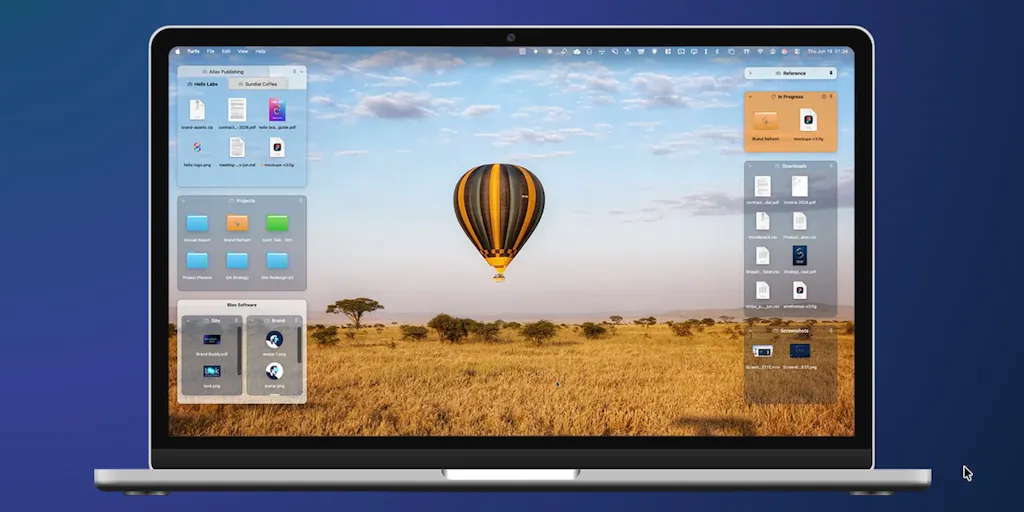
The maker, Ludwig Fun, is blunt about the origin story: he waited more than a decade for someone to bring Fences to the Mac, got tired of waiting, and built it himself. The mechanic is simple. You draw a named area on your desktop. Files you drop in stay where you put them. A turf can be backed by a real folder, so it syncs both ways; by a Finder tag, so it gathers everything on your Mac carrying that tag; or by nothing at all, in which case it’s just a visual container. It works across multiple monitors and Spaces, each Space keeps its own turfs, and you choose what Mission Control does with them. Quit the app and your desktop is exactly as it was — nothing moved, nothing locked in.
The interesting part is the constraint he chose to accept. Making turfs survive Show Desktop was the hardest engineering problem, because macOS treats the desktop as a fixed backdrop and sweeps everything else away. The only way to belong to the desktop layer is to replace Finder’s own icon layer. That decision has a hard consequence: the app can never be sandboxed, which means it can never ship on the Mac App Store. Fun says he decided that was a trade worth making. It’s a direct download, notarized, and self-updating. Pricing is $29 once, no subscription, with a 10-day trial that doesn’t ask for a card. He’s a solo developer. User counts, revenue, and download figures are not disclosed.
Hold that shape in your head, because it’s the same shape as every meaningful decision you make about your content stack.
Why the “can never be sandboxed” line is the whole story
Every creator platform eventually offers you a sandbox. Post natively and you get reach but no data portability. Use the official scheduling API and you get reliability but rate limits and feature lag. Build on a scraper and you get flexibility but you’re one cease-and-desist from zero. Fun looked at the sandbox, understood that accepting it would mean giving up the one feature that made the product worth existing, and walked away from the largest distribution channel in his category.
That is the exact calculus behind every “should I build on this platform or own my audience” argument in the creator economy, and most people get it wrong in the direction of reach. I’ve watched operators spend two years building a following on a platform that then changed its recommendation surface and cut their impressions by more than half. The audience wasn’t theirs. The sandbox was.
How it differs from the incumbents you’re probably already paying
Here’s where the comparison gets useful for social teams, because the desktop-organizer category is a surprisingly good proxy for the scheduling-and-analytics category you actually live in.
Fences is the obvious incumbent — the Windows original Fun spent a decade waiting to see ported. It’s a mature, well-funded product with a long feature history. What it doesn’t have is a Mac-native answer to Spaces and multi-monitor behavior, which is precisely the gap Turfs is aimed at. That’s a classic “the incumbent owns the category but not your platform” play, and it’s the same dynamic that let Later win visual-first creators while Buffer owned the generalist scheduling market and Hootsuite held onto enterprise social teams. None of them are strictly better. They’re better for a specific operator on a specific platform.
The pricing model is the sharper contrast. Almost everything in your stack is a subscription: Metricool, Buffer, Hootsuite, Later, most AI writing tools, most repurposing tools. Turfs is $29 once. No recurring revenue, no expansion revenue, no annual price increase email. For a solo developer that’s a deliberate trade: less lifetime value per user in exchange for not having to keep shipping features nobody asked for just to justify a renewal.
Why creators should care more than most SaaS buyers
If you sell anything — a course, a template pack, a sponsorship package, a membership — you’ve probably been told to move to subscription pricing because it’s “better.” It is better for the seller’s valuation. It is not automatically better for the buyer’s trust, and trust is the actual currency of the creator economy. A one-time price is a promise that the transaction ends. A subscription is a promise that the relationship continues, which means you’d better keep earning it every month.
I’d bet a meaningful chunk of the creator-tool market is over-subscribed and under-loved. People pay for three schedulers, two analytics dashboards, and four AI tools, use maybe 30% of the features, and resent the renewals. A one-time-purchase positioning, done honestly, is a differentiator in a category where everyone else is renting you access. That’s my take, not a claim about Turfs’ business model being superior in general.
What social media teams can borrow from this launch
Three things, and I want to be concrete rather than motivational.
First, the “replace the layer, don’t fight the layer” instinct. Fun didn’t try to make turfs coexist with Finder’s icon management. He replaced it. When I audited my own posting workflow last quarter, I was doing the opposite: trying to bolt a repurposing step onto a scheduling tool that had no native concept of it, exporting CSVs, re-uploading, losing the UTM parameters in the process. The fix wasn’t a better bolt-on. It was replacing the layer — moving the source of truth for a piece of content upstream, so the scheduler was the last step rather than the first.
Second, the “one turf, one job” rule. A turf can be backed by a folder, a tag, or nothing. Three backing modes, one visual metaphor. That’s a good mental model for content buckets. Your evergreen library, your launch assets, and your reactive/trend content have genuinely different backing logic — one lives in a folder, one is tagged across sources, one exists only for the current task. Most social teams collapse all three into a single “content calendar” and then wonder why the calendar is unusable.
Third, the temporary-container idea. In the comments, Peyton Walsh suggested a temporary turf for downloads or files needed only for the current task. That’s a small feature request with a big workflow implication: not everything deserves a permanent home. In your own stack, that’s the difference between a swipe file and a working folder. I keep a “this week only” board that gets deleted every Friday, and it has done more for my output than any tool I’ve paid for.
The repurposing angle nobody talks about
Here’s the operational detail I keep coming back to. When you repurpose one long-form piece into a TikTok script, an Instagram carousel, a LinkedIn text post, an X thread, and a Pinterest pin, you’re not doing five creative acts. You’re doing one creative act and four format translations. The failure mode is treating each translation as a fresh file in a fresh tool with fresh metadata, which is how UTM tracking dies and how you lose the ability to attribute a signup to the platform that actually drove it.
A “turf” for each source asset — one container, everything derived from it lives there, tag-based so it can appear in multiple views — is a genuinely better mental model than a folder tree. I’d bet the teams that get repurposing right are already doing this informally. The tooling just hasn’t caught up.
Where my judgment says this falls short
Let me be balanced, because the launch has real limitations and the maker is unusually upfront about one of them.
The Mac App Store exclusion is the big one. Fun frames it as a deliberate trade, and I believe him, but it has real costs: no App Store discovery, no App Store payments, no automatic trust signal for cautious buyers, and a manual notarization-and-update pipeline he now owns forever. For a solo developer, that’s a permanent maintenance tax. It’s the same tax every creator pays when they leave a platform’s native tools for a self-hosted stack. Sometimes it’s worth it. It’s never free.
The category itself is also narrower than it looks. Desktop organization is a solved-enough problem for most people. The addressable audience is Mac users who (a) care about desktop tidiness, (b) have multiple monitors or heavy Spaces usage, and © are willing to install an unsandboxed app from a solo developer. That’s a real segment, but it’s not a large one, and no user numbers are disclosed to suggest otherwise.
There’s also an open question about longevity. A one-time-purchase solo-developer app has no recurring revenue to fund ongoing macOS compatibility work. Every major macOS release is a potential breaking change, and the icon-layer replacement approach is exactly the kind of thing Apple tends to disrupt. Fun hasn’t said how he plans to fund updates beyond the initial sales. That’s not a criticism so much as a risk I’d want answered before I built a workflow around it.
Who this is not for: anyone on Windows (use Fences), anyone who needs App Store billing or MDM deployment, anyone who wants a subscription with a support SLA, and anyone whose desktop is already clean enough that the problem doesn’t exist. That last group is bigger than the maker probably wants to admit.
Where the math breaks
The $29-once model only works if the buyer count is high enough to fund years of maintenance, or if the developer treats it as a side project rather than a business. Fun describes himself as a solo developer and doesn’t disclose revenue, so I can’t tell you which it is. What I can tell you is that this is the same math every creator runs when they sell a one-time digital product: you need volume, or you need to accept that the thing has a natural lifespan. Neither is wrong. Pretending it’s a forever business is.
What I’d watch / test next
If you run social accounts for a living, here’s what I’d actually do this week, in order.
Audit your sandbox exposure. List every tool in your stack that could be deprecated, rate-limited, or repriced without your consent. For each one, write down what happens to your workflow if it disappears tomorrow. If the answer is “I lose everything,” you have a single point of failure, and it’s probably your scheduler or your analytics layer.
Pick one workflow and replace the layer instead of bolting on. Take your repurposing process — the one where you export a CSV and lose your UTMs — and move the source of truth one step upstream. Test whether the scheduler becomes the last step instead of the first.
Try the temporary-container pattern. Create a working board that gets deleted every Friday. See if it changes what you actually ship.
Watch Turfs specifically for one thing: whether the maker publishes a maintenance or update-funding plan. That’s the signal that separates a one-time-purchase product from an abandoned one, and it’s the same signal I’d apply to any creator tool you’re considering.
And steal the positioning. If you sell anything to creators, test a one-time price against your subscription. Not because subscriptions are bad, but because “no subscription” is a genuinely scarce claim in 2025, and scarcity is the only marketing advantage that doesn’t require an algorithm’s permission.