The doc-rot problem is a content-ops problem, and creators are sleeping on it
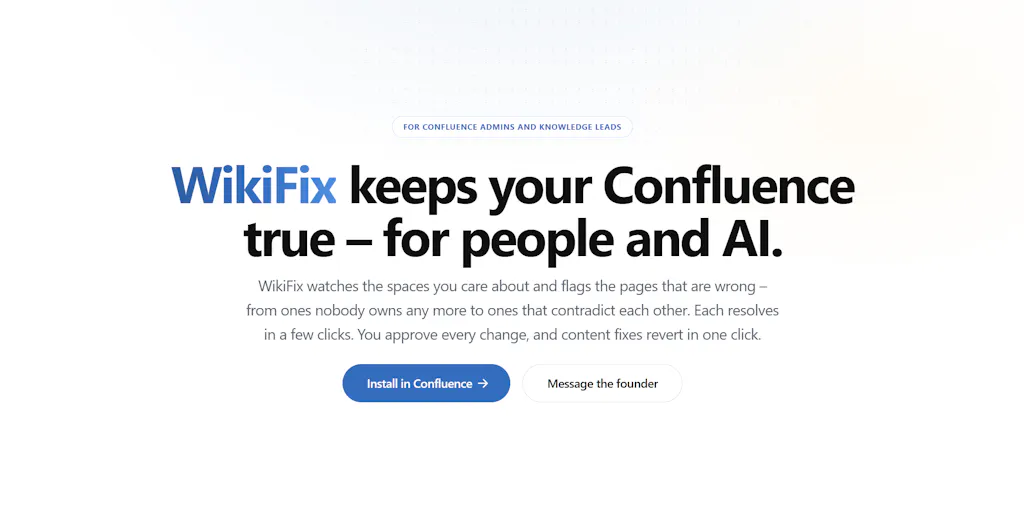
Every social media operator I know is running a de facto knowledge base they never audit: the brand voice doc, the hashtag bank, the posting cadence spreadsheet, the “approved claims” folder, the client onboarding PDF, the crisis-comms playbook. When those go stale, you don’t get a polite warning — you get a junior posting a discontinued product claim, a freelancer using last quarter’s pricing, or a community manager quoting a policy the legal team quietly changed six weeks ago. That’s the real reason a Product Hunt launch about Confluence hygiene caught my eye this week: WikiFix, built by Rezgar Cadro and his team, is a narrow, unglamorous tool aimed at a problem most creator stacks have and almost nobody solves. It scans your knowledge base for contradictions, duplicate pages, and orphaned docs, asks a human which version is correct, and writes the fix — with one-click undo.
That’s the pitch. Below is what I actually think it means for the people who run content operations across Instagram, TikTok, YouTube, X, LinkedIn, Facebook, Threads, and Pinterest — and where I think the framing oversells what a tool like this can do.
What WikiFix actually solves (and what it deliberately doesn’t)
The maker’s framing is refreshingly specific: “If you’ve ever handled an incident with a broken runbook, failed audit due to stale compliance docs, or onboarded someone with outdated guides, you may appreciate a way to keep those docs clean and consistent without frequent manual reviews.” That’s the entire value proposition. It is not a writing assistant, not a summarizer, not a chatbot bolted onto your wiki. It is a contradiction detector with a human-in-the-loop resolution flow.
The mechanics matter here, because the category is crowded with things that sound similar. In v1, WikiFix monitors Confluence spaces for three specific issue types: contradicting claims, duplicate docs, and orphan docs. When it finds a contradiction, it doesn’t decide who’s right. It presents the conflict as a multiple-choice question — the maker’s own example is “Who may sign off an exception for a High or Medium risk?” — with the supporting quotes from each page. You pick the answer, WikiFix updates the relevant pages, and you can revert in one click. Regular Confluence users see a badge saying “X issues found” and can apply an answer if they happen to know it.
The maker pre-empted the obvious objection, which I respect: Rovo and other AI assistants “can help with targeted pages and problems, but not in spotting issues across the board. They start from your question and fetch the few pages likely to answer it. While finding contradictions starts from no question and puts every claim next to every other claim on the same topic.” That’s the correct distinction, and it’s the one I’d lead with if I were positioning this. Retrieval-augmented assistants are query-shaped. Contradiction detection is corpus-shaped. Different data structure, different failure mode, different product.
Where the math breaks
Here’s the number that should shape how you evaluate this: the maker states plainly that “about 1 in 5” findings were wrong when the team hand-checked them, “depending on the wiki.” That’s a 20% false-positive rate, disclosed voluntarily on launch day. I want to be clear that this is unusually honest — most AI launches bury that number or never measure it — but it also means you cannot treat WikiFix output as a queue of confirmed errors. You’re treating it as a queue of candidates, and the human review step isn’t optional politeness, it’s load-bearing.
The maker’s answer to this is a “quality gate” that scores and vets findings before surfacing them, with the option to expand into “less reliable ones” for high-stakes contexts like legal, medical, and compliance. That’s a sensible design, but it introduces a second-order problem: if the default view hides the noisy findings, you don’t know what you’re missing, and if you expand to see everything, you’re back to digging “through AI slop for a rare gem” — the maker’s own phrase. There’s no free lunch in precision-recall tradeoffs, and I’d want to see how the gate is tuned before trusting the default.
The scan numbers are the most interesting part of the launch
The maker ran WikiFix against several public Confluence spaces before launch, and the results are the kind of thing that should make any content lead slightly nervous. From the launch post: NASA showed 57 conflicts across 732 docs, GitLab showed 332 across 4,576, Sourcegraph showed 86 across 901, and Kafka showed 168 across 1,629. The maker links to a public examples page at wikifix.ai/examples if you want to see the actual findings.
I’d flag two things about these numbers. First, they’re the maker’s own scans of public spaces, not an independent audit — treat them as directional, not as a benchmark. Second, and more interesting to me: the rate matters more than the raw count. GitLab’s 332 conflicts across 4,576 docs is roughly one conflict per 14 pages. Kafka is one per 10. NASA is one per 13. Sourcegraph is one per 10. These are four different organizations, four different documentation cultures, and the conflict density lands in a surprisingly tight band. My take: that’s not a coincidence, it’s a base rate. Docs rot at roughly the same speed everywhere, because the underlying cause — humans edit pages independently and don’t re-read the whole corpus — is universal.
Why TikTok creators should care more than LinkedIn ones
If you’re a solo creator posting to TikTok and Instagram, you probably don’t have a Confluence instance and this tool isn’t for you yet. But if you’re running a content team — even a team of three — you almost certainly have some canonical doc that’s drifted: the “how we talk about the product” guide, the “claims we can and can’t make” list, the “which hashtags are banned on which platform” note. The failure mode is identical to the enterprise one. Two people write two versions of the same rule six months apart, nobody deletes the old one, and now your freelancer is following the dead version.
LinkedIn-native B2B creators are actually more exposed here, because their content often cites internal facts — pricing, roadmap, compliance posture — that live in docs nobody audits. A stale claim in a LinkedIn post is a much bigger liability than a stale claim in a TikTok caption.
What content teams can steal from this workflow
The product itself is Confluence-only in v1, with the maker saying it “starts out as a Confluence app but will go standalone in v2” and inviting requests for other KB platforms. Notion is explicitly named as a possible future target. So if you’re a Notion shop, you can’t use this today.
But the workflow is portable, and I think that’s the more useful takeaway for social media operators. The pattern is:
- Pick a corpus. Your brand guidelines, your approved-claims doc, your platform-specific playbooks. One folder, not the whole workspace.
- Scan for contradictions on a schedule. The maker confirmed scans “can run ad-hoc or on schedule,” with weekly or monthly reports landing in your inbox so you “click through the report, answer some questions or send them to owner, and forget about it until the next report.” That cadence — async, batched, low-attention — is the right shape for content ops, because it doesn’t compete with the daily posting rhythm.
- Resolve as multiple-choice, not open-ended editing. This is the design insight I’d steal even without the tool. Presenting a conflict as “which of these two claims is correct?” is a five-second decision. Presenting it as “here’s a doc, fix it” is a thirty-minute task you’ll defer forever.
- Keep two layers of undo. The maker’s point about “WikiFix’s 1-click revert and Confluence’s own page versioning” giving you two safety nets is exactly right, and it’s the thing that makes approving AI edits psychologically tolerable. If you’re doing this manually, version history is your second layer.
The “two true statements from different months” problem
One commenter, Gal Dayan, raised the sharpest critique in the thread: the “pick which answer is right” flow “assumes a single ground truth, but some of our worst doc rot at Dial was actually two true statements from different months that nobody dated clearly.” This is the limitation I’d put at the top of any evaluation. Contradiction detection works cleanly when exactly one statement is wrong. It works badly when both statements were correct at different points in time and the real fix is dating and versioning, not deletion.
The maker didn’t directly answer that question in the thread, and I’d bet it’s genuinely hard — distinguishing “A is wrong” from “A was right in January and B is right now” requires temporal metadata that most wikis don’t reliably carry. If your docs are full of feature-flag-era statements, deprecation notices, and pricing history, expect a meaningful share of findings to be this flavor rather than true errors.
Where I think this falls short, and who shouldn’t buy it
A few honest caveats, some from the source and some from my own read:
It’s Confluence-only right now. If you’re a Notion, Coda, Slite, or Google Docs shop, you’re waiting for v2 or looking elsewhere. The maker is explicit about this and is soliciting platform requests, which is the right move, but it’s a real limitation today.
The 1-in-5 error rate is disclosed, not solved. The quality gate helps, but you’re still approving edits, and approval fatigue is real. If your team already ignores review queues, adding another one won’t help.
The “send it to the owner” flow is a social problem, not a technical one. Routing a contradiction to a page owner only works if page owners respond. In my experience, most wiki ownership is nominal. The tool can surface the conflict perfectly and still fail because nobody with authority clicks the answer.
Not for solo creators. If you’re one person with a Notion page and a content calendar, this is overkill. The value scales with team size and doc count.
Not for teams without a real KB. If your “documentation” is a Slack channel and a pinned message, there’s nothing to scan.
The comparison I’d actually make
The honest competitive set isn’t Rovo or generic AI assistants — it’s the combination of Confluence native search, manual audit sprints, and whatever internal script someone wrote to find duplicate page titles. Against that baseline, a scheduled contradiction scan with a review queue is a clear upgrade. Against a well-run quarterly doc audit with a named owner and a checklist, the value is narrower — you’re buying automation of the finding step, not the fixing step.
I’d also watch how this category evolves against adjacent tools. Notion AI is moving toward workspace-wide Q&A. Guru and Slab have built verification workflows that nudge owners to re-confirm pages on a cadence. WikiFix’s bet is that cross-document contradiction is a distinct, underserved job — and I think that bet is correct, but it’s a feature-shaped bet, not a platform-shaped one. The risk is that Atlassian ships something similar natively inside Confluence and the wedge closes.
What I’d watch / test next
If you run content ops and this resonates, here’s what I’d do this week — none of it requires buying anything:
- Run the free scan offer. The maker’s launch offer is direct: “Got a space you’d bet is fully consistent? Make it your first scan. If WikiFix finds nothing useful there, tell me, and get your credits back twice over.” Pick the doc you’re most confident about and let it try to embarrass you. That’s the cheapest possible test of whether the tool finds things a human wouldn’t.
- Audit your own canonical docs manually first. Before you evaluate any tool, open your brand voice doc, your approved-claims list, and your platform playbooks side by side. Count the contradictions you already know about. That number is your baseline — if a tool can’t beat it, it’s not worth the review time.
- Check the examples page. The public findings at wikifix.ai/examples show what real output looks like. Read three or four and ask whether you’d have caught them.
- Watch the v2 platform announcement. If you’re a Notion shop, the maker is explicitly collecting requests, so it’s worth a comment. If you’re Confluence-native, the question is whether scheduled weekly reports fit your team’s actual review rhythm.
- Pressure-test the temporal case. Find a doc where you know two statements were both true at different times. If the tool flags it as a contradiction rather than a versioning issue, you’ve learned something about its limits before you’ve paid for anything.
The bigger lesson, and the one I’d carry forward regardless of whether WikiFix wins: your content operation has a documentation layer, and that layer is decaying right now. Most teams audit it never. A tool that makes the audit a five-minute click-through instead of an hour of manual editing is worth paying attention to — even if the tool itself is still finding its footing.