The Creator Economy’s Voice Problem Isn’t Content — It’s Infrastructure
Every social media manager I know has a graveyard of half-finished video projects. Not because the ideas were bad, but because the audio was wrong. The voiceover sounded robotic. The transcription missed every other word of that interview. The AI voice you picked for your faceless YouTube channel suddenly got pulled, and you had to re-record 40 scripts in a weekend. We obsess over hooks, hashtags, and posting times, but the actual voice of our content — the literal audio layer — is the most fragile part of the stack. And it’s getting worse, not better.
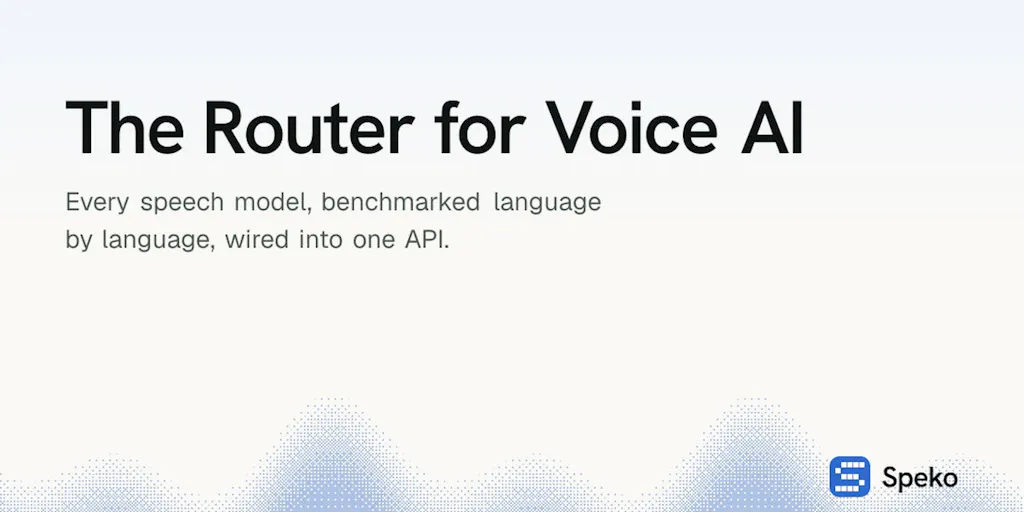
The problem isn’t a lack of tools. It’s a glut of them. Every week there’s a new text-to-speech model that sounds marginally more human, a new transcription service that finally handles that one accent you need, a new voice clone that promises to make your brand sound like a person instead of a robot. But testing them all, comparing them fairly, and then swapping them into your workflow without breaking everything? That’s a full-time job nobody asked for. This is why I was immediately interested when I saw Speko on Product Hunt. It’s not another voice tool. It’s a router for voice models — a middleware layer that claims to solve the selection and integration nightmare. As someone who has spent far too many hours in Google Sheets trying to A/B test audio files, this concept hit close to home. But as a social media operator, I also know that “AI router” is a tech term that needs translation into practical, content-creation reality.
The “Google Sheet of Audio Links” Is Every Creator’s Reality
The founder, Bek Abdik, describes the origin story in a way that feels painfully familiar. He was the CTO at a startup building voice AI apps, supporting 10+ languages. Their process for picking the right speech-to-text or text-to-speech model? A Google Sheet with 15 audio links sent to native speakers for scoring. If a new model was good, you’d swap it in. This isn’t a niche engineering problem — it’s the exact workflow I’ve used for client work, just with different stakes.
Think about the last time you had to choose a voice for a client’s branded TikTok series. You probably went to ElevenLabs, listened to a few samples, picked one that sounded “confident” and “friendly,” and shipped it. But did you test it against the new voices in OpenAI’s TTS? Did you check if a competitor like Play.ht had a model that handled emotional nuance better for the specific script you were using? Probably not. The switching costs are too high. You have to generate the audio, listen to it, maybe render a test video, and then compare it side-by-side with another tool that requires a different API key and a different prompt structure. It’s a time sink that eats into your actual content production hours.
Speko’s premise is that this selection process should be automated and impartial. You tell the router your use case (e.g., “YouTube narration,” “podcast transcription,” “customer support IVR”) and your language, and it routes you to the best model for that specific job, based on their public benchmarks. For a creator, this is the difference between guessing and knowing. It’s the difference between spending an hour on tool selection and spending five minutes.
Why TikTok Creators Should Care More Than LinkedIn Ones
Your platform dictates your audio needs. On LinkedIn, a slightly robotic voiceover in a “thought leadership” video is acceptable — the content is the point. On TikTok, the audio is the content. If your text-to-speech voice sounds like a GPS from 2010, the algorithm will bury you. TikTok’s recommendation engine is notoriously sensitive to user retention, and nothing kills retention faster than audio that grates on the ear. A router like Speko, which can dynamically pick a more expressive TTS model for a high-energy TikTok trend video versus a calm, authoritative one for a YouTube explainer, is a massive workflow upgrade. It’s not just about quality; it’s about contextual quality.
What Speko Actually Does Differently
The critical distinction here is that Speko isn’t trying to be another model in the pile. It’s positioning itself as the OpenRouter for voice AI. For those unfamiliar, OpenRouter is a unified API for text-based LLMs. You send one request, and it routes it to the best (or cheapest) model that fits your prompt. Speko is applying that same logic to the voice stack — speech-to-text, LLM, and text-to-speech.
The key architectural detail that caught my eye is the “proxy-less” design. Abdik explains that routing is decided before the session starts, and then audio flows directly to the provider. This is a huge deal. In a live voice agent scenario (like a phone bot or a real-time translation app), every millisecond of latency matters. If you route audio through a middleman server, you add lag. Speko’s approach avoids that extra hop, ensuring that the audio path is as direct as if you had integrated with the vendor yourself.
This is a stark contrast to how I’ve seen other “aggregator” tools work. Many try to manage the entire session, which introduces complexity and potential points of failure. Speko’s philosophy is more like a smart switchboard operator: it connects the call, then gets off the line.
Where the Math Breaks
However, there’s a catch in the economics. The source doesn’t disclose pricing. For a solo creator, a router service adds a subscription cost on top of the API costs of the underlying voice models. If you’re only generating 20 minutes of audio a month, paying a $20/month subscription to save 30 minutes of comparison shopping might not be worth it. The math only works out when you’re operating at scale — a media agency producing hundreds of videos, a localization team handling multiple languages, or an app developer with thousands of daily active users. For the indie creator, this might be a tool to keep in mind for the future, not a must-have today.
The Impartiality Dilemma: Benchmarks vs. Marketing
The biggest value proposition Speko offers is trust. They claim to be impartial because they don’t train or sell models themselves. This is a smart positioning move. In a market where every vendor claims to be “the best,” having a neutral third party score them is incredibly valuable.
But I have a skeptical eye here. The source mentions they have “public benchmarks,” but it doesn’t specify the methodology or the date of the last update. The voice AI space moves fast. A benchmark from six months ago is essentially worthless. The comment section on the Product Hunt page even shows users asking about this. One user, Lennart Rikk, suggests the site should provide actual voice samples of each model benchmarked across the same text. That’s the kind of transparency that builds trust. A score on a spreadsheet is one thing; hearing the actual output is another. If Speko can maintain a rigorous, frequently updated benchmark suite, they’ll become the de facto standard. If they let it lapse, they’ll just be another directory.
This impartiality is also crucial for the “routing” logic. If Speko had its own proprietary TTS model, there would be a conflict of interest — they’d be tempted to route you to their own product even if it wasn’t the best fit. By staying out of the model-building game, they align their incentives with the user. In my experience, this is rare and valuable.
What Creators and Social Media Teams Can Borrow From This
Even if you never integrate Speko into your stack, the philosophy behind it is a masterclass in operational efficiency for content teams.
1. Standardize Your Evaluation Criteria. The idea of a “Google Sheet with 15 audio links” is actually a good start. The problem is the manual labor. You can borrow this concept by creating a “Voice Benchmark” project in your own workflow. Pick a standard script — one that includes emotional highs, lows, and technical jargon. Run it through your top 3-5 TTS tools every quarter. Listen to them side-by-side. Note which one handles your specific niche best. You don’t need a router to do this, but you do need a system. The act of testing is what separates pros from amateurs.
2. Don’t Be Loyal to a Single Vendor. The source discusses the pain of “swapping” models being seen as an R&D project. In my own experience, this is a trap. I’ve seen teams stick with a subpar voice model for a year because “it’s what we use” or “we already paid for it.” That’s a sunk-cost fallacy. The social media landscape is driven by novelty. A fresh, unique voice can be a brand differentiator. If a new model launches that sounds more engaging, you should be ready to switch. Speko makes that switch easy, but even without it, you should build your content pipeline to be modular — where the voice is a pluggable component, not a permanent fixture.
3. Focus on the “Use Case,” Not the “Model.” When I’m advising clients on video strategy, I tell them to stop asking “What AI voice should I use?” and start asking “What feeling do I want this video to convey?” Speko’s routing logic is built on use cases. This forces you to think about the psychology of your audience. A meditation app needs a calm, soothing voice. A gaming channel needs an energetic, hype voice. A documentary channel needs an authoritative, measured voice. Defining your use case first makes the tool selection process infinitely easier, whether you’re using a router or doing it manually.
Where My Judgment Says It Falls Short
I want to be clear: this is a promising product, but it’s not a magic bullet, and it’s not for everyone.
The Indie Creator Problem. As I mentioned, the cost-benefit analysis is tough for individuals. If you’re a solo YouTuber with 5,000 subscribers, you’re better off spending $20/month on a single high-quality TTS tool that you’ve tested yourself. The problem Speko solves is a comparison problem, and if you only need one voice, you only need to do that comparison once.
The “Black Box” Routing Problem. The source mentions routing to “the best speech-to-text, LLM, and text-to-speech.” But what does “best” mean? Is it the highest accuracy? The lowest latency? The cheapest price? The source doesn’t specify if the user can set priorities. In my experience, “best” is subjective. For a live stream, I need low latency. For a podcast transcription, I need high accuracy and don’t care about latency. If Speko’s router doesn’t let me tweak those parameters, it’s not truly solving my problem — it’s just guessing.
The Language Gap. One commenter, Natalia Iankovych, asks about support for less-common languages like Swedish or Danish. This is a critical question. The source mentions support for 10+ languages, but it doesn’t list them. Voice AI is notoriously English-centric. If the router’s benchmark data is sparse for a specific language, the routing decision becomes less reliable. For creators targeting non-English audiences, this could be a dealbreaker. The source is silent on this, so I’d approach with caution.
The “Voice Agent” vs. “Content Creation” Focus. The source heavily emphasizes “voice agents” — live, duplex sessions like phone calls. This is an enterprise use case. The creator economy use case (batch TTS generation for videos) is mentioned, but it’s clearly not the primary focus. This means the product might be over-engineered for a simple content repurposing workflow. If I just want to turn a blog post into a narrated video, I don’t need a “router” — I need a simple text-to-video tool.
What I’d Watch / Test Next
I’m not going to rush out and rewrite my entire workflow based on a Product Hunt launch. But I’m intrigued enough to put Speko on my radar for a specific set of tests. Here’s what I’d do this week if you’re a head of content or a serious power user:
Stress-Test the Benchmarks. Go to the Speko site. Look for the benchmark section. If they don’t have audio samples, email them and ask. Use their scoring to compare against my own “gut check” for my primary use case (e.g., YouTube narration). The moment I see a score that contradicts my own ears, I lose trust.
Check the Language List. If you create content in any language other than English, check their supported languages immediately. If Swedish isn’t on the list, or if the benchmark data for it is thin, it’s a hard pass for now.
Build a “Modular Voice” Workflow. Regardless of whether you use Speko, take a lesson from them. Isolate your TTS and STT tools in your content pipeline. Use a tool like Make or Zapier to create a system where you can swap out the voice provider with a single variable change. This future-proofs your operation.
Watch the API Docs. For the more technical social media operators, check if Speko offers a simple API that can be integrated with your scheduling tools. If it can route to a cheaper STT provider for your transcription workflow (turning podcasts into blog posts), the cost savings could justify the subscription on their own.
Follow the Founder’s Commentary. The founder’s note about how the “router” concept hides three questions (what gets picked, where it lives, when it decides) is the most insightful part of the entire launch page. It shows he’s thinking deeply about the architecture, not just the marketing. I’d bet that the product’s roadmap will be driven by these nuances, and I’m interested to see how they handle the “when it decides” part — specifically, if they can dynamically switch models mid-session if the quality drops. That would be a game-changer.
The bottom line: Speko is solving the right problem — the discovery and integration problem — but it’s currently aimed at the enterprise and serious developer. For the average social media manager, the takeaway isn’t to buy it today. The takeaway is to adopt its philosophy: be ruthless about testing, be agnostic about vendors, and build your content stack to be flexible enough to adapt to the next big AI voice hit. That’s how you win in this game. Not by having the best tools, but by having the best process for choosing them.