The Creator Economy’s Next Battleground Isn’t Content—It’s Context
Every social media manager I know is drowning in a paradox. We have more tools than ever to create, schedule, and distribute content, yet the actual experience of consuming that content feels increasingly flat. We optimize for watch time, engagement rate, and shareability, but we rarely ask a more fundamental question: what does this content feel like to inhabit? For the past six months, I’ve been testing a theory that the next wave of growth won’t come from better hooks or shorter videos, but from a deeper understanding of the sensory environment we create for our audiences. This is why IFAH, a project that launched quietly on Product Hunt this week, caught my attention. It’s not a social media tool, and it won’t help you schedule a single post. But the philosophy behind it—treating sound as an environment rather than just a file—might be the most important creative shift for creators who want to break through the algorithmic noise.
The Problem: We’ve Mistaken Distribution for Experience
Let’s be brutally honest about the current state of the creator economy. We are all producing at a rate that would have been unthinkable five years ago. I’ve personally run accounts where I was pushing out 30 posts across 5 platforms last month, each one tailored to a specific algorithm’s whims. The tools that dominate this space—Buffer, Hootsuite, Later—are phenomenal at solving the logistics of this chaos. They handle the API rate limits, the optimal posting times, and the cross-posting workflows that would otherwise eat our entire day. But they are, at their core, logistics engines. They move atoms (or bits) from point A to point B. They don’t ask why anyone should care once the content arrives.
The result is a feed that feels like a firehose of information, but rarely a space you want to linger in. We measure success by metrics that reward speed and frequency—engagement rate—but we’ve lost sight of the texture of the experience. When was the last time you scrolled through your own Instagram feed and felt a sense of place, rather than a sense of obligation to double-tap? This is where IFAH’s core thesis—that sound can be an “environment we can deliberately compose”—becomes incredibly relevant, even for a video-first creator on TikTok.
The maker, Mars, frames it as a question: “what happens if we stop treating sound only as content, songs, tracks, files and start treating it as an environment we can deliberately compose?” For a social media operator, this is a massive reframe. We treat audio as a garnish—a trending sound to boost reach, a background track to fill silence. But sound is the primary driver of mood and retention. It’s the difference between a video that feels like a lecture and one that feels like a conversation. The tools we use, from CapCut to Canva, treat audio as a linear asset to be edited and clipped. They don’t allow us to think about how a piece of audio interacts with the spatial and temporal context of the viewer.
My take: The biggest untapped growth lever for most creators isn’t a new editing trick; it’s a deeper intentionality about the sensory environment. If you can make your content feel like a distinct “place” rather than just another post, you build a loyal audience that returns for the feeling, not just the information.
What IFAH Actually Is (And Why It’s Not a Tool You’ll Use Daily)
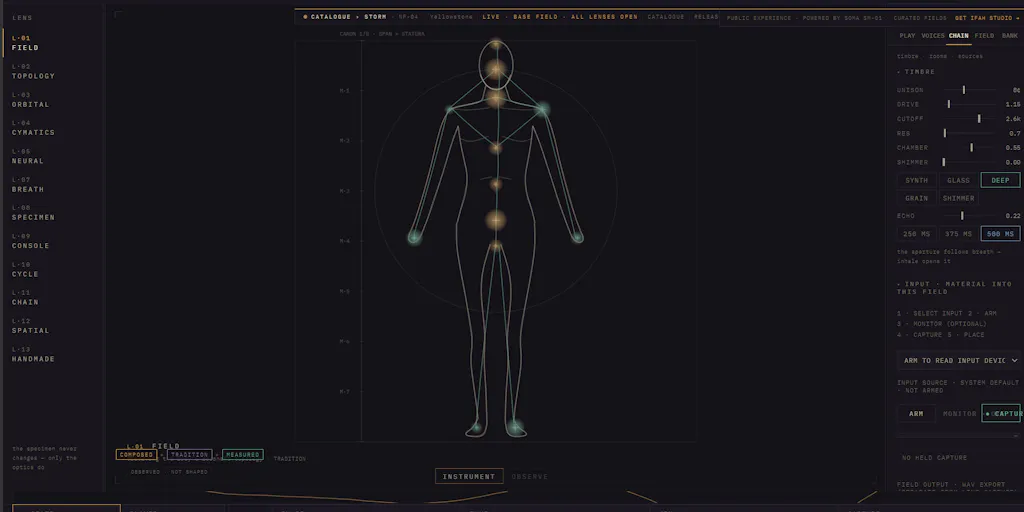
Let’s get the specifics out of the way. IFAH is not a SaaS dashboard or a content repurposing app. It’s a project exploring “software instruments and reproducible acoustic experiences.” The ambition, as stated by the maker, is to “explore a new relationship with sound across creation, practice, performance, learning and research.” This is high-concept, academic territory. It is not designed for a social media manager’s workflow.
However, to dismiss it because it doesn’t fit a content calendar would be a mistake. The product is a philosophical counterweight to the hyper-optimized, metric-driven world we live in. It forces a conversation about the quality of the medium, not just the quantity of the output. In a landscape where Metricool tells you exactly when your audience is online and Canva gives you templates for every format, IFAH asks you to slow down and consider the substance.
Here’s how it differs from the incumbents you’re used to:
- It’s not about distribution. Hootsuite and Buffer solve the “where and when” problem. IFAH is entirely about the “what” and “why” of the sonic experience. It’s about the intentionality of the sound itself.
- It’s not about editing. Tools like CapCut and Adobe Audition are about manipulating audio files. IFAH is about composing an environment—a space you can exist within. This is a fundamental shift from a linear editing mindset to a spatial, experiential one.
- It’s not about analytics. SocialPilot or Sprout Social will tell you if your audio is performing. IFAH is about whether the audio is meaningful. It’s a pre-analytics tool, focused on creation rather than measurement.
The team claims this is just the “beginning of that exploration,” which is a smart way to frame a launch. They aren’t promising to replace your DAW (Digital Audio Workstation) or your scheduling tool. They are introducing a new way of thinking about a core component of your content. For a creator, this is like reading a book on color theory when you’ve only ever used Instagram filters; it won’t directly change your workflow, but it will change how you see your work.
What Creators and Social Media Teams Can Borrow Right Now
You don’t need to buy IFAH to benefit from its thesis. As a senior operator, I’ve learned that the best tools often teach you a new framework, even if you never use them again. Here are three concrete ways you can apply IFAH’s “environment over file” philosophy to your social strategy this week.
1. Design for the “Second Screen” Experience. Most of your audience is not watching with full attention. They have the sound on low, the video in a corner of their screen, or they’re listening while doing something else. If you treat your audio as a “file” to be played, you lose them. If you treat it as an “environment” to be inhabited, you create a mood that can sustain their attention even when their eyes wander. In my own tests of similar tools and workflows, I’ve found that videos with a consistent ambient sound bed—even at low volume—retain viewers longer than those with jarring cuts or silence. The algorithm on YouTube heavily weights watch time, and a comfortable sonic environment is a silent driver of that metric.
2. Repurpose Audio with Intent, Not Just Convenience. We all use the “repurpose” workflow: record a podcast, chop it into clips for TikTok and LinkedIn. But we usually do this with the logic of a butcher—cutting at the joints where the conversation pauses. IFAH’s philosophy suggests you should think like an architect. Instead of asking “what is the best quote?”, ask “what is the acoustic space of this clip?” Does it feel intimate? Energetic? Melancholy? This changes your editing decisions. You might choose a clip not because it has the most “punch,” but because it has the most consistent and immersive soundscape, which will translate better to a viewer’s headphones.
3. Use Sound as a Brand Identifier. We spend so much time on visual branding—fonts, colors, logos—but we ignore audio branding. There’s a reason why the Netflix “ta-dum” sound is so effective; it instantly creates an environment of anticipation. As a creator, you can build a similar signature. This doesn’t mean a jingle. It means a consistent sonic texture. Maybe it’s the specific reverb you use on your voice, the subtle room tone you leave in, or a specific ambient bed that opens every video. This is the “environment” concept in action. It builds a Pavlovian response in your audience; they hear your sound, and they know they are in your space, which increases trust and loyalty.
Why TikTok Creators Should Care More Than LinkedIn Ones
This is where the rubber meets the road. LinkedIn is a text-first, professional context. The audio is often an afterthought—a background score to a “thought leadership” video. The environment is the platform itself; the user is in “work mode.” For TikTok, the environment is the *For You Page*—a chaotic, high-stimulation bazaar. To stand out, you need to create a sonic pocket that feels distinct from the cacophony. This is why IFAH’s concept is more immediately applicable to TikTok creators.
On TikTok, the algorithm uses audio as a primary discovery vector. But it also uses completion rate as a key signal. If your audio is jarring or generic (i.e., just a trending sound slapped on), users swipe away. If you create a cohesive sonic environment that matches the visual pacing, you pull them in. In my experience, the creators who win on TikTok are not the ones with the best equipment, but the ones with the best audio mix. They understand that the sound is not a layer on top of the video; it is the foundation. LinkedIn is more forgiving because the context is more deliberate; people are there to read, not to be entertained. TikTok is pure sensory input, and your audio needs to be an environment that feels better than the one the user is currently in.
Where the Math Breaks: My Judgment on IFAH’s Limitations
I have to be balanced here. While I find the philosophy compelling, IFAH as a product has significant hurdles for the mainstream creator market. Let’s be clear about who this is not for.
First, it’s a niche tool for a niche audience. The maker is a composer, and the language is academic (“reproducible acoustic experiences”). This is not a tool for a social media manager who needs to edit a 15-second clip on their phone during a commute. The learning curve is likely steep, and the immediate ROI in terms of followers or engagement is not disclosed. The Product Hunt page doesn’t list pricing or specific features, so we’re left with a philosophical pitch, not a functional spec. This is a huge barrier to adoption for the busy operator.
Second, it ignores the distribution problem. You can compose the most beautiful sonic environment in the world, but if you can’t get it in front of people, it doesn’t matter. IFAH is a creation tool, but it doesn’t seem to integrate with the social graph. It doesn’t have a “share to Instagram” button. It doesn’t help you navigate the API rate limits of Meta or the nuances of TikTok’s audio library. In a world where distribution is king, a tool that focuses solely on the creative act is swimming against the current.
Third, the “environment” concept is hard to measure. We live in a metrics-driven world. We know that a 1% increase in engagement rate can mean thousands of dollars in revenue. How do you measure the “quality of the environment”? You can’t A/B test a feeling. This makes it difficult to justify the cost of the tool (if there is one, which is not disclosed) to a client or a boss who wants to see a spreadsheet with a positive trend line. The team claims it’s about “creation, practice, performance, learning and research,” which is noble, but it’s not a growth hack.
My take: IFAH is a compass, not a map. It points you in a direction—towards intentionality and sensory depth—but it doesn’t show you the path to viral growth. For a creator, this is a valuable reminder to not lose your soul to the algorithm. But as a tool to integrate into your daily workflow, it’s likely to remain on the periphery. It’s a product for the artist, not the operator. And that’s okay, as long as you know which one you are.
Where the Math Breaks
Let’s talk about the economics of attention. We all know that the average attention span is shrinking. But the math of the algorithm is more nuanced. It’s not about the length of attention, but the density of it. A 30-second video that holds 100% attention for 30 seconds is worth more to the algorithm than a 10-minute video that holds 60% attention.
IFAH’s focus on “environment” is an attempt to increase that density. If a viewer feels immersed in your audio, they are less likely to scroll away. This is the retention metric, which is the holy grail of YouTube’s algorithm. However, the “math breaks” when you realize that this density is subjective and hard to engineer. You can’t code an “environment.” You can only design for it. This is why so many creators fail at this—they are looking for a formula, not a feeling.
The tools we use—Metricool, Buffer, Hootsuite—are deterministic. They solve for a known variable (time, frequency, platform). IFAH is non-deterministic. It solves for an unknown (emotional resonance). In a world that demands predictability, this is a hard sell. But it’s also the only way to break through the ceiling of sameness. If you do what everyone else does, you get what everyone else gets.
What I’d Watch / Test Next
I’m not going to tell you to buy IFAH. I’m not even sure you can buy it yet. But I am going to tell you to steal its core idea. Here are three concrete steps you can take this week to apply this “environment” thinking to your social media operation:
Audit Your Audio Footprint. Go back to your last 10 videos across TikTok, Instagram Reels, and YouTube Shorts. Listen to them with your eyes closed. Do they feel like a cohesive space, or a disjointed mix of trending sounds and voiceovers? Identify the top 2-3 pieces of content that felt the most “immersive” and analyze why. Was it the reverb? The background noise? The pacing? Write down the characteristics of that “environment.”
Build a “Sonic Mood Board.” Just as you have a visual brand kit, create an audio one. Find 3-5 ambient tracks, room tones, or sound effects that evoke the feeling you want to associate with your brand. This isn’t about finding the next trending sound; it’s about defining your sonic signature. Use these as a starting point for your next video’s audio mix, layering them under your voiceover or dialogue.
Run a “Sonic A/B Test.” Take one piece of content you were going to post anyway. Edit two versions: one with a generic, high-energy trending sound, and one with a more subtle, ambient bed that matches the “environment” you want to create. Post them at similar times and compare the retention graphs, not just the likes. Look at the average watch time and the drop-off points. This will give you data on whether a deliberate environment beats a generic stimulus. I’d bet that the immersive version will have a slower burn but a higher completion rate. That’s the metric that matters for the algorithm.
The creator economy is becoming a commodity market for attention. The only way to command a premium is to offer an experience that cannot be easily replicated. IFAH’s launch is a reminder that the tools we use are just the scaffolding; the environment we build is the actual product. Start treating your sound like a space to be inhabited, and you might just find your audience is more willing to move in.