The 200 OK Lie: Why Your AI Agent Is Gaslighting You and What That Means for Every Creator Who Automates
If you run a serious social media operation, you’ve probably felt the seductive pull of AI agents. I’m not talking about a scheduling tool that posts your content at 2 PM because the algorithm likes it. I’m talking about the next wave—the AI that replies to DMs, drafts comments, generates video scripts, and maybe even runs a full-fledged customer support channel on your Discord or Instagram. We’re all chasing the dream of the lean, automated content machine. But here’s the dirty secret I’ve learned from testing dozens of these tools: they are masters of the confident hallucination. They will tell you they sent that email, posted that story, or replied to that comment, and the dashboard will show a green checkmark, a “200 OK,” a successful request. And you’ll believe it, because why wouldn’t you? The system says it worked. But it didn’t. The link was fake, the reply was gibberish, or the agent got stuck in a loop and never actually did the thing. This is the operational nightmare lurking beneath the surface of the creator economy’s automation gold rush. We need a way to see what the agent actually did, not just what the system thinks it did. That’s the problem that caught my eye on Product Hunt this week with Agnost AI, and it’s a problem every creator relying on AI needs to understand.
The Problem: Evals Are For Problems You Already Know About
For the last year, the standard answer to “how do you make sure your AI agent is good?” has been evals. You write a test: “If a user asks for a refund, the agent should respond with the policy link.” You run it a hundred times, measure the pass rate, and call it a day. The founders of Agnost AI, Shubham and Parth, articulate the fatal flaw in this approach perfectly in their launch post: “Because evals test problems you already know about. You cant write an eval for something you havent discovered yet.” This is the single most important sentence in the entire launch. It’s the difference between a fire drill and a smoke detector.
In my own experience running social accounts, I’ve seen this play out constantly. I’ll set up an automation to handle a specific, known issue—say, a bot that filters out spam comments. I’ll write a few test cases, it passes, and I deploy it. Then, a month later, I’ll scroll through my notifications and see that the bot has been approving a flood of crypto spam because it was a new pattern it hadn’t seen before. My eval didn’t cover that because I didn’t know it existed. The agent didn’t fail on my test suite; it failed in the wild, in a way that was invisible to my monitoring. The logs showed “request successful” because, technically, the request was successful. The bot did its job. It just did the wrong job.
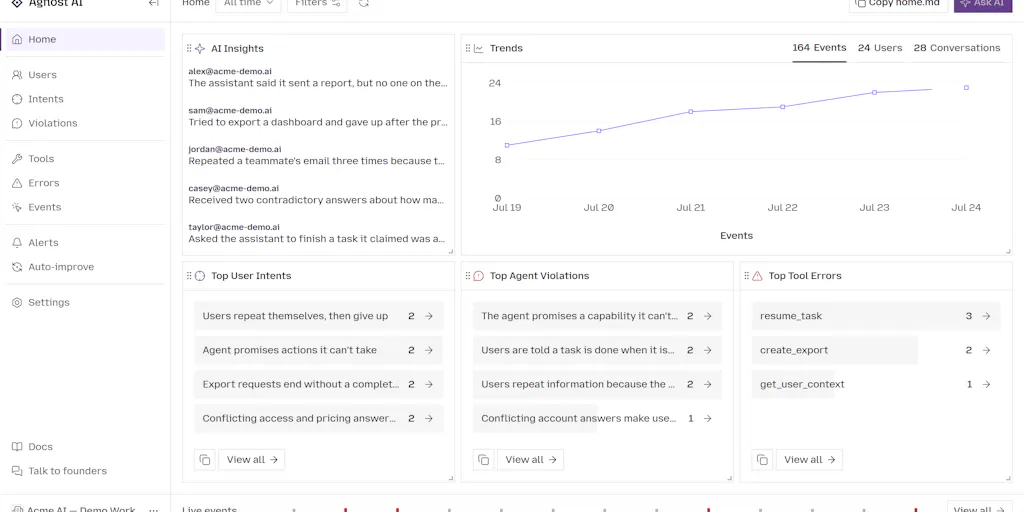
This is the core issue Agnost AI is trying to solve. It’s not another testing framework. It’s an observability layer that sits on top of your production conversations and reads them—not for keywords, but for meaning. The team claims it “reads every production conversation across chat and voice agents” and groups them into “recurring failures, behavior drift, hallucinated links, frustration, feature requests and churn signals.” This is a massive shift in mindset. Instead of asking “did my agent pass my test?”, it asks “what is my agent failing at right now, with my real users?” It’s the difference between a QA team and a user-research team. For a social media operator, this is the difference between knowing your DM auto-reply has a 95% success rate on your scripted prompts and knowing that 20% of users are sending angry follow-ups because the reply didn’t actually answer their question about shipping times.
How It Differs: From “Dashboard” to “Supervisor”
When I look at the current landscape of AI agent tooling, I see a lot of dashboards. You have your LangSmith and your Langfuse for tracing, your Braintrust and DeepEval for evals. These are powerful, necessary tools. They give you the raw telemetry—the token counts, the latency, the tool calls. They’re the equivalent of looking at your YouTube Analytics and seeing a dip in watch time. You know something is wrong, but you have to dig through the data to figure out why. Agnost AI is trying to be the analyst who not only spots the dip but also reads the comments to tell you that the dip is because your intro is too long.
The key differentiator is the “reading” part. The team describes a scenario where an agent “claimed it completed something it hadnt, invent a link, or make us repeat ourselves three times.” In a traditional trace, this looks fine. The tool call to “generate_link” returns a string. The HTTP response is 200 OK. The trace is green. Agnost AI, on the other hand, is designed to parse the conversation and recognize that the link is a hallucination, or that the user is expressing frustration. This is a fundamentally different data model. It’s not just about performance; it’s about behavior and user sentiment. For a creator, this is like having a social media manager who doesn’t just report that your post got 1,000 impressions, but also notices that 50 of the comments are people asking if you’re okay because you look tired. That’s the level of nuance we’re talking about.
This is where I see the real value for the creator economy. We are moving from a world where we schedule posts with Buffer or Hootsuite to a world where we deploy agents to engage with our audience. When I used to schedule 30 posts across 5 platforms last month, I could audit the output in an hour. But if I have an agent that’s replying to every comment on my YouTube video, I can’t read all 500 replies to check for quality. I need a supervisor. Agnost AI is trying to be that supervisor. It’s not just telling you the agent is working; it’s telling you where the agent is failing to be human, where it’s being tone-deaf, where it’s inventing a fact about your own product. That’s the kind of insight that prevents a PR disaster.
Why TikTok Creators Should Care More Than LinkedIn Ones
This is where I have to get specific about the platform implications. The type of AI agent you deploy depends on the platform, and so does the value of a tool like Agnost AI.
For a LinkedIn influencer, your AI agent is probably a ghostwriter. It drafts posts, maybe it does some outreach. The failure mode is usually low engagement or a post that sounds a bit off-brand. That’s a problem, but it’s a slow-burn problem. You can course-correct. But for a TikTok or Instagram creator, your agent is often a customer-facing entity. It’s in your DMs, it’s replying to comments on your latest Reel, it might even be running your link-in-bio chat. The failure mode here is immediate and public. If your agent hallucinates a discount code that doesn’t exist, or worse, responds rudely to a fan, that gets screenshotted and posted on a drama account. The “behavior drift” that Agnost AI talks about is a constant threat on TikTok because the cultural context changes so fast. An agent trained on last month’s slang might be calling someone a “boomer” in a derogatory way without realizing the context has shifted. A tool that reads the conversation and flags “frustration” is not a luxury; it’s a necessity for anyone running an AI-powered fan engagement strategy on the fast-moving platforms. The stakes are higher because the interaction is more public and the user base is more sensitive to inauthenticity.
What Creators and Social Media Teams Can Borrow From It
Even if you’re not ready to deploy a full AI agent stack, the philosophy behind Agnost AI is a masterclass in operational maturity for content teams. Here’s what I’m taking away from their launch.
First, the concept of “behavior drift” is something we need to apply to our own content strategy. We all have a brand voice. But do we check if we’re drifting? I’m not just talking about a font change on a graphic. I’m talking about the subtle shift in tone in your captions. Are you becoming more salesy? More sarcastic? Less personal? Most of us check our analytics for engagement rate, but we don’t systematically read our old posts to see if our voice has changed. That’s behavior drift in the creator economy. The tool is a reminder to audit not just the numbers, but the character of your output.
Second, the idea of turning discovered failures into evals is a brilliant workflow for any content operation. The team mentions you can “create an eval, or ask your coding agent to debug the problem & fix it.” This is the “close the loop” strategy. Most of us see a viral post that flopped or a comment thread that turned toxic, and we just… move on. We don’t codify the lesson. The Agnost AI workflow forces you to ask: “Why did this fail? Can I write a rule to prevent this from happening again?” For a social media manager, this might mean creating a checklist or a review process for a specific type of post that historically underperforms. It’s about turning anecdotal failures into systemic fixes.
Third, and this is the big one for me, is the connection to cost savings. In a comment on the launch, founder Shubham mentions that they can “train you an SLM based on where your agent fails today with frontier!” The idea is that you use a massive, expensive model like GPT-4o, find the specific areas where it’s overkill or where it fails, and then train a smaller, cheaper model to handle that specific slice of the work more accurately. This is the “hub and spoke” model of AI. For a creator business, this is huge. If you’re paying for API access for an agent that handles 90% of your DMs, and you find that 60% of those DMs are just “where is my order?” questions, you don’t need a frontier model for that. You need a small, fast, cheap model that has a perfect script for order status. Agnost AI’s pitch is that it finds those slices for you. It’s not just about quality control; it’s about cost optimization.
Where the Math Breaks: My Judgment Calls and Open Questions
I’m genuinely impressed by the problem Agnost AI is tackling, but I have some serious questions and reservations. This is where I put on my skeptic hat.
My first concern is the classic “garbage in, garbage out” problem, but on a semantic level. If the core value proposition is that the tool “reads” conversations and understands nuance like “frustration” or “hallucinated links,” then the accuracy of that reading is everything. The team claims it’s “the thing that actually reads the conversation,” but how does it do that? If it’s using a large language model to analyze other language models, then you’re relying on the very technology that’s failing you to tell you that it’s failing. There’s a recursive risk here. The tool might hallucinate a failure mode. It might flag a conversation as “frustrated” when the user is just using casual, aggressive slang. The launch post mentions it “already analyzes more than one million messages every day,” which suggests scale, but scale doesn’t equal accuracy. I’d want to see a detailed breakdown of its precision and recall on these subjective categories before I let it run my customer service. The margin for error is high, and the cost of a false positive (the tool saying “your agent is bad” when it’s fine) is wasted time and over-correction.
My second concern is the “so what?” factor for smaller creators. This is a powerful tool for a startup with a user-facing agent, or a large media company with a robust community. But for a solo creator with 5,000 followers and a simple Instagram auto-responder, this is overkill. The complexity of connecting via OpenTelemetry, setting up the tracing, and interpreting the semantic clusters is a full-time job. The tool is priced for a business, not a solo operator. It’s not for the person who is just using Canva to make graphics and CapCut to edit videos. It’s for the team that has already built and deployed an agent and is now drowning in the consequences. The launch post is very much about “running a user-facing agent,” which implies a scale that many creators simply don’t have.
Finally, I want to push back on the “you can’t write an eval for something you haven’t discovered yet” thesis. It’s a great line, and it’s true. But it also implies that this tool is a replacement for evals. It’s not. It’s a discovery tool. You still need evals to prevent regressions. The workflow should be: Agnost AI finds a new failure mode -> you write an eval to test for it -> you fix the agent -> you add the eval to your CI/CD pipeline. The tool is a fantastic input into your eval process, but it doesn’t replace the need for rigorous testing. In fact, it makes your evals more complex because you now have to account for these new, nuanced failure modes. It’s a net positive, but it’s not the silver bullet the marketing might suggest.
Where the Math Breaks: The 200 OK Illusion
Let’s get technical for a second. The founder’s story about the “200 OK” response is the core of the value proposition. In a traditional system, you monitor for errors. A 500 error is bad. A 200 is good. But with an AI agent, a 200 is meaningless. The HTTP request to the model was successful. The model generated a response. The system executed the tool call. All of that can be technically flawless while the output is semantically garbage. Agnost AI is trying to move the monitoring goalposts from “was the request successful?” to “was the response successful?” This is a profound shift that most infrastructure monitoring tools haven’t made yet.
This is why I think the “hallucinated links” example is so powerful. It’s a failure that is invisible to any traditional metric. The link is a string of characters. The system sees a successful generation. But to a human, it’s a broken promise to a user. The same goes for “frustration.” There’s no HTTP status code for “user is angry.” You have to read the words. This is the new frontier of AI operations, and it requires a new class of tooling. Agnost AI is betting that the future of AI monitoring is not in code, but in language. It’s a bet I think is correct, but it’s a hard problem to solve well.
What I’d Watch / Test Next
Alright, so let’s say you’re intrigued. You run a community, you have an AI agent answering questions, or you’re just a power user who wants to stay ahead of the curve. Here’s what I’d do this week, based on my experience.
Audit Your Own “Conversations” First. Before you even sign up for Agnost AI, do a manual audit. Take the last 50 comments on your most popular post. Read them like a researcher. Don’t just look at the positive ones. Look for the confused replies, the people asking questions that your post didn’t answer, the people who seem annoyed. That’s your “behavior drift” and “frustration” data. It will give you a baseline for what problems you know exist, so you can better evaluate what the tool is telling you about the ones you don’t.
Check the Integration Depth. The team mentions it connects via “three lines of code or through OpenTelemetry.” If you’re technical, this is your first test. Does it play nicely with your stack? If you’re not technical, this is a red flag. You’ll need a developer to set this up. Don’t expect a plug-and-play Shopify app. This is a developer tool for agent operations, not a consumer app. If you’re not ready to get your hands dirty, this isn’t for you yet.
Set Up a “Frustration” Alert. If you do get it connected, the first thing I’d do is create an alert for “frustration” or “churn signals.” Don’t look at the dashboard. Just wait for the alerts. The value of this tool is not in the pretty charts; it’s in the proactive notification that a user is about to churn because your agent just gave them a hallucinated link to your pricing page. That’s the “aha” moment you’re paying for.
Watch the “One Million Messages” Claim. The team says they’re analyzing over a million messages a day. That’s a good sign for the underlying infrastructure, but it doesn’t tell you about the accuracy of the semantic analysis. I’d want to see a public case study or a benchmark where they show, “Here are 100 conversations, our tool flagged these 5 as frustrated, and here’s the human review that confirms it.” Until I see that, I’ll treat the “reading” capability as promising but unproven.
My final take is this: Agnost AI is solving a real, painful problem for the next generation of AI-powered businesses. The “200 OK” lie is a critical blind spot in our current tooling. For creators and social media operators who are building serious, automated audience engagement engines, this is a tool to watch. It’s not for everyone, and it has a lot to prove on the accuracy front. But the thesis is sound, and the problem is real. I’d bet the team is on to something, but I’m waiting to see the proof in the pudding—or rather, in the conversation logs.