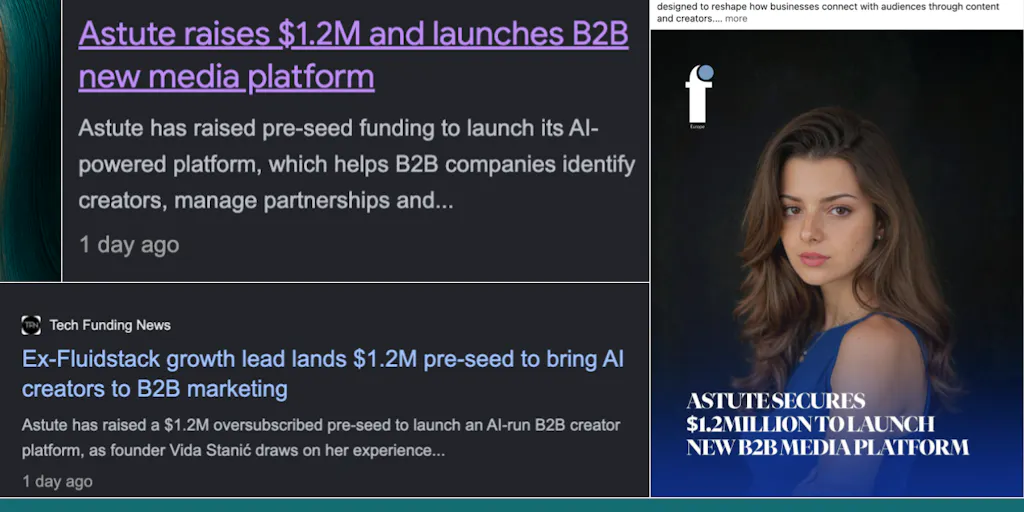
The Creator Economy’s Back-Office Problem Is Now a SaaS Category — and Astute Is the Latest Bet
If you’ve spent more than a year running social accounts, you know the dirty secret of the creator economy: the content is the fun 20%, and the other 80% is a swamp of outreach emails, contract negotiations, invoice chasing, and spreadsheet-based attribution that never quite adds up. We talk about algorithm shifts, engagement rates, and repurposing workflows until we’re blue in the face, but the real bottleneck for brands and agencies isn’t creative — it’s operations.
That’s why the launch of Astute caught my eye. It’s not another scheduling tool or a Canva competitor. It’s an AI-agent platform aimed at managing creator partnerships end-to-end: sourcing, matching, outreach, contracts, payouts, and measurement. And it hit #1 Product of the Day with 495+ points, beating out names like Cursor and OpenAI in the voting — which tells you less about Astute’s long-term viability and more about how hungry the market is for a solution to the operational chaos of influencer marketing.
For social media managers and indie founders, this matters because the tools we’ve been using to manage creators were built for a different era. We’ve been duct-taping together email, spreadsheets, and manual UTM tracking for years. The question now is whether an AI agent can actually replace that glue — or whether it’s just another layer of automation that shifts the pain rather than solving it.
Let me break down what Astute is actually doing, where it fits in the landscape, and what I’d borrow from it even if you never open their dashboard.
The Problem: Creator Partnerships Are a Logistical Nightmare, Not a Creative One
When I was running partnerships for a B2B SaaS brand last year, I had a spreadsheet with 47 tabs. One tab for outreach templates, one for contract status, one for deliverables tracking, one for payment schedules, and one for “attribution” that was basically a graveyard of broken UTM links and unverifiable claims. It took me two full workdays a month just to reconcile what creators had actually delivered against what finance thought we owed them.
The founders of Astute clearly lived this pain. Vida Stanic, one of the makers, mentioned she was at Fluidstack before this and that the worst part was “uploading invoices in the bank or having to manage payouts.” That’s not a niche complaint — that’s the universal experience of anyone who’s run creator campaigns at a company that doesn’t have a dedicated influencer ops team. The comment thread on the Product Hunt page is full of people nodding along: “Anyone who has tried to run creator partnerships manually knows how much of it is chasing contracts and invoices,” wrote one commenter.
Astute’s pitch is that their AI agent handles the whole lifecycle: it sources creators, matches them to your brand, does the outreach, manages the back-and-forth, collects payment, and reports on placement. The team claims the agent can “autonomously outbound, pitch, collect payment and report on the placement, eliminating all the manual lift.” That’s a bold claim, and it’s worth unpacking because the automation of outreach and contracts is genuinely useful — but it’s also where AI agents have historically fallen flat.
In my experience testing similar tools, the outreach part is easy to automate badly. You end up with generic DMs that creators can smell a mile away. The matching part is where the real value hides — and where Astute claims to have spent its engineering time. Their matching engine uses an “extended agentic RAG pipeline” with “enrichment layers” to serve up creator matches tailored to your company. That’s a lot of buzzwords, but the underlying idea is sound: instead of filtering by follower count or niche keywords, they claim to match on the granular trust signals — whether a creator’s audience actually overlaps with your buyer personas.
My take: The problem Astute is solving is real, and it’s not going away. Creator partnerships are becoming a core distribution channel for B2B companies, not just DTC brands. The operational overhead is the #1 reason most companies don’t scale their creator programs past a handful of one-off campaigns. If Astute can genuinely reduce that overhead, it’s addressing a pain point that Buffer, Hootsuite, and Later never touched — because those tools were built for publishing, not for managing the human relationships behind the content.
Why B2B Creators Are the Real Test Case
The comment thread on Astute’s launch has a telling moment. One commenter, Mykhailo Perevoznyk, said that “all kinds of marketing simply repel me” and that he trusts recommendations from creators like Lenny or Pragmatic Engineer over any ad. The Astute team’s response was essentially: “Yes, that’s exactly what we’re building for.”
This is the shift that matters. For years, B2B marketing was about LinkedIn thought leadership posts and SEO content. Now, the buyers are fatigued by both. The algorithm changes on LinkedIn have made organic reach increasingly unpredictable, and SEO is being gutted by AI-generated content and Google’s continued push toward answer boxes and zero-click results. The result is that B2B companies are desperately looking for trusted voices to carry their message — and that’s exactly what Astute is betting on.
But here’s the catch: B2B creator partnerships are harder to measure than consumer ones. A consumer brand can track a promo code or a swipe-up link. A B2B company needs to know which creator influenced a $50,000 annual contract, and that journey often spans months and multiple touchpoints. That’s where the measurement side of Astute gets interesting — and where I have the most questions.
How Astute Differs from the Incumbents
The creator economy tooling space is crowded, but most of it falls into three buckets:
- Discovery platforms like Aspire (formerly Grin’s competitor) or Upfluence, which are essentially databases of creators with contact info and basic analytics.
- Management tools like CreatorIQ or Traackr, which focus on tracking campaigns and measuring ROI for enterprise brands.
- Payment and contract tools like Influencity or Tagger, which handle the financial and legal side.
Astute is trying to be all three, wrapped in an AI agent that does the work for you. That’s ambitious, and it’s also where the risk lies.
The key differentiator, based on the Product Hunt thread, is that Astute doesn’t monetize creators. Stanic says: “Unlike EVERY other platform, we don’t monetize from creators. We don’t charge them $ or %, nothing!” This is a meaningful stance. Most platforms in this space take a cut of creator earnings or charge creators for premium features. That creates a misalignment: the platform’s incentive is to push more transactions through, not necessarily to match the right creator with the right brand. Astute’s model is that companies pay a subscription — the Starter plan is $199, which the team claims is “super startup friendly” — and that covers the network, sourcing, matching, outreach, admin, and payouts.
That’s a clean model, but it’s not novel. What’s more interesting is their approach to attribution, which is the thing that usually kills these tools.
The Attribution Problem: Where the Math Breaks
The most substantive exchange in the entire Product Hunt thread is about attribution. A commenter named Ofir Smolinsky raised the exact problem I’ve hit a hundred times: when creators share links in messaging apps, iOS Mail, or in-app browsers, the referrer gets stripped. A meaningful share of your signups log as “direct” and you can’t tell which post caused them.
This is a real, painful problem. I’ve had campaigns where I knew a creator drove a spike in traffic, but my analytics dashboard showed “direct” because the click came from WhatsApp or the Instagram in-app browser. You end up in a meeting with your CMO saying “trust me, the creator worked” and having no data to back it up.
The Astute team’s response is thoughtful. They don’t claim to recover the referrer — they say you can’t recover what was never sent. Instead, they lean on parameters that travel in the URL itself, not the referrer header. Their agent automatically inserts UTM tags into creator referral links, and can provide proxy URLs if the tags get too long. They also claim to generate a pixel to measure conversions directly and integrate it into Google Analytics.
But the more interesting part is what they call “tracking beyond the direct signals.” One of their engineers, Ishan Kalra, put it well: “A post can send you zero clicks and still get you cited by ChatGPT, quoted in a newsletter, or talked about on a podcast, and a UTM report will tell you it did nothing.” So Astute tracks whether you show up when buyers ask an AI engine about your category, and monitors mentions across social, podcasts, and newsletters. They keep this separate from attributed pipeline. Their founding engineer’s line is worth quoting: “Clicks are what we can prove. Visibility is what compounds. Merging the two into one confident number is how attribution tools lose trust.”
My take: This is the most honest framing of creator attribution I’ve seen from a tool in this space. Most platforms either ignore the problem or pretend they’ve solved it with a dashboard that shows a single “ROI” number that’s basically a guess. Astute’s willingness to separate provable clicks from compounding visibility is a trust signal. But it also means they’re asking you to accept a more nuanced — and therefore harder to sell internally — view of creator impact. That’s a tradeoff that might not work for every organization.
Where the Math Breaks
Here’s the problem with the “visibility compounds” argument: it’s true, but it’s also unfalsifiable. If a creator delivers zero clicks and zero conversions, you can always say “well, they increased our brand visibility.” And you’d be right — but that’s not a scalable argument when you’re trying to justify a $10,000 creator fee to a finance team.
The Astute team acknowledges this. In the thread, they say: “The goal right now isnt to pretend we can attribute every single signup perfectly. Its to give a B2B team enough evidence to answer: which creators are actually influencing pipeline, and where should I put the next dollar?” That’s a reasonable goal, but it’s also a low bar. Any decent analytics setup can tell you which creators drove clicks and conversions. The hard part — and the part that would justify a subscription — is the AI-driven matching and the autonomous outreach. If that works, the attribution is a bonus. If it doesn’t, you’re paying $199/month for a slightly better spreadsheet.
What Creators and Social Media Teams Can Borrow from Astute
Even if you never sign up for Astute, there are three operational lessons from this launch that apply to anyone running social accounts or managing creator relationships.
First, automate the administrative layer, not the creative one. Astute’s pitch is that their agent handles outreach, contracts, and payouts — the stuff that eats your week. That’s the right instinct. The creative work — deciding which creators fit your brand, crafting the brief, reviewing the content — still needs human judgment. The tools that try to automate the creative side tend to produce generic, soulless content that audiences can smell. The tools that automate the logistics free you up to do the thinking.
Second, use UTM tags that survive the in-app browser. This is a practical tip you can implement today. When you send a creator a link, don’t rely on the referrer. Put UTM parameters directly in the URL. Use a link shortener if you need to. Set up a pixel on your landing page. The Astute team’s approach — tagging the link instead of reading referrers — is the correct way to handle the reality that iOS Mail and WhatsApp strip referrer headers. I’ve started doing this for all my creator partnerships, and it’s recovered a significant chunk of “direct” traffic that I previously couldn’t attribute.
Third, separate provable clicks from compounding visibility. This is the most mature takeaway. Don’t try to cram every creator outcome into a single ROI number. Track clicks, conversions, and pipeline separately from mentions, share of voice, and AI citations. The former tells you what’s working now; the latter tells you what’s building for the future. Most teams try to merge them and end up with a number that nobody trusts.
Why TikTok Creators Should Care More Than LinkedIn Ones
It’s worth noting that Astute’s positioning is heavily B2B — they mention startups, founder credibility, fundraising, and hiring as use cases. That means their creator pool is likely skewed toward LinkedIn, YouTube, and newsletter creators, not TikTok dancers or Instagram lifestyle influencers.
But here’s why TikTok creators should still pay attention: the platform’s algorithm has been shifting toward search behavior, and TikTok is increasingly becoming a discovery engine for products and services. A well-placed TikTok creator can drive more qualified traffic than a LinkedIn post, but the attribution is even harder because of the in-app browser issue. If Astute can crack the attribution problem for B2B creators, the same approach could apply to TikTok — and that would be genuinely valuable.
The flip side is that TikTok creators are more likely to be paid per view or per engagement, which is a different payment model than the flat-fee structure Astute seems to be built around. That’s a gap I’d want to see addressed.
Where I Think Astute Falls Short
I’m cautiously optimistic about Astute, but there are three areas where I’d want more clarity before committing to a subscription.
The AI matching is unproven. The team claims their matching engine uses an “extended agentic RAG pipeline” and “enrichment layers,” but there’s no public data on match quality. In my experience, AI-powered matching tools in the creator space have been hit-or-miss. The best ones use a combination of audience overlap analysis and manual curation. The worst ones just keyword-match “tech” and “B2B” and call it a day. I’d want to see a few sample matches before trusting the algorithm.
The pricing page needs work. One commenter, Urh Meza, pointed out that the pricing page doesn’t clearly answer whether creators are charged separately or if it’s included in the subscription. The Astute team clarified that companies pay the subscription and creators are paid separately if they charge fees — but that’s a detail that should be front-and-center on the pricing page, not buried in a Product Hunt comment thread. If the team is reading this: fix that, because it’s a key decision-making factor for buyers.
The “AI slop” problem is real. The team talks a lot about how AI-generated content is destroying trust in marketing, and they position themselves as the antidote. But their own tool is AI-driven. The risk is that the outreach messages their agent sends start to feel like every other AI-generated pitch. The team claims they’ve solved this — one engineer says he’s “personally worked to solve several of those pain points” — but I’d need to see the actual outreach templates before believing it. The trust that makes creator partnerships work is fragile, and it’s easy to burn it with a single generic DM.
Who this is NOT for: If you’re a solo creator or a small team doing a handful of partnerships a year, $199/month is probably overkill. You can manage five creators with a spreadsheet and a prayer. Astute makes sense when you’re running 20+ partnerships across multiple campaigns and the administrative overhead is eating your week. It also doesn’t make sense if you’re looking for a creative tool — this is operations, not content.
What I’d Watch / Test Next
The creator economy is entering a consolidation phase. We’ve seen the publishing tools mature (Buffer, Later, Metricool), the analytics tools mature (Socialbakers, Sprout Social), and now the partnership management tools are starting to mature. Astute is an early bet on the idea that AI agents can handle the back-office of creator marketing. That’s a thesis I believe in, but the execution is still being tested.
Here’s what I’d do this week if I were a social media manager or indie founder evaluating Astute:
Sign up for the free trial. The team is offering a free trial until the end of the month with the code PRODUCTHUNT, so the cost of testing is low. Ask them for sample creator matches in your niche and see if the quality surprises you or disappoints you.
Run a small pilot, not a big campaign. Pick three creators from their matching pool and run a test partnership. Track everything with Astute’s UTM tags and their pixel, but also track it manually in your own spreadsheet. See if their attribution numbers match your own. If they do, that’s a strong signal. If they don’t, you’ve learned something about their reporting.
Ask the hard questions on a sales call. The team seems genuinely responsive — their CEO offered to jump on a call with a commenter. Use that. Ask them how they handle the “AI slop” problem in their outreach. Ask them for case studies of startups that have seen measurable pipeline from creator partnerships. Ask them what happens when a creator doesn’t deliver — who owns the risk?
Borrow their attribution approach regardless. Even if you don’t use Astute, start tagging every creator link with UTM parameters that survive in-app browsers. Set up a pixel on your landing page. Separate your “provable clicks” from your “compounding visibility” metrics. That’s a discipline that will serve you no matter what tools you use.
The creator economy is getting more sophisticated, and the tools are catching up. Astute isn’t the final answer — but it’s a sign that the back-office problem is finally getting the attention it deserves. That’s good news for anyone who’s spent a Sunday night reconciling creator invoices and wondering why the “future of marketing” feels so much like accounting.