The Most Overlooked Creator Skill Isn’t Content—It’s Warmth
If you’ve been managing social accounts for more than a year, you’ve felt the creeping dread that comes when you hit “Schedule” on a DM sequence or a LinkedIn comment thread. You’ve watched the open rates tick down, the replies turn to one-word thank-yous, and the inbox fill with polite declines. The standard advice—send more volume, use better subject lines, A/B your CTA—treats the symptom, not the disease. The disease is that you’re still a stranger when you send that first message.
I’ve run campaigns where I spent three hours manually researching and commenting on a prospect’s last ten posts before sending a single note. It worked. Reply rates jumped from maybe 5% to around 15%. But it was not scalable, and it was brutally boring—the same pattern of scanning feeds, writing thoughtful replies, and hoping I didn’t confuse one person’s job title with another’s. That’s the exact gap the team behind Fuzzy AI set out to fill, and while their Product Hunt launch frames the tool as a sales platform for founders and SDRs, the underlying idea hits something far more relevant for creators, content operators, and growth marketers: warmth as a workflow, not a vibe.
Below, I’ll unpack why this “relationship-first” approach matters for anyone who builds an audience or books deals on social media, where Fuzzy nails the mechanics, where it still leaves cold spots, and what you can steal from it without touching a line of code.
Why “Warm-Up” Is the Only Growth Loop That Still Works
Every algorithm update over the last three years—from LinkedIn’s “relevant conversations” push to Instagram’s shift toward close-friend sharing—punishes the cold blast. The platforms have learned that high-volume, low-context messaging destroys engagement quality Metrics like watch time and reply rate now penalize accounts that behave like spammers. Meanwhile, the creator economy has matured to a point where personal brands are worth more than follower counts. A DM from a well-known creator you’ve never interacted with still feels cold. But a DM from someone who commented on your post last week, liked your thread, and referenced your specific take on distribution? That feels like a natural next step.
Fuzzy’s core premise—build familiarity before you even send the first message—is exactly what the top 1% of creators and social media teams do manually. They don’t pitch. They engage. They comment with substance, not generic flattery. They remember that the person they’re talking to already replied to a thread about repurposing content. Then, when the time comes to propose a collab or a sponsored post, the ask isn’t an ask—it’s a continuation of a conversation.
The tool itself, launched on Product Hunt by founder Serena Lam, is pitched as a platform that “warms up your prospects before you ever reach out, so your first message doesn’t feel cold.” The comment thread on its launch page includes a typical exchange: the maker notes that a comparable cohort went from a 4% cold reply rate to 14% after warming—roughly 3.5x improvement. Those numbers are early and self-reported, but they match every test I’ve run with manual warm-up sequences.
What’s interesting for creators is not the tool itself (I’ll get to who should and shouldn’t use it), but the systematized approach to personalization at scale. That’s something we rarely talk about in content circles. We obsess over hook, format, and posting frequency, but the actual relationship-building side—turning a follower into a collaborator or a sponsor—is still treated as a black art. Fuzzy tries to turn that black art into a pipeline.
What the product actually does (and why it’s not just another LinkedIn automation hack)
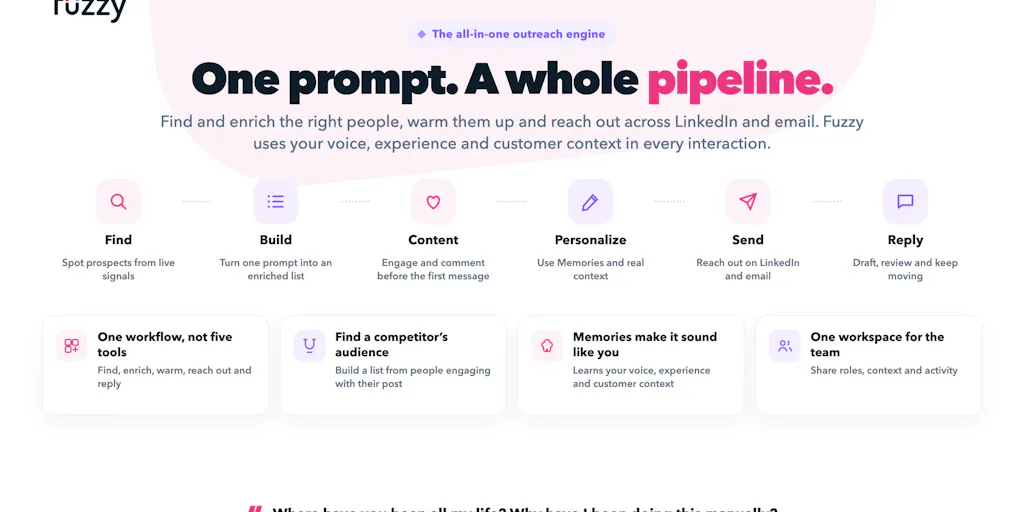
Let me strip away the sales jargon. Fuzzy is a platform that:
- Finds the right people by researching companies, building targeted lists, and identifying “people already engaging with relevant creators or competitors.”
- Engages on your behalf by surfacing prospect posts in a feed called “My Feed” and helping you (or automatically) write thoughtful comments and LinkedIn posts.
- Memorizes context through a “Memories” feature that learns your writing style, product, audience, and past conversations—so every comment and message is grounded in who you actually are.
- Runs multi-step campaigns—LinkedIn messages and emails—with follow-ups that don’t feel robotic because the AI already knows what you’ve said and what they replied.
- Handles replies with drafts that you can review, edit, or approve, or you can set it to autopilot within certain guardrails.
That’s a lot of moving parts. But the essential insight is that personalization is not a prompt—it’s a database problem. Most AI tools hand you a text box and say “write a personalized message.” They don’t know what you talked about three days ago, or that the prospect is a fan of the same newsletter, or that you already identified a shared overlap. Fuzzy forces you to feed it that context, and it remembers.
Compare that to the current state of creator-facing tooling. Buffer and Hootsuite are brilliant for scheduling, but they don’t help you think about who to comment to and why. Later and Canva handle visuals, not relationship workflows. Even the more advanced social listening tools (Brandwatch, Sprout Social) surface mentions but don’t weave them into a sequence. Fuzzy sits in a category that doesn’t really have a creator-market equivalent—I’d place it closer to a CRM like HubSpot Sales Hub or Outreach, but with a LinkedIn-first, content-engagement layer baked in.
Why TikTok creators should care more than LinkedIn ones — TikTok engagement is driven by algorithm distribution, not direct relationship building. A warm-up sequence before DMing a collaborator on TikTok almost never happens because the platform doesn’t surface prior interactions the same way LinkedIn does. LinkedIn, by contrast, is built on comment threads, mutual connections, and shared industry context. That’s why this tool makes sense primarily for creators who operate on LinkedIn—personal brand educators, B2B thought leaders, agency owners, and indie founders who use LinkedIn as their primary distribution channel. If you’re a dance creator on TikTok, this tool’s utility drops to near zero. But if you’re a creator who monetizes through consulting, sponsorships, or affiliate deals that require trust and credibility, the warm-up loop is your lifeline.
Where the Math Breaks—And Where Fuzzy Could Help You Fix It
The biggest mistake I see creators make in outreach is treating it like a yield curve: “If I send 100 cold DMs, I’ll get 5 replies, and maybe 1 booking.” That math works if your volume is high enough, but it destroys your reputation and burns platform goodwill. LinkedIn will shadowban accounts that send too many connection requests without sufficient interaction. Instagram’s message limits aren’t just rate caps—they’re designed to force you to build proximity.
Fuzzy’s approach implicitly tackles this by shifting the cost from volume to context. Instead of sending 100 cold messages, you spend that time engaging with 10 prospects meaningfully. The platform helps you do that at scale by automating the research and the first-draft comments, but it still requires a review step. The maker acknowledges that “it still gets things wrong sometimes. When in doubt, we’d rather post nothing.” That’s the right posture.
In my own tests of similar tools—Dux-Soup for LinkedIn automation, Lemlist for cold email—the dominant failure mode was the same: the AI would draft a comment that sounded plausible but lacked the specific detail that signals you actually read the post. Fuzzy’s “Memories” feature is supposed to solve that by storing not just your tone but your actual knowledge base. For example, if you’re a creator who covers “content repurposing workflows,” Fuzzy should learn that you prefer to cite specific tools (like CapCut or Metricool) and avoid generic advice. That level of memory is hard to build in a generic sales tool—it requires the user to invest upfront in feeding the system.
The memory feature is the real MVP
Serena Lam says in a comment that “Memories teach Fuzzy about your company, product, audience, offer, and writing style.” For a creator, this translates to: your niche vocabulary, your unique takes, your past collaborations, your “no-go” topics. If you’ve ever manually maintained a spreadsheet of “things I know about each subscriber” for email lists, you understand the pain. Fuzzy tries to automate that for LinkedIn relationships.
The danger, of course, is that the memory becomes stale or incomplete. If you change your offer or your content niche, the AI will keep drafting based on old context. That’s a trust issue the team acknowledges by giving users full control over which messages go out. I’d argue that for a creator with a tight schedule, the review step is both a blessing and a curse—it ensures authenticity but adds a cognitive load that might defeat the time-saving purpose. The ideal user is someone who already does manual warm-up but wants to cut the research time by 60–70%.
What Creators and Social Teams Can Borrow (Without Buying the Tool)
I’m not going to pitch you on signing up for Fuzzy today. The tool is clearly built for sales teams and founders doing high-ticket B2B outreach—pricing wasn’t disclosed in the launch page, but its feature set suggests a premium tier that may not make sense for a solo creator with a small audience. However, the workflow it encodes is immediately useful.
Here’s the one-week experiment I’d recommend:
- Identify 10 prospects (sponsors, collaborators, mentors) on LinkedIn.
- Build a “mini memory” for each: what they recently posted, what they care about, any overlap with your expertise.
- Engage three times before any DM—by commenting on posts, sharing their content with your own take, and maybe tagging them in a relevant thread.
- Track reply rates on the eventual DM. Expect at least 2x improvement over cold DMs.
This is the essence of Fuzzy’s approach, and you can do it with a notebook and a browser. The platform just adds automation and a centralized workspace.
For social media teams managing client accounts, the “team workspace” and “duplicate prevention” features are worth noting—one commenter on the Product Hunt page asked about coordination across multiple reps targeting the same enterprise account. That’s a real problem in agencies managing multiple brand accounts. You don’t want two team members commenting on the same prospect’s post within the same hour. Fuzzy flags those overlaps. Any tool that helps you avoid looking like a coordinated spam campaign is worth evaluating, even if you end up using a different CRM workflow.
Where the math breaks — The warm-up loop only works if the prospect is actively posting. If you’re targeting someone who hasn’t posted in months, no amount of friendly comments will build familiarity; you’re back to cold. Fuzzy relies on “My Feed” surfacing active accounts. That means your targeting needs to be both strategic and statistically likely to produce engagement. For niche B2B creators where the audience pool is small, you may run out of active prospects quickly. The platform also doesn’t cover Instagram or TikTok commenting—if your deals happen on those platforms, you’re out of luck.
Limitations I’d Flag Before You Get Too Excited
Let’s be honest about where this tool falls short for the average social media operator:
- No multichannel support. LinkedIn and email are its only touchpoints. If you’re trying to warm up prospects on Instagram, YouTube, or X, Fuzzy won’t help. X (formerly Twitter) conversations are entirely left out. For creators whose primary monetization comes from Instagram DMs or YouTube super chats, this is a non-starter.
- The “AI sales platform” framing is a double-edged sword. The language in the launch page (“prospecting,” “campaigns,” “sequence”) screams sales, not community building. Creators who value authentic engagement may feel squeamish about automating comments. The maker addresses this by emphasizing the review step, but the perception risk remains—if a prospect discovers an AI is writing comments on your behalf, trust erodes fast.
- Pricing is undisclosed, and the tool likely requires a subscription that may not suit a solo creator’s budget. Without a free tier or a clear creator-friendly plan, it’s hard to recommend blindly.
- Results are early and campaign-dependent. The 4% to 14% improvement is from one comparable cohort, not a large-scale study. Your results will vary widely based on industry, targeting, and message quality.
- No integration with content scheduling tools. As a creator, you already use Buffer or Later to schedule posts. Fuzzy doesn’t natively sync with them, so your content calendar and your engagement calendar remain separate unless you build your own workflow.
The team is responsive—CTO Bladen Lam specifically asks for feedback on “whether the review steps give you enough confidence.” That’s a good sign. But for now, Fuzzy is a promising wedge into a pain point that most creator tools ignore, not a complete solution.
What I’d Watch / Test Next
If you’re a creator or social media manager who operates on LinkedIn and already runs a manual warm-up process, sign up for Fuzzy’s free trial (if one exists—the site let me request access). Run a two-week experiment:
- Week 1: Use Fuzzy’s “My Feed” and commenting features on 20 prospects. Track how many comments you approve vs. edit vs. discard. Measure time saved.
- Week 2: Launch a campaign to the same 20 prospects. Compare reply rate to your baseline cold outreach (the last 20 DMs you sent without warming).
Even if you don’t keep the tool, you’ll walk away with a clearer sense of what an automated warm-up loop should look like. That insight is worth more than any subscription.
For teams: evaluate whether the workspace and duplicate detection could replace a spreadsheet. If you’re managing three or more account executives on LinkedIn, the coordination cost is real, and Fuzzy’s shared context might justify the price.
Final thought: The creator economy is moving from “growth at any cost” to “earn the right to be in the inbox.” Fuzzy’s approach is a direct response to that shift. Whether you use their platform or copy the method, the lesson is clear: warmth is not a nice-to-have. It’s the only channel that still converts.