The DM Is the New Landing Page — and Most Creators Are Still Treating It Like a Comment Section
Every social media operator I know is chasing the same phantom: the algorithm. We obsess over watch time, share rates, and the latest TikTok update, all while the most valuable real estate we own sits ignored. I’m talking about the direct message inbox. When I look at my own account analytics across platforms, the pattern is undeniable — the people who comment, share, and eventually buy almost always start in DMs. Yet we treat inbound messages as a support burden, something to check twice a day and answer with a canned “thanks for reaching out!” Meanwhile, the smartest operators I know have quietly realized that a DM conversation is worth more than a thousand impressions. It’s a warm lead, a qualified signal, a person who raised their hand. The problem has never been the opportunity; it’s the operational capacity to actually show up for those conversations at scale. You can’t hire a team of human responders for every creator account, and you can’t be awake 24⁄7 during a launch window. This is the gap that AI agents are finally starting to fill, and it’s why the Ninjō AI launch on Product Hunt caught my attention — not because it’s another chatbot, but because it represents a shift in how we think about the entire social media funnel.
What Problem This Actually Solves
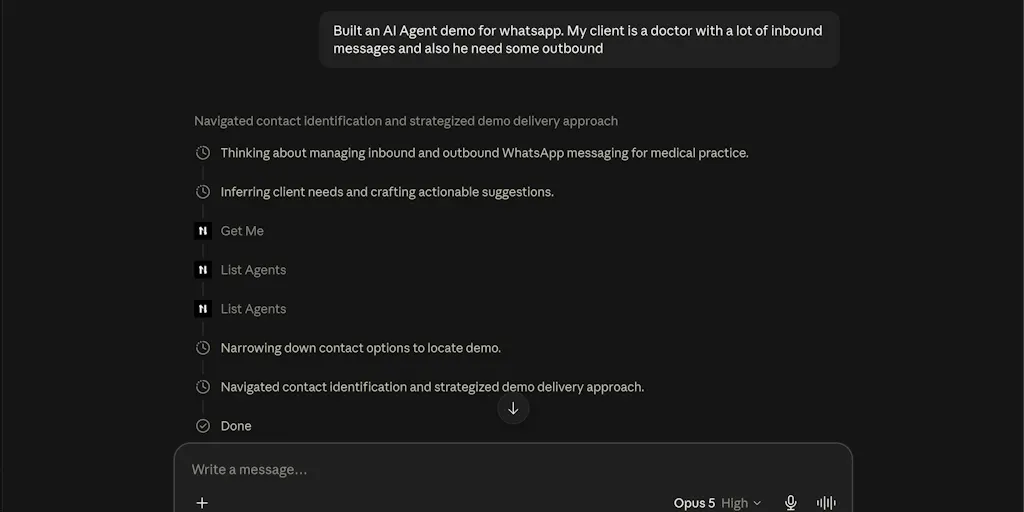
Let me be precise about the pain point here, because the creator economy is drowning in tools that promise “engagement” but deliver nothing but noise. The problem Ninjō is tackling isn’t content creation — there are a thousand AI writing tools for that, and most of them produce the same generic slop. The problem is conversation volume at the bottom of the funnel. When I ran a launch for a client last quarter, we saw a spike in DMs that our two-person team physically could not handle. We had qualified buyers asking about pricing, and their messages sat unanswered for hours because we were busy filming, editing, and posting. That’s not a content problem; that’s a revenue problem. The team behind Ninjō, led by Lorenzo Cappucci, started as an agency building AI sales agents for creators and coaches in Latin America. They claim to now run 45+ clients and 150+ agents in production, handling millions of DMs on Instagram, WhatsApp, and other channels. I can’t verify those numbers independently — the source doesn’t provide a public dashboard — but the operational logic is sound. They’ve built what they call Cortex, a system of prompt templates, KPI rubrics, and anti-patterns learned from real conversations, and they’ve exposed it through an MCP server. The pitch is simple: instead of a dashboard-centric SaaS tool, you get an infrastructure layer that lets you instruct an AI agent in plain language — “build me an agent for my client’s launch, qualify fast and send the payment link” — and it ships, connected to real DMs, verified, and reversible.
The distinction matters. Most social media automation tools I’ve tested, from Buffer to Hootsuite, are built around broadcasting. They schedule posts, track mentions, and give you a unified inbox, but they don’t actually do the work of conversing. They’re a command center, not a workforce. Ninjō is attempting something different: it’s an agent that carries on the conversation itself, with a human in the loop for the high-stakes moments. The company claims one agent generated $65K in a single 4-day launch, handling 839 conversations and recovering 47 declined payments. I’d flag that as a self-reported metric from the maker, not an independent benchmark, but the recovery-of-declined-payments angle is genuinely clever. That’s the kind of operational detail that only emerges from running real campaigns, not from a product roadmap. When you’re in the middle of a launch, every unanswered minute is money on the floor, and a human team physically cannot keep up with that volume inside that window. An agent can.
How It Differs From the Incumbents
The comparison that matters here isn’t to Buffer or Later — those are scheduling tools, and they solve a different problem. The real incumbents are the AI sales rep platforms and the prompt-based agents like ChatGPT or Claude. What Ninjō is doing is closer to a specialized layer on top of Claude Code, which is a fascinating architectural choice. Instead of building a proprietary model, they’re betting on the ecosystem. When MCP (Model Context Protocol) came out, the team at Ninjō had a realization, and I think it’s the right one: the product was never the dashboard. It’s the infrastructure plus the accumulated intelligence. By exposing their entire playbook through an MCP server, they’re making it possible for any developer or technically-minded operator to build a sales agent in minutes, using the tools they already know. This is a fundamentally different approach from, say, ManyChat or Chatfuel, which require you to build flows in a visual editor. Those tools work, but they’re rigid. You’re constrained by the logic tree you can draw. Ninjō’s bet is that natural language instruction will replace flow charts, and that the accumulated playbooks from 150+ agents in production will make the output smarter than anything a solo operator could build from scratch.
The numbers they cite are impressive, but I want to be careful about how I treat them. The team claims $750K+ in sales generated from their agents, 1.9M conversations handled, and 202 sales calls booked in one month on a single mentor’s Instagram. These are self-reported figures on a Product Hunt launch page, which is a promotional context, so I’d take them with a grain of salt. But the shape of the claims is plausible. The most repeatable use case, according to Cappucci, is the ads-to-DM-to-call funnel: paid ads go straight into Instagram or WhatsApp DMs, the agent qualifies the lead and books a call, and a human closes the sale. One client sits at 200+ booked calls a month, every month, generating roughly $200K. That’s not a launch spike; it’s a compounding system. This is the use case I’d bet on for most creators and coaches. It’s boring, it’s repeatable, and it doesn’t require a viral moment to work.
What Creators and Social Media Teams Can Borrow
The most valuable thing Ninjō offers isn’t the tool itself — it’s the operational philosophy. The idea that your accumulated playbooks, your anti-patterns, your KPI rubrics, should be a living system that improves with every conversation. That’s something every social media team can adopt, regardless of whether they ever touch an AI agent. When I look at how most teams handle DMs, it’s ad hoc. The community manager has a set of saved responses, the sales person has their own script, and nobody is systematically tracking what works and what doesn’t. Ninjō’s Cortex approach — treating every prompt template and playbook as part of a reusable system — is a mindset shift. You’re not just responding to messages; you’re building an intelligence layer that gets smarter over time. For a solo creator, this is the difference between treating your DMs as a chore and treating them as an asset.
There’s also a practical lesson in the declined-payment recovery example. The agent chased 47 declined payments one by one in the chat. That’s the kind of follow-up that human teams skip because it feels low-status and tedious, but it’s pure revenue. The same logic applies to content. When I schedule posts across platforms, I’m not just broadcasting — I’m looking for signals. A comment that asks a question is a lead. A DM that says “how do I work with you?” is a qualified prospect. The tools that help you capture and act on those signals faster are worth more than any algorithm hack. Ninjō’s approach to handoff is also worth noting. When the agent isn’t confident mid-conversation, there’s a mechanism for escalating to a human. That’s the right design. The AI handles the volume, the repetitive qualification questions, the scheduling — and the human steps in for the moments that require judgment, empathy, or a personal touch. This is the hybrid model I believe will define the next phase of the creator economy.
Why TikTok Creators Should Care More Than LinkedIn Ones
The DM-as-funnel model works differently across platforms, and this is where I think most operators get it wrong. On TikTok, the algorithm is still primarily driven by watch time and completion rate. But the monetization is increasingly happening off-platform, in DMs and through direct relationships. A creator with 100K followers who has a strong DM funnel will out-earn a creator with 1M followers who treats their inbox as an afterthought. The same logic applies on Instagram, where the link-in-bio has been replaced by the DM as the primary call-to-action for high-ticket offers. On LinkedIn, the dynamic is different — the conversations are often B2B, longer-cycle, and more relationship-driven. An AI agent can qualify inbound leads, but the closing still requires a human touch. My take: if you’re a coach, consultant, or high-ticket seller, the DM funnel is your highest-leverage activity, and AI agents that handle the volume are the force multiplier. If you’re a B2B operator, the agent’s role is more about triage than closure.
Where the Math Breaks
I want to be honest about the limitations, because this is where most AI-agent products fall apart in practice. The first issue is platform risk. Ninjō is handling DMs on Instagram and WhatsApp, which means it’s operating on platforms that have strict API rate limits and terms of service. Instagram, in particular, has been aggressive about shutting down unofficial automation tools. The team claims to have built a system that’s “verified” and “reversible,” but the source doesn’t detail the technical architecture behind that claim. In my experience testing similar tools, the risk of account flags or bans is real, and it’s not something a vendor can fully mitigate. The second issue is the AI-slop question, which came up directly in the Product Hunt comments. One user, Jakub Stonavsky, asked whether this kind of product is safe in an age where people are getting sick of AI-generated content. Cappucci’s response is worth reading: he distinguishes between mass-produced content no one asked for and 1:1 DMs where the person has already raised their hand. That’s a fair point, but it doesn’t fully address the risk of the agent sounding robotic in a high-stakes conversation. The team claims all their agents “read as human,” but that’s a self-assessment. I’d want to see independent testing, and I’d want to see how the agent handles edge cases — a prospect who asks a nuanced question, a complaint, a request that doesn’t fit the playbook.
The third limitation is the pricing and accessibility question. The source mentions 1,000 free messages with code PRODUCTHUNT, but the ongoing pricing is not disclosed. For a solo creator, the cost of an AI agent that handles DMs at scale could be prohibitive, especially if you’re in the early stages of monetization. The tool is designed for clients with real volume — 45+ clients, 150+ agents, millions of DMs — which suggests it’s aimed at agencies and established creators, not beginners. That’s fine, but it’s worth being clear about who this is for. If you’re getting 10 DMs a day, you don’t need an AI agent; you need to answer them yourself. The math only breaks in your favor when the conversation volume exceeds your human capacity.
Where the Math Breaks
Let me get more specific about the cost-benefit analysis. If an agent costs, say, $500 a month (I’m speculating, as the source doesn’t disclose pricing), you need to be generating enough revenue from DM conversations to justify that expense. For a coach selling a $2K program, that’s one extra sale a month. For a creator selling $50 digital products, that’s 10 extra sales. The recovery-of-declined-payments example is compelling because it’s a direct revenue line item, but it assumes you have a payment system integrated and a process for chasing failures. Most creators don’t have that infrastructure. The real question isn’t whether AI agents can handle DMs — they clearly can — but whether the operator has the surrounding systems in place to convert those conversations into revenue. A DM that says “tell me more” is worthless if you don’t have a landing page, a payment link, and a follow-up sequence ready to go.
My Judgment Call
Here’s where I land after reading the launch page and the comment thread. Ninjō is a serious tool built by people who have run real campaigns and learned real lessons. The fact that they started as an agency is a strong signal — they’ve had to make this work for paying clients, not just for a demo video. The MCP-first approach is forward-looking, and I think we’ll see more tools adopt this pattern. The insurance broker example — an agent that quotes car insurance in chat, pulling live prices from six carriers — is genuinely impressive. That’s a complex integration, and it shows the platform can handle more than just simple qualification flows.
But I have reservations. The self-reported metrics are promotional, and the source doesn’t provide independent verification. The platform risk is real, and I’d want to understand the technical safeguards before connecting my Instagram account. The pricing model is opaque, which makes it hard to evaluate whether the ROI math works for a mid-tier creator. And the “reads as human” claim is the hardest one to verify. In my own tests of similar AI sales agents, the ones that work best are the ones that are transparent about being AI, or that have a very narrow scope. The moment an agent tries to do too much, it starts making mistakes. The declining-payment recovery is a great use case because it’s narrow and well-defined. The general “build me an agent for my client’s launch” prompt is more dangerous, because it assumes the AI understands the nuances of your specific audience and offer. It doesn’t — at least not yet.
What This Means for the Social Media Stack
The broader implication is that the social media tool stack is about to change. For years, we’ve been using scheduling tools, analytics dashboards, and engagement platforms as separate layers. The next generation of tools will blur those lines. An AI agent that handles DMs isn’t just a sales tool — it’s also a source of data. Every conversation is a signal about what your audience cares about, what objections they have, what language they use. That intelligence can feed back into your content strategy, your ad targeting, and your offer design. The teams that figure out how to close that loop — from DM conversation to content insight to new offer — will have a massive advantage. The teams that treat AI agents as a replacement for human conversation will fail, because the best conversations are still the ones that build trust, and trust is the currency of the creator economy.
What I’d Watch / Test Next
If you’re a creator or social media operator who wants to act on this, here’s what I’d do this week. First, audit your current DM funnel. How many inbound DMs do you get in a week? How many of those are qualified leads? How long does it take you to respond? If the answer is “too long” or “I don’t know,” you have a problem worth solving. Second, if you have volume, test a tool like Ninjō with the free 1,000 messages offer. Set up a narrow use case — not “handle all my DMs,” but “qualify inbound leads for my coaching program and book a call.” Measure the response time, the qualification rate, and the conversion rate. Compare it to your baseline. Third, regardless of whether you use an AI agent, start documenting your playbooks. Write down your saved responses, your objection-handling scripts, your follow-up sequences. That’s the raw material for any automation, and it’s the thing that will make you better even without AI.
The bigger trend to watch is the MCP ecosystem. If more tools expose their capabilities through MCP servers, we’ll see a shift from monolithic platforms to composable infrastructure. You’ll be able to mix and match — a scheduling tool here, a DM agent there, an analytics layer on top — all connected through a common protocol. That’s a future I’m excited about, and it’s one where the creator who owns their data and their playbooks will have the advantage. The algorithm will keep changing, but the DM inbox is yours. And now, finally, we have the tools to actually work it.