The Creator Economy’s Real Bottleneck Is Attention Residue, Not Tooling
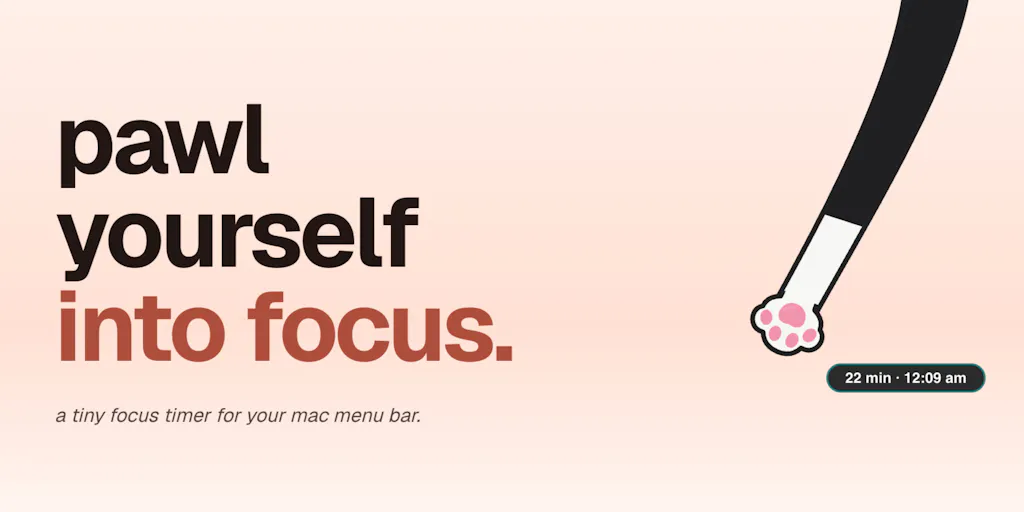
Every social media operator I know has a scheduling stack. We have Buffer or Later for the queue, Metricool for cross-platform analytics, CapCut for the edit, Canva for the thumbnail, and a Notion board that supposedly holds the strategy together. What almost none of us have is a reliable way to protect the ninety-minute block where the actual creative work happens — the scripting, the hook rewriting, the edit that determines whether the algorithm rewards a video with watch time or buries it at 200 views. That is why a $9.99 Mac menu-bar timer called Pawl caught my eye on Product Hunt this week. It is not a social tool. It is a focus companion where you pull a cat paw to start a timer, and that is precisely why it matters to anyone whose output depends on deep work. The launch page is a useful case study in positioning a tiny utility for a distracted audience — and in the limits of doing so.
What Pawl actually is, and the problem it quietly targets
Strip away the cat paws and Pawl is a Pomodoro-style timer built for macOS 14 or later. The maker, Ryana May Que of hibi, describes it as “a tiny focus companion for your mac” where you “pull a cat paw to start a timer.” You can run it as a simple countdown or configure focus and break cycles, pick from eight cat paw styles, switch themes, and either keep it in the menu bar or pin the controls on screen. There is a configurable heads-up before a session ends so you have time to finish what you are doing. The direct version is a one-time $9.99 with no subscription, and it is also listed on the Mac App Store. The stated design goal, per the maker, is “to make starting feel small and playful, then stay out of the way while you work.”
That last sentence is the whole thesis. Most productivity software fails at the “stay out of the way” part. When I tested focus apps over the years — everything from Forest to session timers baked into Notion — the friction was never starting the timer. It was the app becoming another dashboard to check, another notification stream, another thing with a streak to maintain. Pawl’s bet is that a single physical-feeling gesture (pull the paw) plus a menu-bar presence is enough, and that the cuteness lowers the activation energy of starting a session.
Why this is a creator-economy story and not just a Mac utility
Here is the connection I keep coming back to. The creator workflow has two halves that get conflated constantly: production and distribution. Distribution is now heavily automated — Buffer, Hootsuite, Later, and Metricool will happily push your post to seven platforms while you sleep. Production is the opposite. It is stubbornly manual, cognitively expensive, and the part that actually determines performance. Watch time on TikTok and YouTube, dwell time on LinkedIn, saves on Instagram — none of that is scheduled into existence. It is earned in the edit and the hook. So a tool that protects the production block is, indirectly, a distribution tool. If your Reels keep dying at the three-second mark, the fix is rarely a better scheduler. It is forty uninterrupted minutes rewriting the first line.
How it differs from the tools you already pay for
The obvious comparison set is focus and habit software: Forest, Session, Focus, and the timer features baked into Notion or Todoist. Against those, Pawl’s differentiators are narrow and specific. It is Mac-only, it is a one-time purchase rather than a subscription, and the interaction model is a gesture rather than a button. The maker confirmed in the comments that the eight paw styles are just the start (“we have 8 and more to go”), and that pinning the timer on screen — the option one commenter said they would pick so they could “glance at it without clicking around” — is supported.
Against the social scheduling incumbents, the comparison is almost inverted. Buffer and Hootsuite are about throughput: more posts, more channels, more analytics. Pawl is about throttling: fewer inputs, one session at a time. I would not frame them as competitors at all. The honest framing is that Pawl is a complement to a publishing stack, the thing you open when you close the scheduler and start writing.
The one-time pricing is the real positioning move
$9.99 once, no subscription, is a deliberate signal. In a market where Metricool and Later charge monthly and every AI writing tool wants $20 a month forever, a flat-fee utility reads as “I am not trying to become your workflow, I am trying to be one small good thing in it.” My take: that pricing is also a constraint. It caps revenue per user hard, which means the maker needs volume or a broader product line (hibi appears to be the studio umbrella) to make this sustainable. It also means users should expect a slower feature cadence than a VC-backed competitor would ship. That is a trade, not a flaw — but it is a trade.
What creators and social teams can borrow from this launch
Three things, and none of them require buying the app.
First, the activation-energy principle. “Make starting feel small and playful” is a content strategy insight disguised as a UX note. The reason so many creators stall is not lack of ideas; it is that opening a blank CapCut timeline or a script doc feels like a commitment. The creators I know who publish consistently have ritualized the start — a specific playlist, a specific two-minute warmup, a specific first action that is too small to resist. Pawl productizes that ritual. You can borrow the principle without the paw: define the smallest possible first action of your production block and make it the only thing you commit to.
Second, the heads-up pattern. The configurable warning before a session ends exists so you can wrap up rather than get yanked out mid-thought. That maps directly onto how I’d structure a content sprint: build in a five-minute wind-down where you save the draft, note the next step, and close the tabs. Context-switching cost is real, and the “attention residue” literature — the reason you keep thinking about the edit you abandoned — is exactly what a wind-down prevents. When I scheduled 30 posts across 5 platforms last month, the bottleneck was never the scheduling; it was that every production session ended in a hard cut and the next one started cold.
Third, the launch-page lesson itself. The maker asked specific questions: feedback on the pull gesture, the focus/break flow, and which paws to add next. That is how you run a launch — narrow, answerable asks rather than “thoughts?” The comment thread shows it working: users proposed a lock-out mode, asked about sound versus flash on the heads-up, and the maker replied to nearly everyone. For creators launching anything — a course, a template pack, a newsletter — that specificity is the template.
Why TikTok creators should care more than LinkedIn ones
The platform split matters here. A LinkedIn ghostwriter’s day is fragmented by design: comments, DMs, client calls. A TikTok or YouTube creator’s day is dominated by one long edit that either works or doesn’t, and the algorithm’s distribution decisions hinge on retention curves set in that edit. If you are the second kind of creator, protecting a single 90-minute block is worth more than any scheduling upgrade. If you are the first kind, a timer is a nice-to-have and your real problem is inbox triage. I would not pretend Pawl solves the second problem.
Where my judgment says it falls short
Balance time. The launch page is thin on the things operators actually need to know. There is no mention of how sessions are logged, whether there is any history or streak data, whether it integrates with anything (calendar, task manager, Focus modes), or whether the menu-bar presence respects macOS Focus filters. Not disclosed. The maker says a demo existed during early access but is gone now, and floated giving copies away “when i maybe do ugc” — which tells you the growth plan is still forming.
The bigger limitation is structural: Mac-only, macOS 14+, no Windows, no web, no mobile. A social team of five with a mix of machines cannot standardize on it. Compare that to Session, which spans Apple platforms, or the free timers inside Notion that everyone on a team already has. And the enforcement question is real. One commenter put it plainly: they would use it “if the break actually made me stop instead of letting me just dismiss the chime and keep going.” Another asked whether the break locks you out or is skippable. The maker’s answer to the first was “we can add that in” — meaning, as of launch, the break is dismissible. For a focus tool, that is the load-bearing wall. A timer you can ignore is a timer you will ignore, and the entire value proposition rests on whether the gentle nudge is enough or whether you need the hard lock.
My take: the cuteness is doing more work than the maker admits. Eight cat paws and a pull gesture are delightful, but delight fades, and a $9.99 utility has to survive the week after the novelty wears off. The honest test is whether you still pull the paw on day 30 without thinking about it.
What I’d watch / test next
This week, before deciding anything about Pawl, run a two-part experiment on your own production block. Part one: time your next three content sessions with whatever timer you already have — the one in your phone, your watch, your Notion template — and note where you actually lost focus. If the answer is “I never started,” the problem is activation energy and a playful gesture might genuinely help. If the answer is “I started and got pulled into Slack at minute twelve,” a timer will not save you and you need Focus modes and notification discipline first. Part two: check whether your team is even Mac-uniform. If it isn’t, file this under personal tools, not team infrastructure.
For the maker, I’d watch three signals: whether a hard-lock break mode ships (the comment thread is practically a feature request), whether any session history or Focus-mode integration appears, and whether the paws stay a novelty or become a habit. For the rest of us, the takeaway is bigger than the product: the creator stack has spent five years optimizing distribution and almost nothing optimizing the production block that feeds it. Pawl is a $9.99 bet that the second problem is the real one. I think that bet is directionally right — I just want to see the break that actually makes you stop.