The bottleneck that no scheduling tool can fix
For the last three years, every social media manager I know has been optimizing the wrong layer of the funnel. They obsess over posting times, hashtags, UTM tags, and AI visuals. But the actual constraint on growth is throughput: the speed at which a thought becomes a caption, hook, thread, or reply. Platforms now reward depth — watch time, engagement rate, saves, conversation replies — which means more native text, not less. Dictation is the quiet exception to the typing bottleneck, and the new wave of desktop dictation tools is changing the math. Zen Whisper, a Product Hunt launch from ZenProducts, is the first one in a while that made me rethink my content pipeline. My take: the tool matters less than the workflow it unlocks.
The hidden cost of “content volume” — and why dictation is the fix
Every platform shift in the last two years has made the text problem worse. Instagram pushes broadcast channels and Notes. Threads wants conversational posting. TikTok and YouTube reward comment activity. X has made quote-tweets part of the distribution loop. And because the algorithms are optimizing for watch time and engagement depth, the old cheap trick — scheduling identical captions with the same hashtag block across every network — is dying. What survives is original, native-toned text: a hook that stops the scroll, a caption that earns a save, a reply that starts a conversation.
For a social media operator, that is a lot of writing. In my own work last month, I scheduled 30 posts across 5 platforms. The actual scheduling took about an hour and a half. Writing and rewriting the captions, thread drafts, and comment replies took the better part of two days. Typing speed doesn’t scale. Speech does. Most of us can talk through an idea much faster than we can type it — and for the kind of messy, exploratory first draft that content actually starts as, dictation is the natural input.
My take is that most creators underrate how much of their output is verbal thinking. We narrate our opinions in the shower, we record voice notes for ourselves, we explain ideas to friends in a run of sentences. The hard part has never been having ideas; it has been the transcription layer between speech and the text box. Dictation collapses that layer. But dictation has a reputation problem. Apple’s built-in dictation is useful for the occasional message, but it is slow to correct and feels dumb with proper nouns. Cloud transcription services like Otter.ai are accurate, but they require you to upload audio and trust whatever data pipeline comes with it. In my own tests of similar tools, the privacy tradeoff became a deal-breaker when I was dictating a client’s unreleased campaign copy. The words were not secret to me, but they were not supposed to be sitting on a third-party server.
That is why a local-first dictation tool is more than a niche productivity toy. If you can hold a shortcut and dictate into any app, with the core speech recognition staying on your Mac, you remove the two things that made dictation fail for creators: correction friction and privacy anxiety. You still have to edit, but you no longer have to type.
Zen Whisper: a local-first dictation workflow for people who live in the text layer
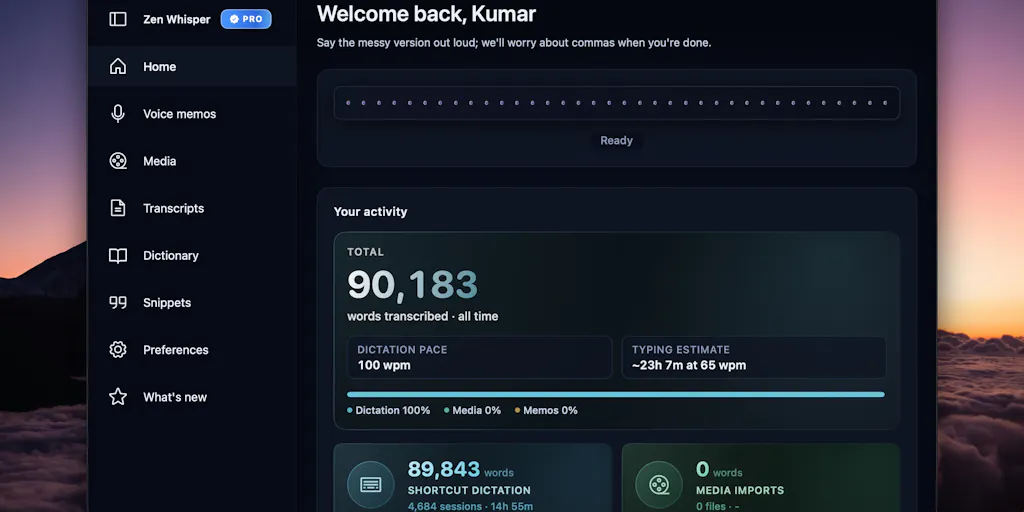
The pitch is simple: hold a shortcut and dictate into any Mac app without sending audio to the cloud. Zen Whisper’s launch page says the core speech recognition is on-device, with local models, searchable transcripts, voice memos, media transcription, and Pro tools for larger models and translation. The maker’s launch note adds that it works across 100+ languages, with especially strong multilingual workflows for India, and that it includes snippets, transcript history, and writing tools in one place. It starts with a free trial, stays usable on the free tier after that, and scales up if you need more. Pricing details beyond that are not disclosed.
The part I find genuinely interesting is the transcript layer. Most dictation tools treat transcription as a temporary input — you dictate, the words appear, then the audio is deleted or ignored. Zen Whisper makes transcripts a searchable resource. That turns the tool from a keyboard replacement into a lightweight knowledge base. If you are a creator who records voice memos of content ideas, or a social media manager who has a call with a client and wants a rough quote for a post, searchable transcripts give you a way to retrieve what you actually said, not just what you can remember you said.
The other feature that stands out is the dictionary and snippet layer, which I’ll dig into in the comparison section. In my experience, this is the difference between a dictation app that works in a demo and one that works in your actual niche. Generic speech models are trained on broad English, not on the names of your favorite creators, your client’s product, or your community’s slang. A tool that lets you teach it your vocabulary is the difference between “welcome to the pre-flight show” and “welcome to the preview show.”
How Zen Whisper stacks up against the incumbents
The AI dictation category on Product Hunt is crowded, and the incumbents are not weak. Wispr Flow, which the source page shows with a 4.7 rating, is the popular choice for people who want to “speak naturally, write perfectly & 4x faster in every app.” superwhisper markets itself as “extremely accurate, voice to text for Mac & iPhone.” MacWhisper has leaned on OpenAI’s Whisper models for high-quality transcription on Mac. There are also smaller alternatives and free options, plus the usual menu-bar clones.
In my experience with Wispr Flow, the cloud-backed accuracy is genuinely excellent — but that’s precisely because it can rotate through bigger models and more compute. With a local-first product, you are trading some accuracy for the guarantee that your audio stays on your machine. The question is whether the tradeoff is worth it for social media work. For content that is going to be public anyway, the privacy argument is weak. For confidential campaign ideas, unreleased product names, or a client’s internal messaging, the privacy argument is strong. Zen Whisper’s bet is that privacy plus workflow beats raw accuracy for a meaningful slice of the market.
Why TikTok creators should care more than LinkedIn ones
TikTok and Instagram creators are already in the habit of talking to a camera. Dictating a draft hook into a notes app or a script document is a natural extension of the same behavior. They also need volume: a standard TikTok week includes multiple distinct hooks, reply videos, and comment responses, and the faster you can get the ugly first draft out, the more content you can test. LinkedIn creators, by contrast, are writing in a more polished, permanent register. The content is usually a story or a career lesson, and the publish-and-edit curve is slower. Privacy matters less for a LinkedIn post you intend to share with the public. The local-first angle matters most for people whose content is time-sensitive and semi-secret: short-form video campaigns under embargo, affiliate deals that haven’t been announced, or product launches with no public name yet.
Where the math breaks
Local is not always better. On-device models have a smaller footprint and less training data than the largest cloud endpoints, which means they can mangle proper nouns, brand names, and jargon. The maker’s answer to that problem is a dictionary and snippets layer. In the Product Hunt comments, a user asked exactly this: can Zen Whisper learn recurring technical terms like API names, package names, and product names that don’t exist in any dictionary? The maker said yes, the tool has both dictionary and snippets built in, and linked to a demo video. That is the right design, but it also means the tool is only as good as the glossary you build. If you don’t invest time teaching it your vocabulary, you will correct the same words over and over.
Also, the “Pro tools for larger models and translation” line suggests the best quality is gated behind a paid tier. That is normal, but it makes the free tier less impressive than the headline. I’d also test how the tool behaves in apps with nonstandard text fields, password managers, and custom CMS editors before betting your entire publishing workflow on it.
What creators and social media teams should steal from this — even if you never buy it
Even if Zen Whisper is not the tool you end up using, the workflow it codifies is worth borrowing. Here are four principles I am taking from it.
Build your own snippet dictionary. The moment you adopt any dictation tool, add the recurring vocabulary of your niche — your brand name, your clients’ product names, your hashtags, the acronyms your community uses. Most dictation failures are not general speech recognition failures; they are domain-specific vocabulary failures. A snippet library that expands “q3launch” into the full campaign name saves more time than a faster model.
Treat voice memos as first drafts. If you record voice notes for content ideas, store them someplace where they can be transcribed and searched. The searchable transcript feature in Zen Whisper is the part that turns a random “shower thought” into an actual content asset. Without search, a voice memo is just a graveyard of half-formed ideas.
Use local processing for anything confidential. Social media managers often handle unreleased campaigns, private launches, and sometimes access to accounts that are public but strategically sensitive. If you are dictating around that material, a cloud transcription service is a liability. The local-first workflow is not a nice-to-have; it is a security posture.
Dictate the dirty draft, edit the clean one. The biggest mistake I see creators make with dictation is trying to produce perfect final copy in one pass. Dictation is for speed, then you edit. Speak in a messy, opinionated monologue, get the paragraphs out, then sit at the keyboard and clean them up. The result is a draft with more life in it than one you would have typed from scratch.
Scheduling tools are mature — Buffer and Metricool handle distribution and API rate limits well enough. They still cannot write the copy for you. If dictation can shrink the time between “idea in your head” and “text in your scheduler,” it does more for your publishing cadence than another calendar feature ever will.
Where my judgment says it falls short
I want to be clear about who this is not for.
First, it is a Mac-only desktop app. The source says nothing about an iPhone or iPad companion, so it cannot replace the voice-to-text keyboard you use on your phone. If you are a creator who works mostly on mobile, this tool is irrelevant for now. Most of the social media workflow eventually happens on a desktop — strategy, content calendar, scheduling — but the wildcard ideas come from the phone. Zen Whisper covers half of that loop.
Second, pricing is vague. The maker says there is a free trial and a usable free tier, and that it “scales up” if you need more. That is not a pricing page. For an individual creator, a free tier is enough. For a social media team that needs to budget for a Pro tier, “not disclosed” is a blocker. I also suspect the larger models and translation features require a Mac with serious memory, which is another hidden cost.
Third, local-first has an accuracy ceiling. For heavily accented speech, rare names, or languages that are historically underrepresented in speech corpora, cloud models are more likely to be accurate. The team’s 100+ languages claim is a marker, but I’d bet the quality is uneven across those languages. India-focused multilingual workflows is a smart positioning because that is a massive market, but it is also a public claim that needs to be tested in real rooms, not a demo reel.
Fourth, there is no collaboration layer mentioned. No shared glossaries, no team workspaces, no approval flow. A social media agency that wants to centralize brand terms in a dictation tool will have to wait. The dictionary feature is per-user, as far as the source says.
In other words, Zen Whisper is a strong personal productivity tool, not yet a team infrastructure product. That is okay. It is a launch, not a complete ecosystem. But I would want those gaps addressed before recommending it to a multi-seat social team.
What I’d watch / test next
Next week, I am going to run Zen Whisper through a specific stress test. I’ll dictate three TikTok hooks, one LinkedIn post, and a batch of comment replies, and I’ll use the dictionary and snippets feature to teach it the brand names I work with. Then I’ll record a ten-minute voice memo about next month’s content calendar and see whether the searchable transcript turns that into a usable outline, or just a wall of text I never open again.
I also want to see if it can replace the first-draft step of my scheduling workflow. If I can dictate a full post directly into Buffer or Metricool instead of drafting in a separate document, the tool has earned a place in my stack. Finally, I’ll watch for two signals: a mobile companion and the actual quality of the Pro tier’s larger models and translation. If both land, this is more than a niche dictation app — it becomes a privacy-preserving content operating system. If not, it’s still a useful reminder that the creator economy’s next real bottleneck is the keyboard.