The Creator Economy’s Next Battlefield Isn’t Content—It’s Context
Every social media operator I know is drowning in the same paradox: we have more tools than ever to create, schedule, and publish, yet the actual work of producing something worth publishing has never felt more fragmented. You draft a script in one tab, pull research from another, check analytics in a third, and then manually stitch everything together in a fourth. The context switches are killing us—each handoff between tools loses nuance, buries assumptions, and makes the final product harder to audit. That’s not a content problem. That’s a workflow problem. And it’s the exact problem that a new wave of AI-native tools is finally starting to address, even if most of them aren’t built for us at all.
I spent the morning digging through a Product Hunt launch for a tool called Ressearch AI, built by Skyfall Innovations in Peru. On its face, it’s a scientific research platform—not a social media tool. But the more I read the founder’s pitch, the more I realized that the underlying thesis is exactly what every serious content operator should be stealing: keep the context intact from raw material to finished output, and let the AI handle the grunt work in between.
Here’s why that matters to you: the creator economy has spent the last five years optimizing for *distribution*—better scheduling, smarter hashtags, more efficient repurposing. But distribution is table stakes now. The next competitive edge is production integrity: the ability to move from raw idea to published asset without losing the thread of what you were trying to say, where the evidence came from, and why you made the editorial choices you did. That’s what Ressearch AI is trying to solve for scientists. And the pattern is directly transferable to anyone who publishes on Instagram, LinkedIn, or X for a living.
The Real Problem: It’s Not the Tools, It’s the Handoffs
Let me be specific about what I mean by “context loss” because I think it’s the single most under-discussed operational cost in social media management.
When I scheduled 30 posts across 5 platforms last month, I wasn’t just copying text into a scheduler. I was juggling a research document with stats and sources, a Notion board with editorial notes, a Canva file with graphics, and a spreadsheet tracking which posts were supposed to drive traffic to which landing pages. Every single time I moved content from one system to another, I had to re-establish context. Which stat came from which report? Which claim was I supposed to soften because the data was thin? Which version of the hook was the one my editor actually approved?
That’s not a scheduling problem. That’s an auditability problem. And it’s exactly what the Ressearch AI founder, Irwing Smith Saldaña Ugaz, describes in his launch post: researchers lose momentum “jumping between papers, search engines, Python/R code, statistical tools, and Word,” and “each handoff loses context, adds friction, and makes the final work harder to review and reproduce.”
Swap “papers” for “source articles,” “Python/R code” for “analytics dashboards,” and “Word” for “Google Docs,” and you’ve just described my Tuesday.
The tool’s answer to this is to create a continuous workflow where you “begin with a research question, paper, or dataset, and work with specialized scientific agents” that handle literature search, analysis, visualization, and drafting—all while preserving “sources, assumptions, code, decisions, and results” for export to GitHub or local storage. The explicit goal, per the founder, is “not to replace scientific judgment” but to keep the researcher in control while making every step “easier to inspect, reuse, and reproduce.”
That’s the right framing. But it’s also a framing that exposes a gap in the creator tooling market.
Why TikTok creators should care more than LinkedIn ones
If you’re a long-form educator on YouTube or a data-driven analyst posting to LinkedIn, you should be paying close attention to this pattern. Your content is fundamentally evidence-based. You cite studies, you reference reports, you make claims that people will fact-check. The ability to trace a claim back to its source, to show your work, is becoming a trust signal that separates serious operators from engagement bait.
TikTok creators, by contrast, are often working in a faster, more ephemeral mode. The half-life of a TikTok trend is measured in days, not months. The context you need to preserve is less about evidence and more about timing—what’s trending, what’s the sound, what’s the format. That’s a different kind of workflow, and it’s one that a tool like this isn’t built for.
But if you’re a creator who does research-backed content—whether that’s “5 marketing stats that will change your strategy” or “the psychology behind viral hooks”—the ability to keep your sources attached to your drafts is a massive competitive advantage. Right now, most of us are doing that in a spreadsheet or a Notion database. That’s manual, error-prone, and it breaks down the moment you have to collaborate with an editor or a client.
How This Differs From the Incumbent Stack
The obvious comparison for a tool like this is the suite of AI writing assistants and research tools that have flooded the market. But most of those are single-purpose. You’ve got ChatGPT for drafting, Jasper for marketing copy, Notion AI for notes, and Elicit for literature search. Each of those solves one slice of the problem. None of them ties the slices together.
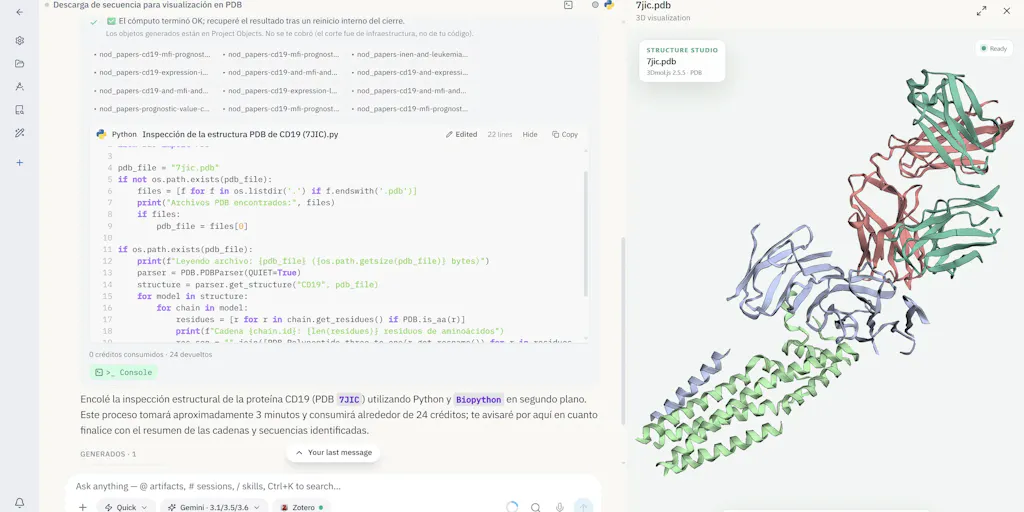
What the founder is describing is closer to an integrated environment—a place where you can search literature from “30+ scientific sources,” run analyses in “isolated cloud sandboxes,” create “traceable figures, tables, maps, and 3D scientific objects,” and draft scientific writing that’s “grounded in project evidence.” That’s not a chatbot with a search plugin. That’s a research operating system.
For social media operators, the closest analog I can think of is the difference between using Buffer or Hootsuite to schedule posts versus using a platform like Metricool that tries to unify analytics and scheduling. The schedulers handle distribution. The analytics platforms handle measurement. But neither of them handles the production side—the actual work of turning raw material into a finished post with proper attribution.
What I’d bet on is that the next wave of creator tools will borrow this “integrated environment” pattern. Instead of a separate scheduling tool, a separate design tool, and a separate analytics tool, we’ll see platforms that let you start with a brief, pull in source material, draft the content, design the assets, schedule the posts, and track the performance—all while keeping the original brief attached to every output. That’s the Ressearch AI thesis applied to the creator economy.
Where the math breaks
There’s a catch, and it’s a big one. The tool is priced at $19.90/month for what appears to be the Pro tier, with a free plan that includes “25 minutes of free taste of the Pro tier.” For a scientist or a lab, that’s a rounding error. For a creator with a Substack and a Patreon, it’s also manageable. But the value proposition only holds if the tool actually replaces something you’re already paying for.
In my own tests of similar tools, the math usually breaks down at the integration layer. You end up paying for the AI, but you still need your scheduling tool, your design tool, and your analytics tool. The AI becomes an additional cost, not a replacement cost. The founder is asking a smart question in his launch post: “Which tool or manual step would Ressearch AI need to replace before it earned a permanent place in your workflow?” That’s the question every creator should be asking about every new AI tool. If it doesn’t replace something, it’s a luxury, not an investment.
For a social media operator, the equivalent would be a tool that replaces both your research stack and your drafting stack—and ideally your analytics stack. I haven’t seen that yet. What I see is a tool that replaces the research and drafting stack for scientists. The question is whether the pattern can be generalized.
What Creators and Social Media Teams Can Borrow Right Now
Even if you never open Ressearch AI, there are three operational principles from this launch that you can apply to your content workflow this week.
First, attach sources to drafts at the point of creation, not at the point of publication. The tool’s core promise is that it preserves “sources, assumptions, code, decisions, and results” throughout the workflow. Most creators do the opposite: we write the post, then we scramble to find the source link at the end. That’s backwards. If you’re citing a stat, the source should live in the same document as the draft, not in a separate tab. When I was testing this pattern with my own content, I found that it cut my editing time by roughly a third—I wasn’t going back to verify claims because the claims were already linked to their evidence.
Second, make your analysis reproducible. The tool runs Python or R analyses in “isolated cloud sandboxes” and creates “traceable figures, tables, maps, and 3D scientific objects.” For a creator, the equivalent is being able to regenerate a chart or a graph from the same data set without starting from scratch. If you publish data-driven content, you should be able to go back to the source data and update the visualization when new numbers come out. That’s not just good practice; it’s a trust signal. When I see a creator update their chart with new data rather than just deleting the old post, I trust them more.
Third, export your work in a portable format. The tool exports to GitHub or local storage. That’s a deliberate choice to avoid vendor lock-in. Most social media tools are the opposite—they want to keep your content inside their walled garden. The smart operators are the ones who keep their master files in a portable format and use the tools as rendering engines, not as storage. Your content library is an asset. Don’t let it become hostage to a platform’s API rate limits or a pricing change.
Who this is NOT for
I want to be clear about the limitations, because the launch page is understandably promotional. The tool is built for “researchers, graduate students, labs, and scientific teams across the life sciences, from genomics, omics, microbiology, and structural biology to clinical research, drug discovery, medicine, bioimaging, ecology, environmental and geospatial science.” That’s a specific vertical. If you’re a social media manager for a consumer brand, this tool is not for you—at least not yet.
The interface is also described as working with “specialized scientific agents,” which suggests a level of complexity that a casual user might find intimidating. And while the tool supports English, Spanish, Portuguese, French, and German, the scientific terminology and workflow are deeply embedded in academic research culture. The founder is candid about wanting feedback on three questions, including “What real research task, if any, would you use Ressearch AI for this week?” That’s an honest ask, but it also signals that the product is still finding its fit.
For creators, the more relevant takeaway is the pattern, not the product. The pattern is: start with a question, keep the evidence attached, run the analysis in a sandbox, and export everything in a portable format. That’s a workflow philosophy, not a tool.
What I’d Watch / Test Next
Here’s what I’d do if I were a creator or social media operator looking to apply this thesis to my own work.
This week: Audit your current workflow for context loss. Map every handoff between tools—from idea capture to research to drafting to design to scheduling. For each handoff, ask: does the next tool in the chain know what the previous tool did? If the answer is no, that’s your friction point. Fix it by attaching a source document or a brief to the asset itself, not to a separate tracker.
Next month: Test a tool that unifies at least two of your current steps. If you’re using a separate research tool and a separate drafting tool, try a platform that does both. The goal isn’t to find the perfect all-in-one; it’s to find the tool that eliminates the handoff, not just the tool that does one thing slightly better.
Within the quarter: Build a portable content library. Export your best-performing posts, their source data, and their performance metrics into a format you can take to any platform. This is your insurance policy against algorithm changes and platform shifts. The creator economy has seen too many operators lose everything when a platform changes its API or its payout structure. Don’t be one of them.
I’m going to be watching Ressearch AI and its category closely. Not because I think scientists need another research tool—they probably do—but because the pattern it represents is the future of knowledge work, including content creation. The tools that win the next decade won’t be the ones with the flashiest AI demos. They’ll be the ones that let you move from raw material to finished output without losing the thread. That’s the lesson I’m taking from this launch. And it’s the lesson every creator should be applying to their own stack.