The Creator Economy Has a Drift Problem — And It’s Not Just in Your Code
If you’ve managed social accounts for more than a quarter, you know the feeling: you’ve got a content calendar humming, your analytics dashboard is green, and then one day you look at your own feed and realize it doesn’t look like you anymore. The voice drifted. The visual identity frayed. Some intern’s template from March is still running in rotation, and your audience can feel it even if they can’t name it.
That’s not a creative failure. It’s a systems failure.
I’ve spent the last several years watching creators and social media teams build increasingly complex content operations — scheduling across five platforms, repurposing long-form into clips, running A/B tests on hooks, layering in AI-assisted drafting. And the more tools we stack, the more we’re all facing the same quiet problem: drift. Not the kind you can see in a single post, but the kind that accumulates across dozens of iterations, platform-specific tweaks, and automated repurposing passes. The kind that doesn’t break anything visibly but turns your brand into someone else’s problem three sprints later.
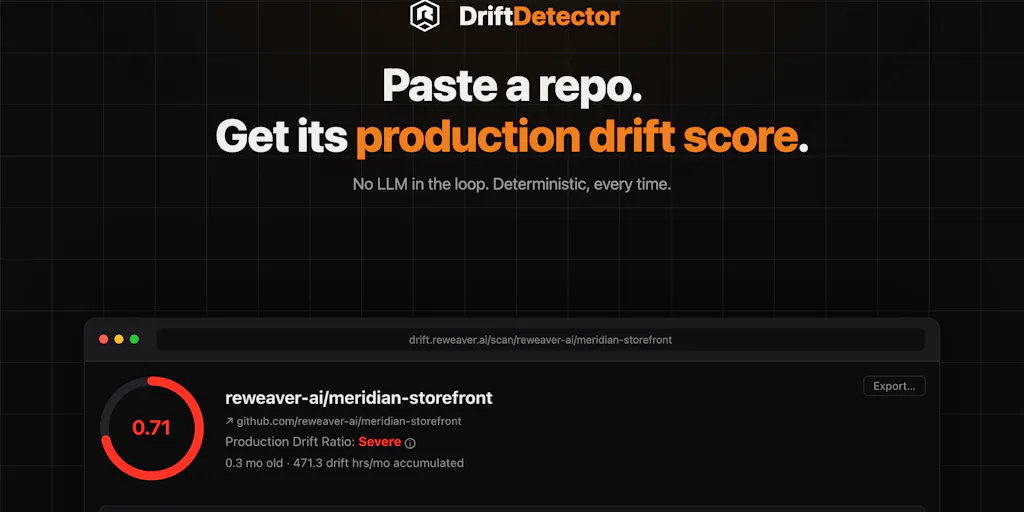
So when I came across DriftDetector on Product Hunt, a tool built by ReWeaver AI that measures code drift with deterministic scans rather than LLM guesses, I didn’t read it as a developer tool. I read it as a metaphor for what’s broken in our content operations — and, more usefully, as a model for how to fix it.
The Problem: Everyone’s Pointing a Second LLM at the Mess
Here’s what I’ve seen happen in every serious content operation I’ve been part of or consulted for. You start with a clear brand voice. You document it. You build templates. You train your team or your AI assistant on it. And then the happy path ends.
The platform algorithm shifts, so you tweak your hook style. A new trend emerges, so you adjust your pacing. You start repurposing YouTube long-form into TikTok clips, then those clips get adapted for LinkedIn, then someone runs them through an AI tool to make them “more professional,” and somewhere in that chain — between the original intent and the final render — the thing stops being yours.
The tools I’ve tested that claim to solve this problem mostly don’t. They point a second LLM at the diff — the difference between your original content and what got published — and ask it to guess what the first one missed. That’s not auditing. That’s asking a second guesser to validate a first guesser. You can’t audit a guess, and you’re paying per token to get one.
Jonathan Gordon, the founder behind ReWeaver AI, describes finding the same failure pattern when he looked at the code his AI assistants were generating. Design tokens that don’t exist in the design system. Accessibility patterns quietly dropped. Business logic leaking into the presentation layer. Tests that pass the day they’re written and protect nothing after.
Swap “design tokens” for “brand voice guidelines” and “business logic” for “your actual value proposition,” and he’s describing the state of most content operations I audit.
The reason this matters to you as a creator or social media operator is not academic. It’s compounding. Every post that drifts slightly off-voice is a tiny tax on your brand equity. Every video that loses its accessibility patterns — captions dropped, contrast ratios ignored — is a small exclusion of part of your audience. Every piece of content that leaks your internal thinking into a public-facing post is a trust erosion event. None of it breaks the build. All of it becomes someone’s problem later.
What DriftDetector Actually Does Differently
Let me be precise about what this tool is, because the distinction matters for how you think about your own content systems.
DriftDetector doesn’t use a second LLM to eyeball changes and offer an opinion. It measures. Scan the same commit twice, you get the same answer. That determinism is the entire point — and it’s the exact quality that’s missing from most AI-assisted content workflows.
The founder’s framing is worth reading carefully: “You can’t audit a guess, and you’re paying per token to get one. DriftDetector measures instead.”
That’s not a subtle difference. It’s the difference between a tool that gives you a vibe check and a tool that gives you a number you can put in front of a team lead. When I’m running a content operation, I need to know — with confidence — whether this week’s batch of posts is more on-brand than last week’s, or whether we’re drifting. A guess doesn’t help me. A measurement does.
The history feature is where this gets interesting for operators. Every point on the chart isn’t a sample — it’s a real scan of that commit. You can zoom into any stretch and have that period re-scanned in detail. So you can find the week the drift actually entered, then open that commit on GitHub straight from the table.
For a social media operator, translate that to: you can find the week your content started drifting off-voice, then open the exact content calendar entry, the exact template change, the exact AI prompt modification that introduced it.
That’s the kind of forensic capability that separates professional content operations from hobby accounts. When something goes wrong in your content — a post lands badly, a campaign misses its audience, engagement drops inexplicably — you need to know when the drift entered, not just that it exists.
Why This Matters More to TikTok Creators Than LinkedIn Ones
Let me get specific about where this kind of thinking applies most urgently.
TikTok’s algorithm distributes based on completion rate and rewatch behavior. That means small drift in your hook style, your pacing, or your visual language has outsized consequences. A 10% shift in your average watch time can be the difference between a video that gets pushed to the For You Page and one that dies at 200 views. And the drift is invisible in the moment — you’re just making “minor tweaks” to try different hooks, and suddenly your content doesn’t feel like yours anymore, and your metrics confirm it.
LinkedIn, by contrast, is more forgiving of voice drift because the algorithm weights engagement signals like comments and shares more heavily than completion rate. Your audience is there for your professional perspective, not your editing style. But that also means drift on LinkedIn is more insidious — it accumulates quietly, and by the time you notice, your network’s perception of you has shifted in ways that are hard to reverse.
In my experience, the creators who benefit most from drift measurement are the ones operating at volume across platforms. When I’m scheduling 30 posts across five platforms in a week — which I did last month, and it was a mess — I need a system that tells me when my multi-platform repurposing pipeline is silently degrading the core message. Not a tool that gives me a pat on the back and says “looks fine.”
What Creators and Social Media Teams Can Borrow From This
You might not write code. You might never open a GitHub repository. But the principles behind DriftDetector’s approach translate directly to content operations.
First: measure, don’t guess. Most content teams I’ve worked with do “vibe checks” on brand consistency. Someone on the team reads the copy, watches the video, and says “yeah, that feels like us.” That’s a guess. A measurement would be: a rubric with specific, checkable criteria — voice attributes, visual elements, structural patterns — scored consistently across every post. You don’t need an AI tool to do this. You need discipline.
Second: make the history inspectable. The reason DriftDetector’s chart matters is that it’s not a single score. It’s a time series. Every point is a real scan. You can find the week the drift entered. For content operations, that means keeping a changelog of your content strategy — when did you change your hook format? When did you update your brand guidelines? When did you switch from vertical video to a new aspect ratio? — and correlating that with performance and brand-consistency metrics.
Third: make the output safe to share. The founder’s point about putting the number in front of a team lead is crucial. In content operations, we’re constantly asked to justify our work to stakeholders who don’t live in the creative weeds. A deterministic score — “our brand consistency is 87% this quarter, down from 92% last quarter, and here’s the week it changed” — is a conversation starter. “We feel like we’ve been drifting” is not.
Fourth: audit the auditors. The most important lesson from DriftDetector’s critique of LLM-based audits is that you need to know what your tools are actually doing. If you’re using AI to repurpose content, to draft captions, to suggest hooks — what’s your check on whether that AI is preserving your voice or slowly erasing it? The tools that claim to “keep you on brand” are often just pointing another LLM at your content and asking it to guess. That’s not an audit. That’s a vibe check with extra steps.
Where the Math Breaks
Let me be clear about where this approach has limits, because I’m not here to sell you a silver bullet.
The founder’s claim that “the screenshots undersell one thing” — that every point on the history chart is a real scan — is compelling for code. Code is deterministic. The same commit scanned twice produces the same result. Content is not code. A TikTok video’s “brand consistency” is not a fixed property; it’s a judgment call that depends on context, audience, platform norms, and timing.
So when you translate DriftDetector’s approach to content, you have to be honest about what you’re measuring. You can measure objective things: does the post include captions? Does it use the brand color palette? Does it follow the hook structure template? Does it include the required CTA? Those are deterministic, checkable criteria.
You cannot deterministically measure whether a post “feels like us.” That’s a judgment call, and any tool that claims to measure it deterministically is either defining “brand” so narrowly that it’s meaningless, or it’s smuggling in a subjective evaluation behind a numerical facade.
The other place the math breaks is in the cost-benefit. For a solo creator posting three times a week, building a full drift-detection system is overkill. You are the brand. You can feel when you’re drifting. But for a team managing multiple accounts, or an agency running content for multiple clients, or a creator with a full repurposing pipeline across platforms — the cost of drift is real, and the measurement is worth it.
Where I’d Push Back on DriftDetector Itself
I want to be balanced here, because the Product Hunt launch has the usual promotional energy — the founder is asking for feedback on compliance packs and effort estimates, which is smart community engagement, but it also means the product is early.
The compliance question is real. The founder asks what compliance or architectural packs are missing for your stack. For content operations, the equivalent question is: what platform-specific or industry-specific drift criteria matter to you? A healthcare brand has different compliance requirements than a gaming creator. A financial services firm has different accessibility obligations than a fashion influencer. The tool — and any content equivalent — needs to let you define what “drift” means for your context, not just offer a generic score.
The effort estimate question is revealing. The founder asks how close the effort estimate lands to your team’s real sprint velocity. That’s a question about whether the tool’s output translates into actionable planning. For content operations, the same question applies: does knowing your brand consistency score help you plan next week’s content, or does it just give you a number to report? In my experience, most analytics tools stop at measurement and leave the action planning to you. The good ones — the ones that change how you operate — connect the measurement to a workflow.
The determinism claim has a ceiling. The founder is right that deterministic measurement is more trustworthy than LLM guessing. But the tool measures code drift, not code quality. You can have perfectly consistent code that’s still bad code. Likewise, you can have perfectly on-brand content that’s still boring, ineffective, or wrong for the platform. Drift detection tells you when you’ve changed. It doesn’t tell you whether the change was an improvement.
Who This Is Not For
Let me be direct about who should skip this.
If you’re a solo creator posting to one platform, posting what you want, when you want — you don’t need drift detection. You need to make good content and post consistently. Your drift is your evolution, and your audience will tell you if they don’t like it.
If you’re a brand that’s still figuring out what your voice is — drift detection is premature. You can’t measure consistency against a standard that doesn’t exist yet. Get your brand guidelines solid first, then worry about enforcement.
If you’re a content team that’s already drowning in dashboards and analytics — adding another metric is probably counterproductive. The problem isn’t that you don’t know what’s happening; it’s that you don’t have the capacity to act on what you know. Drift detection is only useful if you have the bandwidth to fix what it finds.
If you’re a developer or engineering team evaluating DriftDetector for your actual codebase — the founder’s invitation to run it on something you’ve shipped is genuine, and the tool takes seconds to try with no account required. That’s the right way to evaluate any tool: run it on your real work and see if the output tells you something you didn’t already know.
What I’d Watch and Test Next
The founder’s challenge — post your score, see who has the cleanest and messiest codebase — is a smart community move, but it’s also a useful exercise for anyone evaluating drift detection in their own content operation.
Here’s what I’d do this week, concretely:
Run a brand-consistency audit on your last 20 posts. Not with a tool — with a rubric. Define five criteria that matter for your brand: voice, visual identity, structure, accessibility, and call-to-action consistency. Score each post 1-5 on each criterion. See where you land. You’ll likely find that your drift is not uniform — it’s concentrated in specific areas, and it entered at specific times.
Map your drift to your workflow changes. When did your scores start slipping? What changed in your workflow that week? New tool? New team member? New AI assistant? New platform you started repurposing to? In my experience, drift almost always enters through a workflow change, not through gradual decay.
Check your AI tools’ assumptions. If you’re using AI for content creation or repurposing, ask what the tool is doing to preserve your brand voice. If the answer is “it uses your existing content as context” — that’s a guess, not a guarantee. The tool is pointing an LLM at your content and hoping it infers your voice correctly. You need a deterministic check on that.
For developers: take the founder up on his offer. Run DriftDetector on something you’ve shipped. It takes seconds, no account, and the link is at the top of the Product Hunt page. If the score tells you something you didn’t know, that’s signal. If it just confirms what you already knew, that’s also useful — it means your intuition is calibrated.
For content operators: steal the principle, not the tool. The most valuable thing about DriftDetector isn’t the code scanning. It’s the philosophy: measure, don’t guess; make history inspectable; make output shareable. Apply that to your content operation and you’ll catch drift before your audience does.
The creator economy is maturing. The tools are getting more sophisticated. But the fundamentals haven’t changed: consistency builds trust, drift erodes it, and the only way to manage drift is to measure it. Whether you use a deterministic scanner or a disciplined rubric, the principle is the same.
Stop guessing. Start measuring. Your audience will notice the difference — even if they can’t name it.