You are not here for office leasing. Stay anyway — because the launch page Tandem just published is the clearest description I’ve read in months of the disease that runs through every social media operation I consult for: a market that runs on memory. The creator economy’s version looks different — it’s the editor who still leans on the three TikTok sounds that worked in April, the strategist carrying engagement benchmarks in her head because no dashboard publishes anyone else’s numbers, the freelancer negotiating from a 2022 rate card because nobody in her network shares real comps. Tandem’s product is real-estate AI. The meta-lesson is what happens when an agentic layer watches a market constantly so humans stop being the relay. That is the next wave of social media tooling, and this launch shows both its promise and its hiding places.
The relay problem is your content pipeline
The launch copy from Brendan Suh describes commercial leasing as a market with “thousands of office spaces and no single view of them.” What exists instead is memory: a few hundred brokers, each carrying a personal map of the city, built by walking it. Those maps are good — twenty-year brokers know their buildings cold. But it’s one person’s map of a market that changes every week, and no one person keeps up with all of it. So the process runs on relays: you spend an hour explaining what you need, your broker spends the week calling the brokers they know, who call the landlords they represent. Eight options come back. You like one. The calls start over. “Nobody is doing anything wrong. It just takes days to move a question through a chain of people.”
Read that paragraph again and tell me it isn’t a content operation. You spend an hour explaining the campaign to the marketing lead, who emails the freelance strategist, who DMs three creators, who reply two days later. Now you’re a week in with five content options and a trend that just peaked. Nobody is doing anything wrong. The market for “what’s working right now” is the same kind of memory map, built by walking feeds daily — but one person cannot keep up with all of it, because the feed changes every week and the algorithm changes faster.
The incumbent tooling doesn’t fix the relay; it digitizes it. Buffer, Hootsuite, Later, and Metricool are scheduling dashboards that show you your own past performance in a tidy calendar. They are the broker’s map — useful, familiar, and stale the moment the platform shifts distribution. When a platform changes its weighting toward Reels or reshapes search results, the map breaks. Then you start the relay again: hire a consultant, poll your network, read three newsletters. Days to move a question through a chain of people.
In my experience running accounts, the cost of this relay is invisible because it’s baked into the rhythm. You don’t notice you’ve normalized a two-day lag between “what’s popping” and “what we’re publishing.” You notice only when a direct competitor posts the exact format you’d identified in a trend report two weeks earlier, and you ask yourself why your report took two weeks to move through five people.
Why TikTok creators should care more than LinkedIn ones
The value of a live market watcher scales with market velocity. LinkedIn moves slowly enough that a thoughtful strategist’s remembered map stays valid for months; the human is still fine. TikTok is the office market that “changes every week” — sounds, hooks, formats, and the algorithm’s mood shift in days. On TikTok, a creator with a live agent watching everything beats a creator with a great memory every single cycle. If you’re evaluating the next generation of “AI social agents,” ask whether your platform is a LinkedIn or a TikTok. A spreadsheet still wins on LinkedIn. On TikTok, the relay is quietly killing you.
What an agentic brain actually changes
Tandem’s model is deliberately boring on the surface: “On paper, Tandem is an office leasing brokerage like any other. Same license, same tenant rep fee, same person meeting you in the lobby.” The difference is what that person knows and how fast they can act on it. Every agent works with an agentic brain watching the market constantly: what came available this morning, what a comparable unit actually leased for last month, which landlords are flexible on term. The team claims clients who search with Tandem “see 30%+ more spaces than in a traditional search, and finish about 6x faster” — and I want to underline that attribution, because the team claiming it is not the same as an independent auditor confirming it. We’ll get to the math later.
Strip away the real estate and the mechanism is exactly what social media operations lack. When I scheduled 30 posts across five platforms last month, I spent the next three days in dashboards reconciling what actually published, which links carried their UTM parameters, which platform silently dropped a caption, and which audience actually watched past the first three seconds. The reports arrive hours or days late because platform APIs are rate-limited and the SaaS layer only pulls a subset of your data. By the time I have a clean read on last week’s engagement rate, the trend that drove it is dead. Tandem’s promise — “answers in minutes, over email, text, or phone” — is the promise every social operator actually wants. Not another dashboard. An answer.
Now imagine the Tandem pattern applied directly: an agentic layer watching every platform’s trending audio, format shifts, and comparable accounts’ performance, able to tell you in minutes what a similar account in your niche actually got for a sponsored post last month. “What should this cost” stops being a guess from memory and becomes a comp pulled from the market. “What’s about to trend” stops being a vibe and becomes a signal. That is not what Buffer or Metricool sell you today. They sell you a mirror of your own past. The next wave sells you a map of everyone else’s present.
There’s one more Tandem line worth stealing: “A 3,000 square foot requirement gets the same attention as a 30,000 one, because your agent isn’t paid more for a bigger deal.” In creator terms, that is the promise that a $500 sponsorship gets the same strategy energy as a $5,000 one. Right now the economics run the opposite way: most agencies and freelance managers triage by deal size because their compensation scales with it. The small stuff starves, the client notices, and the relationship decays. If I were building a creator agency in 2025, I’d steal Tandem’s flat-attention promise outright — flat-rate retainers, not percentage-of-take, so the long tail of work doesn’t get the long tail of neglect.
The incentive question is the whole ballgame
The launch page’s comment section is where this turns from a smart pitch into a trust case study. Artem Fedorovich asks the question every tenant — and every client — eventually asks: “The broker incentives never felt aligned with mine, since they get paid more when I pay more. How does your model change that?” Then Rabnoor Singh delivers the line of the thread: “AI does not fix that conflict. It hides it.” The reasoning is surgical. A human broker’s conflict is legible — you know who pays them and you discount accordingly. An agent that has “seen every building in the city” arrives sounding objective, and the recommendation lands with no visible interest attached. “Same incentive, tell removed.”
That is the most important sentence any AI vendor will hear this year, and it applies to the creator economy with brutal precision.
Every AI content tool has a tell, and most of them hide it behind a dashboard. A scheduling SaaS is incentivized to keep you subscribed, so it surfaces vanity metrics and engagement insights that make you feel momentum. A talent agency is incentivized by a percentage of your income, so it pushes you toward more deals at higher prices even when your audience is showing burnout. An AI “best time to post” model is trained on aggregate data from its own user base — the same data the vendor may sell to enterprises or use to tune its own ad products. The recommendation arrives sounding objective, with the interest removed.
The trust rule I now apply to any tool, and that this thread crystallized: ask who pays the vendor and what the vendor’s next-best outcome is. If the answer is “the same person who benefits when you post more,” discount the recommendation accordingly. In my experience, the honest tools are the ones that can point to a fee structure that does not track your usage — a flat subscription, a capped retainer, or an explicit disclosure of which side of the deal they sit on.
Tandem at least says “no cost to you,” which any real estate veteran immediately reads as “the landlord pays the fee.” That’s the structure. The maker’s own launch copy confirms it: “same tenant rep fee” as any other brokerage. This is not a sin; it’s a disclosure. But Rabnoor’s point stands: the AI layer does not make the conflict disappear. It makes the tell harder to see, because there is no human across the table whose body language you can read.
The self-serve counterweight
Tandem hedges its incentive problem with a genuinely smart move: the whole market is browsable at tandemspace.com. Compare asking rents, book a tour for tomorrow, bring your agent in whenever you want them. That is a meaningful trust signal — if the client can see every option, the broker’s tell is weakened, because the client can verify the recommendation against the full set. For creators, the equivalent is publishing your data: public rate cards, public engagement breakdowns, and a clear “here’s what this costs and why.” When the market is browsable instead of mediated, the memory game dies. The reason most creator rates are still set by memory is that nobody publishes the comps.
What creators should borrow from this launch
Even if you never lease an office, this launch is a template for positioning your own work.
First, name the broken economics. Tandem’s opening does it in one sentence: “A 3,000 square foot suite on a two year term takes nearly the same work and returns a fraction of it.” Your version: a $500 sponsorship takes the same negotiation overhead as a $5,000 one. That fact is what kills small deals. So state it out loud, and then explain why you’re built differently — why you bundle small deals, standardize deliverables, and refuse bespoke proposals below a floor. The launch page is a masterclass in saying “this is how the math works, and here’s why we’re not wired to exploit it.”
Second, position the AI layer as the amplifier, not the replacement. Tandem is careful: “same license, same tenant rep fee, same person meeting you in the lobby.” The agentic brain is the difference, not the substitution. When you sell your own services or build your own tooling, resist the “AI replaces your strategist” pitch. It triggers exactly the distrust Rabnoor articulated — invisible interest and no accountable human. Say instead: the human got faster and saw more of the market. That is a pitch people can verify.
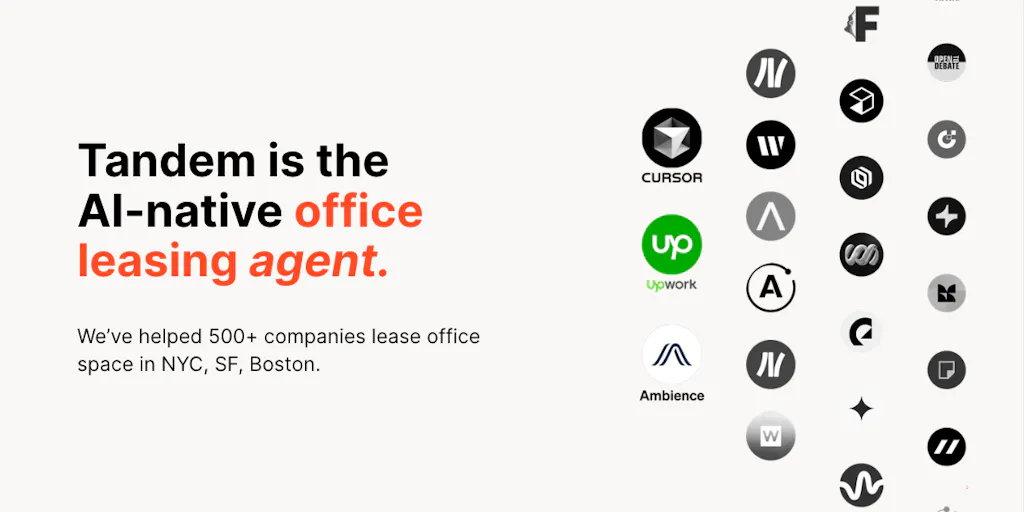
Third, lead with logos but separate the claims. Tandem says it has “placed more than 500 companies into offices, including Cursor, Upwork, Apollo GraphQL” — that is a hard, checkable trust anchor. Then it layers on the 30% and 6x claims, which float without methodology. When I write my own positioning, I keep that distinction loud: hard facts get named; soft metrics get a clear caveat about sample size and measurement.
The rate card as market data
Tandem’s “you know what it should cost” comes from seeing what comparable units actually went for. For creators, the equivalent is pooling and publishing sponsorship comps — what similar accounts in your niche charge per 1,000 views, what engagement rates they actually deliver, what the real take-home is after platform fees. Right now everyone negotiates from memory, and memory is why inequities persist: the newer creator underprices because she has no comps, and the brand wins. A public comp sheet flips that. It doesn’t need to be a product; a shared Notion or Google Sheet among five peers is enough to start. That is how a market stops running on memory.
Where the math breaks (and who this is not for)
Let me be balanced, because the trust test applies to me too. Not disclosed on the launch page: which AI model powers the agentic brain, what data sources feed the comparable-rent estimates, the sample size behind the 30% and 6x claims, the exact fee arrangement beyond “no cost to you,” and how “6x faster” is measured. The team says its average time from first tour to signed lease is 27 days versus an industry average of ~180 days — but that industry average is not sourced here. The team may well have rigorous internal data. The launch page just doesn’t show it.
For social media operators evaluating AI tooling, this is the exact audit to run on every vendor benchmark that crosses your desk: who was measured, over what period, and can I reproduce the number? The same skepticism you’d apply to “10x your reach” in an ad should apply to “6x faster” on a launch page. Claim speed and coverage, but show me the denominator.
Who is this not for? Most creators, for a start. Tandem is a brokerage live in San Francisco, New York City, and Boston — you cannot plug it into your stack, and it won’t help you schedule a single Reel. If you’re an indie founder looking for an off-the-shelf social media AI agent, this is a forecast, not a download. And if you believe the agent removes human negotiation, the comment thread is the warning: the agent watches the market, but the persuasion is still human. The team that answers “how does your model change broker incentives” with “same tenant rep fee” hasn’t solved the conflict; it has automated the market view around it.
My overall judgment: this launch matters more as a template than as a product for this audience. The structure — name the broken relay, add an agentic layer, keep a human accountable, claim speed and coverage — is exactly how the next generation of social media operations tools should be pitched. But the incentive gap is the load-bearing wall. If the next social agent can’t tell you who pays it and what it does not see, it’s just a broker with a better poker face.
What I’d watch / test next
Three concrete moves for this week, regardless of your stack.
First, map your own relay. Pick one recurring operation — sponsor approvals, asset requests, trend reports — and count the handoffs and the waiting time between them. If it takes more than three touches and more than a day, you’ve found the bottleneck that an agentic layer should eventually kill. You don’t need to buy software to see it.
Second, pressure-test one metric you currently trust. Take your scheduler’s “best time to post” recommendation or your engagement-rate baseline and ask: what data powers this, and who benefits if I post more? If the vendor can’t answer plainly, the tell is hidden, not gone.
Third, build your comp sheet. List five comparable accounts in your niche with their engagement rates and estimated sponsor rates, and use that as your negotiation baseline instead of memory. Pool it with peers if you can. A real number beats a confident recollection every time.
Fourth, watch the agentic wave. I’d bet we see a Tandem-for-social-ops within the next twelve months — an agent that watches trend shifts, comparable creator performance, and platform algorithm signals, and answers in minutes instead of reports in days. When it lands, run it through the test this launch teaches: 30% more and 6x faster are promises, and promises are appetite. The fee structure and the data methodology are the substance. If it hides its interest, walk.