The Creator Stack Is Getting an Uncensored, Cheaper Inference Layer — and That Should Change How You Budget Your AI Workflows
If you run social accounts for a living, the model layer feels abstract until the invoice arrives. Every AI-assisted caption, repurposing pass, and thumbnail variant you ship is a token bill somewhere, and most creators I know are quietly paying retail for it through a consumer chat subscription that hides the marginal cost. So when a small inference team shows up with published weights, per-token pricing, and a security-tuned model family, the interesting question for a social media operator isn’t “what is this?” — it’s “does this change what I can afford to automate, and what do I lose by routing my content pipeline through a model that was deliberately stripped of refusals?” That’s the lens I want to use here, because Zro is a developer-facing product, but the economics and the trust questions it raises land squarely on creator workflows.
What Zro Actually Is, and the Problem It’s Really Solving
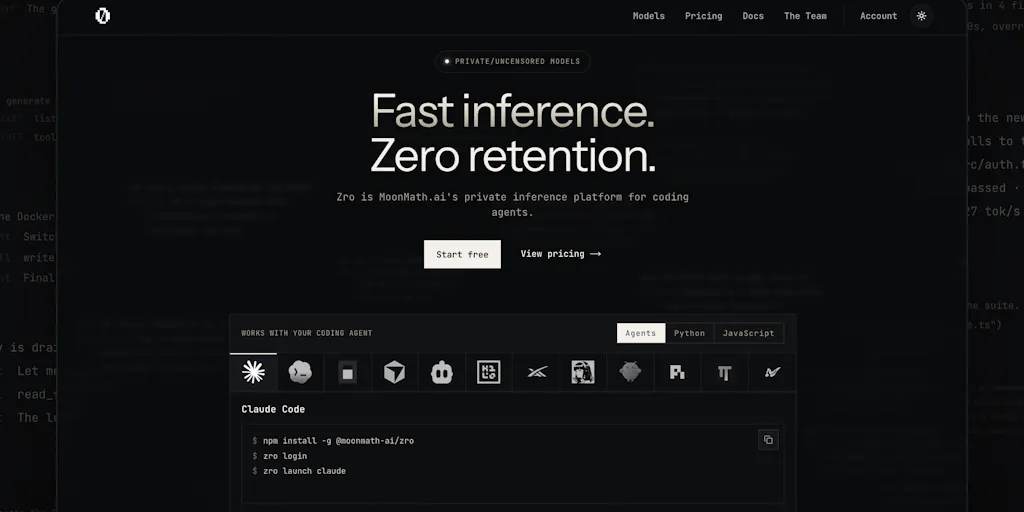
Let me be precise about the source material, because the Product Hunt page is easy to misread as a generic AI launch. Zro is an inference provider built by MoonMath. It first launched in July with a narrow pitch: fast, private inference for coding agents. The maker, Emir Soytürk, says the team has sent pull requests upstream to SGLang and vLLM and writes up its inference findings publicly — the kind of engineering-forward positioning that tends to correlate with real latency work rather than a reseller wrapper. The team also claims it has served over 250 billion tokens since that July launch. That figure is a maker claim, not an audited number, but it’s the kind of volume that suggests a real customer base rather than a demo.
The new launch adds two things. First, a free plan with daily usage on Flash-tier models. Second, a family of security-focused models the team calls Dolly, built because general-purpose models tend to refuse cybersecurity research questions before an investigation gets anywhere. The two live models are Dolly 1 Security, based on GLM-5.3 Flash at $0.45 input / $1.50 output per 1M tokens, and Dolly 2 Security, based on GLM-5.3 and “abliterated in-house with a focus on retaining general capability,” at $2.10 input / $6.30 output per 1M tokens. The team says it has published the weights and evaluation for Dolly 2. There’s also a Product Hunt offer of 25% off the first month of Pro or Max with the code ZROPRODUCTHUNT, a $5-for-$5 referral credit, and a stated roadmap that includes Kimi K3.1 and a security-focused DeepSeek V4.1 Flash variant. Pricing for the Pro and Max tiers themselves is not disclosed on the page.
Here’s the translation for a creator: this is a metered, API-accessible inference layer with a free tier, a cheap Flash model, and a more expensive uncensored model, plus open weights you could theoretically self-host. The “security” framing is the maker’s, not mine — but the underlying capability, an uncensored model at a published per-token price, is directly relevant to anyone building automated content pipelines that keep hitting refusals.
Why an uncensored model matters to a content operator (and why it’s a trap)
I’ve run repurposing workflows where the model refuses to help with a topic that’s entirely legitimate — a compliance explainer, a piece about account bans, a post dissecting a scam. Refusals are friction, and friction at scale is expensive. An abliterated model, which the maker defines in the comments as “uncensored, unbound,” removes that friction. My take: that’s genuinely useful for research-heavy verticals like security, fintech, and policy, and genuinely dangerous for anyone who mistakes “won’t refuse” for “will be accurate.” Refusal behavior and hallucination behavior are different axes. Stripping one doesn’t improve the other, and may degrade it. That’s the single most important thing to internalize before you route brand-facing copy through a model like this.
How It Compares to What Creators Already Use
The honest comparison set here isn’t other social schedulers. It’s the AI layer underneath the tools you already pay for. Most creators interact with models through ChatGPT, Claude, or Gemini subscriptions, or through features baked into Canva, CapCut, Buffer, Later, or Metricool. Those are bundled, convenient, and priced per seat rather than per token — which is great until you’re doing high-volume batch work like generating 200 caption variants, transcribing and summarizing long-form video, or running a classification pass over comments.
At the published rates, Dolly 1 Security at $0.45/$1.50 per million tokens is cheap enough that a solo operator could run a meaningful daily batch job for what amounts to pocket change — though I’d caution that token counts on real content are larger than people estimate once you include system prompts, context, and output length. Dolly 2 at $2.10/$6.30 is roughly 4x the input and output cost, which is still well below what you’d pay routing the same work through a premium frontier model via a consumer API. The free tier on Flash models is the real on-ramp for testing.
Where Zro differs structurally from the incumbents: it’s inference-only, developer-first, and CLI-oriented. The documented path is installing a CLI package, logging in, and launching Claude Code pointed at a Dolly model. That’s a workflow for someone comfortable in a terminal. It is not a workflow for a social manager who wants a sidebar in their browser. My take: this is a building block, not a product for most creators today — and that’s fine, because building blocks are what the next wave of creator tools will be assembled from.
Where the math breaks
Per-token pricing looks transformative until you model a real pipeline. A repurposing workflow that ingests a 40-minute video transcript, generates 12 platform-native posts, then runs a second pass for tone and compliance, can burn through context fast — especially if you’re re-sending the full transcript per output. The cheap Flash model absorbs that well. The expensive uncensored model does not, and you shouldn’t be using it for caption generation anyway. The correct architecture is tiered: Flash for bulk transformation, the premium model only for the narrow slice where refusals or domain depth actually block you. If you’re not already segmenting your AI workload by task difficulty, a per-token provider will expose that inefficiency rather than fix it.
What Creators and Social Teams Should Actually Borrow From This
Three things, and none of them require switching providers.
First, the tiered-model discipline. Zro’s own pricing structure — a cheap Flash tier and a 4x-expensive premium tier — is a template. Audit your AI spend by task. Bulk caption variants, hashtag generation, comment classification, and first-draft summaries belong on the cheapest model that clears your quality bar. Only strategy-level work, nuanced brand-voice editing, and genuinely blocked research topics justify premium tokens. I’d bet most creator teams are running everything through one premium model out of habit, and that habit is costing them more than any subscription they’re reviewing.
Second, open weights as a hedge. The team published Dolly 2’s weights on Hugging Face. For a creator business, that’s not about self-hosting today — it’s about not being locked out. If a provider changes pricing, deprecates a model, or tightens policy, open weights mean your workflow has an exit. When you evaluate any AI tool that touches your content pipeline, ask whether the underlying model is portable. If the answer is no, price that lock-in into your decision.
Third, evaluation literacy. The most substantive comment on the launch page, from Oleksii Sekundant, pushes exactly the right button: show security-task accuracy and ordinary coding accuracy side by side after the modification, so a regression in one is visible before release. A second commenter, JC, notes that “abliterating while trying to retain general capability is easy to claim and hard to show.” The maker responds that this is why the team runs evaluations before releasing a model and points to the published weights. My take: that exchange is the whole ballgame. Any creator using an uncensored or fine-tuned model for content work should demand the same — a side-by-side eval on your task, not the vendor’s benchmark. Run 20 of your real prompts through both the tuned and base model and diff the outputs. That’s a 30-minute test that tells you more than any launch page.
Why TikTok and YouTube operators should care more than LinkedIn ones
Platform-native content on short-form video is high-volume, high-variance, and relentlessly iterative — you’re generating dozens of hooks, captions, and variant scripts per week, and most of them are disposable. That’s precisely the workload where per-token economics and a cheap Flash tier change your unit costs, and where refusal friction on edgy-but-legitimate topics (diet claims, finance disclaimers, account-growth tactics) actually bites. LinkedIn and long-form X operators ship fewer, higher-stakes pieces where brand safety and accuracy dominate, and where an uncensored model is a liability rather than an asset. Match the model tier to the platform’s risk profile, not to a single team-wide default.
Where My Judgment Says This Falls Short
I want to be clear about what the source does and doesn’t establish, because launch pages are marketing by another name.
The creator use case is inferred, not demonstrated. Zro is positioned for coding agents and security research. Nothing on the page describes a content, marketing, or social workflow. The token prices are real and published; the claim that this is a good deal for caption generation is my inference, not the maker’s claim, and it depends entirely on your volume and tolerance for terminal-based tooling.
“Private inference” is asserted, not specified. The page uses the phrase but doesn’t detail the privacy architecture — no data-retention policy, no statement on whether prompts are logged or used for training, no compliance certifications listed. For a social team handling client content or unreleased campaign material, that’s the first question I’d ask in the Discord before sending anything sensitive. Not disclosed is not the same as bad, but it is not the same as verified either.
The evaluation story is thin on the page itself. The maker says evaluations are published and links the weights, and a commenter explicitly asks whether the evals cover security and general tasks side by side. The maker’s reply affirms the intent but the launch page doesn’t reproduce the numbers. If you’re considering the uncensored model for anything brand-facing, go read the actual evaluation artifacts before you trust the “retains general capability” framing.
The “fastest inference I have ever seen” comment is a single unverified user remark, and the 250B-token figure is a maker claim. Neither is a benchmark. Treat both as directional.
Who this is not for: anyone who wants a point-and-click interface, anyone whose content workflow lives entirely inside a scheduler’s built-in AI features, and anyone who can’t articulate why they need an uncensored model in the first place. If your refusals are rare and your volume is low, the switching cost isn’t worth it — a consumer subscription is cheaper in time even if it’s worse in tokens.
What I’d Watch / Test Next
This week, before you touch a new provider, do the audit: pull your last 30 days of AI-assisted content work and tag each task as bulk-transform or high-judgment. That split tells you whether per-token pricing is even relevant to you. Then run the refusal test — take five prompts that a general model has rejected or watered down for your niche and see whether an uncensored model actually helps or just introduces accuracy risk you now have to QA manually. If you’re terminal-comfortable, the free tier is the lowest-risk way to benchmark latency against whatever you’re using now; if you’re not, watch for the tooling layer — schedulers and repurposing SaaS will inevitably wrap providers like this, and the ones that expose model choice will be worth paying for. Finally, follow the evaluation thread. The maker says stronger evaluations and clearer evidence of how the security models are modified are on the roadmap, and that’s the claim I’d hold them to before recommending anyone route client work through Dolly 2. The pricing is interesting. The transparency is the part that will decide whether this matters in twelve months.