The Creator Economy Has an Integration Problem, and It’s Not the One You Think
If you run a serious social media operation — even a two-person indie brand with 40k followers on TikTok and a newsletter — you’ve hit this wall: the tools that power your content pipeline are only as trustworthy as the glue holding them together. That glue is APIs. When your scheduling tool stops talking to your analytics dashboard, when your email list doesn’t sync to your CRM, when your affiliate payout webhook fires twice and double-charges a sponsor — your content calendar doesn’t care. Your audience doesn’t care. But your revenue does.
I’ve spent the last decade managing accounts that span every platform from Instagram to Pinterest, and I’ve learned that the most expensive bug in social media isn’t a typo in a caption. It’s a silent integration failure that looks like it worked. The post published. The analytics pulled. The payment processed. Except it didn’t, and you find out three weeks later when a sponsor’s invoice is wrong and your engagement data has been feeding you garbage.
That’s why I pay attention when a tool like FetchSandbox shows up on Product Hunt — not because I’m going to use it directly, but because it signals something bigger: the creator economy’s tooling stack is maturing past “pretty dashboards” into “does the damn thing actually work.” And that shift matters for every social media operator who’s ever trusted an automation to run while they slept.
What FetchSandbox Actually Solves: The “It’s Fixed” Lie
Let me paint a scenario you’ll recognize. You’ve got a content repurposing workflow — you post a YouTube video, and an automation should clip it for TikTok, generate a LinkedIn carousel, and update your newsletter. You set it up once, test it, it works. Three months later, a sponsor changes their tracking parameters, or your email provider updates their API, and suddenly your automation half-runs. The TikTok clip posts. The LinkedIn post silently fails. The newsletter goes out with a broken link. Nothing throws an error. Everything looks fine.
This is exactly the problem FetchSandbox targets, except it’s aimed at developers and AI coding agents rather than social media managers. The founder, Raj Nagulapalle, frames it bluntly: “Your agent can write a Stripe integration. It can’t run one.” The same logic applies to your content automation stack. The tool that schedules your posts can claim it ran. Whether it actually did — whether the webhook your payment processor sent actually updated your subscriber list — is a different question entirely.
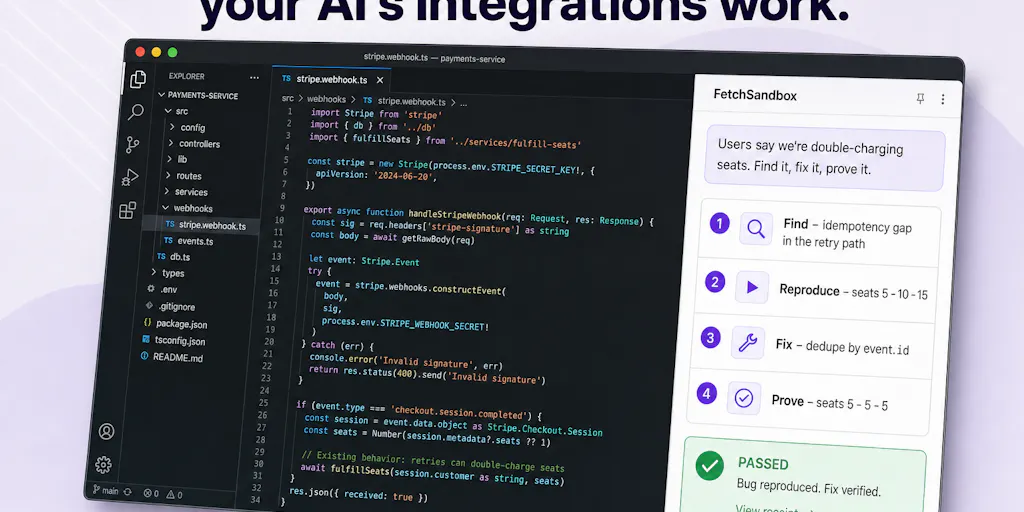
The core insight here is what the maker calls “the proof check.” When an AI agent (or a human, honestly) fixes a broken integration, the typical result is that the error disappears. But “the error disappeared” and “the data is now correct” are two very different things. Nagulapalle gives a perfect example: a customer paid for 5 seats, a retry gave them 10, then 15. An agent fixed it, and after the fix nobody got any seats at all. Tests passed because the duplicates were gone — but the actual business outcome was broken.
For social media operators, the parallel is obvious. If your analytics integration breaks and you “fix” it so the numbers stop erroring, but you’re now pulling data from the wrong date range or the wrong platform, you haven’t fixed anything. You’ve just made the failure invisible. And invisible failures in social media are how you end up telling a sponsor your engagement rate is 4% when it’s actually 1.2%.
Why This Is Different From Postman, WireMock, and Every Other Mocking Tool
I’ve tested enough API testing tools to have strong opinions. Postman is the industry standard for manual endpoint testing, and it’s genuinely good at what it does. But as one reviewer on the FetchSandbox page put it, Postman “requires heavy configuration to simulate asynchronous webhook lifecycle failures.” Translation: it can tell you if an endpoint returns a 200, but it’s terrible at simulating the messy real-world conditions that actually break integrations — duplicate webhook deliveries, out-of-order events, stale state, token timeouts.
Similarly, WireMock and custom mock servers built with tools like MSW can stub out responses, but they’re brittle. You maintain them by hand, they rot as APIs change, and they fundamentally can’t replicate stateful race conditions. A mock that returns “200 OK” every time doesn’t teach you anything about whether your code handles a webhook arriving twice, or arriving in the wrong order, or arriving with a stale token.
What FetchSandbox does differently is package “realistic behavior profiles” for over 60 major services — Stripe, HubSpot, Clerk, Resend, Twilio, and more — into a single environment that runs through the Model Context Protocol (MCP). If you’re not familiar with MCP, it’s the emerging standard that lets AI coding agents like Cursor or Claude Code talk to external tools directly. Instead of opening a separate dashboard, the sandbox lives inside your editor. You tell your coding agent to test something, and it runs the test against FetchSandbox’s curated failure patterns, not a happy-path stub.
The reviews on the launch page are telling. One reviewer, Ulykbek Asylbek, notes that “most API mocking tools stop at verifying basic status codes, which hides major async flaws.” Another, Daniyal Khamzin, emphasizes that FetchSandbox “replicates real-world environment anomalies like out-of-order webhook delivery, token timeouts, and late event retries.” These aren’t edge cases — they’re the exact failures that bite you in production, and they’re the exact failures that standard testing tools never catch.
Why the MCP Integration Matters More Than the Sandbox Itself
Here’s my take on the architectural bet FetchSandbox is making, and why it’s smarter than it might look at first glance. The tool itself is useful — a sandbox with realistic failure patterns is genuinely valuable. But the MCP integration is the real innovation. By plugging directly into Cursor, Claude Code, Windsurf, and Codex, FetchSandbox removes the friction of “go open another dashboard.” The testing happens where the work happens.
For social media operators, this is a lesson in workflow design. The tools that actually get used are the ones that live inside your existing workflow, not the ones that require you to switch contexts. I’ve seen this play out with scheduling tools — Buffer and Hootsuite are powerful, but if your team already lives in Notion or Slack, the scheduling tool that integrates with those platforms wins, even if it’s technically less capable. The same principle applies here: FetchSandbox wins because it’s where the developers already are, not because it’s the most feature-complete testing platform.
What Creators and Social Media Teams Can Borrow From This
You might be thinking, “I’m not a developer, why should I care about API testing?” Fair question. But here’s the thing: every serious social media operation runs on integrations. You’ve got your scheduling tool talking to your analytics platform. You’ve got your email service provider syncing with your CRM. You’ve got your affiliate tracking pinging your payment processor. If any of those break silently, you’re making decisions based on bad data.
Here’s what I’m taking from FetchSandbox’s approach, and what I’d suggest every social media team implement this quarter:
1. Demand proof, not just “it’s fixed.” When your automation vendor tells you they’ve resolved an issue, ask for evidence. What exactly did they test? What’s the end state they verified? The FetchSandbox philosophy is that a fix isn’t real unless you can reproduce the original bug, apply the fix, and show the outcome is correct — not just that the error stopped. Apply that standard to your own workflows. If your Instagram analytics are pulling wrong numbers, don’t accept “we fixed it” without asking what the correct numbers should be and how they verified it.
2. Test for the messy conditions, not just the happy path. Most of us test our automations once when we set them up, see that they work, and move on. But the real world is messy. Webhooks arrive out of order. Rate limits hit. Tokens expire. Duplicate events happen. When you’re building or reviewing a content automation workflow, ask yourself: what happens if this fires twice? What happens if it fires in the wrong order? What happens if the API is down? The tools that handle these edge cases gracefully are the ones that don’t cost you money later.
3. Build your own “failure library.” FetchSandbox maintains a curated library of failure patterns for major services. You can do the same for your own stack. Keep a document of every integration failure you’ve experienced — the time your email provider’s API changed and broke your newsletter signup, the time your scheduling tool double-posted to Twitter, the time your affiliate tracking went silent for a week. When you evaluate new tools or review existing ones, check against that list. Does the new tool handle the failure modes you’ve actually hit? If not, you’re buying the same problem again.
Why TikTok Creators Should Care More Than LinkedIn Ones
Here’s a nuance worth flagging. If you’re a LinkedIn-focused B2B creator, your integration stack is probably simpler — maybe a scheduling tool, a newsletter platform, and analytics. The failure modes are less catastrophic because the stakes are lower. A missed LinkedIn post is annoying, but it’s not going to cost you a sponsorship.
TikTok creators, on the other hand, are living on the bleeding edge of platform API changes. The TikTok API has been in flux for years, and the tools that work this month might break next month. If your analytics integration breaks silently, you might be making content decisions based on stale or incorrect data. If your repurposing automation fails, you might miss the window on a trending sound or format. The cost of invisible failures is much higher when you’re operating at TikTok speed.
The FetchSandbox philosophy — reproduce the failure, prove the fix, verify the end state — is directly applicable here. When a tool you rely on breaks, don’t just accept “we fixed it.” Ask what the correct behavior should be, and verify it yourself. The platforms change too fast to trust silent success.
Where My Judgment Says FetchSandbox Falls Short
I want to be balanced here, because the launch page is full of enthusiastic reviews and the maker is refreshingly honest about what’s still on the roadmap. But there are real limitations, and you should know them before you get excited.
1. The curated library is the product, and it’s not generic yet. The biggest strength is also the biggest weakness. FetchSandbox has deep, curated failure patterns for 60+ seeded services, and those patterns are what make it valuable. But as the maker himself acknowledges in response to Daniyal Khamzin’s review, the deep failure library “only exists for the seeded set today.” If you’re testing a proprietary internal API or a niche third-party service, you can import an OpenAPI spec, but you won’t get the same depth of failure reproduction. The tool is excellent for Stripe, HubSpot, Twilio, and the other big names. It’s much weaker for the long tail.
2. The “automated repair loop” isn’t shipped. One reviewer credited FetchSandbox with an automated repair loop where an agent applies a fix. The maker corrected this directly: “today fetchsandbox reproduces the failure and proves whether a fix holds, but it does not apply the fix for you.” That’s an honest correction, but it means the tool is currently a verification layer, not a full autonomous agent. You still need a human (or a coding agent) to actually write the fix. The loop of “agent fixes, then FetchSandbox proves it” is the roadmap, not the current state.
3. Deterministic out-of-order replay isn’t live yet. This is a subtle but important technical limitation. Replaying webhooks out of order is easy. Replaying them deterministically — so your test passes consistently, not flakily — is hard. The maker confirms this is “literally the next thing I’m building,” but it’s not here yet. For now, if you’re testing race conditions, you might get inconsistent results.
4. Observability under heavy load is thin. The terminal view gets “thin under heavy parallel runs,” as the maker admits. If you’re running many concurrent agent simulations with complex webhook loops, you won’t get great telemetry on state transitions. This is a debugging experience issue, not a fundamental flaw, but it matters if you’re trying to trace a failure through a deeply nested retry cycle.
5. No offline or self-hosted mode. The engine runs server-side, which means teams with strict data security requirements can’t use it for internal APIs. The maker notes this is “a real enterprise ask I’m tracking,” but it’s not available today.
Where the Math Breaks
Here’s a concrete scenario where I’d hesitate to rely on FetchSandbox’s approach. Say you’re testing a webhook handler that processes payments. The curated failure pattern for Stripe includes a duplicate delivery scenario. You reproduce the bug, your agent fixes it, FetchSandbox proves the fix works. Great. But then Stripe changes their API — which they do regularly — and the failure pattern changes. Your curated test is now testing against an outdated scenario. The tool’s value depends on keeping those 60+ service profiles current, and that’s a maintenance burden that grows with every API change.
The maker doesn’t disclose how they handle API drift or how often the curated patterns are updated. That’s not disclosed on the launch page, and I’d want to know before betting a production pipeline on it. In my experience, this is where API testing tools die — not because the initial library is bad, but because maintaining it against constant upstream changes is a treadmill that most teams eventually fall off.
What I’d Watch and Test Next
If you’re a social media operator who wants to apply FetchSandbox’s philosophy without becoming a developer, here’s what I’d do this week:
1. Audit your own integration stack for silent failure modes. Pick your top three automations — the ones that, if they broke silently, would cost you money or data quality. For each one, write down: what’s the happy path? What’s the failure path? What’s the end state you’d verify to confirm it actually worked? You don’t need FetchSandbox for this; you just need to think like the tool does.
2. Test one tool’s response to an edge case. If you use a scheduling tool that integrates with multiple platforms, deliberately test a failure scenario. What happens if you schedule a post and then delete the platform account? What happens if your API rate limit is hit? What happens if the platform’s API is down at the scheduled time? Most tools handle these gracefully; some don’t. The ones that don’t are the ones that will cost you later.
3. Watch the MCP ecosystem, not just this tool. FetchSandbox’s bet on MCP is the bigger story. If MCP becomes the standard way AI agents interact with external tools — and the adoption by Cursor, Claude Code, and Codex suggests it might — then every tool in your stack will eventually need MCP support. Start paying attention to which of your tools are MCP-native and which are bolting it on. The MCP-native ones will be more reliable.
4. If you’re a developer or work with one, actually try FetchSandbox. The setup is genuinely simple — one block in your MCP config, no API key, no signup. The maker’s suggested test is to tell your agent “./fetchsandbox Test my Stripe webhook for duplicate deliveries” and see if it reproduces a real failure. That’s a low-friction way to see whether the proof-check philosophy changes how you review agent-generated code.
5. For the rest of us: demand receipts. The most transferable idea from FetchSandbox is the “receipt URL” — a persistent, runnable record that a bug was found, fixed, and verified. When your tool vendors tell you something is fixed, ask for their equivalent of a receipt. If they can’t show you a reproducible before/after, they haven’t actually fixed it. They’ve just made the error disappear.
The creator economy runs on integrations, and integrations run on trust. FetchSandbox is a reminder that trust isn’t a feeling — it’s a verification loop. The tools that embrace that philosophy, whether they’re API testing platforms or social media schedulers, are the ones that will earn your business. The ones that just show you a green checkmark and expect you to believe them? Those are the ones that will cost you a sponsor, a campaign, or a week of bad data. Choose accordingly.