The creator economy’s real bottleneck isn’t content anymore — it’s inbound noise
Every social media operator I know has the same secret shame: the DMs, calls, and inbound messages that pile up while you’re heads-down editing a Reel, recording a podcast, or running a live session. You built an audience, and the audience came with a phone number. Brand deals, podcast invites, a customer asking about a broken order, a journalist on deadline, and — mostly — spam. For creators and small teams, the phone has quietly become the least-managed channel in the entire stack, and it’s the one we’re least willing to let an algorithm touch. That’s the context in which Hola AI launched on Product Hunt, and it’s why I think it’s worth a serious look from anyone whose business runs on being reachable without being perpetually available.
What Hola AI actually does, and why the framing matters
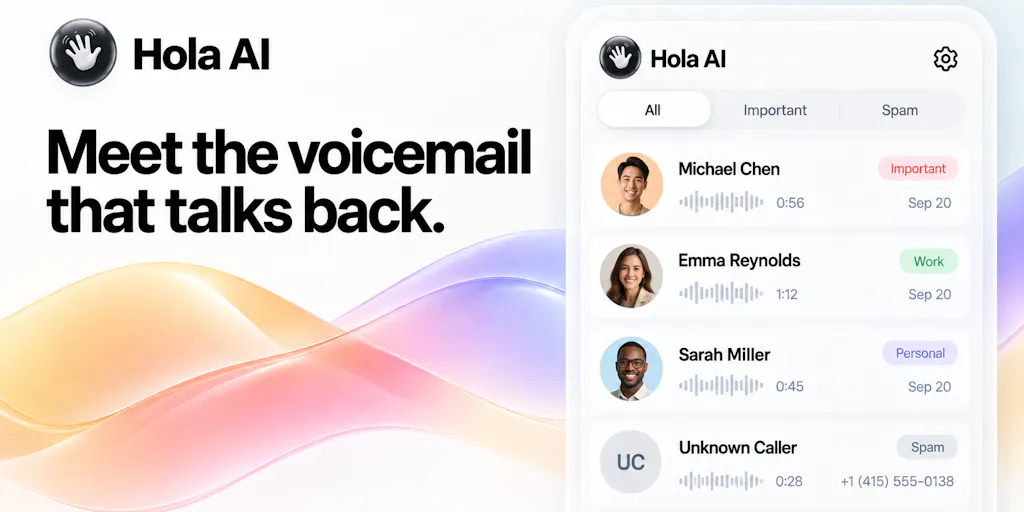
The pitch from the team is refreshingly narrow. As the maker Gaurav Singh Bisen puts it in the launch thread, the product exists because “you can’t always answer a call, but you still want to know why someone called.” That’s the whole thesis. Hola AI answers on your behalf when you’re in a meeting, driving, on a flight, deep in work, or simply not willing to pick up an unknown number. It talks to the caller, figures out why they’re calling, takes a message, filters spam, records and transcribes the conversation, and delivers a summary so you have context before you call back. The stated goal, per the makers, is that “you stay reachable without having to be available all the time.”
This is not a novel category — Google’s own call screening, Apple’s Live Voicemail, and a long line of virtual receptionist startups have been circling it for years. What’s interesting is the framing. Most voicemail replacements sell you on “never miss a lead.” Hola AI sells you on “know why someone called.” For a creator whose inbox is already a firehose, the second framing is the more honest one. You don’t actually want to talk to every caller. You want to triage.
Why a creator with 50k followers should care more than a B2B sales rep
Here’s the operational reality I keep running into. A LinkedIn creator gets inbound that is mostly routed through the platform’s own messaging, so the phone stays relatively quiet. An Instagram creator with a link-in-bio that includes a business number, or a YouTube creator who lists a booking line, gets the opposite: the phone becomes the catch-all for sponsors, podcast bookers, and scammers, all mixed together with no metadata. In my experience running accounts across both, the phone is where the highest-value and lowest-value inbound collide. A tool that summarizes and filters that stream is worth more to the Instagram/TikTok operator than to the LinkedIn one — not because LinkedIn matters less, but because LinkedIn’s own inbox already does half the triage for you.
How this differs from the tools you’re probably already using
If you’re a social media manager, you live inside a stack that already claims to “manage inbound.” Let me be specific about where Hola AI sits relative to the incumbents you actually pay for.
Buffer, Hootsuite, Later, and Metricool all handle the outbound side: scheduling, publishing, analytics, and — in Hootsuite’s and Sprout Social’s case — social inbox management for comments and DMs. None of them touch the phone. That’s a genuine gap. The social inbox tools solve the public-facing layer; Hola AI is aimed at the private, synchronous layer that those tools structurally cannot see.
On the AI-assistant side, the closest comparisons are the built-in OS features — Apple’s Live Voicemail and Google’s Call Screen — plus a wave of virtual receptionist services aimed at SMBs. The difference the makers are claiming is that Hola AI doesn’t just transcribe a voicemail; it converses with the caller, then hands you a summary. That’s a meaningfully higher bar than transcription. Transcription is a solved problem. Real-time conversational triage, with spam filtering, is not.
There’s also a nice signal in the launch thread itself. Gal Dayan from Dial — a company building “agents that place and answer calls programmatically” — showed up to ask a specific, technical question about how the spam filtering works: is it trained on caller-ID and carrier spam signals, or is it actually listening to the first few seconds of audio and making a real-time judgment before deciding to engage or silently voicemail? That’s the right question, and notably, the makers did not answer it in the thread. I’d flag that as an open item, not a red flag — but it’s exactly the kind of detail that separates a demo from a product you’d trust with a business line.
The failure mode nobody wants to talk about
Dayan also named the thing I’d worry about most: a legitimate caller who sounds like a robocall opener — “Hi, is this a good time to talk about…” — getting auto-filtered before they get a chance to explain themselves. For a creator, that’s a brand deal lost to a false positive. This is the same class of problem as a shadowbanned post or a comment auto-hidden by an overzealous moderation filter: the algorithm makes a call you’d have made differently, and you never even see the evidence. Any AI that sits between you and inbound must give you a log of what it rejected, or you’re flying blind on the one channel where the stakes are highest.
What social media teams can borrow from this — regardless of whether they buy it
Even if Hola AI isn’t the tool you end up using, the pattern is worth stealing for your content and community operations. Here’s what I’d take from it.
1. Triage before response, always
The product’s core insight — summarize first, decide later — is exactly how you should be handling comment sections on a viral post. When a Reel or TikTok blows up, you don’t read every comment in order; you scan for intent signals (questions, complaints, collab requests, spam) and batch your responses. If you’re not already using your scheduler’s inbox features to filter by keyword or sentiment, you’re doing manual triage that a tool could do for you. Sprout Social and Hootsuite both offer this; the free tiers of most schedulers don’t.
2. Summaries beat transcripts
Hola AI’s promise of “a quick summary so you know what happened before calling back” is the same reason I tell creators to stop reading raw analytics exports and start reading weekly digest summaries. A transcript is data. A summary is a decision. When you’re repurposing a long-form YouTube video into shorts, you’re not exporting the transcript — you’re extracting the three moments worth clipping. Same principle. If your analytics tool doesn’t summarize, build a habit of writing your own one-paragraph weekly read.
3. Spam filtering is a content strategy problem
The maker framing — filter spam calls — maps directly onto the spam problem every creator faces in DMs and comments: crypto bots, “check your DM” scams, and low-quality agency pitches. The operational move here isn’t to install a tool; it’s to set up keyword filters and auto-hide rules in your platform settings before the next viral moment, not after. I’ve watched too many creators lose an afternoon to comment moderation on a post that took ten minutes to make.
Where my judgment says this falls short — and who it’s not for
Let me be honest about the limits of what I can assess from a launch page. Several things are simply not disclosed: pricing, whether there’s a free tier, which platforms or carriers it works with, how the transcription is stored, what the data retention policy is, and — critically — whether the caller is told they’re talking to an AI. That last one is an ethics and, in some jurisdictions, a legal question, not just a product detail. If you’re a creator whose brand is built on authenticity, having an AI impersonate you on a call without disclosure is a reputational risk you should think hard about.
The product is also clearly not for anyone whose business depends on live human connection — a coach taking discovery calls, a creator running a paid community with office hours, or anyone whose monetization is built on the intimacy of a real conversation. For those operators, an AI answering the phone is the wrong tool. It’s also not for teams that need CRM integration out of the box; there’s no mention of whether summaries sync to a CRM, a Notion database, or a Slack channel, and that integration layer is where most “AI receptionist” tools either win or die in real workflows.
And I’d push back gently on the enthusiasm in the thread. One commenter, Pragya Nagpal, says it’s been in use “for the past few months” and calls it a “life saver” for spam and unnecessary conversations. That’s a real signal — but it’s a single user’s experience, and the makers’ own replies in the thread don’t add technical specifics. I’d want to see how it handles accented callers, background noise, and the false-positive scenario Dayan raised before I’d route a business line through it.
What I’d watch / test next
If you run a creator business and inbound calls are a real part of your workflow, here’s what I’d do this week — concrete steps, not vibes.
First, audit your own inbound. For seven days, log every call you get: who it was, what they wanted, and whether it was worth your time. I’d bet the ratio is something like 80⁄20 spam-to-signal, and that number is the actual business case for a tool like this — not the marketing copy.
Second, test the free or trial tier against your real call volume, not a demo number. Route your business line through it for a week and specifically watch for false positives: did it reject anyone legitimate? Did the summaries actually give you enough context to decide whether to call back? If the answer to either is no, it’s not ready for your primary line.
Third, check the disclosure and data policies before you commit. Ask the makers directly — the launch thread is still open, and they’ve been responsive. Ask where transcripts are stored, how long they’re retained, and whether callers are informed they’re speaking to an AI. If those answers aren’t clear, don’t route anything sensitive through it.
Finally, watch the category, not just this product. Dial is building the other side — agents that place calls programmatically — and the OS-level features from Apple and Google are only going to get better and free. My take: the durable winners in this space will be the ones that integrate with your existing stack (your scheduler, your CRM, your Slack) and give you a transparent log of every decision the AI made. Hola AI has the right framing and a clean, narrow pitch. Whether it earns a permanent slot in a creator’s stack depends entirely on the details the launch page didn’t show.