The interview-prep playbook is quietly becoming a creator-economy problem
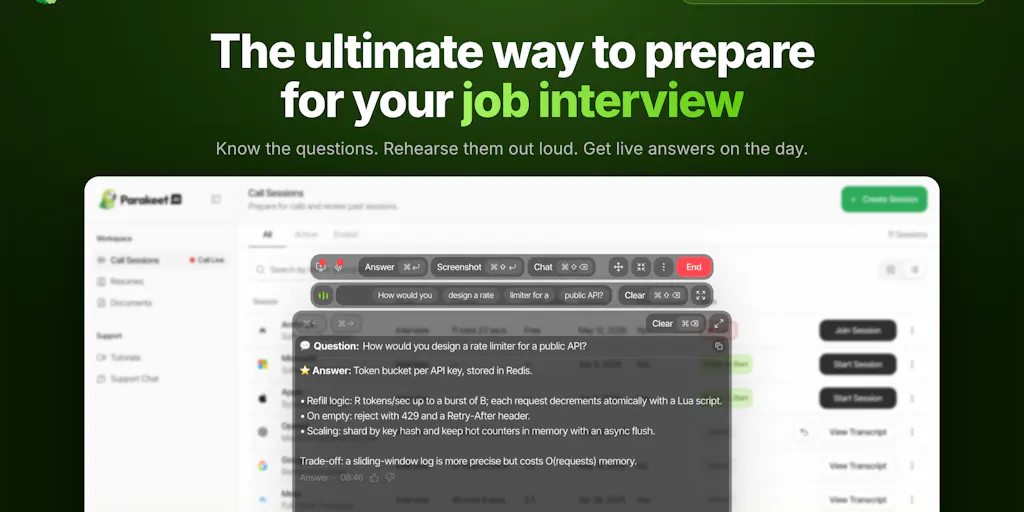
If you run social accounts for a living, you already know the feeling: the deliverable is rarely the hard part. The hard part is the rehearsal — the dry runs, the repurposing passes, the “did that land?” loops that happen before anything gets published. So when a tool shows up on Product Hunt promising to turn a one-shot performance (a job interview) into a repeatable, transcript-backed practice loop, I pay attention — not because creators are job-hunting, but because the underlying mechanic is exactly what most social teams are missing. ParakeetAI relaunched with a three-stage workflow — question bank, AI mock interviewer, live call assistant — and the middle stage is the one worth stealing.
What ParakeetAI actually is, and what problem it’s solving
The maker’s framing is refreshingly specific. In the launch post, Domen Perko writes that the original version “did one thing: it listened to your interview and helped you answer in real time,” and that candidates kept saying “the answer on the day is only as good as the prep before it.” The relaunch is positioned as covering “the whole interview, start to finish.”
Three components, per the source:
- Question Bank — collects “real interview questions per company, ranked by how often they come up,” built “only from real interviews, never from mocks.”
- Mock Interview — an AI interviewer that “speaks in a real voice, waits for your answer and follows up on what you said,” with configurable role, company, and language. ParakeetAI “drafts answers beside you the whole time,” and every mock is “saved with its full transcript.” The first mock is free.
- Call Assistant — in the live interview, it “listens and drafts your answers live, in the browser, the desktop app or on your phone.”
The company also ran an earlier ParakeetAI launch on September 11th, 2024, described there as “Your real-time AI interview help.” Pricing for the new tier is not disclosed in the source. User counts, revenue, and funding are likewise not disclosed.
Why I’m writing about an interview tool on a social-media blog
Because the shape of this product is the shape of the tooling gap in content ops right now. Most creators I know have a publishing stack — Buffer, Later, Metricool, Hootsuite — and a production stack (CapCut, Canva, Descript). What almost nobody has is a rehearsal stack: something that forces you to say the thing out loud, records what you actually said, and lets you diff attempt one against attempt two. That’s the gap ParakeetAI is poking at, just in a different vertical.
The three-stage loop is the real product — and it maps directly onto content
Strip away the interview framing and you have a generic workflow: research what gets asked → rehearse out loud with a transcript → perform live with an assist layer. That is precisely how a competent social team should be operating, and almost none of them do the middle step.
Why the transcript is the underrated feature
Look at the comments. Oleksii Sekundant, maker of SonOf, zeroes in on exactly this: “The transcript after a mock interview is a nice touch. Much easier to work on an answer when you can go back to what you actually said.” And Josip Begic asks the natural follow-up — can you “compare two tries of the same question” to see if your answer got better? That’s the sharpest question on the page, and the maker’s reply isn’t captured in the source, so I’ll leave it open.
In my experience running short-form video for clients, the single highest-leverage habit is transcribing your own drafts. Not for captions — for self-diagnosis. When you read your own hook back as text, you can see in five seconds whether it’s a hook or a throat-clear. Descript made this mainstream for video editors, and it’s the reason I’d bet the transcript feature is what actually retains ParakeetAI users, not the live assistant.
Why TikTok creators should care more than LinkedIn ones
Here’s my take, and it’s contrarian: the rehearsal half of this product matters far more to short-form video creators than to the white-collar job-seekers it’s marketed to.
LinkedIn content tolerates — even rewards — a certain amount of written-formality. You can draft a post in a doc, edit it, and publish. The performance layer is thin. TikTok and Reels are the opposite: the algorithm distributes on watch time and rewatch rate, which means the first 1.5 seconds are a spoken deliverable. You cannot edit your way to a better hook; you have to say it, hear it, and cut it. That’s a rehearsal problem, and it’s the exact problem a “mock interviewer that waits for your answer and follows up” is built to solve. If you’re a founder doing talking-head content, an AI that pushes back on your answers is more useful than a teleprompter.
Where the math breaks
Now the honest part. A few structural issues I’d want answered before recommending this to anyone in my orbit:
- The live-assist layer is a compliance and trust minefield. Real-time answer drafting during a live interview is, in many jurisdictions and at many employers, somewhere between “against the rules” and “grounds for rescission.” The source doesn’t address this at all. I’m not going to pretend that’s a small thing.
- “Real interview questions per company” is a data-provenance claim, not a feature. The maker says it’s “built only from real interviews, never from mocks.” That’s a sourcing claim I can’t verify from the page, and it’s the kind of claim that either holds up under scrutiny or collapses. Treat it as the team’s assertion, not established fact.
- The free tier is one mock. That’s enough to feel the loop, not enough to build a habit. Whether the paid tier is priced for individual creators or only for job-seekers is — again — not disclosed.
- No integration story. For a creator, the value would multiply enormously if transcripts exported to Notion or dropped into a repurposing pipeline. As described, it’s a closed loop.
What creators and social teams should actually borrow from this
Forget the product for a second. The architecture is the takeaway, and you can implement it this week with tools you already pay for.
Build a question bank for your own niche
ParakeetAI’s Question Bank ranks real questions by frequency. Do the same for your content. Every time a comment, DM, or sales call surfaces a recurring question, log it. After a month you’ll have a ranked list of the 20 things your audience actually asks — which is a content calendar that writes itself. This is the same logic behind AnswerThePublic and the “People also ask” panel, but sourced from your own inbound, which is far higher-signal.
Rehearse out loud, on camera, with a transcript
The mock-interview mechanic — speak, get followed up on, review the transcript — is a direct upgrade over the standard creator workflow of “write script, read script, hope.” In my own tests of similar AI-voice tools, the follow-up question is what breaks the spell: it forces you off the script and into the version of you that’s actually watchable. Pair that with CapCut’s auto-captions or Descript’s transcript editor and you have a rehearsal loop for under the cost of one coffee a week.
Treat the live-assist layer as a production tool, not a crutch
The Call Assistant’s “drafts your answers live” is the part I’d port over to webinars, podcasts, and live selling — contexts where an assist layer is expected and disclosed. Live shopping on TikTok Shop and Instagram is a real-time performance with real money attached; a live-drafting assist that surfaces objection-handling lines is genuinely useful there. In a job interview, it’s a liability. Context is everything.
Where I think this falls short, and who it’s not for
It’s not for you if you’re looking for a content repurposing engine. ParakeetAI is a performance tool, not a distribution tool. There’s no scheduler, no cross-posting, no analytics, no UTM handling — nothing that touches the Buffer/Later/Metricool layer of your stack. If your bottleneck is “I have 40 clips and no idea what to post when,” this does nothing for you.
It’s also a hard sell for anyone with ethical qualms about live interview assistance. I’ll say plainly: I think the mock-interview and question-bank features are legitimate and useful, and the live-drafting feature is the one I’d want a very clear policy conversation about before touching. The maker’s own framing — “Know it, practice it, nail it” — actually supports the prep-first reading, which is the version I’d defend.
And the platform risk is real. Anything that listens to a live call is one API change, one OS permission update, or one employer-side detection tool away from breaking. If you build a workflow on it, build a fallback.
What the comments tell you about the product’s real center of gravity
Read the launch comments as a signal, not as social proof. Dimpi Kaidwal says it’s “helping me a lot in my interviews.” Karl praises the “botless interviews” — interesting word choice, suggesting the team has iterated on how the assistant presents itself. Muni krishna and Karthick K both highlight the mock interviews as the feature that “gives idea where we are at.” keith onyango calls it “of great assistance in my previous interviews.” Notice what nobody praises: the live call assistant. The prep loop is what’s landing. That’s the tell.
What I’d watch / test next
Three concrete things I’d do this week if I were evaluating this workflow for a content team — or for myself:
- Run a five-day rehearsal sprint. Pick five recurring audience questions, record a 60-second spoken answer to each, transcribe, and diff day one against day five. You don’t need ParakeetAI to do this — Descript or even a phone voice memo works. If the diff is visible, you’ve found your new pre-production ritual. If it isn’t, you’ve learned something about your own process.
- Pressure-test the question-bank claim. If you’re job-hunting, use the free mock and see whether the follow-up questions feel like real interviewer behavior or like generic LLM prompting. The maker explicitly asked for feedback “especially on the mock interviewer” — take them up on it. That’s the feature the whole product rests on.
- Watch the policy line, not the feature line. For anyone in my audience considering live-assist tooling for interviews, webinars, or live selling: the question isn’t “does it work,” it’s “is it disclosed and permitted.” Write your own policy before you need one.
My overall read: ParakeetAI is a well-scoped prep tool wrapped around one feature (live drafting) that will generate most of its controversy and least of its retention. The part worth copying is the boring part — a ranked question bank, an out-loud rehearsal with a transcript, and a diff between attempts. That loop is portable to almost any creator workflow, and it’s the closest thing to a genuine edge I’ve seen in a launch post this quarter.