The churn problem nobody wants to look at — and what a tiny Turkish app gets right about it
Most social media operators I know are running the same broken loop: publish, check the vanity number, feel nothing, publish again. The dashboard tells you reach went up 4%. The chart is green. You close the tab and go make another Reel. That numbness isn’t burnout from failing — it’s burnout from never noticing progress, because the interface between you and your own growth is a spreadsheet. So when an indie developer launches a tool that turns your subscriber count into a little isometric office where real paying customers physically walk through a door each morning, I pay attention — not because it’s cute, but because it’s attacking the exact motivational gap that kills creator businesses in month four. ShipHQ, built by indie developer Rıdvan Uyan, is nominally an App Store analytics toy. For anyone who runs an audience, a newsletter, a membership, or a paid community, it’s actually a case study in how to make retention data emotionally legible — and that’s a skill most social teams are terrible at.
What ShipHQ actually is, and what problem it’s really solving
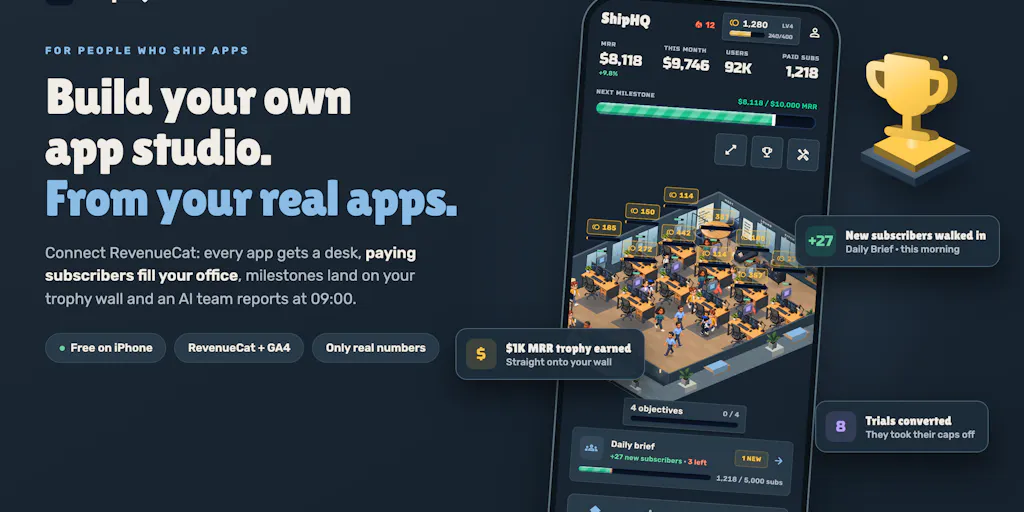
Strip away the pixel art and here’s the mechanic: you connect RevenueCat with a single sign-in — the team is explicit that there are no API keys to manage — and each app you own gets a desk in a shared office. Paying subscribers become the people sitting at those desks. Add GA4 and your web traffic becomes the street outside the window. Every morning, a “Daily Brief” replays what happened overnight: new subscribers queue at the door, the door opens, confetti fires, the team claps. Trials walk in wearing a cap and take it off when they convert. When someone churns, a character walks out and someone pours a cup of water behind them — a Turkish gesture, as Uyan explains in the launch thread, meaning “go smoothly like water, come back just as easily.”
Desks earn “Company Cash” from your real MRR, which you spend on furniture, rooms, and coffee. Desk tiers — Pro Desk at $100 MRR, Product Pod at $1K, Prestige at $10K — cannot be bought, only earned. Milestones become trophies on a wall: first $100, first 100 paying customers, a 30-day streak, and 40+ more. On the higher tiers, a small AI team runs a 09:00 standup — Leo on growth, Ada on market and competitors, Noah on App Store reviews with a reply draft, Emre on Reddit mentions, Zoe on news — and every note links back to its source.
The problem this solves isn’t analytics. RevenueCat already tells you what happened. The problem is that a chart of MRR moving by $12 produces no emotional signal, and Uyan’s own framing is that this is how founders burn out: “not from failing, but from never noticing we’re making progress.”
The two rules that matter more than the art
Buried in the launch copy are two design constraints that I think every creator tool should steal. First: no invented numbers. A metric without a connected source shows a dash, never an estimate. Second: no retroactive trophies. The day you connect is your baseline; only progress from there gets celebrated. In the comments, Uyan admits he was tempted to fill empty screens with estimates so the office would look busier — but “every time I did, the trophies stopped feeling like mine. A dash felt more honest than a nice-looking guess.”
That’s a product philosophy, not a feature. And it’s the opposite of how most social analytics dashboards behave, which is to pad sparse data with modeled reach, estimated impressions, and “potential audience” numbers that mean nothing.
Why this matters more for TikTok and YouTube operators than for LinkedIn ones
Here’s my take, and I’ll flag it as opinion: the platform where this kind of emotional-legibility design pays off most is the one with the shortest feedback loop and the most brutal variance — short-form video. If you’re posting to TikTok or YouTube Shorts, your daily reality is a slot machine. One video does 400 views, the next does 400,000, and the algorithm gives you almost no signal about why. Watch time, completion rate, and re-watch percentage are the real levers, but they arrive as flat numbers in a creator dashboard that looks identical whether you’re growing or dying.
A LinkedIn operator, by contrast, is playing a slower game with a more legible graph. Follower count and comment quality move gradually. You don’t need confetti to feel a LinkedIn post land — the notifications do it for you.
So the transferable lesson isn’t “gamify your analytics.” It’s this: the platforms with the highest variance need the most narrative scaffolding. When your distribution is noisy, the only way to stay in the game is to ritualize the small wins. A “first 100 paying customers” trophy is a ShipHQ feature, but the underlying behavior — deliberately marking milestones you’d otherwise scroll past — is something any creator can do manually in a Notion doc this afternoon.
Where the AI standup fits into a real content workflow
The AI team angle is the part I’d actually test first, because it maps onto a real operational gap. Most solo creators and two-person social teams don’t have a growth analyst. They have a notes app full of half-ideas and a vague sense that competitors are doing something they’re not. A 09:00 standup that surfaces App Store reviews with a reply draft, Reddit mentions, and competitor moves — with every claim linked to its source — is a lightweight version of what agencies charge retainers for.
The sourcing discipline is what makes it credible. Uyan is explicit that “every note links to its source,” which is the difference between an AI assistant and an AI hallucination machine. I’ve tested enough AI content tools to know that the ones that survive in a real workflow are the ones that show their work. If a tool tells you “your audience is shifting toward X” and can’t link to the comment thread that proves it, you’ll stop trusting it within a week.
What creators and social teams can borrow from this, even without the app
You don’t need to be an App Store developer to extract value here. Three things I’d port into a social media operation immediately:
1. Baseline-then-celebrate. ShipHQ refuses to award trophies for milestones crossed before you install. The equivalent for a creator: pick a date, snapshot your current numbers across every platform, and only celebrate growth from that line forward. It sounds arbitrary. It’s also the only way to stop comparing yourself to accounts that started three years earlier.
2. Give churn a ritual. The water-pouring detail is the most-discussed thing in the launch thread — multiple commenters single it out as the emotional hook. For a creator, unsubscribes and unfollows are the metric everyone avoids looking at. What if you didn’t? A weekly “who left and why” review — checking your Mailchimp or Beehiiv unsubscribe reasons, reading the one-star reviews on your App Store listing, scanning YouTube’s “not interested” feedback — turns a loss into a lead. Uyan’s line in the comments stuck with me: “Every loss is an opportunity to learn a new knowledge. And sometimes they really do come back.”
3. Refuse to estimate. If a metric isn’t connected to a real source, show a dash. This is the hardest one to hold yourself to, because every analytics tool you use — Metricool, Later, Buffer — will happily show you “estimated reach” and “potential impressions.” Those numbers feel good and teach you nothing. The discipline of the dash is the discipline of only optimizing against signal you can actually act on.
Where I think it falls short, and who shouldn’t bother
Let me be balanced, because this is a launch-day product with real open questions.
Platform lock-in is severe. ShipHQ is built on RevenueCat and GA4. That’s a clean fit for indie app developers — which is clearly the target audience — but it means a creator running a Substack, a Patreon, a Kajabi course, or a Stripe-billed membership has no obvious way in. If your monetization isn’t app-store subscriptions, this tool isn’t for you yet. Not disclosed whether other payment sources are on the roadmap.
iOS only, for now. In the comments, Uyan says Android is “hopefully in a month” and offers to DM interested users when it hits the Play Store. If your team is on Android — which is most of the world outside the US — you’re waiting.
The quiet-week problem is real and unsolved. This is the sharpest critique in the entire thread, and it comes from Gal Dayan of Dial, who asks what a genuinely slow month looks like: does the office just sit still, and does the gamification risk making a bad week feel worse than the raw number already does — pushing founders to avoid the Daily Brief exactly when they need it most? Uyan’s answer is honest: the office doesn’t empty out, paying users are still at their desks, and a dip reads as “a quieter chapter” rather than flashing red. But he concedes the contrast problem isn’t fully solved. “A week of confetti followed by a week of nothing can feel worse than a flat line on a chart.” That’s a maker being straight with a critic, and it’s the kind of exchange that makes me trust the product more, not less.
Pricing is light but tiered. Free for up to 2 apps. Memberships — Mini, Growth, HQ — start at $4.99/month and add desks, rooms, AI reports, and managers. The launch offer runs until Oct 15: every annual plan starts with one month free, and the code PRODUCTHUNT adds another month on HQ Annual for the first 100 redemptions, redeemable via the App Store offer link. No revenue yet? There’s a guest sample office to explore first. I’d call the pricing aggressive for a hobby tool and reasonable for anyone with real MRR — but I’d want to see how the AI standup quality holds up past the honeymoon month before committing annually.
Who should skip it
If you’re a pure brand-side social manager running Instagram, Threads, and Pinterest for a client, this does nothing for you — your “subscribers” aren’t app-store payers and your success metrics are reach, saves, and engagement rate, not MRR. If you’re a creator monetizing through brand deals and affiliate links, same answer. ShipHQ is a founder tool wearing a game’s clothing. It’s for people who own the P&L on a subscription product.
What I’d watch / test next
If you run any subscription-based product and want to pressure-test the underlying philosophy without installing anything, here’s what I’d do this week:
- Snapshot your baseline today. Export current subscriber counts, MRR, and churn rate across every platform into one doc. Date it. That’s your “day you connect” line. Everything before it is context, not achievement.
- Build a churn ritual. Set a recurring 15-minute calendar block to read unsubscribe reasons, cancellation survey answers, and one-star reviews. Write down one thing you’ll change. Do it weekly for a month and see if retention moves.
- Audit your dashboards for estimated numbers. Go into Metricool, Later, or whatever you use, and find every “estimated” or “potential” metric. Ignore them for 30 days. Optimize only against numbers tied to a real, verifiable source.
- If you’re an indie app dev on iOS, install the free tier, connect RevenueCat, and watch two or three Daily Briefs before deciding whether the emotional layer actually changes your behavior. That’s the only test that matters — not whether it’s fun on day one, but whether you still open it on day forty.
The deeper question ShipHQ raises isn’t whether gamified analytics work. It’s whether the tools we use to measure our growth are helping us sustain the work or quietly grinding us down. A dash instead of a guess, a cup of water instead of a red arrow — those are small design choices with outsized consequences for anyone trying to build something over years rather than quarters. I’d bet the next wave of creator tooling borrows more from this than from the next dashboard refresh.