The creator-economy lesson hiding in a solar inverter dashboard
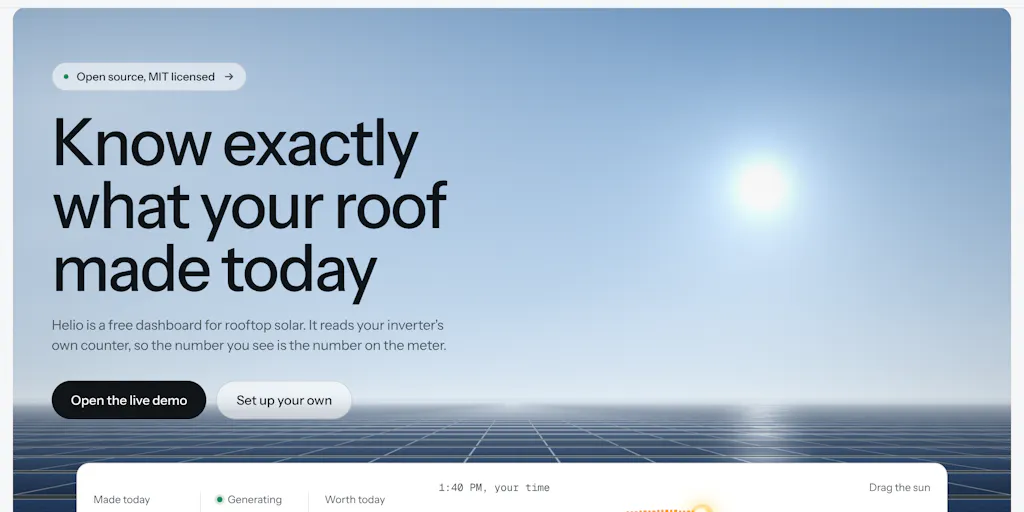
Most Product Hunt launches I scroll past have nothing to do with the work you and I do every day — scheduling, repurposing, analytics, monetization. This one is different, and not because it’s a social tool. Helio is a self-hosted dashboard for rooftop solar, built by Rishi Shah after his own SmartClient app buried the one number he opened it for — today’s units generated — behind six taps. That’s the whole thesis, and it’s the same thesis behind every good creator tool: the metric you check daily should be one glance away, not six clicks deep. If you run social accounts for a living, the interesting question isn’t whether you need a solar app. It’s what Helio’s design choices — single-purpose home screen, self-hosting, privacy-first, honest about its limits — tell you about how the next generation of creator tooling should behave, and where your current stack is quietly wasting your attention.
The problem Helio actually solves (and the one it doesn’t)
Strip away the solar framing and Helio is an attention-reclamation product. The maker’s origin story is almost comically specific: his rooftop system came with the SmartClient app, he opened it daily for a single figure, and it took six taps to find it. So he built something that “opens straight on today’s units, read from the inverter’s own counter,” with live power, history, and savings in your own currency arranged around it. That’s it. One number front and center, context orbiting it.
If you’ve ever opened Metricool or Later just to check whether yesterday’s Reel popped, you know the feeling. Dashboards accrete. A tool that started as “show me engagement rate” becomes a wall of widgets, and the number you actually came for gets pushed below the fold or behind a tab. The best scheduling tools I’ve used over the years — Buffer in its early, ruthlessly simple form; Hootsuite before it became an enterprise console — won because they respected the daily check-in. Helio is a reminder that “fewer taps to the number that matters” is a product strategy, not a feature.
What Helio does not solve is anything beyond one inverter family. More on that below, because it matters for how you read the rest of this.
The self-hosting angle creators should steal
The maker’s pitch has three bullets, and the middle one is the one I’d underline: “Yours: deploy your own copy to Vercel in 5 minutes, free. Private: your login stays on your server, no database, no tracking.” That’s a deliberate architectural stance, and it’s the same stance a growing slice of creator tooling is drifting toward — partly as a reaction to API pricing shocks (the Twitter/X API changes that gutted a generation of indie scheduling bots), partly because creators are tired of handing OAuth tokens to yet another SaaS that might pivot, get acquired, or leak.
In my experience running multi-platform accounts, the privacy question is usually framed wrong. It’s not “do I trust this vendor with my data” in the abstract — it’s “what happens to my scheduled queue and my analytics history if this company dies or changes its pricing.” Self-hosting answers that question structurally. You own the deployment; the tool can’t rug-pull you. That’s a real consideration when you’re managing client accounts and can’t afford a Tuesday-morning surprise.
How it differs from the incumbents — and where the comparison breaks
Here’s where I have to be blunt: Helio is not a social media tool, and comparing it head-to-head with your stack is a category error. But the design philosophy comparison is fair game, and it’s instructive.
The scheduling/analytics SaaS market has consolidated around a few models. Buffer sells simplicity and a flat per-channel price. Hootsuite sells enterprise breadth and approval workflows. Later sells visual planning and link-in-bio commerce. Metricool sells analytics depth and a generous free tier. Sprout Social sells reporting and team collaboration at a premium. Each of them, to justify the subscription, keeps adding surface area — inbox, listening, AI caption generation, competitive benchmarking. The result is that the daily check-in, the thing you do forty times a week, gets worse as the product gets “better.”
Helio’s counter-position is almost a design manifesto: one screen, one number, no database, no tracking, deploy it yourself. The team claims a five-minute Vercel deploy and a free price point — I’d treat both as maker claims until you’ve actually done it, because “five minutes” for a self-hosted deploy usually assumes you already have a Vercel account and know your way around environment variables. But the shape of the promise is the interesting part.
Why TikTok creators should care more than LinkedIn ones
This is where I’d push back on the obvious “solar app, not my problem” reaction. Think about which platforms reward a fast daily check-in versus a deep weekly review.
TikTok and Instagram Reels are velocity games. A video’s first few hours of watch time and completion rate determine whether it gets pushed to a wider pool, and you often need to know within the day whether a post is catching or dying so you can decide whether to boost it, repost a variant, or move on. That’s a Helio-shaped problem: one number, now, no digging. If you’re managing a TikTok account, the metric that matters at 9 a.m. is “how is yesterday’s post doing against my median,” not a forty-widget dashboard.
LinkedIn is a slow-burn platform. A post’s reach compounds over days, the algorithm rewards dwell time and comment threads, and checking it hourly tells you almost nothing. So the Helio philosophy — obsessive daily glanceability — is less valuable there and more valuable on the short-form video platforms where the feedback loop is tight. If you’re a LinkedIn-first operator, your equivalent of “today’s units” is probably a weekly engagement-rate comparison, not a live counter. My take: match your dashboard cadence to your platform’s distribution speed, and Helio’s single-number ethos maps cleanly onto TikTok and Reels and poorly onto LinkedIn and Pinterest.
Where the math breaks
I want to be careful here, because the parallel has limits and I’d rather flag them than oversell the analogy. Helio reads “the inverter’s own counter” — a single, authoritative source of truth. Social analytics have no such thing. Your Instagram reach number in the native app, in Metricool, and in a third-party API pull will disagree, sometimes by double digits, because of API sampling, attribution windows, and definitional drift (is a “view” three seconds or one?). So the “one number, front and center” design works for solar because the number is unambiguous. It works for social only if you pick a definition and stick to it — e.g., “views as reported by the native app at 24 hours” — and resist the urge to reconcile across tools. That’s an operator discipline, not a product feature, and no dashboard will save you from it.
What creators and social teams can borrow from Helio
Three transferable ideas, in descending order of how quickly you can act on them.
1. Build your own “today’s units” screen. Whatever tool you use, configure one view that shows the single metric you check daily — for most short-form operators that’s 24-hour views or completion rate versus your trailing median — and put nothing else on it. In Buffer or Metricool that means a saved report or a pinned analytics tab; in a spreadsheet it means one tab you actually open. The point is ritual, not tooling.
2. Treat self-hosting and data portability as a buying criterion. Helio’s “no database, no tracking, your login stays on your server” is an extreme version, but the underlying question — “if this vendor disappears, what do I keep?” — should be on your evaluation checklist for any scheduling or analytics tool. CSV export, API access, and clear data-ownership terms are the minimum. The maker even lists “CSV export of every day” as a feature, which tells you he understands that ownership means export, not just hosting.
3. Steal the honesty. The launch post says “Eybond / ShineMonitor systems only for now” and asks commenters which inverter brand they use to decide what to support next. That’s a maker being transparent about scope and using the launch itself as demand research. If you’re an indie founder building a creator tool, that’s the template: name your narrow beachhead, say so plainly, and let the audience vote on the roadmap. If you’re a buyer, reward that honesty — it’s a better signal than a feature grid.
The Telegram-summary pattern
One detail buried in the maker’s reply deserves its own beat: “Daily Telegram summary every evening, one tap to connect.” A push-based daily digest is the natural complement to a pull-based dashboard. You don’t have to open the app to know the number; it comes to you. For social operators, this is the single most underrated workflow upgrade available — most scheduling tools will email you a weekly digest, but almost none will push a clean daily summary to a chat app where you already live. I’ve built this myself with Zapier and a webhook into Slack for client accounts, and it changed my morning routine more than any dashboard redesign. If your current stack doesn’t do it natively, wire it up manually; the friction of “open the app and find the number” is exactly the friction Helio was built to kill.
Where my judgment says it falls short
Balance time. Helio is a genuinely charming indie product, and I’d rather it exist than not — but it is not a social media tool, and dressing it up as one would be dishonest.
Scope is extremely narrow. The maker is explicit: Eybond / ShineMonitor inverter systems only, for now. That’s a beachhead, not a platform. If you don’t own that hardware, the product is irrelevant to you today, full stop. The roadmap is literally a comment thread asking which brand to support next — which is admirable transparency but also an admission that coverage is thin.
“Five minutes to deploy” is a maker claim. Self-hosting on Vercel is easy if you’re already comfortable with deploys, environment variables, and reading a README. For a non-technical creator, “deploy your own copy” is a barrier, not a feature. This is the classic self-hosted tradeoff: you trade convenience for ownership, and the convenience cost is real. I’d bet a meaningful share of interested users bounce at the deploy step.
No disclosed traction, pricing beyond “free,” or team size. The source doesn’t say how many users Helio has, whether there’s a paid tier coming, or who’s behind it beyond the solo maker. “Free” plus self-hosted usually implies a hobby project or an eventual paid hosted tier; the source is silent on the business model, so I won’t speculate beyond noting the silence.
The privacy pitch is strong but unverifiable from the outside. “No database, no tracking” is a claim about the code, and unless you read the repo or audit the deploy, you’re trusting the maker. That’s fine for a free self-hosted tool — the trust surface is smaller than a SaaS — but it’s still trust, not proof.
Who it’s NOT for: anyone without Eybond/ShineMonitor hardware, anyone who wants a hosted turnkey app, and — obviously — anyone looking for social scheduling. It’s a solar dashboard. The lessons transfer; the product doesn’t.
What I’d watch / test next
Three concrete moves for this week, whether or not you own a solar panel.
First, audit your daily check-in ritual. Time yourself opening your primary analytics tool and finding the one number you actually care about. If it’s more than three taps or clicks, you’ve found your own six-tap problem — fix it with a saved view, a pinned tab, or a daily digest. Second, add data portability to your tool evaluations. Before your next renewal, check whether each tool in your stack offers CSV export and API access, and whether your scheduled content survives a vendor shutdown. Third, if you’re building anything for creators, copy the launch playbook: name your narrow beachhead, state your limitations in the first paragraph, and use the comments to pick your next integration.
What I’ll be watching on Helio specifically: whether the maker ships support for a second inverter brand (the real test of whether this is a product or a weekend project), whether a hosted paid tier appears to solve the deploy-friction problem, and whether the “one number, front and center” ethos survives contact with feature requests. My bet: the self-hosted privacy stance is the durable idea, and the solar dashboard is just the first place it got applied. The creators who internalize that — own your data, respect the daily glance, be honest about scope — will build better workflows than the ones who wait for the next all-in-one platform to solve it for them.