Best Times to Post on LinkedIn in 2026: Data Analysis of 4.8 Million Posts

Cross‑border sellers spend a lot of effort each day planning LinkedIn content, yet they often get drowned out by their target audience’s activity feed because the posting time is off. LinkedIn’s algorithm heavily relies on engagement signals as the weight for content recommendation; choosing the right time window can boost the exposure of an ordinary post by several times, while a wrong choice can make the content disappear. This article analyzes 4.8 million LinkedIn posts published via Buffer, revealing the distribution of high‑engagement time slots in 2026 and offering actionable time‑zone adjustment strategies for globally operating cross‑border sellers.
A carefully crafted product story or industry insight, if posted during a low‑activity window, may sink to the bottom of the feed within hours. LinkedIn’s algorithm decides whether to expand a post’s reach based on the density of interactions in the first few minutes after publishing, meaning the timing directly influences the algorithm’s initial assessment. Good content posted at a good time creates a synergistic effect far greater than optimizing either factor alone.
Why Posting Time Is Critical for LinkedIn Content Performance
LinkedIn’s content recommendation mechanism isn’t fully transparent, but public information and extensive empirical data show that engagement signals—likes, comments, shares—are the core criteria the algorithm uses to judge content quality. When a post receives dense interactions shortly after publishing, the system flags it as high‑value and pushes it to more users’ home feeds. Conversely, if the target audience is offline at publishing time, sparse reactions cause the algorithm to abandon further recommendation.
Data from 2026 show a clear shift from previous years: users are consuming professional content more during non‑working hours. In the past, LinkedIn’s high‑engagement periods were almost entirely during work mornings and lunch breaks, but the 4.8 million‑post analysis shows that posts published after 3 PM actually achieve a higher average engagement rate. This reflects a change in B2B buyer behavior—after work, during commutes, or before sleep, they browse supplier and industry content. This habit shift directly impacts content reach efficiency.
For cross‑border sellers, understanding this change means rethinking scheduling logic. If your target customers are procurement managers on the U.S. East Coast, a 9 AM Eastern Time post may no longer be as effective as a 4 PM post. Sellers looking to systematize global social‑media distribution can refer to the full 2026 strategy on how cross‑border sellers use AI for global social‑media distribution and plan content cadence in advance.
2026 LinkedIn Best Posting Time Slots and Rankings
Overall, the highest‑engagement period on LinkedIn in 2026 falls between 3 PM and 8 PM. Compared with 2025, the peak has clearly shifted from work hours to the evening, a trend that has persisted for two years and is unlikely to be a random fluctuation. The three most outstanding precise slots are: Wednesday 4 PM, Friday 3 PM, and Friday 4 PM.
Weekday engagement curves start climbing around 1 PM, peak between 3 PM–5 PM, and then stay high into the evening. Weekend total engagement is far lower than weekdays, but occasional small peaks appear on Sunday evenings, possibly linked to users preparing for Monday work.
| Time Slot | Weekday Engagement Trend | Weekend Engagement Trend | Best Practice |
|---|---|---|---|
| 8 AM–12 PM | Moderate engagement, slight rise during lunch | Very low engagement | Good for teaser content |
| 1 PM–3 PM | Activity period begins to rise | No clear change | Suitable for data or industry reports |
| 3 PM–5 PM | Peaks on Wednesday and Friday | No clear change | Core publishing window |
| 5 PM–8 PM | Sustained high engagement | No notable activity | Ideal for deep‑dive articles or interactive posts |
| After 8 PM | Engagement gradually declines | Occasional unexpected Sunday peaks | Can experiment with posting |
A notable observation: the evening high‑engagement period aligns with most users’ fragmented reading after leaving the office. If cross‑border sellers publish data‑rich or insight‑driven content during this window, the likelihood of retention and sharing by target customers rises significantly.
Detailed Best Posting Times for Each Day of the Week
Monday and Tuesday have the lowest weekly engagement. Users are catching up on weekend‑accumulated work, compressing feed‑browsing time; even good posts can miss the interaction golden period. Prioritize lightweight teasers or short announcements on these days rather than key content.
Wednesday 4 PM is the most reliable posting window of the week. Mid‑week users have a stable work rhythm, and attention shifts from urgent tasks to industry information; posts at this time usually receive the densest initial interaction. Thursday’s active period mirrors Wednesday’s, with consistent performance from 3 PM to 5 PM, suitable for maintaining mid‑week content cadence.
Friday is special. 3 PM and 4 PM rank second and third overall for the week, but the engagement window is relatively narrow—morning interaction is clearly lower than mid‑week, and the post‑peak decline is faster. This suggests Friday attention concentrates in the latter half of the afternoon, making it better for light yet informative content.
I once worked with a seller exporting industrial equipment who insisted on posting a meticulously prepared LinkedIn new‑product update at 10 AM on Monday. Interaction data were poor for four consecutive weeks. After shifting the publishing time to Wednesday 4 PM with the same content structure, interaction rose by more than threefold. The gap wasn’t about content quality but purely about timing and audience activity windows.
On weekends, Saturday’s engagement is uniformly low; main content should not be placed there. Sunday evenings occasionally show a small interaction peak, possibly linked to users entering work mode early; experimental posting can be tried.
How Cross‑Border Sellers Can Combine Time‑Zone Optimization with Posting Strategy
All the timing data above are based on Eastern Time (ET). If your audience spans multiple time zones, directly applying these windows may miss the optimal moments. The correct approach is to convert the core market’s time zone back to your posting schedule.
For sellers whose primary market is the U.S. East Coast, the optimal posting time is roughly 3 PM–4 PM ET, which translates to 3 AM–4 AM Beijing Time the day after—clearly unsuitable for manual operation. Sellers targeting Europe should shift the window to Central European Time 3 PM–5 PM, corresponding to 9 PM–11 PM Beijing Time, a more manageable slot. The Asia‑Pacific market shows greater behavioral variance; it’s advisable to first verify local active periods using LinkedIn’s native post analytics tool.
A common mistake is to publish a single post at one moment hoping all regions will see it. This practice dilutes the localized impact in each time zone. A more reasonable strategy is to schedule by region: post at 3 PM ET for the U.S., then another at 3 PM CET for Europe (or localize the original post before reposting).
If cross‑border sellers also run independent sites and social media, time‑zone adaptation is just one link in the chain. Further guidance can be found in the “Cross‑Border Independent Site Fully Automated Operations Tech Stack Guide,” which builds a complete workflow from content creation to multi‑time‑zone distribution. At the full‑chain strategy level, the 2026 Cross‑Border Content Stack Collaboration Blueprint also offers cross‑platform coordination ideas.
How to Automate the Posting Process with Tools
Manually tracking the best posting time each day and logging into each platform to publish becomes error‑prone with just a few accounts, and nearly impossible when handling multiple regional markets. A typical cross‑border seller may need to manage LinkedIn, Instagram, Facebook, X, etc., each with different audience peak times; manual scheduling can easily exceed 10–15 hours per week.
Most social‑media scheduling tools support timed publishing, but the real workload reduction hinges on two aspects: automatic adaptation of copy to each platform’s format, and one‑click multi‑platform publishing. Platforms like Loomly are mature in calendar planning and collaboration, yet for cross‑border scenarios requiring AI rewriting and synchronized multi‑platform posting, additional toolchains are needed.
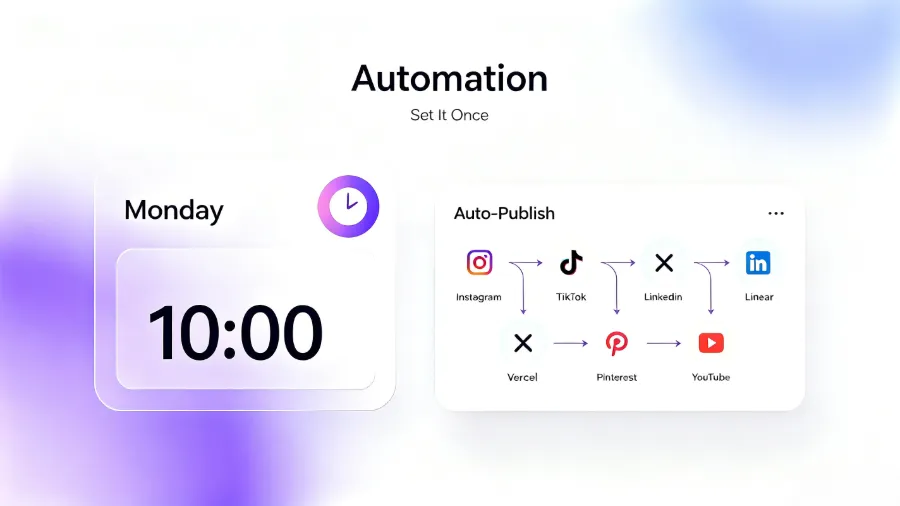
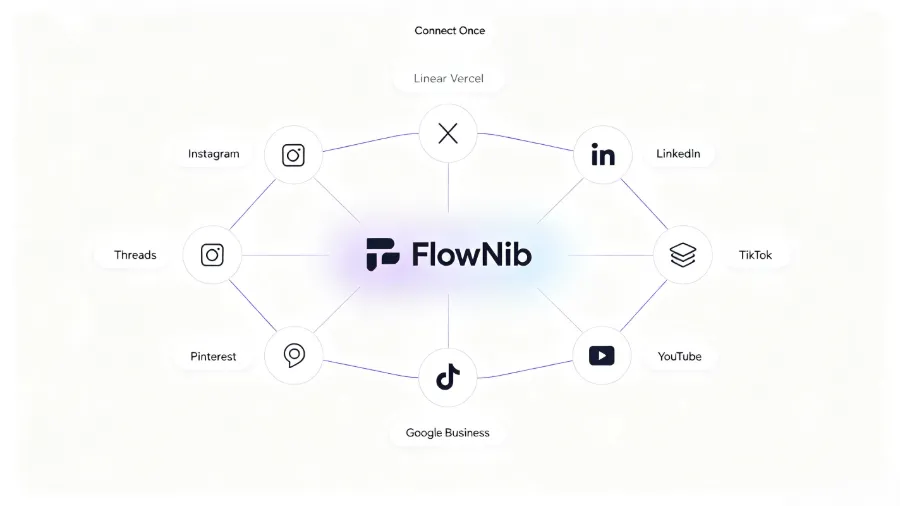
In practice, a more efficient path is to use a tool that supports AI content rewriting and multi‑platform synchronized publishing, merging creation and distribution into a single pipeline. For example, tools like Flownib let AI automatically adapt a post to LinkedIn, Instagram, X, etc., respecting character limits and style, then publish according to pre‑set time‑zone schedules. For sellers operating multiple regional accounts, this consolidates time‑zone conversion, content adaptation, and scheduled publishing into one operation.
When selecting tools, if you’re evaluating different scheduling solutions, refer to the “2026 Top 10 Social‑Media Scheduling Tools Deep Comparison,” which lists each tool’s performance on AI rewriting, multi‑platform support, and time‑zone scheduling. The core criterion isn’t the number of features but whether the tool covers the most frequent operational scenarios—especially multi‑time‑zone scheduling and automatic content adaptation for cross‑border sellers.
FAQ
Did the optimal LinkedIn posting times change in 2026?
Yes. The peak period shifted from work hours to 3 PM–8 PM, with evening engagement clearly rising compared to 2025. Wednesday 4 PM, Friday 3 PM, and Friday 4 PM are the three most precise high‑performance slots.
Are these recommended times applicable to global users?
Not directly. The data are based on Eastern Time. For audiences in Europe or Asia‑Pacific, convert to the local time zone. Europe: 3 PM–5 PM CET; Asia‑Pacific: verify with your own data.
Can posting on weekends still yield good engagement?
Overall weekend engagement is low, but occasional small peaks appear on Sunday evenings. It’s not advisable to place main content on weekends, but experimental or lightweight posts can be tested for specific audiences.
What if my target audience spans multiple time zones?
Schedule by core market rather than trying to cover all zones with a single post. For example, post at 3 PM ET for the U.S. market, then another at 3 PM CET for Europe. Use scheduling tools to set multiple time‑rule groups, dramatically reducing manual time‑zone calculations.
Beyond posting time, what other factors affect LinkedIn post exposure?
Content type, engagement prompts (clear topics or questions), the authority of the publishing account, and whether the first two lines of the title attract readers all have a combined impact that often outweighs the time window itself. Timing is a multiplier; content quality is the foundation.
Share Article