How to Choose a Social Media Distribution Tool? Deconstruct Your Selection Criteria from Five Dimensions

Spending half an hour each day manually copying and pasting content to different social platforms, only to miss Instagram Reels or forget to adjust the LinkedIn copy length—this inefficient repetitive work finally needs a tool that truly understands cross‑platform distribution.
When selecting a tool, many teams fall into traps early on. Looking only at price or a feature list, then after a month discovering that the core platform isn’t supported, resulting in wasted content and tangled account data, and the switching cost turns out to be much higher than expected. A reliable selection framework should be broken down into five practical dimensions: platform coverage, AI adaptation, scheduling capability, cost, and ease of onboarding. Each dimension corresponds to a real operational scenario, not just a numeric game on a spec sheet.
Platform Coverage: The Tool Should Reach Where Your Target Audience Is
Platform coverage is the first gatekeeper in selection and the easiest to overlook. Many teams receive a list of tools, see a dozen platform names, and think that’s enough, but in actual operation the tool should cover wherever the audience is, not the other way around.
Mainstream platforms such as Instagram, X (Twitter), LinkedIn, TikTok, Facebook, Threads, Pinterest, YouTube, Bluesky, and Google Business total roughly ten. Long‑tail platforms like Discord, Telegram, and Reddit have value, but their API openness and traffic volume differ greatly from mainstream platforms. The trade‑off logic is simple: if your core audience is on LinkedIn for B2B business, a fully supported TikTok is meaningless. Conversely, for fast‑moving consumer brands, Instagram and TikTok take priority over Bluesky.
It is crucial to check whether a tool supports direct official API connections. Third‑party plugins or browser automation break when a platform changes its interface, leading to failed posts or, worse, account risk controls. Direct official API connections are far more stable and support richer publishing features, such as Instagram Reels and Carousel, LinkedIn Articles and Documents, and YouTube Shorts scheduling.
Multi‑account management’s real impact on team collaboration is often underestimated. A brand may operate regional accounts, or an agency may manage multiple clients. If the tool doesn’t support unified multi‑account management, repeated logins and logouts hurt efficiency and security.
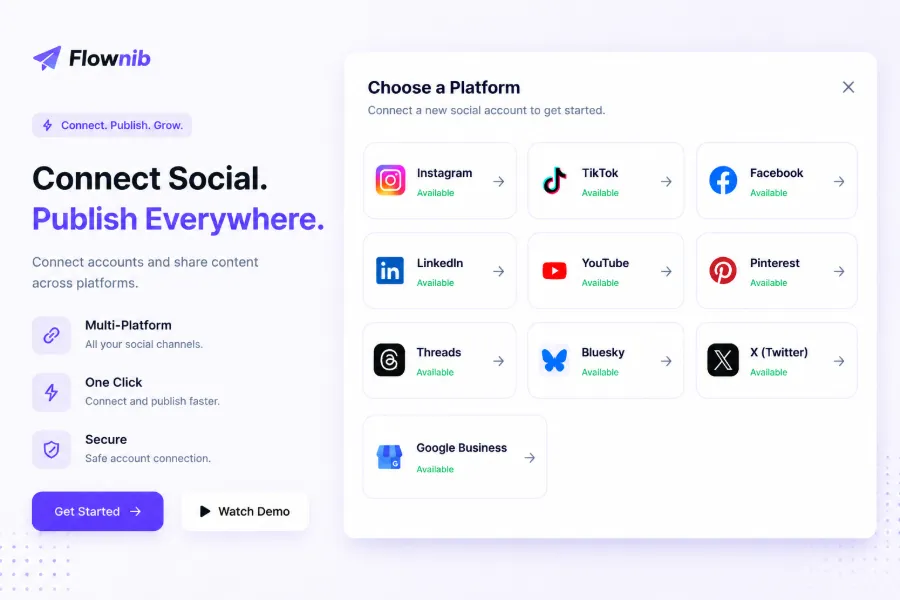
Take Flownib as an example; it supports all ten platforms above via direct official APIs, and multi‑account management is handled within a single dashboard. For teams that need cross‑platform operation, the degree of platform coverage directly determines whether the tool is usable. If the tool doesn’t support your core platform, a cheap price is still a waste. For efficiency gains from multi‑platform management, see the article “Breaking Social Media System Silos”, which details the time cost of tool switching.
AI Adaptation: Can the Content Be Automatically Tailored to Each Platform’s “Language”?
The stylistic differences between platforms are larger than many people imagine. Instagram copy is short, with up to 30 hashtags, but too many can hurt organic reach; LinkedIn requires a professional tone, with a 3,000‑character limit, yet overly long posts reduce engagement; X (Twitter) still enforces a hard 280‑character limit; TikTok titles and descriptions must match video rhythm; YouTube descriptions need SEO keyword placement. If you manually adjust each piece, you can handle three platforms in ten minutes, but ten platforms become a half‑hour job with higher error risk.
AI rewriting capability is critical here. It isn’t just keyword substitution; it’s style transfer after understanding each platform’s context. For example, a product launch announcement rewritten by AI would emphasize industry trends and business value on LinkedIn, highlight visual impact and emotion on Instagram, and condense into short, interactive prompts on X. Consistent brand tone requires the AI model to preserve core information while adapting expression for each platform.
Preview functionality is the final line of defense for content quality. If the tool lacks a preview after AI rewriting, you can’t check formatting, links, or images before publishing. Many tools expose issues during preview—emoji garble, hashtag format errors, image cropping mismatches—that would otherwise be discovered only after posting, forcing deletion and reposting.
Flownib’s AI rewriting supports content adaptation for the ten platforms, and its preview shows the actual publishing result for each. The workflow shift from manual adjustment to automatic adaptation balances efficiency and consistency. For concrete value of AI rewriting in cross‑platform distribution, see “Why You Need an AI Distribution Tool in 2026”, which offers detailed scenario analysis.
Scheduling Capability: Can You Precisely Control Publishing Rhythm?
The difference between manual scheduling and intelligent dispatch is evident in daily operations. Manual scheduling sets a fixed time, e.g., 10 am every day. Intelligent dispatch uses historical data to analyze each account’s optimal posting times and automatically arranges the sequence. For teams spanning time zones, intelligent dispatch can be set up in two minutes, whereas manual scheduling requires calculating each zone’s time individually.
A content calendar visualizes publishing rhythm. A team operating multiple platforms without a calendar view can’t see whether content is evenly distributed, risking days with too many posts or empty days. The calendar also helps plan holidays and campaigns in advance, avoiding last‑minute rushes.
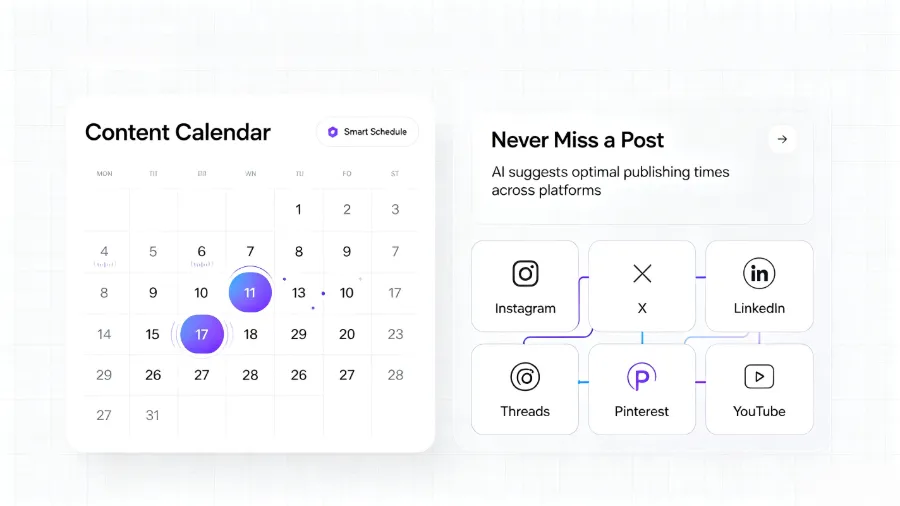
Scheduling supports long‑term strategy execution. Posting one piece of content daily for three months noticeably boosts account authority and stabilizes interaction rates. Inconsistent posting—three days on, two days off—reduces algorithmic recommendation weight. A scheduling tool helps maintain rhythm even during travel or vacations, preventing content gaps.
Cross‑time‑zone publishing is common. For a Chinese team targeting the US market, the audience is active 9–11 am Eastern Time, which is 9–11 pm China time. Manual posting is possible but tiring over time. Intelligent dispatch handles time‑zone conversion automatically, ensuring content goes live during the audience’s peak activity. For optimal posting frequencies per platform, refer to the LinkedIn frequency data “LinkedIn Best Posting Frequency Data”, which provides concrete operational metrics.
Cost: Can Core Needs Be Covered Within Budget?
Free tier availability and limits are the first thing most teams encounter. Most tools limit the number of accounts and posts in the free tier—e.g., three social accounts and six posts per month. This may be sufficient for individual creators or very small teams, but quickly runs out when managing multiple brand accounts.
Paid tier ladder design must match team size. Starter plans suit individual creators, Growth plans suit growing businesses, and Agency plans serve agencies and large teams. Core differences lie in account count, AI credits, and post limits. For instance, the Growth plan offers unlimited social accounts but only 300 AI credits per month; heavy AI rewriting will deplete credits fast.
Hidden costs are easily overlooked. API call volume, account numbers, AI credits, and multi‑user permissions may be restricted in free tiers. Some tools charge per API call; high publishing frequency can push the monthly bill beyond expectations. Cost‑benefit analysis of tool combinations is also important—a single tool handling all functions is cheaper than multiple tools, provided it meets all your needs.
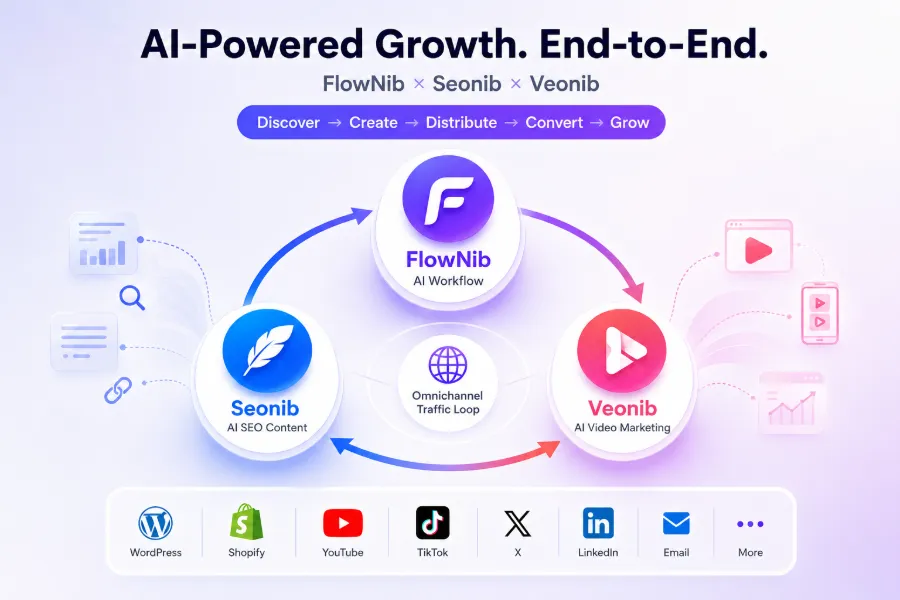
Cost isn’t just a price tag; it’s a balance of feature coverage and team efficiency. A tool starting at $11 per month can save 15 hours of copy‑paste work each month—time cost far exceeds the subscription price. For cost‑benefit analysis of tool combos, see the case study “Full‑Funnel Closed‑Loop Practice for Independent Sites”, which includes detailed ROI calculations.
Ease of Onboarding: Can the Team Deploy Quickly?
The complexity and time cost of setup directly determine how quickly a team can start using the tool. Many tools claim a two‑minute setup, but you still need to authorize accounts, connect APIs, and configure content templates. Unclear documentation or a convoluted authorization flow can stretch this to half an hour or more.
The learning curve heavily impacts team adoption. Even with a good tool, if members don’t know how to use it—or refuse to—its value disappears. A cluttered interface with too many buttons forces ordinary operators to spend a week becoming proficient, raising adoption costs. Tools with clean, layered interfaces are easier for team members to accept.
Unified multi‑account management is also crucial during onboarding. If each account requires separate authorization and configuration, the learning stage becomes a barrier. A unified dashboard lets the team perform all actions from one screen, reducing learning overhead.
The end‑to‑end experience from registration to first post determines whether users will continue. Smooth registration, clear account authorization, and a successful first publish are essential; any hiccup can cause abandonment. The initial publishing experience often decides whether users give the tool a second chance.
FAQ
What is the core value of a social media distribution tool?
Its core value is eliminating repetitive manual cross‑platform posting. A tool lets you create content once, automatically adapt it, schedule publishing, and frees time for higher‑value strategy and data analysis.
How do I judge whether a tool’s platform coverage is sufficient?
List the platforms you currently operate and plan to operate, then compare with the tool’s supported list. If the tool doesn’t cover your core platforms, it’s unusable regardless of price. Also confirm the tool uses direct official API connections rather than third‑party plugins.
Can AI rewriting truly maintain brand tone?
It depends on the AI model’s training quality. A good AI rewriting feature analyzes your historical content style, preserving core information and brand tone while adjusting expression for each platform. Test 5–10 pieces before purchase to see if the results stay consistent.
How important is scheduling for content strategy?
Scheduling is essential for executing a content strategy. Without it, publishing relies entirely on manual effort and is prone to gaps. Intelligent dispatch finds optimal posting times, boosting exposure and interaction. Data shows that accounts that stick to a schedule see an average 30%+ increase in interaction rates after three months.
Can a free tier meet a small team’s needs?
For individual creators or very small teams, a free tier can cover early needs. However, watch the limits on account numbers and post volume. If the team needs multiple brand accounts or high‑frequency publishing, upgrading to a paid tier is advisable to avoid interruptions.
Share Article