
Do Third‑Party Social Tools Really Face “Rate Limiting”? The Truth About Stable Distribution Revealed by Flownib’s Official API

Opening a social‑media operations group, the claim “the reach drops when you use a third‑party tool” appears almost every week. This concern isn’t baseless, but the real issue isn’t the four words “third‑party tool” – it’s the type of API being called underneath: unofficial interfaces and official APIs follow completely different paths.
Operators often assume “rate limiting” is a blanket attack by the platform on third‑party tools, but the reality is subtler: the platform detects behavioral patterns, not tool identity. The request pattern of an official‑API tool is almost indistinguishable from manual operation, while the crawler characteristics of unofficial interfaces are easily flagged by risk‑control systems.
What the Algorithm Is Actually Punishing – The Real Source of “Rate‑Limiting” Rumors
Platforms like Instagram, X, and LinkedIn have a clear mechanism for detecting abnormal publishing behavior: abnormal request frequency, non‑standard User‑Agent, and non‑compliant authentication. If any of these three signals is triggered, the system automatically lowers the account’s weight or directly rate‑limits it.
Unofficial APIs – such as crawlers or simulated logins – trip all three dimensions. They typically use a fixed User‑Agent string, concentrate request frequency in short bursts, and obtain tokens via packet sniffing or simulated form submission, which can be blacklisted by the platform at any time. In 2024, a cross‑border brand that used such tools had its Instagram account rate‑limited for 30 days, losing roughly $70 k in exposure for a holiday campaign. Post‑mortem analysis showed the tool was constantly using a crawler endpoint to fetch the publishing endpoint instead of submitting content through the Instagram Graph API.
Official APIs follow a completely different logic. Platforms not only recognize but also encourage developers to integrate via official channels, and they provide clear rate‑limit documentation. Mainstream social platforms typically limit official‑API request rates to 200–500 calls per 15 minutes, returning a 429 status code when exceeded. This is a compliance hint, not a punishment.
That’s why distinguishing “third‑party tool” from “unofficial API” is a key step in tool selection. As long as a tool operates entirely through the official API, it is essentially the platform‑approved integration method with no reason to be targeted. For example, Flownib is a scheduling tool built entirely on the official APIs of each platform, and its request behavior mirrors the manual operations of operators in a browser.
Official API vs. Third‑Party Proxy – The Technical Divide Between Two Publishing Paths
From a technology stack perspective, official APIs and third‑party proxies (unofficial interfaces) diverge at the authentication stage. Official APIs use OAuth 2.0, with tokens issued directly by the platform, featuring explicit expiration times and refresh mechanisms. Third‑party proxies rely on simulated logins; tokens are stored centrally on the server, and once the platform detects many tokens active from the same IP, a bulk ban follows.
The differences in request‑frequency control are even larger. Official APIs embed traffic‑control logic, isolating each application ID so they don’t interfere with each other. Third‑party proxies often pool multiple users’ requests into a single quota‑sharing pool, so a single user’s high‑frequency actions can degrade the entire cluster’s quality.
| Comparison Dimension | Official API | Third‑Party Proxy (Unofficial) |
|---|---|---|
| Authentication | OAuth 2.0, token issued by platform | Simulated login, token easily bulk‑banned |
| Request Control | Built‑in rate limits, isolated by app ID | Shared quota across cluster, easy collateral risk‑control triggers |
| Error Handling | Returns standard error codes, supports retry strategies | Common timeouts or empty responses, no effective diagnostics |
| Platform Acceptance | Official channel, whitelisted upon integration | Grey area, may be blocked at any time |
Regarding retry mechanisms, official APIs support exponential back‑off algorithms and standard HTTP status‑code parsing, allowing developers to precisely determine whether a failure is due to rate limiting, content violation, or token expiration. Third‑party proxies typically use simple polling; on timeout they retry, and on retry failure they drop the request without any diagnostic basis.
According to operational data from Later, posts published via the official API achieve an average engagement rate 12 %–18 % higher than those via simulated interfaces. This gap directly impacts brand reach efficiency. If you’re evaluating a publishing tool’s reliability, check whether its technical documentation clearly states the API version and rate‑limit policy for each platform – this is the most intuitive way to distinguish the two paths. A more systematic comparison can be found in the FlowNib vs Buffer vs Hootsuite: 2026 Global Brand AI Scheduling Tools Horizontal Review.
How Flownib’s Official‑API Cluster Achieves 99.99 % Stable Distribution
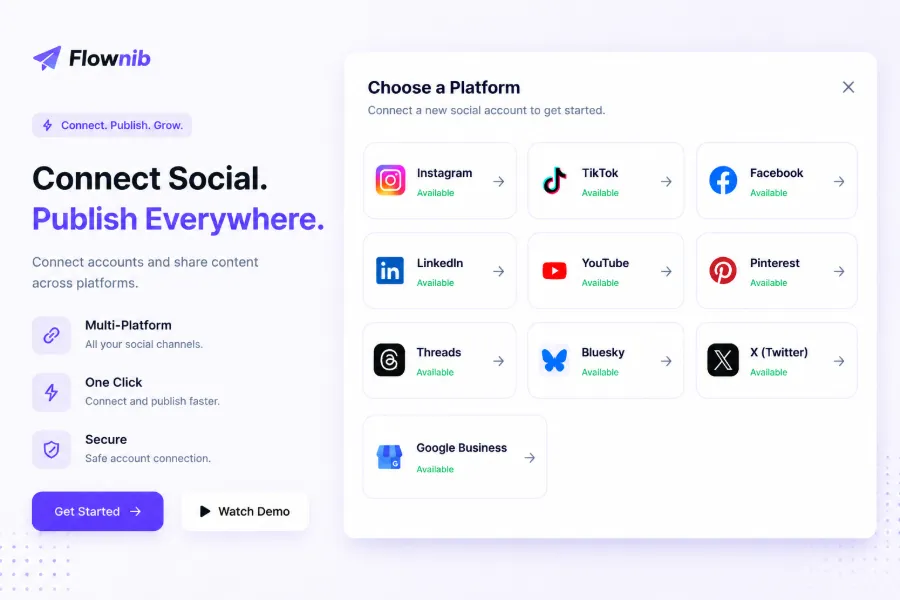
Flownib connects to ten platforms using direct official OAuth APIs, with no intermediate proxy layer. This is its unique technical starting point – during multi‑platform simultaneous publishing, each platform enforces its own rate limit independently, without interference. Instagram requests are not throttled because LinkedIn is congested, and vice versa.
The intelligent scheduling algorithm automatically adjusts the push sequence based on each platform’s peak times. For example, LinkedIn’s active hours concentrate on weekday mornings in the U.S., while Instagram’s engagement peaks are in the evenings and weekends. Publishing the same content in a fixed order could miss the optimal windows. Flownib’s scheduling module recalculates the best publishing times for each platform using historical data and reorders the queue accordingly.
Multi‑account management is handled in a single dashboard, avoiding token‑refresh issues caused by frequent login switches. This is especially useful for teams managing multiple brands or regions – no more repeated authorizations and verifications when switching accounts; the system automatically maintains each account’s token lifecycle. Flownib’s average setup time is only two minutes, and its API availability remains at 99.99 %.
If you want to learn about real‑world experience and functional limits, read the detailed review “FlowNib One‑Stop AI Social Distribution Tool – Is It Worth It for Cross‑Border Sellers?”.
AI Rewriting + Official Publishing – Balancing Content Consistency and Native Reach
Copy‑pasting the same image or copy across platforms saves time on the surface, but it can be flagged as duplicate content, reducing exposure weight. Platforms’ anti‑spam models check text hash values; identical content spread across platforms is a high‑risk signal for risk‑control systems.
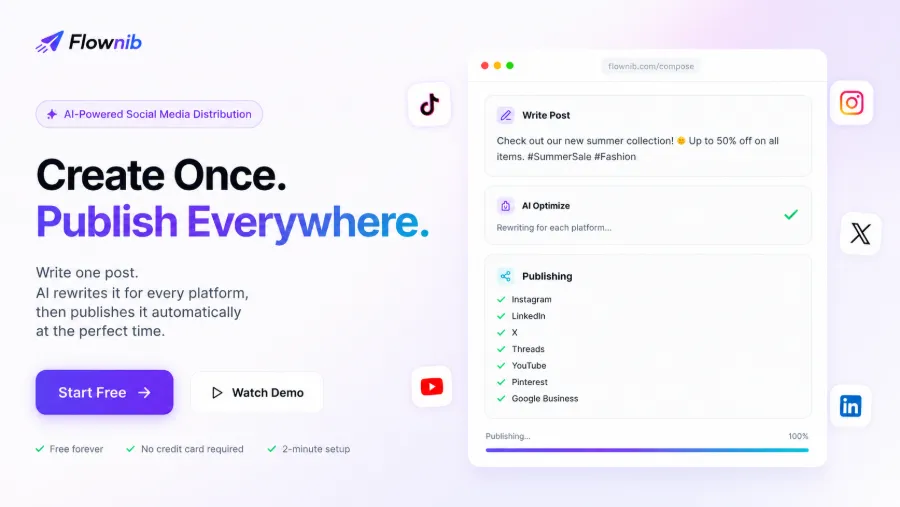
Flownib’s AI rewriting mechanism reorganizes language according to each platform’s character limits, stylistic conventions, and audience preferences. The core message stays the same, but the expression varies – LinkedIn audiences expect a professional, in‑depth opening, while X users prefer concise, punchy points. The same product launch will automatically adapt its copy style, sentence length, and embedded‑link placement for each platform.
The rewritten content is submitted via the official API, avoiding duplicate‑content penalties while gaining a native feel through format adaptation. The content‑calendar feature lets operators visualize cross‑platform publishing rhythms, reducing idle periods.

To date, Flownib has published over 500 k posts, maintaining a 99.99 % API success rate. This “AI rewriting + official submission” workflow essentially unifies compliance and nativeness. The exact operational steps are detailed in the article “Workflow for Creating Once and Publishing Everywhere Across Platforms”.
When to Switch to an Official‑API Social Publishing Tool
Not every team needs to switch to an official‑API tool immediately. However, if the following conditions are met, the time cost of manual operations already exceeds the tool’s price: managing three or more platforms, and publishing more than five pieces of content per day. Assuming five minutes per piece for manual copy‑paste and editing, that’s 25 minutes daily, over ten hours per month – not counting cross‑platform format adjustments and token refresh overhead.
Brands sensitive to reach and engagement data cannot tolerate the uncertainty of unofficial APIs. A single rate‑limiting event can cause a month‑long traffic recovery period, which for e‑commerce and marketing teams with short activity windows and tight rhythms is not an efficiency issue but an account‑security issue.
Growth‑stage teams that need multi‑account management, content review, and collaboration also benefit. Official‑API tools typically provide a unified dashboard and collaborative space, where members can see publishing records, interaction data, and content calendars, avoiding information gaps during account handovers. Multiple teams report saving 10–15 hours per week on cross‑platform publishing when using official‑API tools.
A free plan (3 accounts, 6 posts) is enough for individual creators to validate the effect before upgrading. If the budget is tight and platform dependence is low, start with the free tier. A comprehensive analysis of Flownib’s pricing and features is available in “FlowNib Pricing and Feature Full Analysis: For the Indecisive Cross‑Border Newcomer”.
When selecting a tool, also explore related ecosystem partners. For example, the Seonib website offers complementary scenarios that work alongside official‑API tools, helping teams with substantial operation volumes further optimize content distribution efficiency.
Back to the opening question: Do third‑party social tools really get rate‑limited? The real warning isn’t the phrase “third‑party” but the underlying API type. Choosing a tool that follows the official‑API path makes rate‑limiting risk almost negligible; picking an unofficial interface, no matter how polished the UI, leaves the account’s security hanging over a blade.
FAQ
Will a tool that uses the official API never be rate‑limited?
Not absolutely. If the content itself violates platform community rules (e.g., spam ads, fraudulent links), the official API does not exempt you from rate limiting. However, as long as the content is compliant, publishing via the official API will not be penalized because of the “tool” factor. Rate limiting is usually related to other variables – content quality, user interaction rates, and abnormal publishing frequency.
How can I tell whether a social‑publishing tool uses the official API or an unofficial interface?
Look at two aspects: first, whether the authorization flow fully follows OAuth 2.0 (e.g., redirects to the platform’s official authorization page); second, whether the rate‑limit policy is clearly documented. If the tool asks you to manually input a Cookie or token string in the settings, it is likely using an unofficial interface.
Is Flownib’s free plan sufficient? What are its limitations?
The free plan includes three social accounts and six posts, suitable for individual creators or teams just testing the waters. The main limitations are the lack of multiple workspaces, analytics dashboards, and priority AI generation features. If your publishing frequency is low and you use few platforms, the free tier is enough to run a month and evaluate performance.
What if my platform isn’t among the ten supported by Flownib?
Flownib currently supports ten platforms covering the vast majority of mainstream social channels. If your platform isn’t listed, you have two options: manually publish on the missing platform, or wait for official‑API support updates. It’s not advisable to switch to an unofficial‑API tool just for a niche platform.
Will AI rewriting completely change the tone of the content?
No. The rewriting mechanism adjusts sentence structure, word choice, and format while preserving the core message and brand voice. For example, a product launch will have a LinkedIn version that leans toward industry context and longer paragraphs, while the X version will be more concise and direct. The core information remains identical; only the expression changes.
Share Article