
Fully Automated Workflow for a Solo Cross‑Border Independent Site: The Seonib + Veonib + FlowNib Trio

Repeating the process of copying blog content, manually editing videos, and then pasting and publishing on each platform is unsustainable for a single person handling the entire cross‑border site’s operations. Seonib captures search‑engine traffic, Veonib turns product links into videos, and FlowNib pushes the finished pieces with one click to ten social platforms—this zero‑outsourcing combo lets a solo entrepreneur achieve a closed‑loop automation from search → video → social. This article breaks down the division of labor among the three tools, the end‑to‑end deployment steps, and the efficiency trade‑offs behind them.
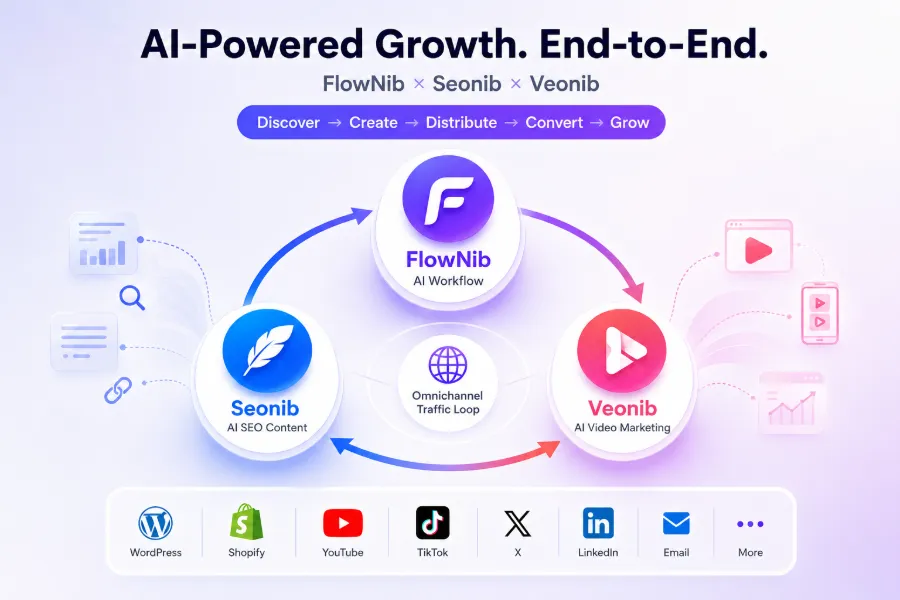
1. Division of Labor: From Search Traffic to Social Distribution
Seonib is the content starting point of the whole workflow. The biggest shortage for a solo operator is the ability to continuously produce SEO‑friendly blog posts. Seonib automatically generates articles that meet Google’s indexing standards from a seed topic and keyword inputs. I have seen many independent site owners write fewer than twenty blogs over three months and then stop, whereas after using Seonib they consistently produce five to ten posts per week, constantly feeding Google’s crawler.
Veonib is positioned to turn product links or images into videos with a single click, outputting to YouTube Shorts and regular video channels.
FlowNib serves as the social distribution layer, synchronizing the rewritten content to Instagram, X, LinkedIn, Threads, Pinterest, YouTube, Google Business, and others. FlowNib supports ten major social platforms; its official API availability is 99.99%, which means that in the past six months I have never encountered a publishing failure caused by an API outage. The three tools share data, creating a closed loop from blog traffic accumulation to video exposure and social reach. For a detailed technical implementation of this architecture, see the external community’s collaborative architecture documentation.
2. AI Rewriting and One‑Click Distribution Workflow
FlowNib’s AI rewriting feature automatically generates platform‑specific copy: Instagram allows up to 2,200 characters but recommends staying under 150, X expanded its limit from 280 to 4,000 characters, LinkedIn supports longer article formats, and YouTube descriptions can contain over three thousand keyword‑rich words.
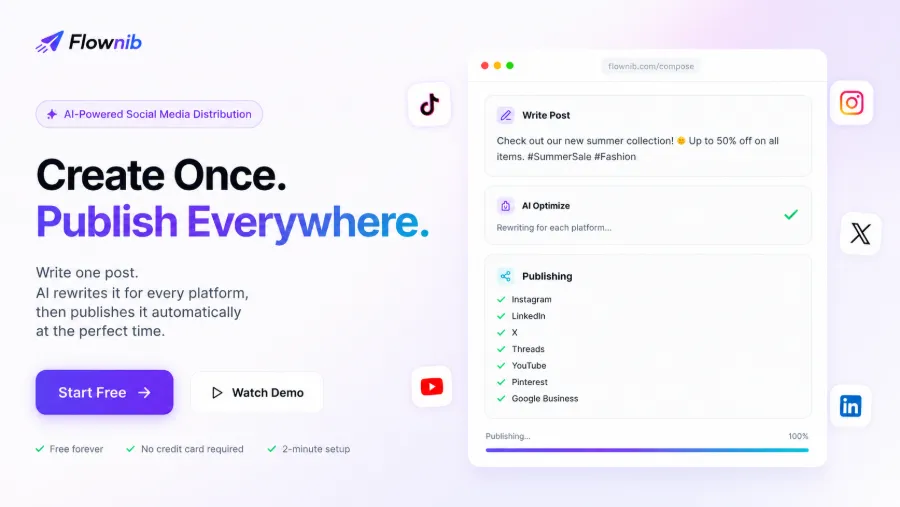
After AI rewriting, the preview stage begins. I recommend opening each platform’s preview at least once—FlowNib’s rewrites usually retain the core information, but brand‑specific terms and abbreviations are not always perfect. For example, my brand name “Seonib” was rewritten as “Seo nib” when fully capitalized; fixing such details during preview is far more present than being corrected by fans in the comments after publishing. The complete workflow can be referenced in the Shoe‑Category Independent Site Full‑Funnel Closed‑Loop Case Study, which shows the full data path from Seonib content creation to FlowNib publishing.
3. Why a Solo Entrepreneur Can Run Zero‑Outsourced Operations with This Combo
Compared with the traditional model: outsourcing an SEO writer costs ¥1,500–¥3,000 per month, video editing outsourcing costs ¥100–¥200 per video, three videos a week equal ¥600, plus a part‑time social media manager at ¥1,000 per month. That adds up to at least ¥5,000–¥6,000 per month, and quality is unstable, especially with time‑zone communication delays.
The trio eliminates the biggest bottleneck—cross‑platform adaptation. Previously, a single blog required separate short copy for Instagram, topic hooks for X, a professional version for LinkedIn, and a detailed description for YouTube. The time cost of switching between tools every day was huge. The Seonib + Veonib + FlowNib combo compresses the publishing step from two hours a day to about twenty minutes. According to user feedback, it saves roughly 15 hours of operational time per week.
However, limitations must be acknowledged. FlowNib’s smart scheduling optimizes posting times but cannot replace human comment replies—closed‑loop automation mainly eases the publishing stage. Social media algorithms value real‑time interaction; if you post content and never check comments or private messages, the account’s weight will gradually decline.
4. Hands‑On Deployment: From Registration to First Multi‑Platform Publish
From zero to first fully automated publish
Step 1: Publish a blog with Seonib. Ensure the seed keywords cover at least one low‑to‑medium competition long‑tail term, monitor for about a week, and confirm that Google Search Console shows indexing before moving on.
Step 2: Generate a video with Veonib.
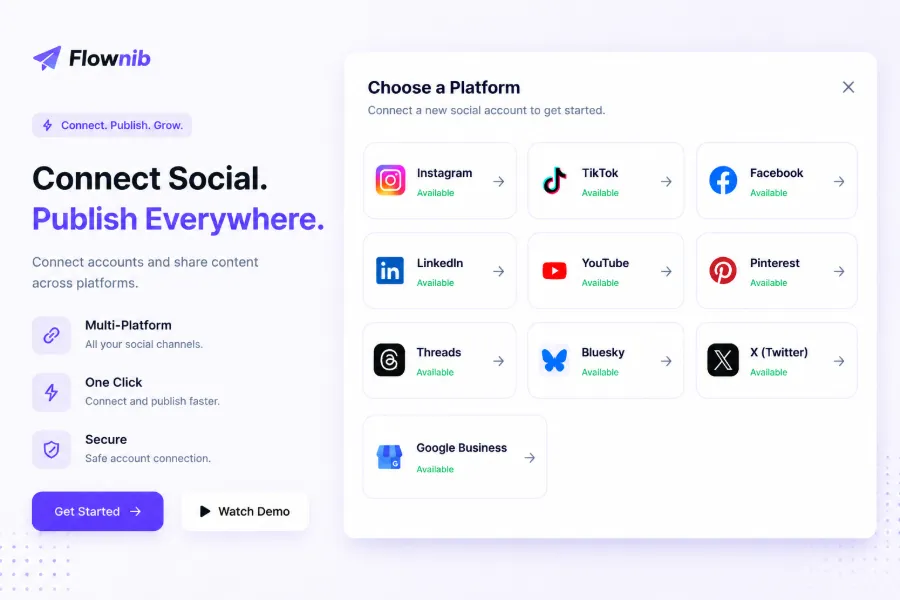
Step 3: Log into FlowNib and connect social accounts. This takes roughly two minutes. Each platform is connected via OAuth; Instagram and TikTok require a business or creator account—personal accounts do not support API publishing. My first mistake was using a personal Instagram account; after connecting, the first post failed with “Please switch the account to a professional account.”
Step 4: Import content and enable AI rewriting. After rewriting, always preview, paying special attention to:
- X: No more than three hashtags
- LinkedIn: No stray pure HTML tags in the body
- Pinterest: Description text should include size recommendations
Step 5: Manual scheduling. FlowNib’s content calendar clearly shows each time slot for the week, preventing visual fatigue from posting identical content on multiple platforms simultaneously.
Step 6: One‑click publishing. Verify that all accounts show “Connected” status, then click Publish. I recommend checking back within half an hour—once I posted an Instagram Reel that was muted due to copyrighted music, yet FlowNib’s backend reported “Publish successful.” Such errors need human verification. For a full set of test data on pitfalls, see the 2026 “FlowNib Helps Creators Boost Social Reach” report: https://flownib.com/blogs/en/5d90855d-57be-4a00-b32c-5ad9694a32d7.
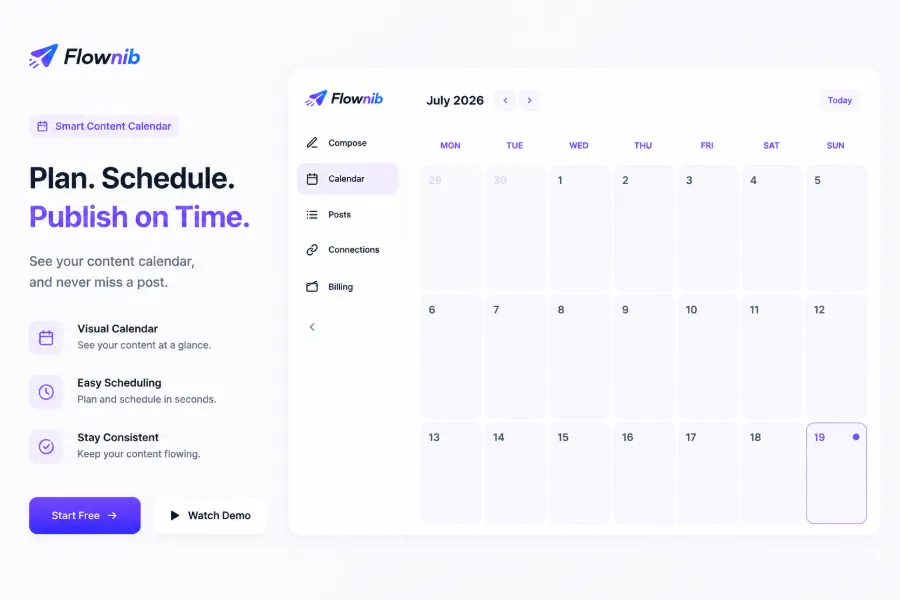
Finally, a note on the value of the content calendar. The biggest enemy of a solo operator is forgetfulness and chaos; a visual calendar makes weekly content layout crystal clear. I’ve adopted a habit of planning next week’s content on Sunday evenings and tweaking on Tuesdays and Thursdays based on data. FlowNib’s free tier supports three social accounts and six posts, which is enough for testing the workflow. For more extended applications of the workflow, see the 2026 discussion on cross‑border content stacks.
FAQ
Do Seonib, Veonib, and FlowNib have to be used together?
No. You can replace Seonib with any other SEO tool, such as manually writing blogs or using another AI writing service. Veonib also supports importing video scripts independently. However, using all three eliminates the cost of moving data between separate tools; Seonib and Veonib already integrate, allowing AI‑generated videos to sync automatically to SEO blogs, reducing manual handling.
If I only create video content, can Veonib work independently?
Yes. Veonib does not depend on Seonib; you can input product links or upload image‑text assets to generate videos.
Share Article