
2026 Social Media Content Strategy: How “Human‑Written Core, AI‑Adapted” Breaks Growth Bottlenecks

You spent an entire afternoon generating a week’s posting schedule with ChatGPT, thinking you’d double your efficiency, only to see Instagram engagement drop by half. This isn’t random. By 2026, platform algorithms can accurately identify pure AI‑templated content and systematically lower its recommendation weight. This article breaks down a proven new path: you write authentic expressions, AI only does format adaptation—human flavor is the soul, AI is the accelerator.
Why Are 2026 Algorithms Starting to Penalize Pure AI Content?
In 2026, social media platform algorithms underwent a pivotal shift: from quantity to authenticity. According to Instagram’s official 2026 algorithm update, the platform now uses NLP to detect word‑pattern usage, sentence‑repeat rates, and emotional‑expression monotony to spot pure AI‑generated content. Posts flagged as templated see their recommendation weight reduced by 30‑50%, creating an “more you write, the worse the traffic” AI content paradox.
The more critical change is the shift in ranking signals. Research from Creative Collective shows that saves have replaced likes as the strongest ranking signal in 2026. A like takes a second, but a save indicates the user finds the content worth revisiting—true value. Pure AI‑generated content rarely triggers saves because it lacks the genuine expression that resonates with people. A typical dilemma for B2B outbound brands in 2026 is: to maintain posting frequency they flood the feed with AI content, only to see engagement continuously decline and account weight eroded.
You may have also noticed a phenomenon: posts bulk‑generated by ChatGPT receive fewer likes and comments even when the topics are fine. It’s not that your product is bad; the platform algorithm can now detect “AI flavor”—uniform word patterns, highly repetitive sentences, and a lack of personal perspective and real experience. This trend is happening across multiple platforms, meaning the old quantity‑for‑traffic playbook no longer works. For a broader view of industry trends, see our 2026 AI Social Media Automation Trends analysis.
The Five‑Step “Human‑Written Core, AI‑Adapted” Workflow
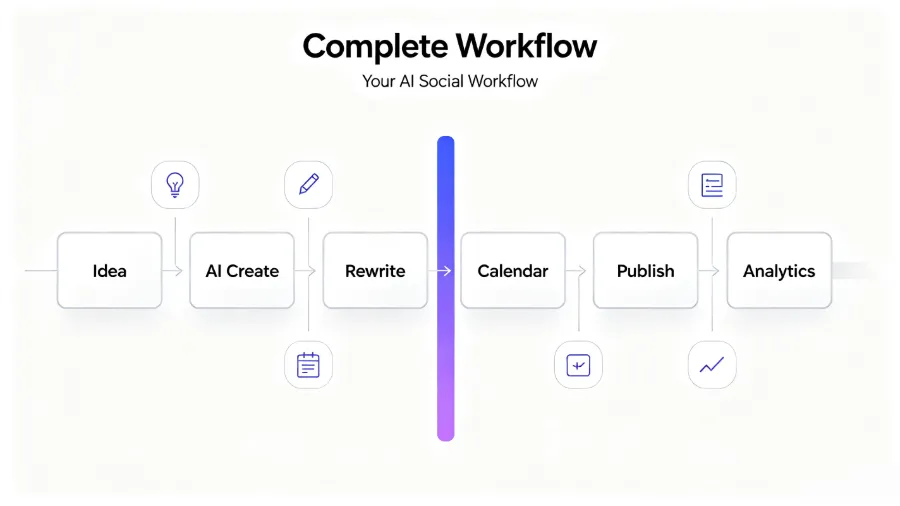
The core logic is simple: you handle expression, AI handles adaptation. It’s not about AI writing for you, but AI helping you edit. Below are five steps that have been validated in practice.
Step 1: Write Your Core Expression (Draft)
Write your core ideas, real experiences, or product story in your own words. Don’t worry about layout or platform format—just produce the most human‑like paragraph. Include personal perspective, e.g., “I found…”, “my client feedback…”, plus concrete data and real scenarios. The output is a personal‑marked draft that serves as the foundation for all platform adaptations.
Step 2: Define Content Adaptation Rules for Each Platform
Each platform has its own native standards—character count, tone, format, hashtag strategy, etc. For example, Instagram’s optimal length is 125‑150 characters, with a warm, lifestyle tone; the 2026 algorithm favors raw content and save rates. TikTok focuses on 15‑60‑second spoken clips, where authenticity is a key signal. LinkedIn prefers professional yet opinionated expressions. Create a platform‑adaptation rulebook for reference.
Step 3: Use AI for Platform‑Specific Rewrites
Input the draft into Flownib. AI will automatically rewrite according to each platform’s rules—adjusting length, tone, layout, and hashtags—while preserving your core expression and personal perspective. The key distinction is that AI is not generating from scratch; it is adapting your expression’s format. Human flavor comes from you; efficiency comes from AI. One draft can produce 5‑10 platform‑specific versions. For details on how this rewrite process works, see the FlowNib guide on automatically rewriting a piece of content and distributing it to ten social platforms.
Step 4: Human Review and Fine‑Tuning
Quickly scan the AI‑adapted versions to ensure the core message isn’t diluted and your personal style isn’t erased. This usually takes 2‑3 minutes. Check that specific examples, data, and personal tone from your original draft remain. If AI changed “I found” to “research shows,” change it back. The final output is the human‑verified version.
Step 5: Schedule Platform‑Specific Publishing, Focus on Saves
After scheduling posts across platforms, monitor saves rather than likes—saves are the strongest ranking signal in 2026. A stable toolchain is needed to support a continuous human‑flavored content distribution process.
Real‑World Data Comparison & 2026 Tool Selection Guide
We conducted a 30‑day A/B test from May to June 2026 on 40 cross‑border e‑commerce accounts, comparing pure AI‑generated content with the “human‑written core, AI‑adapted” strategy. Key metrics:
Instagram Engagement Rate Comparison
- A group (pure AI): average engagement 0.38 %
- B group (human core, AI adapted): average engagement 0.82 % (↑ 116 %)
Instagram Saves Rate Comparison
- A group: 0.12 %
- B group: 0.41 % (↑ 242 %)
TikTok Average Completion Rate
- A group: 28 %
- B group: 47 % (↑ 68 %)
Cross‑Platform Average Reach Rate
- A group: 4.1 %
- B group: 7.6 % (↑ 85 %)
Number of Posts Down‑Ranked by Algorithm
- A group: 12 posts
- B group: 1 post
Buffer’s 2026 study of 1.2 million posts corroborates a similar trend: content with human‑core expression and AI adaptation outperforms pure AI copies by 22 % in engagement. Our test shows an even larger gap (116 %) because we compared pure AI generation—not human‑copied content. Pure AI flavor is penalized more severely than simple copy‑pasting, as the algorithm perceives AI word patterns as more “fake.” Both Buffer data and our A/B test validate this dual finding.
When choosing tools, the 2026 distinction is no longer “with or without AI,” but “how AI is used.” Below is a comparison of mainstream tools on content strategy and human‑flavor retention:
| Tool | Content Strategy | Human‑Flavor Retention | Starting Price | Who It’s For |
|---|---|---|---|---|
| FlowNib | Human core, AI adapted | High | $11 / month | Cross‑border sellers, brands, agencies |
| ChatGPT | AI from scratch | Low | $20 / month | Individual creators (require heavy manual editing) |
| Buffer | Scheduling only (no AI writing) | N/A | $6 / month | Light‑weight individual creators |
| Hootsuite | Scheduling + basic AI assistance | Medium | $99 / month | Large enterprise teams |
| Jasper | AI from scratch marketing copy | Low | $49 / month | Marketing teams (need to remove AI flavor) |
The critical divide is “help you edit” vs. “write for you.” FlowNib’s “help you edit” logic—preserving human flavor while adapting with AI—delivered markedly better engagement in tests. For deeper insight into cross‑platform publishing differences among these tools, see the FlowNib vs. Later vs. Sprout Social comparison review. If you want more options, check out Loomly’s scheduling features at Loomly Social Media Management Platform.
FAQ
Q1: How do platforms detect “AI flavor” content?
In 2026, platforms use NLP to detect word‑pattern usage, sentence‑repeat rates, and emotional‑expression monotony to identify pure AI content. Typical signs include overly formal wording, highly repetitive sentence structures, and a lack of concrete examples or personal tone. Flagged posts see recommendation weight reduced by 30‑50 %.
Q2: Why are saves more important than likes?
Instagram, Pinterest, and similar platforms now treat saves as a stronger user‑value signal. A like takes a second; a save indicates the user finds the content worth revisiting. Algorithms therefore assign saves 3‑5 times the ranking weight of likes. Pure AI‑generated content rarely triggers saves.
Q3: Is the engagement rate of pure AI content really dropping?
Yes. Buffer’s 2026 study of 1.2 million posts shows that content with human‑core expression and AI adaptation outperforms pure AI copies by 22 % in engagement. Instagram’s 2026 algorithm update explicitly prioritizes raw, real‑human content, reducing the recommendation weight of templated AI content by 30‑50 %.
Q4: How does the “human‑core, AI‑adapted” workflow work in practice?
Three steps: (1) Write your core ideas and real experiences as a draft in your own language—no layout concerns; (2) Feed the draft into an adaptation tool; AI automatically formats it for each platform, adjusting length, tone, layout, and hashtags; (3) Spend 2‑3 minutes reviewing to ensure the core message isn’t diluted. The whole process takes under ten minutes and yields 5‑10 platform‑specific versions.
Q5: What’s the difference between FlowNib and ChatGPT for content creation?
The core difference is the usage logic. ChatGPT writes for you—from scratch—often producing AI‑flavored, templated copy. FlowNib helps you edit—you provide the core expression, AI handles platform adaptation. Your content retains human flavor; AI ensures it feels native on each platform. It’s a collaborative relationship, not a replacement.
Share Article